A flow is shares created or redeemed at NAV, not volume. How baskets of 10,000 to 40,000 shares become a dollar figure, why it lands a day late, and how 13 assets are tracked.
TL;DR. A crypto ETF flow is the dollar value of shares an authorised participant created or redeemed with the fund that day, priced at net asset value. It has nothing to do with how many shares changed hands on the exchange. Shares move in fixed baskets, from 10,000 for most altcoin trusts to 40,000 for BlackRock's IBIT, so a small fund's flow arrives in lumps. The number is derived, not reported: change in shares outstanding times NAV, and because most issuers book a creation into the next day's share count, Tuesday's figure is known on Wednesday. cryptoetf.today tracks 13 assets and 51 trading funds in two regimes: five majors with aggregator history and issuer snapshots since 11 September 2026, and eight newer assets computed entirely from issuer disclosures because no aggregator covers them.
Contents · 11 sections
- What a flow is, and what it isn't
- Baskets, NAV and the arithmetic of one creation
- Cash or coin: what changed on 29 July 2025
- The formula, and why Tuesday's flow appears on Wednesday
- Two data regimes: aggregators and issuer disclosures
- What a flows page shows
- Why weekends and holidays are blank
- Comparing a $500m Bitcoin day with a $2m Sui day
- Five things that look like flows and aren't
- FAQ
- Sources and further reading
What a flow is, and what it isn't
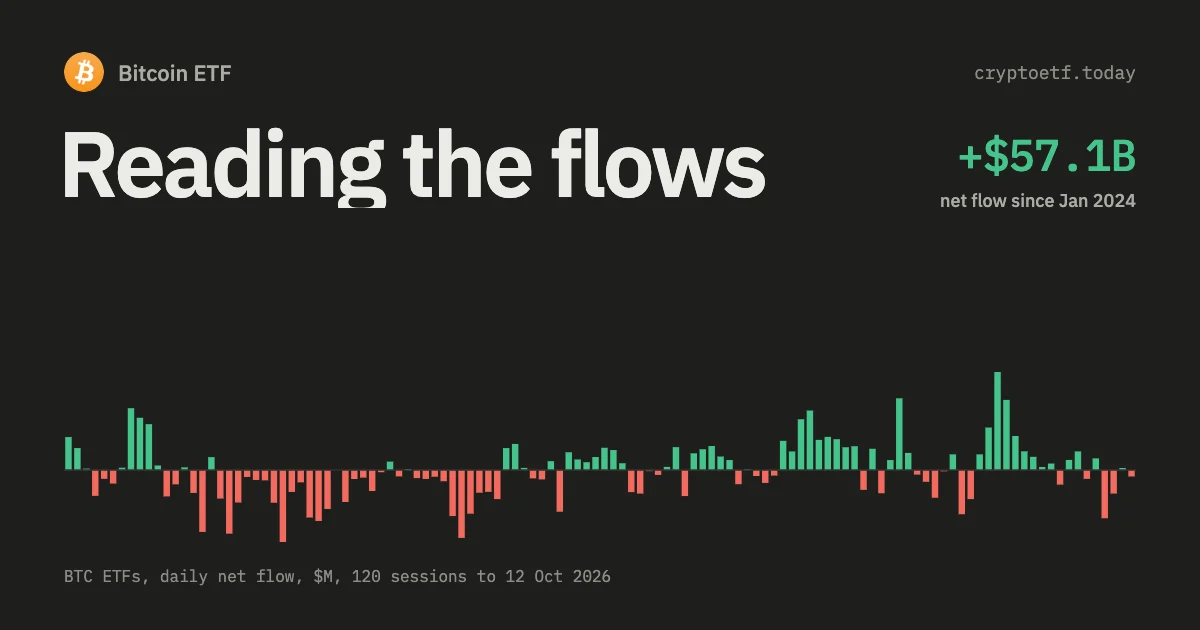
Every spot crypto ETF in the United States is a trust that holds one coin at a custodian and issues shares against it. The share count isn't fixed. When demand for the shares outruns supply on the exchange, a broker-dealer with a contract to do so (an authorised participant, or AP) hands the trust cash or coin and receives new shares. When shares trade below what the coin behind them is worth, the AP hands shares back and takes out cash or coin. The first is a creation and prints as an inflow; the second is a redemption and prints as an outflow. Net flow for the day is creations minus redemptions, in dollars.
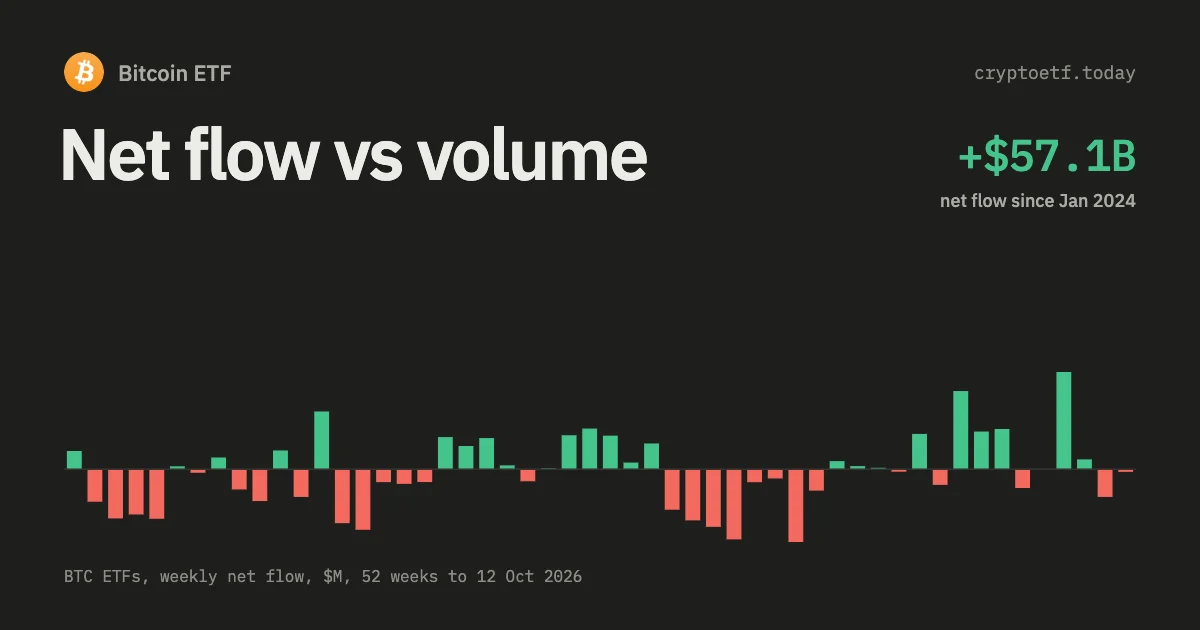
What that definition excludes matters more than what it includes. Two investors trading IBIT with each other at 11am generate volume and zero flow. The trust's coin only changes when the share count changes, and the share count only changes through an AP, so flow is the one public number that says whether new money entered the fund rather than changing hands inside it. The distinction is the subject of net flow versus volume; the firms doing the creating are in how authorised participants work. Nor is a flow a price move: a fund whose coin rose 8% with no orders has a bigger balance sheet and a flow of zero.
Baskets, NAV and the arithmetic of one creation
APs don't create shares one at a time. Each prospectus fixes a creation unit, called a basket, and the trust only issues or cancels shares in whole multiples of it. BlackRock's iShares Bitcoin Trust sets the basket at 40,000 shares; Fidelity's Wise Origin Bitcoin Fund uses 25,000; Grayscale's Dogecoin Trust ETF and 21Shares' Dogecoin ETF both use 10,000.
A basket costs NAV per share times the basket size. NAV is the coin per share (total coin in trust divided by shares, net of the accrued sponsor fee) multiplied by the fund's reference price at its daily valuation time. So a 10,000-share basket at a $9.43 NAV is $94,300, and the trust adds the matching coin. That one order is the fund's entire flow for the day.
Basket size is why small funds produce lumpy series. One IBIT basket at a $60 NAV is $2.4m, a rounding error on a fund holding tens of billions. One GDOG basket is closer to $90,000, more than 1% of a fund holding $8m to $9m, and a handful of them is the whole month.
Cash or coin: what changed on 29 July 2025
When the spot Bitcoin ETFs launched in January 2024 the SEC permitted only cash creations and redemptions: the AP delivered dollars and the trust bought the bitcoin itself. The Ether funds of July 2024 got the same restriction. On 29 July 2025 the Commission approved orders permitting in-kind creations and redemptions for crypto asset ETPs, so an AP can now deliver coin for shares and take coin back on redemption; the press release notes the earlier products "were limited to creations and redemptions on an in-cash basis."
For the flow series the change is invisible: a creation is still priced at NAV and the coin ends up in the trust either way. What moves is who executes the coin trade and who pays for it. Which model a fund uses is in its prospectus, and most altcoin trusts listed since October 2025 provide for both.
The formula, and why Tuesday's flow appears on Wednesday
Issuers don't publish a line called "flow". They publish shares outstanding and NAV per share once a day, and the flow is derived:
flow(T) = (shares(T+1) − shares(T)) × NAV(T)
The one-day shift is the part people miss. For iShares, Grayscale and Franklin Templeton, a creation ordered on Tuesday settles into Wednesday's share count. Wednesday minus Tuesday therefore measures Tuesday's orders, priced at Tuesday's NAV because that's the NAV the basket was struck at.
Three issuers book shares differently. Bitwise, 21Shares and Canary publish a share count dated T that already includes T's orders. A reconciliation on 13 September 2026 showed the consequence: BHYP's −$6.78m and THYP's −$1.40m belonged on 11 September, but the standard shift put them on 10 September. For those issuers the site uses shares(T) minus shares(T−1), times NAV(T), and their flow is known the same evening. So a GDOG creation on Tuesday appears dated Tuesday on Wednesday evening, while a TDOG creation on Tuesday appears the same night. If two funds in one asset print on adjacent days, suspect the publishing gap before assuming one followed the other; how to read Dogecoin ETF flows works through a live example.
Where an issuer publishes coin held rather than shares (VanEck), the same idea runs in coin, with one correction on staking funds: rewards add coin without any investor adding money, so the site converts coin to an implied share count through the fund's coin-per-share ratio, rounds to the basket, and differences that. Bitwise's BAVA rebuilt this way landed on exactly the 970,000 shares the fund published on 21 August 2026.
None of this is real-time. US share settlement has been T+1 since 28 May 2024, an issuer's count lags an order by a day, and cryptoetf.today updates once per business day after the files land. For the five majors a day's first print can come from an aggregator and is replaced by the issuer-derived figure once the next snapshot exists.
Two data regimes: aggregators and issuer disclosures
The five majors. Since 11 September 2026 the primary source for 34 of the 37 Bitcoin, Ether, Solana, XRP and Hyperliquid funds has been the site's own issuer snapshots (BlackRock's holdings CSV, Grayscale's daily spreadsheet, Bitwise's fund sites, and the pages or feeds of the eight other issuers). Earlier rows, and the three Fidelity funds (FBTC, FETH, FSOL), whose data Fidelity serves only to a browser, come from publicly reported daily flow data.
The eight newer assets. Dogecoin, Chainlink, Avalanche, Hedera, Litecoin, BNB, Polkadot and Sui have no public flow series. Every figure is computed from the five issuers that run these funds (Grayscale, Bitwise, 21Shares, Canary, VanEck). Four of the five keep no history on their sites, so the site takes a daily snapshot of each fund and differences them. Grayscale's spreadsheet goes back to each trust's birth, and Bitwise publishes wallet addresses, so BWOW and BAVA were rebuilt from the chain. Fund-by-fund background is in the full list of new crypto ETFs.
| Asset | US funds tracked | Data source | Series starts | Live page and guide |
|---|---|---|---|---|
| Bitcoin | 12 | Issuer snapshots since 11 Sep 2026; public flow data before | 11 Jan 2024 | BTC flows · guide |
| Ether | 10 | Issuer snapshots since 11 Sep 2026; public flow data before | 23 Jul 2024 | ETH flows |
| Solana | 7 | Issuer snapshots since 11 Sep 2026; public flow data before | 28 Oct 2025 | SOL flows |
| XRP | 5 | Issuer snapshots since 11 Sep 2026; public flow data before | 13 Nov 2025 | XRP flows |
| Hyperliquid | 3 | Issuer snapshots since 11 Sep 2026; public flow data before | 12 May 2026 | HYPE flows · guide |
| Dogecoin | 2 (BWOW closed 22 Oct 2026) | Grayscale file, 21Shares API, BWOW wallet | 24 Nov 2025 | DOGE flows · guide |
| Chainlink | 2 | Grayscale file, Bitwise site | 2 Dec 2025 | LINK flows · explained |
| Avalanche | 3 | Grayscale file, Bitwise wallets, VanEck holdings | 26 Jan 2026 | AVAX flows · guide |
| Hedera | 1 | Canary page | 28 Oct 2025 | HBAR flows · explained |
| Litecoin | 1 | Canary page | 28 Oct 2025 | LTC flows · explained |
| BNB | 1 | VanEck holdings | 28 May 2026 | BNB flows · explained |
| Polkadot | 1 | 21Shares API | 6 Mar 2026 | DOT flows · explained |
| Sui | 3 | Grayscale file, Canary page, 21Shares API; no aggregator at all | 18 Feb 2026 | SUI flows · explained |
Fund counts are from the site's registry at publication; "series starts" is the first trading day of the earliest fund, which for Grayscale's uplistings is the ETF date, not the private trust's. Sui is the odd one out twice: no aggregator tracks it, and two of its three funds (SUIS, TSUI) publish neither history nor wallets, so their per-fund series begins the day snapshots started.
Issuer data is more complete than a listing-day flow series in one specific way. BWOW and BAVA each had a creation made the day before listing ($2.5m of DOGE on 25 November 2025, $10.7m of AVAX on 15 April 2026). A series that starts on listing day can't see those; the chain and the issuer file can.
What a flows page shows
Each asset page has the same parts. At the top, four figures: fund assets, the latest daily flow, year-to-date flow and the coin price, with a launch date and issuer count. A donut splits cumulative net inflow by issuer. The chart has two tabs, daily net flow and cumulative assets, over 7-day, 30-day, 90-day or full ranges. Below it an issuer table lists each fund with assets, market share and the latest day's flow. The eight issuer-computed assets add a "how this is calculated" note and, where some funds lack history, say how many of them the per-fund split covers. On the majors the daily bar is a reasonable signal on its own; on an asset where one basket is a visible spike, read the slope of the cumulative line, because the bars are individual orders.
Why weekends and holidays are blank
Coins trade every day; trusts don't. A fund strikes its NAV once per US trading day and accepts creation and redemption orders only when the exchange is open. On a Saturday there's no NAV, no order window and no share count to compare, so there's no row. The page leaves the day blank rather than printing zero, and the difference isn't cosmetic: zero means the fund was open and no basket moved, blank means the fund wasn't open. Whatever demand a 10% weekend price move creates shows up as Monday's order, dated Monday, and for most issuers published on Tuesday.
Comparing a $500m Bitcoin day with a $2m Sui day
Raw dollars don't compare across assets that differ in size by three orders of magnitude. A $500m Bitcoin day at a $95,000 price is about 0.027% of the coin's market capitalisation; the same 0.027% of Sui at $2 is roughly $1.9m. Proportionally those are the same event, and a page that ranks assets by dollar flow will always put Bitcoin first and tell you nothing.
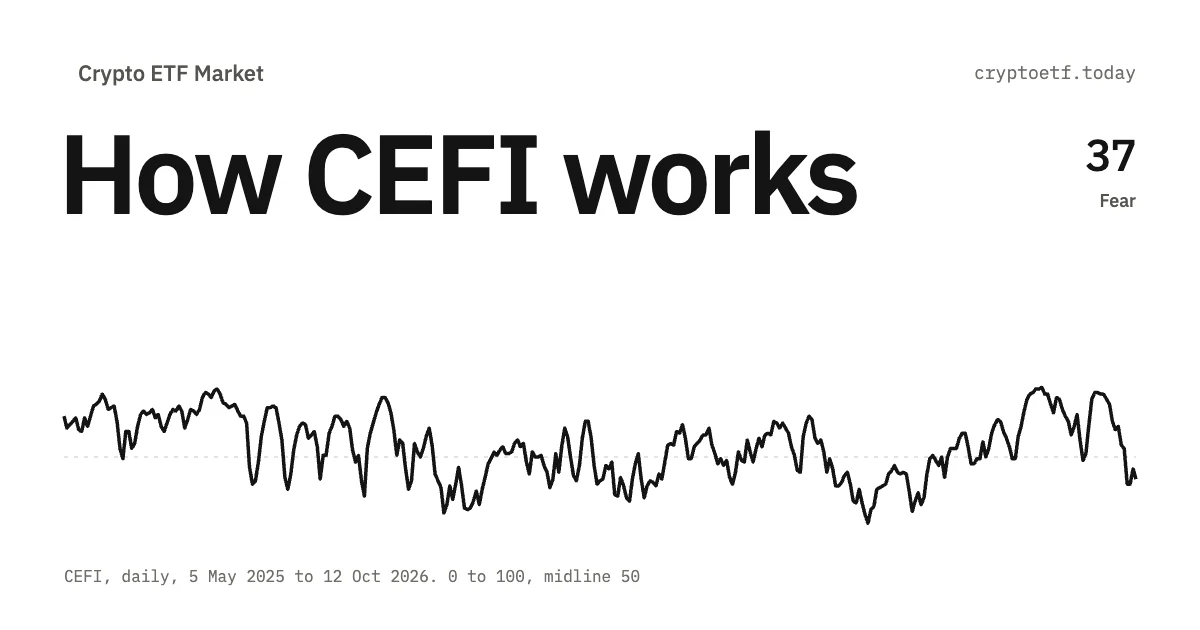
That's the problem the Crypto ETF Flow Index exists to solve. It divides each asset's daily flow by the coin's market cap before anything else, smooths the result, and scores it against the asset's own recent history on a 0 to 100 scale, so a Sui day and a Bitcoin day sit on one axis. The composite adds all 13 assets after that scaling, which is why a modest day in a small complex can move it as much as a large one in Bitcoin. Every constant is in how the CEFI index is calculated. By hand, divide the day's flow by the fund's assets the morning before: a creation worth 1% of a fund is a meaningful order whether the fund holds $8m of Dogecoin or $80bn of Bitcoin.
Five things that look like flows and aren't
- The seed creation. Every fund starts with a sponsor or affiliate buying the first baskets, usually a day or two before listing, and young funds get more of them. Grayscale's HYPG went from 470,000 shares to 5.49m on 25 June 2026: $112.7m at that day's NAV and 39% of everything the three Hyperliquid funds had raised by 20 August, per the Hyperliquid guide. A seeding event is a balance-sheet transfer and says nothing about demand. When a young fund prints a day that dwarfs its neighbours, check the share count first.
- The liquidation. A fund that closes redeems every share at once. Bitwise's BWOW left NYSE Arca on 14 October 2026 and paid out the 21 October NAV in cash on 22 October under the schedule in its 8-K. That final print is a distribution announced six weeks earlier. Nobody decided to sell, and it belongs in a footnote to the Dogecoin cumulative line.
- The waiver rotation. Several altcoin funds launched with a fee waiver that ends on a date: Grayscale's GAVA waiver ended 12 June 2026, Franklin's XRPZ waiver ran to 31 May 2026. A holder moving to a cheaper fund when a waiver expires prints as an outflow in one product and an inflow in another, with net demand unchanged. Read the asset total, and check the fee table in Avalanche ETF explained or the equivalent guide before calling it a sell-off.
- The intra-asset switch. The Bitcoin complex ran the same pattern at scale in 2024, when GBTC holders rotated into cheaper funds and the headline hid positive net demand for months; what Bitcoin ETF outflows really mean covers it.
- The premium arbitrage. If a small fund's shares slip below NAV, redeeming is profitable regardless of anyone's view on the coin, and the outflow is an AP squaring a book. A redemption followed by a creation within a day or two (GDOG's −$0.76m and +$0.42m on 2 and 3 September 2026) is usually this; see premium and discount to NAV.
Three of the five are far more common in the eight small complexes than in Bitcoin, which is why the site publishes per-fund tables alongside the asset totals. The guides for Dogecoin, Chainlink, Hedera, Litecoin, BNB, Polkadot and Sui list the funds, fees and staking terms behind each series.
A routine that survives all five: cumulative line over the full range first, then the 30-day bars to see whether money arrives as a drip or one order at a time, then the issuer table to see which fund moved, then the CEFI reading for whether the last two weeks are unusual against the asset's own past. The same 13 assets and daily figures are in the Bitcoin ETF Flow Tracker app for iOS, and each asset's series is on its flows page, starting with Bitcoin ETF flows.
FAQ
What is a crypto ETF flow?
The dollar value of shares an authorised participant created or redeemed with the fund on a trading day, priced at that day's net asset value. Creations are inflows, redemptions are outflows, and net flow is the difference. Shares traded between investors on the exchange generate volume but no flow.
How is ETF flow calculated from issuer data?
Issuers publish shares outstanding and NAV per share daily. Flow for day T is the change in shares times NAV. For iShares, Grayscale and Franklin a creation lands in the next day's share count, so the formula is (shares on T+1 minus shares on T) times NAV on T. Bitwise, 21Shares and Canary include the day's orders in the same day's count, so their flow uses shares on T minus shares on T-1.
Why do crypto ETF flows appear a day late?
Because for most issuers a creation ordered on Tuesday only shows in Wednesday's published share count, and the figure can't be computed until that count exists. US share settlement has been T+1 since 28 May 2024. Data on cryptoetf.today is updated once per business day.
Why are weekends blank on the flows chart?
Trusts only strike a NAV and accept creation or redemption orders on US trading days. With no NAV and no order window there is nothing to compute, so weekends and market holidays are left blank. A blank is not a zero: zero means the fund was open and no basket moved.
What is the difference between cash and in-kind creations?
In a cash creation the AP delivers dollars and the trust buys the coin; in an in-kind creation the AP delivers the coin itself. US spot bitcoin and ether ETFs were cash-only until the SEC approved in-kind orders on 29 July 2025. Either way the creation is priced at NAV and counts the same in the flow series.
How does cryptoetf.today get flow data for assets no aggregator covers?
For Dogecoin, Chainlink, Avalanche, Hedera, Litecoin, BNB, Polkadot and Sui the site reads each issuer directly: Grayscale's daily spreadsheet, Bitwise's fund sites and wallet addresses, 21Shares' product API, Canary's fund pages and VanEck's holdings feed. It stores a daily snapshot per fund and computes the flow as the change in shares times NAV.
How do I compare flows between assets of very different size?
Divide the flow by the coin's market capitalisation, or by the fund's assets, before comparing. A $500m Bitcoin day at $95,000 and a $1.9m Sui day at $2 are both about 0.027% of market cap. The CEFI index does this scaling for all 13 assets and scores each against its own recent history on a 0 to 100 scale.
Sources and further reading
- SEC press release, "SEC Permits In-Kind Creations and Redemptions for Crypto ETPs", 29 July 2025 — sec.gov.
- iShares Bitcoin Trust ETF prospectus (40,000-share baskets, seed creation baskets) — sec.gov.
- Fidelity Wise Origin Bitcoin Fund prospectus (25,000-share baskets, cash and in-kind mechanics) — sec.gov.
- SEC investor bulletin on the T+1 settlement cycle, effective 28 May 2024 — investor.gov.
- Grayscale product pages with daily performance files (shares outstanding and NAV per fund) — etfs.grayscale.com.
- Internal: how to read Bitcoin ETF flows, net flow versus volume, how the CEFI index is calculated.
For information only. Not investment advice.
 BTC
 ETH
 SOL
 XRP
 HYPE
 LINK
 HBAR
 AVAX
 DOGE
 LTC
 SUI
 DOT
 BNB
 NEAR
 TRX
 ZEC