GDOG changed its share count on 25 of 202 trading days, TDOG on 6 of 163. How DOGE ETF flows are computed, why one 10,000-share basket reads as a spike, what BWOW's exit prints.
TL;DR. A Dogecoin ETF flow is the dollar value of shares created or redeemed on a given day, computed from each issuer's own share count and NAV because no aggregator covers DOGE. The series is sparse: through 16 September 2026, Grayscale's GDOG changed its share count on 25 of 202 trading days for $12.0m of cumulative inflow, and 21Shares' TDOG on 6 of 163 for $1.6m. Every change was a multiple of one 10,000-share basket. Bitwise's BWOW, never larger than 50,000 shares, left NYSE Arca on 14 October 2026 and paid out in cash on 22 October under the schedule in its 8-K; that final redemption is a closure, not a sell signal.
Contents · 11 sections
- What the number measures
- How the figure is built from two issuers
- What BWOW's liquidation looks like in the series
- Why most days print zero
- Why one order looks like a spike
- GDOG month by month
- Retail or institutional money?
- Reading flows next to price and the CEFI composite
- Six ways to misread this data, and a routine that avoids them
- FAQ
- Sources and further reading

What the number measures
When the Dogecoin ETF flows page shows +$0.4m, nobody bought $0.4m of shares on the exchange. An authorised participant handed the trust cash (or DOGE, where the fund allows it) and received a block of new shares; redemptions run in reverse. Two investors trading GDOG with each other generate volume and zero flow.
That's the same mechanic behind Bitcoin ETF flows, and the plumbing is described in how authorised participants work. What changes with Dogecoin is scale: the two surviving funds held $10.9m between them on 16 September 2026, so one basket is a meaningful share of the fund. Fund facts are in Dogecoin ETF explained; this piece is only about the data.
How the figure is built from two issuers
No public source tracks daily DOGE ETF flows, so the site reads the issuers directly.
- GDOG. Grayscale posts a daily spreadsheet: date, shares outstanding, NAV per share, market price and assets, one row per trading day back to the private-placement era. The ETF series starts on 24 November 2025, the first row with a market price, and on 16 September 2026 stood at 904,700 shares and a NAV of $9.43.
- TDOG. 21Shares' product page is fed by a JSON endpoint with the valuation history since listing: date, units outstanding, NAV per unit, total NAV. It had 163 rows from 22 January to 16 September 2026, ending at 150,000 shares and $16.07; days without a valuation simply don't appear.
From either feed the daily flow is:
flow(T) = (shares(T+1) − shares(T)) × NAV(T)
The one-day shift matters: a creation ordered on Tuesday settles into Grayscale's Wednesday share count, so Wednesday minus Tuesday is Tuesday's order, priced at Tuesday's NAV.
The dating rule that differs by issuer
21Shares publishes differently. Its prospectus says baskets are created and redeemed "on the NAV of the date of the creation or redemption", and its share count dated T already includes T's orders. Bitwise and Canary do the same. For those issuers the same pair of snapshots yields a flow dated T+1 and priced at NAV(T+1); the site keeps a list of same-day issuers and applies that rule, after a check on 13 September 2026 showed the standard formula landing their flows a day early.
The practical effect: a TDOG creation is known the evening it happens; a GDOG creation shows up the next business day. If the two funds move on adjacent days, don't assume one led the other.
What BWOW's liquidation looks like in the series
Bitwise filed the closure on 10 September 2026 (Form 8-K, CIK 0002053791). The schedule from the filing:
| Date | Event | What the flow series should show |
|---|---|---|
| 10 Sep 2026 | Liquidation announced | Nothing; shares and coins unchanged |
| 14 Oct 2026 | Last trading day on NYSE Arca; trust converts DOGE to cash | Coin-in-trust drops toward zero; share count still 50,000 |
| 15 Oct 2026 | Creations cease before the open | No further creations possible |
| 21 Oct 2026 | Final NAV struck | Basis for the cash payout |
| 22 Oct 2026 | Cash distributed; shares cancelled | A final redemption equal to the remaining NAV, then zero shares |
Three things about that last print. It's a distribution, not a sale: nobody decided to leave, the sponsor decided to close, so the outflow belongs in a footnote to the DOGE cumulative line rather than in a sentiment read. Its size was bounded by what was left: on 16 September 2026 BWOW reported 50,000 shares, net assets of $654,937 and 8,195,053 DOGE at a NAV of $13.10, and the trust's on-chain wallet held the same 8,195,053 coins.
And the coin series and the share series diverge for a week. The trust converts to cash on the last trading day but only cancels shares at distribution, so a coin-based reconstruction prints the exit on 14 October and a shares-based one on the 22nd.
BWOW mattered to data quality out of proportion to its size. Bitwise published the trust's Dogecoin address, so every creation, redemption and fee deduction was a visible transaction, and that history caught a 16.4m DOGE creation on 25 November 2025, the day before listing, which the aggregator series had missed. No other DOGE issuer discloses an address; both survivors are issuer-reported, not verifiable on-chain.
Why most days print zero
On the Bitcoin funds, a zero is rare enough to be news. On Dogecoin it's the resting state. Through 16 September 2026:
| Metric (as of 16 Sep 2026) | GDOG | TDOG |
|---|---|---|
| First ETF trading day | 24 Nov 2025 | 22 Jan 2026 |
| Trading days with data | 202 | 163 |
| Days the share count changed | 25 | 6 |
| Creation days / redemption days | 23 / 2 | 5 / 1 |
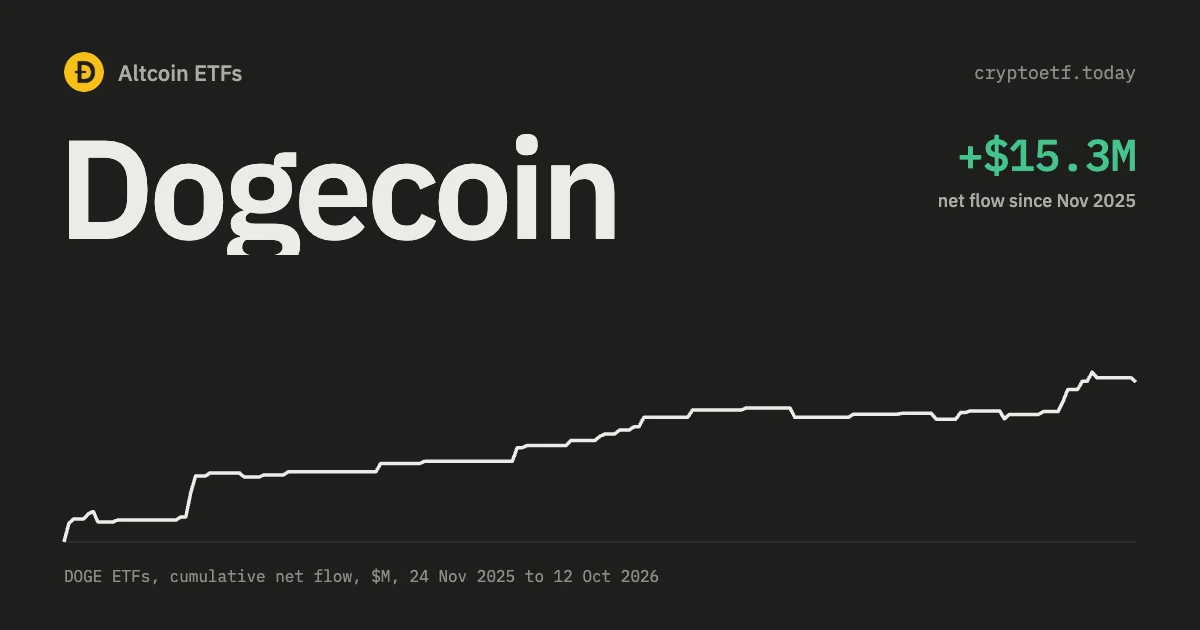
| Cumulative net flow | $12.0m | $1.6m |
| Shares at listing → now | 94,700 → 904,700 | 80,000 → 150,000 |
| NAV at listing → now | $18.02 → $9.43 | $25.05 → $16.07 |
| Longest run without any flow | 38 trading days (3 Mar to 24 Apr 2026) | 67 trading days (7 May to 12 Aug 2026) |
Source: Grayscale's daily file and 21Shares' valuation history, read on 17 September 2026. GDOG moved on 12% of days, TDOG on 4%. A zero means the exchange matched buyers and sellers without anyone minting or destroying shares; it isn't an outflow, and GDOG's 38-day gap sat inside a stretch where its cumulative line was still rising.
Weekends and US market holidays are a different kind of empty. Trusts don't strike a NAV when the exchange is closed, so there's no row to compute from, and the flows page leaves those days blank rather than showing zero. Dogecoin trades on Saturday; the ETFs don't.
Why one order looks like a spike
Both prospectuses set the creation unit at 10,000 shares, and the data agrees: all 25 of GDOG's share-count changes and all 6 of TDOG's were exact multiples of 10,000. At $9 to $18 a share, one basket is $90,000 to $180,000, and a handful of baskets is the whole fund.
Two GDOG days show the problem. On 25 November 2025, its second day of trading, an AP created 100,000 shares worth $1.80m against a fund holding $1.70m: it doubled in one order. On 2 January 2026, 140,000 shares arrived at once for $2.30m, equal to 49% of assets that morning and 19% of everything GDOG has ever raised. TDOG's version is 10 April 2026: 70,000 shares for $1.34m, which is 82% of its lifetime inflow on one day.
Then the flip. On 2 September 2026 GDOG's flow read −$0.76m (80,000 shares redeemed); the next day, +$0.42m (40,000 created). A sell-off and a recovery inside 24 hours? More likely an AP squaring a position; the honest reading is "net −40,000 shares over two days".
GDOG month by month
GDOG is the only Dogecoin fund with a full public daily history, so its monthly series is the closest thing to a DOGE flow record. Figures are the standard formula applied to Grayscale's file, as of 16 September 2026.
| Month | Net flow | Shares added | Days with flow |
|---|---|---|---|
| Nov 2025 (from 24th) | +$2.16m | +120,000 | 2 |
| Dec 2025 | +$1.15m | +70,000 | 4 |
| Jan 2026 | +$4.23m | +250,000 | 3 |
| Feb 2026 | +$0.25m | +20,000 | 1 |
| Mar 2026 | +$0.78m | +70,000 | 1 |
| Apr 2026 | +$0.46m | +40,000 | 1 |
| May 2026 | +$1.93m | +150,000 | 4 |
| Jun 2026 | +$0.86m | +80,000 | 2 |
| Jul 2026 | −$0.53m | −60,000 | 2 |
| Aug 2026 | +$0.74m | +80,000 | 2 |
| Sep 2026 (to 15th) | −$0.06m | −10,000 | 3 |
January's $4.23m came from three days, $3.90m of it from two (2 and 5 January). Take those out and the typical month is $0.5m to $1m across one to four orders: small, irregular, positive in nine months of eleven. The one month with a redemption of size, July, came as DOGE slid toward its low (GDOG's NAV bottomed at $8.07 on 6 August 2026), and buyers came back in August.
Retail or institutional money?
Retail, on three counts. Size: a fund family holding $11m can't take an allocation from anyone managing real money without becoming that allocator's fund, and the 13F disclosures behind Bitcoin ETF institutional ownership have nothing to show here. Behaviour: GDOG's share count grew 9.5 times while its NAV fell 48%; averaging down for ten months into an inflationary meme coin is a brokerage-account habit, not a committee decision. Liquidity: TDOG traded 132 shares on 16 September 2026 with a 30-day median spread of 0.23%, per 21Shares' own data; an institution can't get in or out of that.
So the series measures whether people who hold DOGE through a brokerage or an IRA are adding: a narrow signal, but a clean one, and it lives in the cumulative line.
Reading flows next to price and the CEFI composite
Don't expect DOGE ETF flows to move the DOGE price. Dogecoin's market capitalisation was around $12bn in September 2026 (roughly 155bn coins at about $0.08); a $0.4m creation is a rounding error against a day of spot and perpetual volume. The relationship runs the other way: price moves first, and a creation follows once brokerage orders add up to a basket. The pattern worth watching is creations arriving on a flat or falling week, the one that says something about conviction.
Dogecoin is also inside the CEFI composite. Each day's DOGE net flow is divided by Dogecoin's market capitalisation and smoothed on its own series, then added to the other twelve assets, and the composite is z-scored against a window of at most 90 rows; the full method is in how the CEFI index is calculated. Dividing by market cap measures a DOGE day against Dogecoin's own size rather than Bitcoin's. There's no separate CEFI-DOGE reading, and with 25 non-zero days in ten months there shouldn't be: a z-score on a series that's mostly zeros would swing to an extreme on every basket.
Six ways to misread this data, and a routine that avoids them
- Reading zero as an outflow, or a blank as zero. Zero means no basket moved; a blank means no NAV was struck. Only a negative number is money leaving.
- Building a story on one bar. A single 10,000-share basket is nearly 7% of TDOG's 150,000 shares. The 2 and 3 September flip is the cautionary example; sum the week.
- Comparing raw dollars with Bitcoin. Scale by fund assets, or let the CEFI normalisation do it.
- Counting BWOW's final redemption as sentiment. It was a scheduled distribution announced six weeks in advance.
- Assuming both funds are dated the same way. A TDOG creation lands the same day; a GDOG creation lands the next.
- Expecting cumulative flow to equal assets. GDOG raised $12.0m and held $8.5m on 16 September 2026; the gap is DOGE's price. TDOG holds more than it raised because its $2.0m of seed shares on 22 January 2026 aren't a flow.
The routine that follows is short. Read the cumulative line first and the daily bars second: on a series this sparse the slope is the signal, the bars are individual orders. Sum by week or month; one to four orders a month is normal, and a month with none, like the March-to-April gap, matters only if the next one is empty too. Count baskets rather than dollars, because a 10,000-share day is one AP order whatever the price. And note which fund moved: GDOG has taken 23 creations to TDOG's 5, so if TDOG, the dearer fund at 0.50% against 0.35%, starts moving regularly, something changed in who's buying.
The Dogecoin ETF flows page shows the daily net figure, the cumulative line and a per-fund table, updated every business day after Grayscale and 21Shares post their numbers. It isn't real-time; GDOG's figure for a day appears the following business day.
FAQ
What does a Dogecoin ETF inflow mean?
New shares were created that day, so the trust took in cash or DOGE and now holds more coins. The figure is the change in shares outstanding multiplied by NAV, computed from the issuer's own daily data. It isn't trading volume on the exchange.
Why do Dogecoin ETF flows show zero on most days?
Because no 10,000-share basket was created or redeemed. Through 16 September 2026 GDOG changed its share count on 25 of 202 trading days and TDOG on 6 of 163. Buyers and sellers were matched on the exchange, so the trust had nothing to mint or cancel.
What happened to BWOW in the flow data?
Bitwise announced the closure on 10 September 2026. The fund's last trading day was 14 October, when it converted its DOGE to cash, and shareholders received the 21 October NAV in cash on 22 October. The final redemption shows as an outflow bounded by the fund's remaining assets: a closure, not investors selling.
Why do GDOG and TDOG flows land on different days?
Grayscale's share count dated T reflects orders through the previous day, so a creation shows up in the next day's count, priced at that day's NAV. 21Shares creates shares on the NAV of the order date, so its count dated T already includes T's orders. The site applies the matching rule to each issuer.
Do Dogecoin ETF flows affect the DOGE price?
Not measurably. Dogecoin's market capitalisation was around $12bn in September 2026, so a typical $0.2m to $0.9m creation is negligible against daily spot and derivatives volume. GDOG's share count rose 9.5 times while its NAV fell 48%: flows follow holders' habits rather than driving price.
Is Dogecoin included in the CEFI sentiment index?
Yes, in the composite. Each day's DOGE net flow is divided by Dogecoin's market capitalisation and smoothed, then added to the other twelve tracked assets before the composite is z-scored over a window of at most 90 rows. There is no separate per-asset CEFI reading for DOGE.
Sources and further reading
- Grayscale Dogecoin Trust ETF, daily performance file, etfs.grayscale.com; prospectus, 10,000-share basket (Form 424B3, March 2026), sec.gov.
- 21Shares Dogecoin ETF, product page and valuation history, 21shares.com; prospectus, same-day NAV rule (Form 424B3, March 2026), sec.gov.
- Bitwise Dogecoin ETF, Form 8-K and press release on the liquidation (10 September 2026), sec.gov; fund page with wallet disclosure, bwowetf.com.
- Daily data: Dogecoin ETF flows. Internal: how to read Hyperliquid ETF flows, what outflows really mean, every new crypto ETF of 2026.
Live data on this topic
For information only. Not investment advice.
 BTC
 ETH
 SOL
 XRP
 HYPE
 LINK
 HBAR
 AVAX
 LTC
 SUI
 DOT
 BNB
 NEAR
 TRX
 ZEC