Three US spot Avalanche ETFs stake AVAX: VanEck VAVX (0.20%, since 26 Jan 2026), Grayscale GAVA (0.35%, 12 Mar) and Bitwise BAVA (0.34%, 15 Apr). Fees, custody, staking cuts.
TL;DR. Three spot Avalanche ETFs trade in the US: VanEck VAVX (Nasdaq, since 26 January 2026, 0.20% fee), Grayscale GAVA (Nasdaq, 12 March 2026, 0.35%) and Bitwise BAVA (NYSE Arca, 15 April 2026, 0.34%). All three custody AVAX at Coinbase and stake most of it on Avalanche's P-Chain; VAVX and GAVA pay the reward out in cash, BAVA says it intends to. The complex is small: BAVA held $20.2m on 17 September 2026, GAVA $5.5m, and VAVX $11.6m at its 30 June 10-Q. No aggregator publishes AVAX flows, so the numbers on this site are computed from three different issuer disclosures, including 32 on-chain wallets Bitwise publishes for BAVA.
Contents · 10 sections
 Avalanche ETFsNet flow Fri 16 Oct0
What a spot Avalanche ETF is
A spot Avalanche ETF is a grantor trust listed on a US exchange that holds AVAX, the native token of the Avalanche network, and issues shares against it. Each share is a claim on a slowly changing number of tokens: about 2.43 AVAX per GAVA share at 30 June 2026 (649,891 coins across 267,980 shares, per the 10-Q) and 2.716 per BAVA share on 16 September, per Bitwise's fund page. You trade the shares in a brokerage account; the trust handles custody, staking and the tax paperwork.
The wrapper is the one spot Bitcoin uses. Authorised participants create shares when the price runs above the underlying AVAX and redeem when it falls below. Those creations and redemptions are the "flows" the tracker reports; two shareholders trading with each other move nothing. How to read Bitcoin ETF flows covers the mechanic in detail.
Two things separate this from a Bitcoin fund: a staking reward, and more than one chain.
Avalanche in one section
Avalanche's Primary Network is three blockchains with different jobs. The C-Chain runs EVM smart contracts and is where tokens arrive when a fund buys them. The P-Chain coordinates validators and holds staked AVAX. Little happens on the X-Chain any more. A fund that stakes moves coins from C to P with an atomic export and import, where they sit for the staking term.
Staking rules are what shape the funds. Per the Avalanche docs, a validator needs 2,000 AVAX and a delegator 25. Stakes lock for a chosen term of two weeks to one year, with no way out early. There's no slashing either: a validator online less than 80% of its term simply earns nothing. So the risk the funds carry is liquidity, not principal: a chunk of the trust's coins can't be sold until a lock expires.
The three US funds
| Ticker | Issuer | Exchange | First traded | Fee | Launch waiver | Custodian | Staking |
|---|---|---|---|---|---|---|---|
| VAVX | VanEck | Nasdaq | 26 Jan 2026 | 0.20% | 0% on first $500m to 28 Feb 2026 | Coinbase Custody (Anchorage backup), State Street for cash | Coinbase Crypto Services, 4% of rewards; 85% staked at 30 Jun 2026 |
| GAVA | Grayscale | Nasdaq | 12 Mar 2026 | 0.35% | 0% to 12 Jun 2026 or $1bn NAV | Coinbase Custody | Third-party validators; sponsor and validators take 23% of gross rewards; 81% staked by value at 30 Jun 2026 |
| BAVA | Bitwise | NYSE Arca | 15 Apr 2026 | 0.34% | 0% on first $500m to 14 May 2026 | Coinbase Custody | Attestant (Bitwise affiliate), 12% of rewards; 70% target, 69% on 17 Sep 2026 |
Sources: each fund's 10-Q for the quarter ended 30 June 2026, plus issuer pages on 17 September 2026. Two numbers contradict what circulated at launch.
VanEck VAVX
VAVX was first, listing on Nasdaq on 26 January 2026. VanEck's S-1 amendments carried a 0.30% sponsor fee, and that figure still sits in fund databases. The rate the trust charges is 0.20%, per its launch release and its June 2026 10-Q, after a full waiver on the first $500m that expired on 28 February. At 30 June the trust held 1,726,678 AVAX across 825,000 shares, $11.56m at $14.02 a share, with 1,468,087 coins staked, or 85%.
VanEck was also first to distribute. An 8-K dated 17 June 2026 set a quarterly cash distribution policy under IRS Revenue Procedure 2025-31, the safe harbour that lets a grantor trust stake without losing its tax status. The first payment went out on 8 July: $0.1697 a share, $140,003 in total, for rewards earned from 8 January to 30 June net of Coinbase's 4% and a custodian staking fee.
Grayscale GAVA
GAVA is the oldest vehicle and the newest ETF. Grayscale formed the trust on 3 November 2021, opened it as a private placement on 20 August 2024, and uplisted it to Nasdaq on 12 March 2026. The daily file shows 237,980 shares at a $23.10 NAV on listing day and 297,980 shares at $18.45 on 17 September 2026: 60,000 shares created in six months, $5.50m of assets.
The 0% launch fee was real and short. Per the 10-Q, the sponsor waived its fee from 12 March until the earlier of 12 June 2026 and NAV passing $1bn; the date arrived first, and 0.35% has applied since. On staking, Grayscale's fee and the validators' fees together take 23% of gross rewards, the heaviest cut of the three. An amendment dated 6 August 2026 obliges the fund to convert rewards to cash and distribute at least quarterly, monthly where it can.
Bitwise BAVA
BAVA listed on NYSE Arca on 15 April 2026 at 0.34%, waived through 14 May on the first $500m. Bitwise stakes through Attestant, an affiliate the 10-Q names as staking agent, at a cost of 12% of the AVAX generated. It ladders two-week stakes so something is always close to unlocking, targets 70% staked with the rest as a liquidity reserve, and showed 69% on 17 September.
It's the largest of the three: $20.2m across 980,000 shares on 17 September 2026, 2,661,993 AVAX in trust. Bitwise's launch release quoted "Avalanche's average staking rewards of 5.4%"; its page showed 5.25% gross and 3.23% net on 17 September, the gap being the 12% cut and the 30% left unstaked.
Where the money is
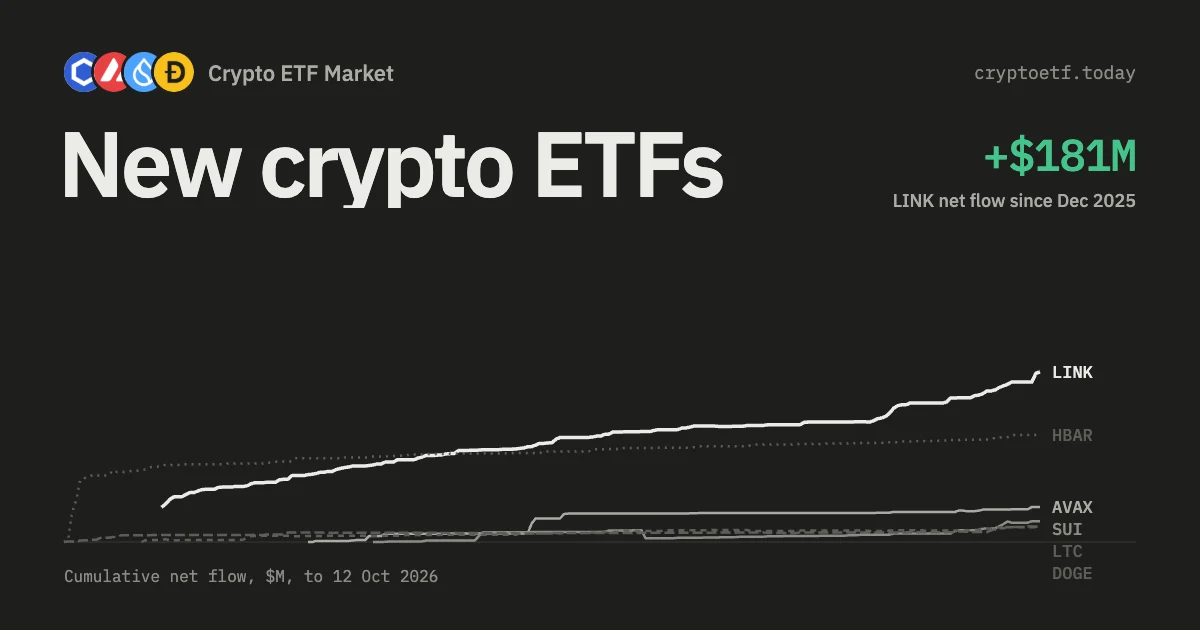
Together the US Avalanche ETFs hold under $40m: BAVA $20.2m and GAVA $5.5m on 17 September, plus VAVX's 1.73m AVAX, about $13m at September prices if the coin count hasn't moved since June. Fee revenue on that is a little over $100,000 a year across three issuers; nobody launched these for the fees. They exist because the SEC's generic listing standards of 17 September 2025 made a spot fund on any qualifying asset a matter of weeks. The full roster is in every new crypto ETF of 2026.
The tracker's backfill put cumulative net inflows at about $25m through 20 August 2026, most of it BAVA and most of BAVA's from a seed creation at launch. Since then GAVA has added 30,000 shares and BAVA 10,000: still inflows, slowly. Price did more: Bitwise's 17 September holdings imply about $7.60 a coin against roughly $6.60 in the June 10-Qs, so a fund flat on flows still gained about 15% in a quarter. Daily figures are on the Avalanche ETF flows page.
How staking changes the maths
A spot Bitcoin fund's coins per share fall every day by the fee. An AVAX fund's can rise, because staked coins earn coins. Rough arithmetic on $10,000 at a 5% gross reward (Bitwise showed 5.25% in September, Grayscale 5.41% in August):
| Per $10,000, one year | VAVX | GAVA | BAVA |
|---|---|---|---|
| Sponsor fee | −$20 | −$35 | −$34 |
| Share staked | 85% (Jun 2026) | 81% (Jun 2026, by value) | 70% target |
| Gross reward at 5% | +$425 | +$405 | +$350 |
| Staking cut | 4% plus custodian fee | 23% | 12% |
| Net carry before price | ~+$385 | ~+$277 | ~+$274 |
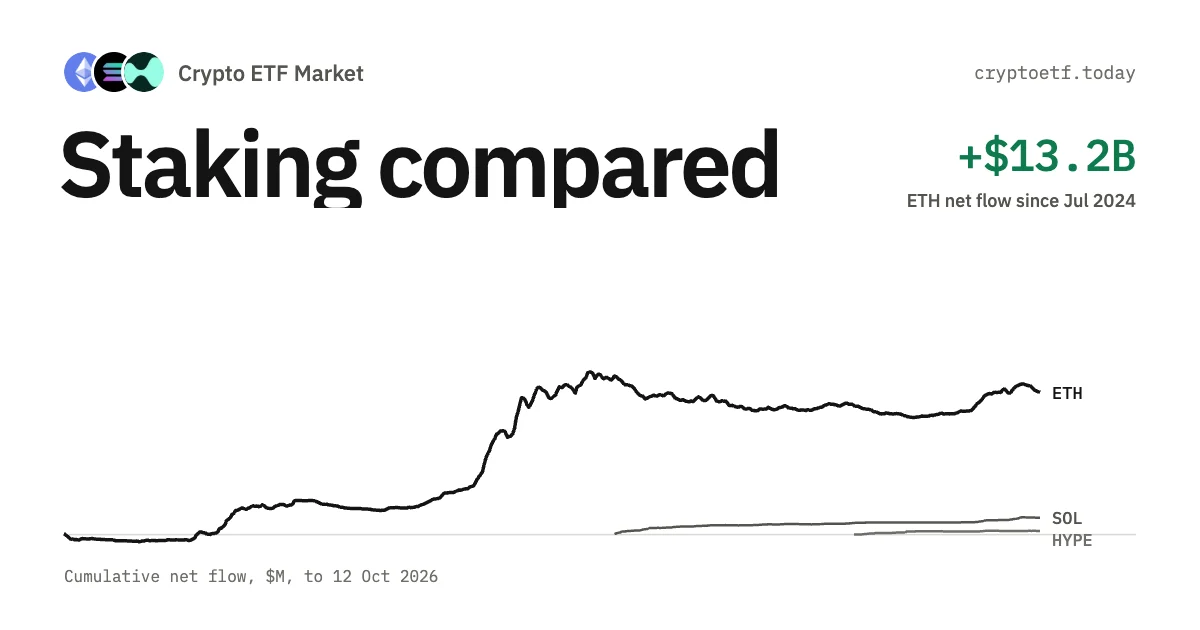
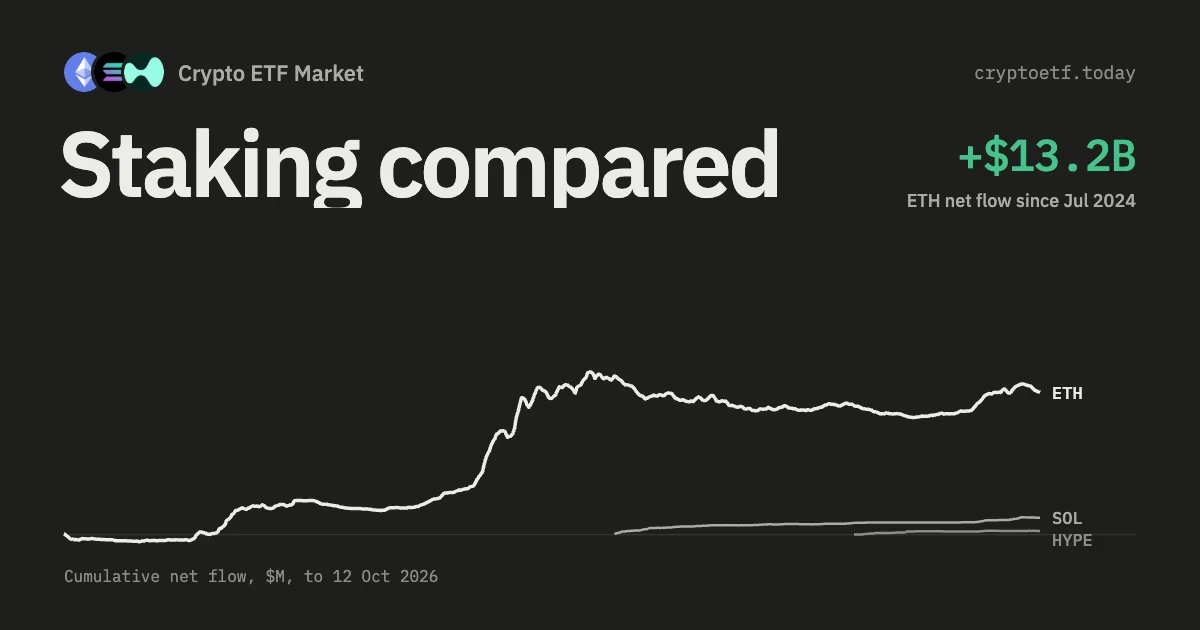
Caveats: GAVA's staked share is a June snapshot by value ($3.45m of $4.27m), VAVX's 85% is one date, and the reward rate moves with network activity. GAVA versus BAVA is a coin flip; VAVX wins under any assumption. How other staking funds handle this is in crypto ETF staking compared.
What differs from the Hyperliquid funds is where the reward goes. The HYPE ETFs mostly let it accrue into coins per share. VAVX pays cash quarterly since July, GAVA at least quarterly since August. BAVA's page says it "intends to distribute" net staking income periodically, but its 10-Q leaves that to the sponsor's discretion and it had paid nothing by 18 September 2026, so for now the reward stays in the coin count. Cash is cleaner for tax reporting and worse for compounding; a distribution is taxable in a brokerage account and a non-event in an IRA. The Ethereum staking ETF explainer covers how the SEC got here.
How the flow numbers are derived
No public source publishes daily Avalanche ETF flows, so this site computes them from issuer disclosures. Three issuers disclose three different things, hence three methods.
GAVA: shares and NAV. Grayscale posts a daily spreadsheet with shares outstanding, NAV and AUM for every trading day since the 2024 private placement. Flow on day T is the change in shares times that day's NAV, shifted a day because a creation appears in the share count at settlement. Rows before 12 March 2026 are cut: a private-placement subscription isn't an ETF inflow.
VAVX: coins, not shares. VanEck doesn't publish shares outstanding, but its holdings endpoint reports AVAX in trust each day, one day in arrears. Flow is the change in coins times price; where that drifts from the share method, the gap is fees paid out in coin and rewards paid in.
BAVA: 32 wallets on two chains. Bitwise is the only issuer that publishes wallet addresses, and its fund page lists 32 on Avalanche. It sounds like the easiest fund to audit and is the hardest. Coins arrive on the C-Chain and leave for the P-Chain to be staked, so holdings are the sum of both: on 21 August 2026, 791,249 AVAX on C plus 1,839,205 on P, matching the fund's published 2,630,454 to the coin. And staking rewards land in the same wallets, and a reward isn't an investor flow. The fix is to divide coins by AVAX per share and round to the 10,000-share creation basket; rewards and fees move coins and NAV together and cancel in the share count, leaving only what authorised participants created or redeemed. Rebuilt that way, the daily series matched Bitwise's own numbers for 30 straight days.
What the wallets buy is history. Bitwise's page shows only today's share count, so without the chain there'd be no BAVA series before our snapshots began. With it, the series runs from launch and includes something aggregators miss: a seed creation of roughly $10.7m before the first trading day. Third-party totals start on listing day, so they show BAVA about that much smaller than it is and VAVX's cumulative flow as zero despite 1.7m AVAX in the trust. Same asset, different counting rule, a 40% gap in the headline.
Outside the US
Europe had Avalanche products four years earlier, at prices that show what no competition costs. The 21Shares Avalanche Staking ETP (ISIN CH1135202088) launched on 18 November 2021, accrues the staking reward into NAV and charges 2.50%; it held $10.7m on 17 September 2026. VanEck's Avalanche ETN (DE000A3GV1T7, ticker VAVA) launched on 8 December 2021 at 1.50%, about EUR 7m in September 2026 per justETF, no staking. That's four to twelve times the US sponsor fees for the same coin, and the US funds aren't marketed in the EU.
Who these funds are for
- Retirement money. An IRA can hold GAVA. It can't hold AVAX on a P-Chain address.
- People who want the reward without the lock. Staking yourself means a two-week to one-year lock with no early exit. Fund shares sell any weekday and settle T+1; the lock is the trust's problem, until redemptions exceed the reserve.
- Not active Avalanche users. A share carries no vote and pays no gas. If you use the network, the token does more.
The risks: AVAX is volatile, and the June-to-September move runs the other way too. The funds are small, so spreads run wider than on the Bitcoin giants; BAVA's 30-day median bid-ask spread was 0.59% on 16 September 2026. Check the premium or discount before a market order. And none of the three is a 1940 Act fund, a sentence every prospectus prints and most buyers skip.
FAQ
Is there an Avalanche ETF in the US?
Yes, three spot funds: VanEck VAVX on Nasdaq since 26 January 2026, Grayscale GAVA on Nasdaq since 12 March 2026, and Bitwise BAVA on NYSE Arca since 15 April 2026. All hold AVAX and stake most of it.
Which Avalanche ETF has the lowest fee?
VanEck VAVX at 0.20% of net assets, per its June 2026 10-Q. Bitwise BAVA charges 0.34% and Grayscale GAVA 0.35% after its 0% launch period ended on 12 June 2026. Staking cuts differ too: 4% to Coinbase at VAVX, 12% at BAVA and 23% at GAVA.
Do Avalanche ETFs pay staking rewards?
VAVX paid its first cash distribution of $0.1697 a share on 8 July 2026 and pays quarterly. GAVA amended its trust agreement in August 2026 to distribute at least quarterly. BAVA says it intends to distribute periodically but had made no payment by mid-September 2026.
How much AVAX do the ETFs hold?
On 17 September 2026 BAVA held 2,661,993 AVAX ($20.2m) and GAVA had 297,980 shares worth $5.5m. VAVX reported 1,726,678 AVAX ($11.6m) at 30 June 2026. Combined, under $40m.
Why do sites show different Avalanche ETF flow totals?
Because no aggregator publishes AVAX flows, every site computes them. Counting from the first trading day misses seed creations made before it, about $10.7m for BAVA. This site rebuilds each fund from issuer data and, for BAVA, from its 32 disclosed wallets.
Can an Avalanche ETF lose money to slashing?
Avalanche has no slashing. A validator below 80% uptime forfeits its reward for that term, so a bad validator costs income, not principal. The real staking risk is liquidity: staked coins are locked for two weeks to a year.
Sources and further reading
- VanEck Avalanche ETF, Form 10-Q for the quarter ended 30 June 2026 and 8-Ks of 17 June and 6 July 2026: sec.gov.
- Grayscale Avalanche Staking ETF, Form 10-Q for the quarter ended 30 June 2026 and 8-K of 7 August 2026: sec.gov; daily performance file: etfs.grayscale.com.
- Bitwise Avalanche ETF, Form 10-Q for the quarter ended 30 June 2026: sec.gov; fund page with wallet addresses: bavaetf.com.
- Avalanche Builder Hub, staking parameters: build.avax.network.
- 21Shares Avalanche Staking ETP product page: 21shares.com.
- Daily data: Avalanche ETF flows tracker.
Live data on this topic
ETFs still waiting for approval: Injective, SEI, Cronos, PEPE, Worldcoin, Canton, Aave, TRUMP, Ondo, Uniswap, Aptos, PENGU
For information only. Not investment advice.
 BTC
 ETH
 SOL
 XRP
 HYPE
 LINK
 HBAR
 DOGE
 LTC
 SUI
 DOT
 BNB
 NEAR
 TRX
 ZEC