Three AVAX ETFs, three disclosures: Grayscale shares, VanEck coins, Bitwise 32 wallets on two chains. Why only 24 of 164 days moved and what staking does to the count.
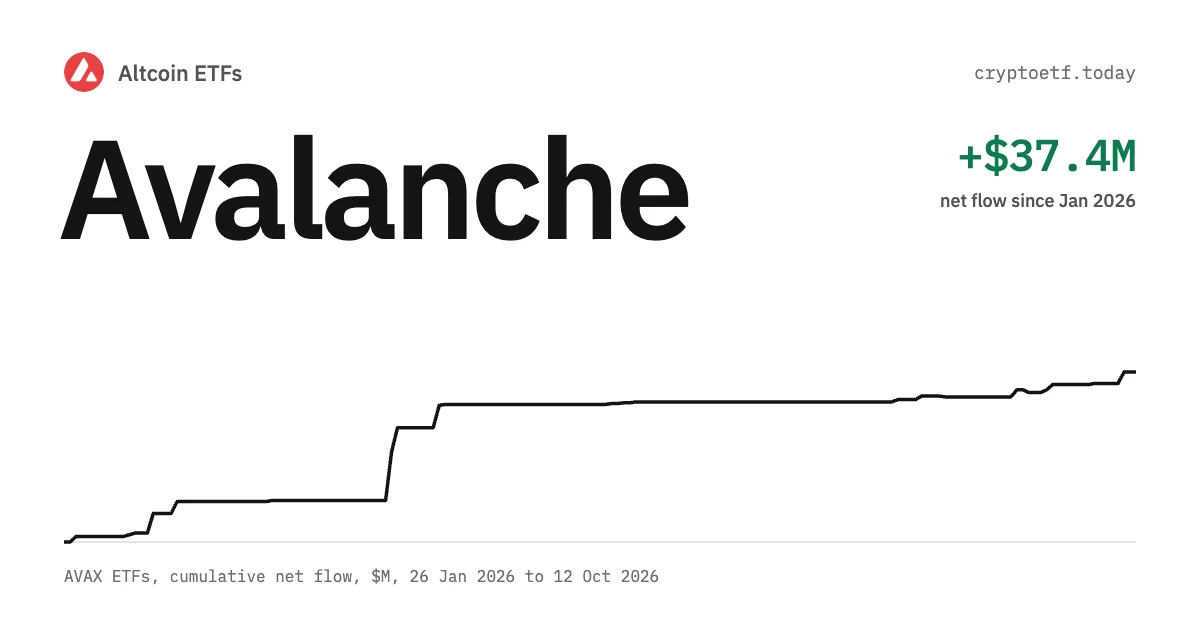
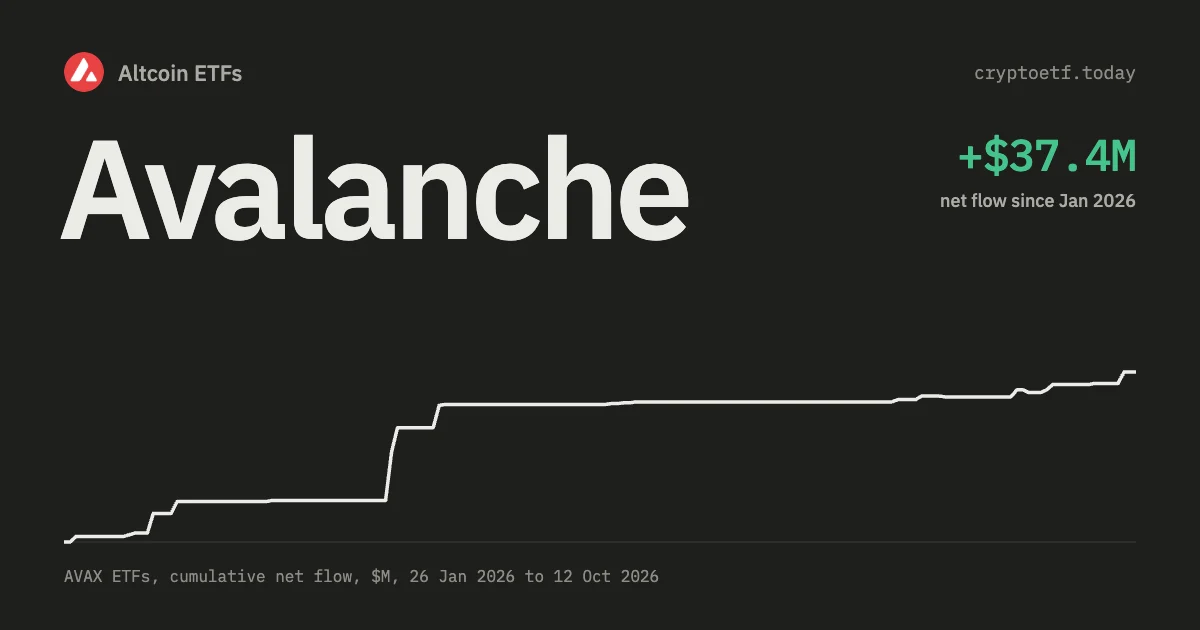
TL;DR. An Avalanche ETF flow is the dollar value of shares an authorised participant created or redeemed that day. No aggregator publishes it, so the site builds it three ways: Grayscale's GAVA from a daily share count, VanEck's VAVX from the coin count in its holdings feed, and Bitwise's BAVA from 32 disclosed wallets across Avalanche's C-Chain and P-Chain, then from Bitwise's own share count once daily snapshots began. Through 18 September 2026 the series had 164 trading days since VAVX listed on 26 January, and 24 of them were non-zero (21 creations, 3 redemptions) for $32.9m of cumulative net inflow. One order can be 4% of a fund: BAVA's 40,000-share creation on 14 September was followed by a 30,000-share redemption two days later. Read the cumulative line first, count baskets, and remember that staking rewards land in the same wallets as investor money.
Contents · 10 sections

What the number measures
A +$0.8m print on the Avalanche ETF flows page doesn't mean $0.8m of shares changed hands. It means an authorised participant delivered cash to a trust and took new shares, so the trust now holds more AVAX; a redemption runs backwards. Volume on Nasdaq or NYSE Arca is a separate thing, and two shareholders trading with each other all day produce none of it. The mechanic is the one behind Bitcoin ETF flows; what differs is the size. The three US funds held about $41m between them in mid-September 2026 (BAVA $22.1m on 18 September, VAVX $13.8m and GAVA $5.5m on 17 September), so a single 10,000-share basket is visible in every chart.
Fund facts, fees and staking cuts live in Avalanche ETF explained. This piece is about the data: where each number comes from, what it can and can't show, and how to read it without inventing a story.
Three funds, three disclosures, three methods
The formula is the same for every fund the site computes itself:
flow(T) = (shares(T+1) − shares(T)) × NAV(T)
The day shift exists because a creation ordered on Tuesday appears in Wednesday's share count at most issuers. Wednesday minus Tuesday is Tuesday's order, priced at Tuesday's NAV. The trouble with Avalanche is that only one of the three issuers publishes what the formula needs.
| Fund | What the issuer publishes | How the site gets a flow | When a Tuesday order shows up |
|---|---|---|---|
| GAVA (Grayscale) | Daily spreadsheet: shares outstanding, NAV, AUM, one row per trading day since the 2024 private placement | Standard formula on the file; rows before the 12 March 2026 listing are dropped | Wednesday, dated Tuesday |
| VAVX (VanEck) | Holdings feed: AVAX in trust and its market value, one day in arrears; no share count | Change in coins times the fund's own price (market value divided by coins), with the 0.20% fee added back | Thursday at the earliest, dated Tuesday |
| BAVA (Bitwise) | Fund page with today's shares, net assets, coins, a NAV chart, and 32 wallet addresses; no share history | History rebuilt from the wallets; daily flows since 24 August 2026 from snapshot pairs of the share count | Tuesday evening, dated Tuesday |
The Bitwise dating rule
Bitwise's share count dated T already includes T's orders, and so do 21Shares' and Canary's. The site keeps a list of these same-day issuers and, for them, prices the same pair of snapshots at NAV(T+1) and dates the flow T+1. The rule was added after a check on 13 September 2026 showed the standard formula placing Bitwise's HYPE and Bitcoin flows a day early. In practice a BAVA creation is on the page the evening it happens; a GAVA creation appears the next business day; a VAVX change waits for VanEck's one-day lag and then the next snapshot. If two funds move on adjacent days, that's often the same day's orders wearing different dates.
BAVA: 32 wallets on two chains
Bitwise is the only Avalanche issuer that publishes wallet addresses, and its page listed 32 on 18 September 2026 with a combined balance of 2,662,740 AVAX against 2,662,689 in the fund's holdings table. That makes BAVA the only AVAX fund whose history can be rebuilt from the chain, and also the hardest to rebuild, because the fund stakes.
Coins arrive on the C-Chain, the EVM chain where a custodian delivers them, and leave for the P-Chain by atomic export to be staked. Per the Avalanche documentation, a stake locks for a term of two weeks to one year, rewards are sent to the wallet at the end of the term, and a validator online for less than 80% of its term simply earns nothing; there is no slashing. So at any moment the trust's coins are split between the two chains, and a C-Chain explorer alone under-counts. On 21 August 2026 the split was 791,249 AVAX on the C-Chain and 1,839,205 on the P-Chain, 2,630,454 in total, matching Bitwise's published figure to the coin.
The P-Chain part can't be summed from transactions. Staked coins don't appear in ordinary outputs, so adding up deltas gave 28,000 AVAX where 1.84m sat; adding the staked amounts instead over-counted seven times, because Bitwise ladders two-week stakes and each renewal counts again. Two things work: a point-in-time balance from Avalanche's Glacier API, or the C-Chain's own record of exports minus imports. The second gave 2,602,174 AVAX, 28,280 short of the fund's number: 1.08% over four months of staking, which is the reward, and spreading it across the days it accrued closes the gap.
That last point is why the wallet series is not the flow series. A reward increases coins in trust without any investor buying anything, and the fee is deducted in coin without anyone selling. So coins are converted to shares first, by dividing by the fund's AVAX per share (2.7118 on 21 August, 2.7170 on 18 September) and rounding to the 10,000-share creation basket. Rewards and fees move coins and NAV together and cancel in the share count; what remains is what authorised participants created or redeemed. Rebuilt that way, the series ended on exactly the 970,000 shares Bitwise showed on 21 August 2026, and the last 30 days matched the fund's own figures day for day, including the one non-zero day, 17 August, at $0.5m here and $0.51m there.
Two limits. The rebuild starts with coins already in the wallets on 14 April 2026, and an opening balance isn't a flow; the fund has 980,000 shares while the series has created a net 880,000, so about 100,000 shares' worth at the $25.00 opening NAV sits outside the count. And the biggest print in the whole AVAX series, $10.7m dated 15 April 2026, is a seed creation around listing day, which a series starting on the listing date would miss.
VAVX: coins, not shares
VanEck's holdings endpoint reported 1,825,830 AVAX worth $13,849,012 as of 17 September 2026. It doesn't report shares outstanding, so VAVX is the one fund computed in coin: the change in AVAX between two snapshots times the fund's implied price, plus the daily fee, which VanEck deducts in coin and which would otherwise look like a permanent trickle of outflow.
What the coin method can't do is tell a creation from a reward. VAVX had 85% of its coins staked at 30 June 2026, and when a staking term ends the reward lands in the trust as more AVAX. The site adds back the fee but doesn't subtract rewards, so the small prints in VAVX's column since its computed series began on 20 August 2026 (+$0.014m, +$0.006m, −$0.006m, +$0.005m, +$0.014m, +$0.006m) are the size of reward payments on a 1.5m-coin stake, not orders. The one print of size, +$0.78m on 21 August, is about 100,000 AVAX at that day's price; VanEck's entire first-half reward, distributed on 8 July, was $140,003 after fees, so that one was money. Between 20 August and 17 September the coin count rose 109,121, which is the same story in the raw feed.
Before 20 August there is no VAVX computed series at all. The tracker shows zero for VAVX from 27 July, when snapshots started, and nothing per fund before that; the five non-zero days between 28 January and 23 February 2026, $8.9m in total, sit in the asset total without a fund attached, carried over from third-party data during the backfill. VAVX was the only Avalanche ETF trading then, but the site doesn't attribute what it didn't compute itself.
What the series looks like
| As of 18 Sep 2026 | GAVA | VAVX | BAVA | Asset total |
|---|---|---|---|---|
| Per-fund series from | 12 Mar 2026 | 27 Jul 2026 (computed from 20 Aug) | 14 Apr 2026 | 26 Jan 2026 |
| Trading days with data | 132 | 39 | 110 | 164 |
| Days the flow was non-zero | 5 | 7 | 8 | 24 |
| Creations / redemptions | 4 / 1 | 6 / 1 | 7 / 1 | 21 / 3 |
| Cumulative net flow | +$1.18m | +$0.82m | +$22.0m | +$32.9m |
| Shares, first row → now | 237,980 → 297,980 (17 Sep) | not published | opening balance → 980,000 | |
| Largest single day | +$0.74m (14 Sep, 40,000 shares) | +$0.78m (21 Aug) | +$10.7m (15 Apr, about 420,000 shares) | +$10.7m |
Source: the site's AVAX series read on 19 September 2026, Grayscale's daily file, VanEck's holdings feed and Bitwise's fund page. GAVA's five prints were +10,000, +10,000, +10,000, −10,000 and +40,000 shares, which is how 237,980 became 297,980. April's $21.1m is BAVA's launch; May and July had no flow at all. The longest empty stretch ran 43 trading days, from 15 June to 14 August 2026. That's the resting state of a complex this size: a zero means buyers and sellers were matched on the exchange and nobody minted or destroyed shares. Weekends and US holidays are a different kind of empty. No NAV is struck, so there's no row to compute, and the page leaves those days blank rather than printing zero. AVAX trades on Sunday; the ETFs don't.
Reading a creation against a price move
The series carries AVAX's price alongside each day, and it's the more eventful line. AVAX went from $11.72 on 26 January 2026 to a low of $6.24 on 25 June and back to $7.61 by 18 September. The flows don't track it. February's $7.7m arrived as the price fell from $9 toward $8. BAVA's launch-month $21m came at $9.3 to $9.7. The two June baskets, 8 and 12 June, were bought within a week of the low, at $6.77 and $6.57. The August and September prints came after the bounce. Neither "flows chase price" nor "flows lead price" fits all of it, and at roughly $3.2bn of market capitalisation (using the 425 million supply constant the CEFI calculation applies) a $0.8m creation is noise against a day of spot volume.
What the series does show is who's committing. On 14 September 2026 GAVA and BAVA both created 40,000 shares, $1.57m together, the largest day since April and the first time two issuers printed on the same order date (the Bitwise dating rule matters here; without it GAVA's order would look like a day-later echo). Two days later BAVA redeemed 30,000 shares. Read as bars, that's a rush in and a rush out; read as a week, it's a net 50,000 shares across two funds, which is the honest number. A basket that arrives on a flat or falling week says more about conviction than one on a rally, and June's two baskets at the low are the clearest case so far.
A distribution isn't a flow either. VAVX paid $0.1697 a share in cash on 8 July 2026 and GAVA must distribute at least quarterly since its August amendment; both reduce NAV and leave the share count alone. On the coin method, selling the reward for cash can show up as a small negative VAVX print that the fee add-back doesn't cover. Don't read one of those as investors leaving.
How AVAX enters the CEFI composite
Avalanche has no per-asset score on the CEFI page; only Bitcoin, Ethereum, Solana, XRP and Hyperliquid do. AVAX enters the composite, and it enters as a single daily total rather than the per-fund weighted figure the five original assets get. That total is divided by AVAX's market capitalisation (daily close times a fixed 425,000,000 supply constant), smoothed with an exponential moving average where today counts 30% and yesterday's smoothed value 70%, then added to the same quantity for the other twelve assets before the composite is z-scored against a window of at most 90 rows and mapped to 0–100. The full method, with the constants, is in how the CEFI index is calculated.
Dividing by market cap is what makes a small complex count. The $1.57m of 14 September was 0.05% of AVAX's market cap at that day's $7.30 close; the same 0.05% of Bitcoin at $95,000 would be about $0.9bn, and before smoothing those two days weigh the same in the composite. After smoothing, a lone AVAX basket fades within about two weeks. The absence of an AVAX-only score is a feature: a z-score on a series that's 85% zeros would swing to an extreme on every order.
Five ways to misread this data
- Reading a blank as zero, or zero as an outflow. Blank means no NAV was struck (weekend, holiday, or a source that hasn't published). Zero means no basket moved. Only a negative number is money leaving.
- Treating VAVX's small prints as orders. Anything under about $20,000 in the VAVX column is the coin method seeing a reward or a rounding, not an authorised participant.
- Comparing cumulative flow with assets. The complex holds about $41m and the series has raised $32.9m even though AVAX is 35% below its January price. The difference is seed coins that predate each fund's series: VAVX's whole launch position and BAVA's opening balance are starting points, not flows.
- Reading a two-day flip as a reversal. BAVA's +40,000 and −30,000 shares on 14 and 16 September is one AP squaring a position. Sum the week.
- Assuming the newest row is final. The site's own figure for day T needs the snapshot from T+1, so the latest day can carry a provisional morning placeholder until the evening recompute overwrites it. Check tomorrow before quoting today.
The routine that follows is short. Read the cumulative line before the bars; on a series where 140 of 164 days are zero, the slope is the signal and the bars are individual orders. Count baskets rather than dollars: a 10,000-share day is one order whether the NAV is $26 or $17. Note which fund moved, because GAVA at 0.35% has taken four creations and BAVA at 0.34% seven, and a regular VAVX print at 0.20% would say something about who's buying that the other two don't.
The Avalanche ETF flows page shows the daily net figure, the cumulative line and a per-fund table, updated every business day after the three issuers post. It isn't real-time, and each fund's column starts on the day the site could compute it, which is later than the fund's listing for VAVX and BAVA.
FAQ
What does an Avalanche ETF inflow mean?
New shares were created that day: an authorised participant delivered cash to VAVX, GAVA or BAVA and the trust bought AVAX. The figure is the change in shares outstanding multiplied by NAV. It is not exchange volume, and a staking reward landing in the trust is not an inflow either.
Why do Avalanche ETF flows show zero on most days?
Because no 10,000-share basket was created or redeemed. Through 18 September 2026 the asset series had 24 non-zero days out of 164, and the longest empty stretch ran 43 trading days from 15 June to 14 August. A zero means buyers and sellers were matched on the exchange.
How is the BAVA flow calculated from wallets?
Bitwise publishes 32 Avalanche addresses. Coins on the C-Chain are summed from transactions and coins staked on the P-Chain are taken as a balance on each date (or as C-Chain exports minus imports). The total is divided by AVAX per share and rounded to the 10,000-share basket, so rewards and fees cancel and only creations and redemptions remain. Since 24 August 2026 daily flows come from Bitwise's own share count instead.
Why does staked AVAX matter for reading the wallets?
Staked coins sit on the P-Chain, locked for two weeks to a year, and a C-Chain explorer does not see them. On 21 August 2026 BAVA had 1,839,205 of its 2,630,454 AVAX on the P-Chain. Rewards are paid to the wallet at the end of each term, so the coin count rises without any investor money arriving.
Why do VAVX flows look different from GAVA and BAVA?
VanEck does not publish shares outstanding, so VAVX is computed from the change in coins in trust times the fund's implied price, with the 0.20% fee added back. The method cannot separate a creation from a staking reward, so small prints of a few thousand dollars are rewards, and the computed series only starts on 20 August 2026.
Is Avalanche included in the CEFI index?
In the composite only. The daily AVAX net flow is divided by market capitalisation (close times a 425 million supply constant), smoothed with a 0.3 EWMA and added to the other twelve assets before the composite is z-scored over up to 90 rows. There is no separate per-asset CEFI score for AVAX.
Sources and further reading
- VanEck Avalanche ETF, fund page and holdings feed (AVAX in trust as of 17 September 2026), vaneck.com; 10-Q for the quarter ended 30 June 2026 and 8-K of 17 June 2026, sec.gov.
- Grayscale Avalanche Staking ETF, daily performance file, etfs.grayscale.com; 10-Q for the quarter ended 30 June 2026, sec.gov.
- Bitwise Avalanche ETF, fund page with shares outstanding, holdings, NAV history, staking metrics and the 32 wallet addresses (as of 18 September 2026), bavaetf.com; 10-Q for the quarter ended 30 June 2026, sec.gov.
- Avalanche Builder Hub, staking parameters: minimum stake, 2-week to 1-year terms, rewards paid at end of term, 80% uptime, build.avax.network; Glacier API for P-Chain balances at a timestamp, developers.avacloud.io.
- Daily data: Avalanche ETF flows. Internal: how to read Hyperliquid ETF flows, how to read Dogecoin ETF flows, what outflows really mean.
For information only. Not investment advice.
 BTC
 ETH
 SOL
 XRP
 HYPE
 LINK
 HBAR
 DOGE
 LTC
 SUI
 DOT
 BNB
 NEAR
 TRX
 ZEC