Grayscale ZCSH is the only US spot Zcash ETF: NYSE Arca since 25 Aug 2026, 2.50% fee, 3-for-1 split. Inflows peaked at $306m, $100m of it from Grayscale’s parent DCG.
TL;DR. The Zcash ETF from Grayscale, ticker ZCSH, is the only US spot ZEC ETF. It isn't a new fund: the Grayscale Zcash Trust was formed in 2017, quoted on OTCQX from October 2021 and converted into an ETF on NYSE Arca on 25 August 2026. It charges 2.50% a year and holds ZEC at Coinbase Custody. Cumulative net inflows peaked at $306.1m on 22 September, but about $100m of that was one in-kind contribution from Grayscale's parent, DCG, on 8 September. Redemptions then cut the total to $216.4m by 7 October 2026. A 3-for-1 share split took effect on 30 September.
Contents · 12 sections
- What is the Zcash ETF?
- ZCSH ETF at a glance: ticker, fee, custody, split
- Zcash in one section: Bitcoin's supply rules with optional privacy
- From OTC trust to ETF
- The fee: 2.50%, tied for the highest
- Zcash ETF flows: a fast month in, then a turn
- The 3-for-1 split, and why it isn't an inflow
- How cryptoetf.today builds the ZCSH series
- How to buy the Zcash ETF
- Who ZCSH is for, and the risks
- FAQ
- Sources and further reading

What is the Zcash ETF?
The Zcash ETF (ZCSH) is a Grayscale-sponsored Delaware statutory trust whose only investment asset is ZEC, listed on NYSE Arca. A share is a claim on the trust's ZEC, net of accrued fees: 0.0266 ZEC per share on 7 October 2026, after the split. The trust values its holdings against the CoinDesk Zcash Benchmark Rate. Coinbase Custody Trust Company is the main custodian, and on 29 September 2026 Grayscale added Anchorage Digital Bank as a second custodian for part of the ZEC. BNY is transfer agent and administrator. The prospectus names Jane Street Capital and Virtu Americas among the authorised participants.
As an ETF, ZCSH creates and redeems shares in baskets of 10,000 for authorised participants, through either in-kind orders, where ZEC changes hands, or cash orders, where the trust's liquidity providers buy or sell the coins. Each creation and redemption is what the flow figure on this site measures. For a refresher, see how authorised participants work.
Like the other spot crypto ETFs, it's registered under the Securities Act of 1933, not the Investment Company Act of 1940, so it doesn't carry mutual-fund investor protections.
ZCSH ETF at a glance: ticker, fee, custody, split
| Item | The Zcash ETF |
|---|---|
| Ticker / exchange | ZCSH / NYSE Arca |
| Trust formed / OTCQX / ETF listing | 23 Oct 2017 / 18 Oct 2021 / 25 Aug 2026 |
| Sponsor fee | 2.50% a year, accrued daily, paid in ZEC |
| Custodians | Coinbase Custody (primary), Anchorage Digital Bank (additional) |
| NAV benchmark | CoinDesk Zcash Benchmark Rate |
| Basket | 10,000 shares, cash or in kind |
| Staking | None: Zcash is proof-of-work |
| Share split | 3-for-1, effective 30 Sep 2026 |
| Shares outstanding | 21,927,900 (7 Oct 2026) |
| Net assets / ZEC held | $775.5m / 584,302 ZEC (7 Oct 2026) |
| NAV / market price | $35.37 / $35.35 (7 Oct 2026) |
| 30-day median spread | 0.21% (7 Oct 2026) |
Dates, fee and structure come from the prospectus and 8-K filings; the dated rows from Grayscale's fund page. Current figures are on the ZCSH price and holdings page.
Zcash in one section: Bitcoin's supply rules with optional privacy
Zcash launched on 28 October 2016. The prospectus calls it a derivative of Bitcoin rather than a fork: it reuses Bitcoin's design on a new chain and adds optional privacy based on zero-knowledge proofs (zk-SNARKs). Transparent addresses work like Bitcoin's, with sender, receiver and amount visible on chain. Shielded addresses hide all three while still letting the network verify that no coins were created from nothing. Users choose which to use.
The monetary policy is close to Bitcoin's: a 21 million supply cap, proof-of-work mining and block rewards that halve about every four years, most recently in November 2024. Circulating supply was 16.7 million ZEC on 30 June 2026. That makes ZEC a scarce, mined asset, not a staking token, so there's nothing for an ETF to stake and no yield inside the wrapper.
Privacy is why Zcash gets attention and why it carries regulatory risk. The prospectus cites network data showing that from launch through 30 June 2026 about 45% of Zcash transactions were fully transparent, 45% involved one shielded party and 10% were shielded on both sides. The prospectus doesn't say the trust holds its ZEC in shielded addresses, so don't assume it does.
From OTC trust to ETF
Grayscale has done this before with Bitcoin and Ethereum. A private trust sells shares to accredited investors, those shares later trade over the counter, and eventually the trust converts into an ETF. Before conversion the trust couldn't continuously create and redeem shares, so the OTC price drifted far from the value of the coins. The prospectus gives the numbers for ZCSH between 18 October 2021 and 30 June 2026: a maximum premium of 240%, an average premium of 53%, an average discount of 19%, a maximum discount of 55%, and a 17% discount on the last day of that period.
| Date | Event |
|---|---|
| 23 Oct 2017 | Grayscale Zcash Trust formed |
| 18 Oct 2021 | Shares quoted on OTCQX under ZCSH |
| 24 Aug 2026 | Renamed The Zcash ETF; more than $313.5m in assets, per launch coverage |
| 25 Aug 2026 | First day on NYSE Arca |
| 8 Sep 2026 | DCG contributes 85,705 ZEC (about $100m) for shares |
| 18 Sep 2026 | 3-for-1 forward split announced |
| 29 Sep 2026 | Anchorage Digital added as second custodian |
| 30 Sep 2026 | Split effective before the open |
The conversion matters for flow data in one specific way. The assets the trust carried into the ETF are a starting balance, not inflow. The flow series on this site therefore begins on the listing date, 25 August 2026, even though Grayscale's daily file has market prices going back to October 2021. Starting earlier would mix five years of OTC history, when no creations happened, into an ETF series.
The fee: 2.50%, tied for the highest
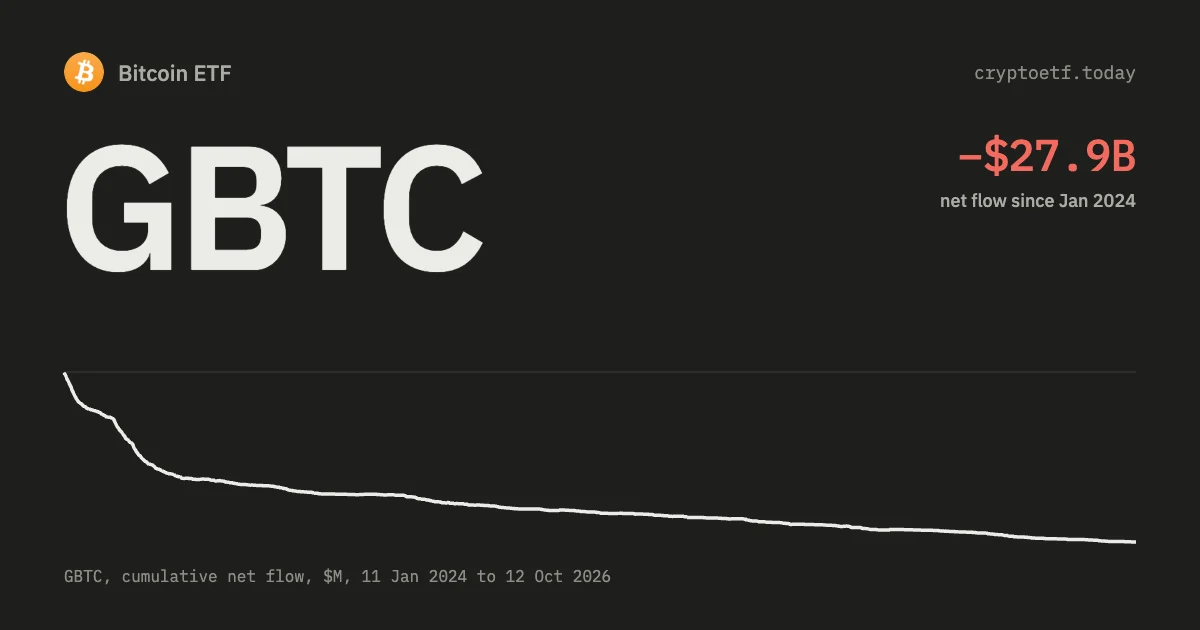
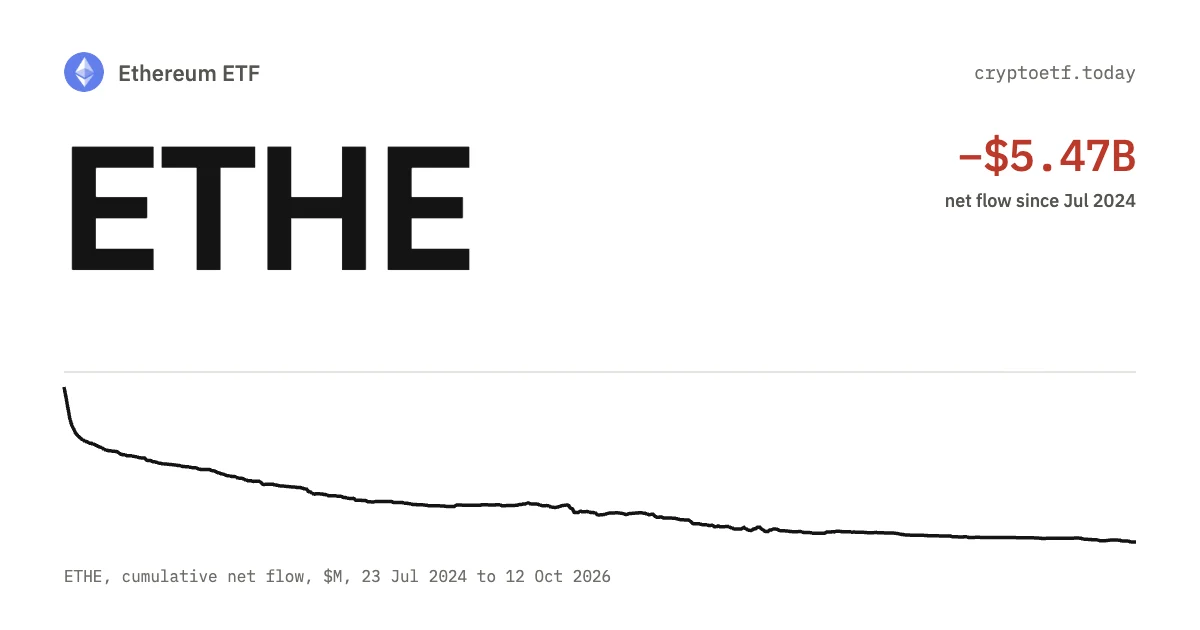
ZCSH charges 2.50% a year, accrued daily and paid in ZEC. Among the US spot crypto ETFs this site tracks, only Grayscale's own ETHE charges as much. It's about seven times the 0.35% Grayscale charges on its Dogecoin and Chainlink ETFs. Converted trusts tend to start this way: GBTC kept a 1.50% fee when it converted in January 2024, far above new competitors, and ETHE kept 2.50%. Both then lost assets to cheaper funds; see our GBTC analysis and the Grayscale ETHE review. ZCSH has no competitor yet, so its fee hasn't been tested.
One twist: Grayscale's fund page says that for up to 12 months after the registration became effective, the sponsor will direct all ZCSH management fees to Zcash ecosystem development and to marketing ZCSH. It's a voluntary pledge paid from Grayscale's own revenue, and the sponsor can end it at any time. It doesn't lower what a shareholder pays.
Over a year, 2.50% removes about one fortieth of the ZEC behind each share. Over five years it compounds to roughly 12%. For anyone who can hold ZEC directly, that's the cost of the wrapper. For an IRA or an adviser platform that can only hold listed securities, it's the only way in.
Zcash ETF flows: a fast month in, then a turn
ZCSH's first six weeks as an ETF had two distinct phases, and one large day that needs its own explanation.
Phase one: creations
The listing day showed no flow. From 27 August authorised participants created shares on almost every session: $4.6m and $8.3m in the first week, then $8.9m to $20.9m a day in early September. Later in the month, 17 and 18 September added $46.6m and $37.7m, and 22 September another $32.8m. Cumulative net flow peaked at $306.1m that day. ZEC rose throughout, from about $768 on listing day to about $1,630 on 22 September in our price series.
8 September: $112.1m, mostly from Grayscale's parent
The biggest day was not ordinary demand. According to an 8-K filed that day, DCG International Investments, a subsidiary of Grayscale's parent Digital Currency Group, acquired ZCSH shares worth about $100m through an authorised participant in exchange for 85,705 ZEC. The prospectus had flagged the talks in August, at about 200,000 ZEC. That in-kind contribution accounts for roughly $100m of the $112.1m recorded on 8 September. Without it, cumulative inflows would have peaked near $206m, not $306m. It's still a real creation, so it stays in the series, but it's a related-party transfer of coins DCG already owned, not new money from outside buyers.
Phase two: redemptions
After three flat sessions, the direction reversed: −$8.1m on 28 September, −$30.2m on 30 September, −$12.4m on 1 October, −$26.9m on 2 October, −$3.6m on 5 October and −$8.5m on 7 October. Cumulative flow fell to $216.4m as of 7 October 2026, and ZEC slipped to about $1,365.
| Milestone | Date | Value |
|---|---|---|
| Largest single-day inflow (incl. ~$100m from DCG) | 8 Sep 2026 | +$112.1m |
| Peak cumulative net inflow | 22 Sep 2026 | $306.1m |
| Largest single-day outflow | 30 Sep 2026 | −$30.2m |
| Outflows since the peak | 28 Sep – 7 Oct 2026 | −$89.7m |
| Cumulative net inflow | 7 Oct 2026 | $216.4m |
The sequence looks like momentum money arriving with a rally and partly leaving when it stalled. It's also consistent with something specific to converted trusts. Investors who bought ZCSH over the counter at a discount, 17% as recently as 30 June, could now sell near NAV for the first time, and when sellers outnumber buyers, participants redeem shares. Flow data alone can't separate those groups. It does show the order of events: the turn came after the price peak, not before.
Scale matters too. On 7 October the fund held 584,302 ZEC, about 3.5% of the 16.7 million in circulation at the end of June. That's why ZCSH's daily flows look large next to other altcoin funds: a $30m redemption is a bigger event for the ZEC market than the same amount is for Bitcoin. For how to read a run of outflows without overreacting, see what ETF outflows mean.
The 3-for-1 split, and why it isn't an inflow
Grayscale announced a 3-for-1 forward split on 18 September 2026. Holders of record at the close on 28 September received two additional shares for each share held, distributed after the close on 29 September, and the shares traded on a split-adjusted basis from the open on 30 September. According to the 8-K, shares outstanding went from 7,989,300 to 23,967,900 and NAV per share from $111.41 to $37.14. Total value didn't change.
For a flow tracker that works from share counts, a split is a trap. Flow is the change in shares times NAV. Applied naively across the split, that formula would read 15,978,600 "new" shares as a creation worth about $1.8bn at the pre-split NAV, or about $590m at the post-split NAV, more than the fund's entire inflow history.
Two things prevent that on cryptoetf.today. First, Grayscale restated its whole daily file on a post-split basis, so there's no jump in the data around the 28 September outflow of $8.1m. Second, the calculation recognises a split on its own in case a source isn't restated: when shares and NAV move in opposite directions by the same whole multiple, it treats the change as a split, not a creation. The result is on the Zcash ETF flows page, with no spike around 30 September.
How cryptoetf.today builds the ZCSH series
- Source. Grayscale's daily performance file, which lists shares outstanding and NAV for every trading day.
- Formula. The change in shares outstanding times that day's NAV, dated to the session of the creation, which settles into the share count the following day. Each day's figure is published with a one-business-day lag (T+1).
- Start. The ETF listing date, 25 August 2026. The trust's OTC-era assets aren't counted as inflow.
How to buy the Zcash ETF
- Confirm your broker carries NYSE Arca-listed crypto ETPs. A few platforms still block them, and Grayscale says ZCSH is available through many, not all, brokerage and investment accounts.
- Search the ticker ZCSH. The fund's official name is "The Zcash ETF", without Grayscale in it, so some brokers list it that way.
- Check price against NAV. Since listing the gap has been small: −0.06% on 7 October 2026, a long way from the OTC era's double-digit discounts.
- Use a limit order. The 30-day median spread was 0.21%.
Who ZCSH is for, and the risks
ZCSH is for investors who want ZEC exposure in an account that can't hold coins: retirement accounts, adviser platforms, or institutions that need a listed security. It isn't a privacy product. Owning a share of a trust gives you none of Zcash's privacy features, and the position is reported like any other brokerage holding. If you can hold ZEC directly and want the privacy, the ETF isn't a substitute. If you can hold it directly and don't care about privacy, you're paying 2.50% a year for convenience. Unlike the staked NEAR and Tron ETFs, there's no staking income to offset any of it.
Risks specific to this fund:
- Regulatory risk to privacy coins. Exchanges and regulators have restricted privacy coins before. Delistings would hurt ZEC's liquidity and price, and that flows straight through to the ETF.
- Fee. 2.50% a year is a heavy drag with no yield to offset it, and the GBTC and ETHE precedents show what happens when a cheaper rival arrives.
- Volatility. ZEC more than doubled between the listing and the 22 September peak, then fell about 16% by 7 October. ETF flows amplified both legs.
- Concentration. The fund holds about 3.5% of circulating ZEC, and one related party contributed a large block. Heavy redemptions mean meaningful selling of the underlying.
This article explains how ZCSH works. It isn't investment advice and doesn't recommend buying or selling ZCSH or ZEC.
FAQ
Is there a Zcash ETF?
Yes. The Zcash ETF from Grayscale, ticker ZCSH, has traded on NYSE Arca since 25 August 2026. It is the converted Grayscale Zcash Trust and the only US spot ZEC ETF.
What is the ZCSH expense ratio?
2.50% a year, accrued daily and paid in ZEC. Among US spot crypto ETFs tracked on cryptoetf.today, only Grayscale’s ETHE charges as much.
When did ZCSH split, and what changed?
A 3-for-1 forward split took effect before the open on 30 September 2026: holders received two additional shares for each one. Shares outstanding went from 7,989,300 to 23,967,900 and NAV per share from $111.41 to $37.14. Total value did not change.
How much money has flowed into the Zcash ETF?
Cumulative net inflows peaked at $306.1m on 22 September 2026, then redemptions brought them to $216.4m by 7 October 2026. About $100m of the total was an in-kind contribution of 85,705 ZEC from DCG, Grayscale’s parent group, on 8 September.
How do I buy the Grayscale Zcash ETF?
Through a brokerage account that allows NYSE Arca-listed crypto ETPs: search the ticker ZCSH, which some brokers list as The Zcash ETF, and use a limit order. The 30-day median spread was 0.21% on 7 October 2026.
Does the Zcash ETF offer privacy or staking?
Neither. Shareholders get no privacy features: ZCSH is a listed trust, reported like any brokerage holding, and its prospectus does not say the trust uses shielded addresses. Zcash is proof-of-work, so there is nothing to stake.
Why does the ZCSH flow history start in August 2026?
The trust was quoted on OTCQX from October 2021 but could not create and redeem shares like an ETF. Flow is counted from the ETF listing on 25 August 2026; assets carried over from the trust are a starting balance.
Sources and further reading
- The Zcash ETF, prospectus (Form 424B3, 25 August 2026): fee, structure, OTC premium and discount history, DCG talks, network data, sec.gov.
- The Zcash ETF, Form 8-K on the DCG in-kind contribution (8 September 2026), sec.gov.
- The Zcash ETF, Form 8-K on the 3-for-1 forward split (30 September 2026), sec.gov, and on the Anchorage Digital custody agreement (filed 5 October 2026), sec.gov.
- Grayscale ZCSH fund page: net assets, shares, ZEC held, NAV, spread (7 October 2026) and the fee pledge, etfs.grayscale.com. Pre-conversion assets: launch coverage on yellow.com.
- Daily flows: cryptoetf.today, from Grayscale's daily file. Pages: Zcash ETF flows tracker, ZCSH price and holdings, Grayscale crypto ETFs.
- Further reading: every new crypto ETF of 2026.
Live data on this topic
ETFs still waiting for approval: Injective, SEI, Cronos, PEPE, Worldcoin, Canton, Aave, TRUMP, Ondo, Uniswap, Aptos, PENGU
For information only. Not investment advice.
 BTC
 ETH
 SOL
 XRP
 HYPE
 LINK
 HBAR
 AVAX
 DOGE
 LTC
 SUI
 DOT
 BNB
 NEAR
 TRX