ETHE charges 2.50% for ether its own sibling holds at 0.15%. Shares outstanding fell from 310m to 96m in two years, and the mini now holds more ETH. Who still holds it, and why.
TL;DR. The Grayscale Ethereum Staking ETF (ETHE) is the oldest ether fund in the US and the most expensive by a wide margin: 2.50% a year against 0.15% for the Grayscale Ethereum Staking Mini ETF (ticker ETH), which holds the same asset at the same custodian under the same sponsor. ETHE spent five years as an over-the-counter trust that traded as much as 956% above and 60% below the value of its ether, converted to an ETF on 23 July 2024, and has shrunk ever since: shares outstanding went from 310.2 million on conversion day to 95.8 million at 30 June 2026. It began staking on 6 October 2025 and keeps 23% of the rewards, where the mini keeps 6%. The $1.22bn still inside belongs mostly to holders whose tax bill for leaving exceeds the fee for staying. For anyone else, it's the one US ether ETF with no case.
Contents · 13 sections
- Fund at a glance
- Three lives of one trust
- The premium and the discount
- Conversion day and the spin-off
- The redemption wave, in Grayscale's own numbers
- Why the fee is still 2.50%
- Staking: what ETHE does now
- ETHE against the two funds people leave it for
- The tax reason to stay, with the arithmetic
- Who should switch, and to what
- What to watch on the flows page
- FAQ
- Sources and further reading
 Ethereum ETFsNet flow Thu 15 Oct−$60.3M
Fund at a glance
| Item | Detail (source and date) |
|---|---|
| Name | Grayscale Ethereum Staking ETF (renamed from Grayscale Ethereum Trust ETF on 5 January 2026) |
| Ticker / exchange | ETHE, NYSE Arca |
| Sponsor | Grayscale Investments Sponsors, LLC |
| Formed | 13 December 2017, Delaware statutory trust, private placement to accredited investors |
| OTCQX quotation | 20 June 2019 |
| ETF listing | 23 July 2024 |
| Sponsor fee | 2.50% of net assets per year |
| Staking | Since 6 October 2025; about 82% of ether staked at 30 June 2026; 23% of gross rewards kept by sponsor, custodian and validators |
| Custodian | Coinbase Custody Trust Company; Anchorage Digital Bank as alternative |
| Net assets | $1.22bn, 774,999 ETH, 95,828,500 shares (30 June 2026 10-Q) |
| Structure | Grantor trust, not a 1940 Act fund; options approved 9 April 2025 |
Three lives of one trust
ETHE has been three products under one ticker, and most of what's strange about it today is inherited from the first two. It's the ether twin of the GBTC story, same architecture, more violent price history.
- December 2017 to June 2019: private placement. Accredited investors deposited ether and received shares, locked up before resale. No public market, no redemptions. The 2.50% fee dates from here, when there was nothing to compare it with.
- June 2019 to July 2024: OTCQX trust. Shares became quotable on OTCQX on 20 June 2019. Anyone with a brokerage account could buy ETHE, but the trust still couldn't redeem shares for ether, so price and underlying value were free to drift apart. They drifted a long way.
- 23 July 2024 onward: spot ETF. The trust uplisted to NYSE Arca the day the first US spot ether ETFs began trading, alongside eight other funds. Authorized participants could now create and redeem, which pinned the price to NAV and let two years of trapped holders out.
Grayscale's 10-K for 2025 states that since the uplisting the maximum premium to NAV has been 1.64% and the maximum discount 0.64%. Hold those two numbers against the next section.
The premium and the discount
The FY2023 10-K puts it in one sentence: between the June 2019 OTCQX quotation and 31 December 2023, the maximum premium of the closing price over NAV per share was 956%, the maximum discount was 60%, the average premium was 191% and the average discount was 26%.
Both extremes came from the same defect. With no redemptions, the only thing that could pull the share price back toward ether was new issuance to accredited investors, and issuance was slow and gated by lockups. When brokerage-account demand for ether outran supply, the shares traded at multiples of their ether value; in June 2020 the premium was reported in the 600% to 1,000% range. When the market turned in 2022, the same structure worked in reverse: a discount reported at about 59% at the end of December 2022, after FTX, and a 40% to 50% range through most of 2023. It was 12% on 29 December 2023 and gone by conversion. Why a closed-end product can sit that far from its assets is in how premium and discount to NAV work.
Both halves of that history feed the tax question below. Someone who bought at a 50% discount in late 2022 roughly doubled their money on the discount closing alone, before ether moved. That gain is embedded, and it's why the exit door has a price.
Conversion day and the spin-off
Grayscale prepared the conversion with a spin-off. On 8 July 2024 it announced a pro rata distribution to ETHE holders of record on 18 July: 10% of the trust's ether would move into a new vehicle, the Grayscale Ethereum Mini Trust, and every ETHE share would receive one Mini share. On 23 July the distribution completed with 310,158,500 Mini shares and 292,262.99 ETH transferred, structured so as not to be a taxable event for the trust or its holders.
The Mini launched at 0.15%, waived to zero for six months or until it reached $2bn. Grayscale's launch release put ETHE at $9.19bn on 23 July 2024 and the Mini at $1.02bn. A 1-for-10 reverse split on 19 November 2024 is why the Mini's share count today looks nothing like the 310 million it started with.
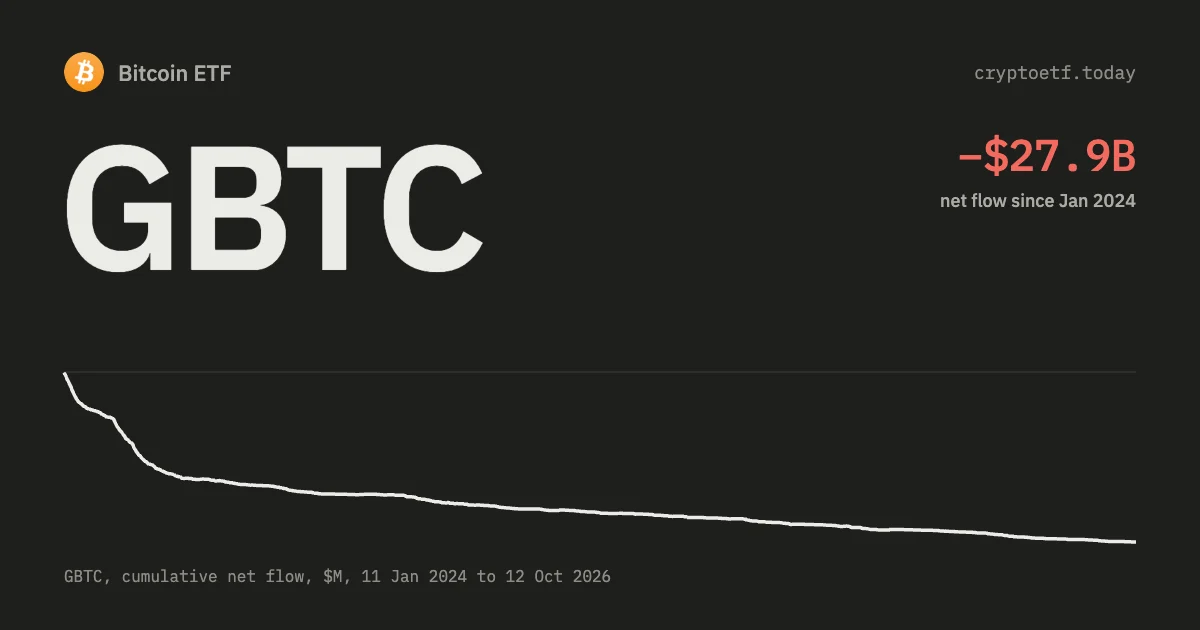
The logic matched the GBTC and Bitcoin Mini pair six months earlier: keep the legacy fund at the legacy fee for holders who can't leave without a tax bill, and give everyone else a cheap Grayscale product so the money stays in the family. The difference is scale. ETHE charges 2.50% where GBTC charges 1.50%, so the gap to its own sibling is 2.35 percentage points a year rather than 1.35.
The redemption wave, in Grayscale's own numbers
The outflow started on day one. Press reports put ETHE's redemptions at about $1.7bn in its first five sessions and $2.84bn by late September 2024. The cleaner record is the trust's own filings, which don't depend on anyone's flow estimate.
| Date | ETHE shares outstanding | ETHE ether held | Note (source) |
|---|---|---|---|
| 31 Dec 2023 | n/a | about 2.5% of ETH in circulation | FY2023 10-K; 0.0096 ETH per share |
| 23 Jul 2024 | 310,158,500 | about 2.63m (derived) | Mini distribution 1:1; 292,263 ETH was 10% of holdings |
| 31 Dec 2025 | n/a | 910,329 ETH; about 0.8% of supply | FY2025 10-K and Q2 2026 10-Q; $2.70bn net assets |
| 20 Feb 2026 | 104,058,500 | n/a | FY2025 10-K cover |
| 30 Jun 2026 | 95,828,500 | 774,999 ETH | Q2 2026 10-Q; $1.22bn net assets |
Two years after conversion, 69% of the shares that existed on 23 July 2024 have been redeemed, and the trust's share of all ether in existence fell from about 2.5% to 0.8%. Net assets dropped from $2.70bn to $1.22bn in the first half of 2026 alone, though most of that was price: ether funds lost roughly 46% of NAV per share in the half, while ETHE's ether count fell 15%, from 910,329 to 774,999.
The mini went the other way in the same six months, from 733,994 to 854,643 ETH, and at 30 June 2026 it held more ether than ETHE for the first time, $1.35bn against $1.22bn. Some of that is direct migration, holders selling ETHE and buying the mini in the same account, which shows on the Ethereum ETF flows page as a red bar for ETHE and a green one for ETH on the same day. It's the ether version of the rotation in what ETF outflows really mean: a big negative number from one fund that says nothing about demand for the asset.
Why the fee is still 2.50%
Nine US spot ether ETFs charge between 0.15% and 0.25%. ETHE charges between ten and seventeen times that. Grayscale has never cut it, and after two years of redemptions it's fair to conclude it won't, because the fee is doing exactly what it's designed to do.
The holders who left were the ones who could. What remains has two properties: a large embedded gain, from ether deposited in the private placement when it cost a few hundred dollars or from shares bought at a 40% to 60% discount in 2022 and 2023, and a taxable account, because inside an IRA there's no reason to stay. On that base, 2.50% of $1.22bn is about $30m a year. Cutting the fee to win new money would give most of that up for little, since the mini already exists for new money. From Grayscale's side the arithmetic is simple. From the holder's side it's a slow tax on staying put.
Staking: what ETHE does now
The July 2024 approval came with staking stripped out of every filing, the story in Ethereum ETF staking explained. That changed in autumn 2025. Grayscale began staking in both ETHE and the mini on 6 October 2025, ahead of every other US ether fund, and on 5 January 2026 the trust took the word into its name.
The economics, from the Q2 2026 10-Q: about 82% of ETHE's ether was staked at 30 June 2026. The sponsor's staking fee, the custodian's fee and the staking provider's share together take 23% of gross rewards; 77% belongs to the trust. Rewards are sold for cash and distributed, monthly by intention and at least quarterly by policy. The first payment, on 6 January 2026, was $0.083178 per share for rewards from 6 October to 31 December 2025. Five more followed by June: $0.025709, $0.021011, $0.022794, $0.024577 and $0.019508, for $0.196777 per share in the first half of 2026. Each one is a taxable event in a taxable account, which is precisely where most ETHE holders are.
The comparison that stings is with the mini: same sponsor, same Coinbase custody, same validators, a 6% cut instead of 23%. At Ethereum's reward rate (iShares quoted 1.45% for its own staked fund in September 2026) the gap between keeping 77% and 94% is worth roughly 0.2 percentage points a year, on top of the 2.35-point fee gap. How every US crypto ETF that stakes splits its rewards is in crypto ETF staking compared.
ETHE against the two funds people leave it for
| ETHE | ETH (Grayscale mini) | ETHA (BlackRock) | |
|---|---|---|---|
| Sponsor fee | 2.50% | 0.15% | 0.25% |
| Exchange | NYSE Arca | NYSE Arca | Nasdaq |
| Stakes? | Yes, 77% of rewards to holders | Yes, 94% of rewards to holders | No (BlackRock's ETHB stakes instead) |
| Custodian | Coinbase Custody | Coinbase Custody | Coinbase Custody |
| Net assets | $1.22bn (30 Jun 2026) | $1.35bn (30 Jun 2026) | $8.57bn (16 Sep 2026) |
| Annual cost on $10,000 | $250 | $15 | $25 |
| First traded | OTCQX 20 Jun 2019; ETF 23 Jul 2024 | 23 Jul 2024 | 23 Jul 2024 |
Sources: Grayscale Q2 2026 10-Qs for both trusts; iShares product page for ETHA. On every line that involves money, ETHE loses to its own sibling. The mini is the destination for anyone who wants to keep Grayscale and keep staking; ETHA for anyone who wants the deepest liquidity and options chain and doesn't care about staking, as set out in our ranking of all ten US ether ETFs.
The tax reason to stay, with the arithmetic
Selling ETHE to buy the mini is a sale. In a US taxable account that realises the gain at long-term rates of 0%, 15% or 20% depending on income, plus 3.8% net investment income tax for higher earners. The question is whether that one-off bill is bigger than the fee gap you'll pay by staying.
An illustration, not advice. Take a $100,000 ETHE position with a $70,000 embedded gain, held by someone at 20% plus NIIT. Leaving costs about $16,700 in tax today. Staying costs the fee gap, about $2,350 a year on a flat price, plus roughly $200 a year of staking rewards lost to the 23% cut. The switch pays for itself in six to seven years, sooner if ether rises, because the fee is charged on a growing balance while the tax on the old gain was fixed the day you paid it. With a $30,000 gain the exit costs about $7,100 and breaks even in three years. In the 15% bracket with no NIIT, faster still.
Then there's the case nobody planned for in 2024. Ether funds lost close to half their NAV per share in the first six months of 2026, so anyone who bought ETHE at or after conversion may be sitting on a loss, not a gain. For that holder the tax argument for staying doesn't exist, and switching realises a loss that can offset other gains. Whether selling ETHE and buying the mini triggers the wash-sale rule is unsettled, since the IRS hasn't ruled on whether two ETFs holding the same crypto asset are "substantially identical"; the cautious approach is in tax-loss harvesting with Bitcoin ETFs and transfers directly to ether.
Who should switch, and to what
- Tax-advantaged account, any size: switch; there's no tax consequence and no reason to pay 2.50% for another day. To the mini for staking at the smallest haircut, to ETHA for liquidity and options, to ETHB for staking under BlackRock's name at an 18% reward cut and 0.25% once its waiver ends in March 2027.
- Taxable account, at a loss, or inherited shares with a stepped-up basis: switch, and in the first case harvest the loss, with the wash-sale caveat above.
- Taxable account, modest gain (under about a third of the position): switch to the mini. Breakeven is short and the mini keeps the Grayscale structure and the staking.
- Taxable account, large gain from the private-placement or discount years: run the numbers with a horizon. Over a decade the fee gap compounds past the tax bill for most gain sizes. If you expect to sell within a few years anyway, or to leave the shares to heirs with a stepped-up basis, staying can be rational.
- New money, any account: never. No new dollar belongs in ETHE when the mini holds the same ether at the same custodian for a sixteenth of the fee.
One practical note. Neither Grayscale fund trades anything like ETHA's volume, and spreads on both can widen on thin days. Use limit orders, avoid the first minutes after the open when the previous night's ether move is still being priced, and split a large position across a few sessions.
What to watch on the flows page
ETHE's flow line is the easiest in the category to misread. Across every reporting period since July 2024 the share count has fallen, so the line is net negative; that's the redemption wave still draining, not a verdict on ether. The number that carries information is the pair: ETHE outflow against mini inflow on the same day is migration inside Grayscale; ETHE outflow with no offset anywhere is a holder leaving the asset. Both funds sit side by side on the Ethereum ETF flows page, computed each business day from Grayscale's own holdings files, and the ETH reading of the CEFI index nets the whole category into one 0 to 100 score so a single fund's exit can't dominate the picture.
The other thing to watch is the share count in each quarterly 10-Q. About 8 million shares were redeemed between 20 February and 30 June 2026. At that pace ETHE has years of runway, and a $1.2bn fund earning $30m a year isn't going anywhere. But the direction hasn't changed once in two years, and nothing in the fee structure suggests it will.
FAQ
What is the expense ratio of Grayscale ETHE?
2.50% of net assets per year, unchanged since the trust was formed in December 2017. Every other US spot ether ETF charges between 0.15% and 0.25%. Grayscale's own Ethereum Staking Mini ETF (ticker ETH) holds the same ether at the same custodian for 0.15%.
Does ETHE stake its ether?
Yes. Grayscale began staking in ETHE on 6 October 2025, the first US spot ether ETF to do so, and renamed it Grayscale Ethereum Staking ETF on 5 January 2026. About 82% of its ether was staked at 30 June 2026. Sponsor, custodian and validators keep 23% of gross rewards; 77% is paid to shareholders in cash. First-half 2026 distributions totalled $0.196777 per share.
Why did ETHE trade at a 60% discount?
Before its July 2024 ETF conversion, ETHE was a closed-end trust with no redemption mechanism, so its share price could drift far from the value of its ether. Per Grayscale's FY2023 10-K, between June 2019 and December 2023 the shares traded at a maximum premium of 956% and a maximum discount of 60% to NAV. The discount was widest at the end of 2022 and closed only when ETF conversion allowed redemptions.
What is the Grayscale Ethereum Mini Trust and how is it related to ETHE?
The mini (ticker ETH) was created on 23 July 2024 by spinning off 10% of ETHE's ether, 292,263 ETH, and giving every ETHE shareholder one mini share per ETHE share, in a distribution structured to be non-taxable. It charges 0.15%, stakes, and keeps only 6% of rewards. At 30 June 2026 it held 854,643 ETH, more than ETHE's 774,999.
How much money has left ETHE since it became an ETF?
By Grayscale's own filings, shares outstanding fell from 310,158,500 on 23 July 2024 to 95,828,500 at 30 June 2026, a 69% reduction, and the trust's holdings fell from about 2.5% of all ether in circulation at end-2023 to 0.8% at end-2025. Net assets were $1.22bn at 30 June 2026 against $9.19bn on conversion day, though much of that drop is ether's price.
Should I sell ETHE and buy the mini or ETHA?
In an IRA or 401(k), yes, there is no tax cost to switching. In a taxable account it depends on your embedded gain: the 2.35-point annual fee gap typically repays the capital gains tax on a moderate gain within three to seven years, while a very large gain from the private-placement or discount years can justify staying. If you bought after July 2024 and are at a loss, switching also harvests the loss. Not tax advice; check your own numbers.
Who is the custodian of ETHE?
Coinbase Custody Trust Company, LLC, with Anchorage Digital Bank N.A. named as an alternative in the Q2 2026 10-Q. The mini uses the same primary custodian, as do eight of the ten US spot ether ETFs.
Sources and further reading
- Grayscale Ethereum Staking ETF (ETHE), Form 10-Q for the quarter ended 30 June 2026: net assets, ether held, staking split, custodian, distributions: sec.gov.
- Grayscale Ethereum Staking ETF, Form 10-K for 2025: name change, staking commencement, share count, share of ETH supply: sec.gov; Form 10-K for 2023: OTCQX premium and discount history: sec.gov.
- Grayscale Ethereum Staking Mini ETF (ETH), Form 10-Q for the quarter ended 30 June 2026: sec.gov.
- Grayscale launch release, 23 July 2024: Mini Trust fee waiver, 10% spin-off, AUM on listing day: globenewswire.com; reverse split completion, 19 November 2024: globenewswire.com.
- CNBC, 24 July 2024: Grayscale's $9bn head start in ether at conversion: cnbc.com.
For information only. Not investment advice.
 BTC
BTC SOL
SOL XRP
XRP HYPE
HYPE LINK
LINK HBAR
HBAR AVAX
AVAX DOGE
DOGE LTC
LTC SUI
SUI DOT
DOT BNB
BNB NEAR
NEAR TRX
TRX ZEC
ZEC