Bitwise NRR is the only US spot NEAR ETF: NYSE Arca since 29 Sep 2026, 0.75% fee, 3.29% net staking rate. Net inflows hit $62.2m by 7 Oct 2026, 93% in the first three days.
TL;DR. The NEAR ETF is the Bitwise NEAR ETF, ticker NRR, and it's the only US spot NEAR ETF. It started trading on NYSE Arca on 29 September 2026, charges a 0.75% sponsor fee, keeps its NEAR at Coinbase Custody and stakes nearly all of it. Bitwise put the net staking reward rate at 3.29% on 5 October 2026, after a 33% cut for staking expenses. Net inflows reached $62.2m by 7 October 2026, and 93% of that arrived in the first three sessions.
Contents · 10 sections
- What is the NEAR ETF?
- NRR ETF at a glance: ticker, exchange, fee, staking
- What NEAR Protocol is, and the three properties that matter for the fund
- How NRR stakes NEAR, and what holders keep
- NEAR ETF flows: the first seven sessions
- How cryptoetf.today calculates NRR flows
- How to buy the NEAR ETF
- Who NRR is for, and the risks
- FAQ
- Sources and further reading
 NEAR ETFsNet flow Wed 14 Oct0
What is the NEAR ETF?
The Bitwise NEAR ETF (NRR) is an exchange-traded trust that holds NEAR, the token of NEAR Protocol, and stakes it. Each share is a claim on the coins in the trust, net of accrued expenses. On 6 October 2026 one share stood for 5.22 NEAR, according to Bitwise's fund site. You buy it in a brokerage account like any listed stock, so there's no wallet or seed phrase to look after.
New shares are created, and old ones redeemed, only by authorised participants and only in blocks of 10,000 shares, which the prospectus calls a Basket. When NRR trades above the value of its NEAR, a participant can deliver cash or coins, take a fresh basket and sell it. When it trades below, the trade runs the other way. Those creations and redemptions are the flow this site measures. Investors swapping existing shares on the exchange don't change it. The mechanics are the same as for Bitcoin funds and are explained in how authorised participants work.
Like every spot crypto ETF in the US, NRR isn't registered under the Investment Company Act of 1940. It's a trust registered under the Securities Act of 1933, and its prospectus says shareholders don't get the protections that come with an ordinary mutual fund.
NRR ETF at a glance: ticker, exchange, fee, staking
| Item | Bitwise NEAR ETF |
|---|---|
| Ticker / exchange | NRR / NYSE Arca |
| Inception / first trading day | 28 September 2026 / 29 September 2026 |
| Sponsor fee | 0.75% a year, accrued daily, paid in NEAR |
| Custodian | Coinbase Custody Trust Company |
| Administrator | Bank of New York Mellon |
| NAV benchmark | CME CF NEAR Protocol–Dollar Reference Rate, New York Variant (4:00 p.m. ET) |
| Basket | 10,000 shares, cash or in kind |
| Staking | Target 100%; 95% staked on 5 Oct 2026; in-house |
| Staking expenses | 33% of rewards; the trust keeps about 67% |
| Gross / net staking reward rate | 4.91% / 3.29% (5 Oct 2026) |
| Shares outstanding | 2,350,000 (6 Oct 2026) |
| Net assets / NEAR held | $65.4m / 12,270,909 NEAR (6 Oct 2026) |
| NAV / market price | $26.47 / $26.82 (5 Oct 2026) |
| 30-day median bid-ask spread | 0.50% |
Fee, custodian, basket and staking terms are from the prospectus. The dated rows are from Bitwise's fund site and change daily; current values are on the NRR price and holdings page.
What NEAR Protocol is, and the three properties that matter for the fund
NEAR is a proof-of-stake layer-1 blockchain. Illia Polosukhin and Alexander Skidanov started the project in 2017, and the network launched in 2020. It splits processing across shards, a design it calls Nightshade; the August 2024 Nightshade 2.0 upgrade was the biggest protocol change since mainnet, according to the prospectus. Accounts have human-readable names, and Bitwise markets the fund around NEAR's role in AI agents that hold keys and transact on their own.
For an ETF holder three properties matter more than the architecture:
- No supply cap. New NEAR is issued to validators and delegators every year, partly offset by fees burned in transactions. A holder who doesn't stake is diluted by the new issuance.
- Native staking. That's why the trust stakes: the rewards are what offsets dilution.
- A short unbonding period. Unstaked NEAR is locked for two to four epochs of about 12 hours each. The prospectus expects roughly 48 hours under normal conditions, so a fully staked trust can't turn coins into cash on the same day a redemption arrives.
How NRR stakes NEAR, and what holders keep
Almost everything is staked
Staking is what sets this product apart from a plain NEAR tracker. The prospectus says the trust intends to stake 100% of its NEAR and, at the time of filing, didn't plan to use a liquidity reserve. On 5 October 2026 the fund site showed 95% staked against the 100% target; Bitwise notes that newly invested coins take time to stake. Bitwise runs the staking in-house, and the prospectus says the sponsor may prefer its affiliate Attestant as staking agent. The coins stay at Coinbase Custody throughout.
The 67/33 split
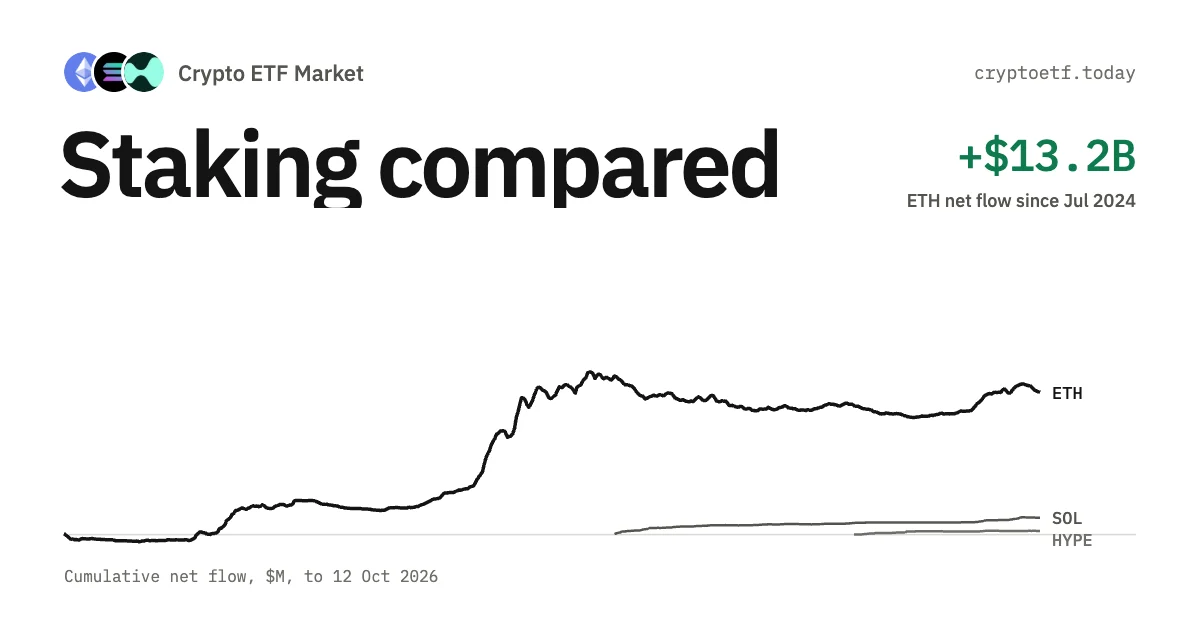
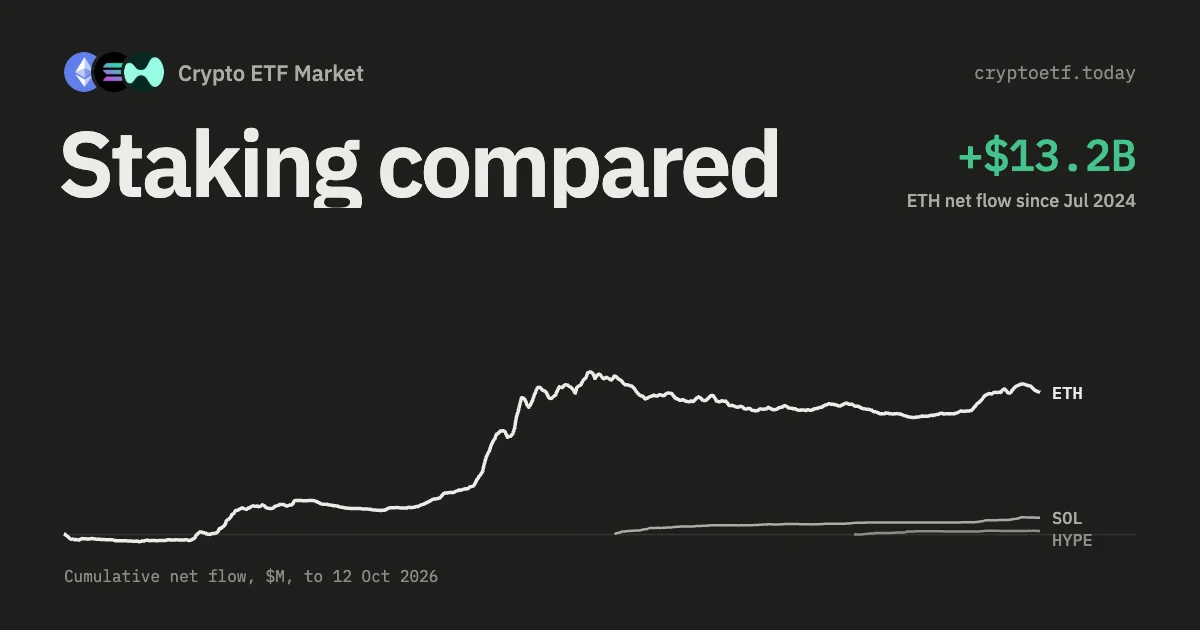
Rewards are shared. Staking expenses equal 33% of the NEAR the trust earns, split among the staking agents, the custodian and the sponsor, so the trust keeps about 67%. The retained NEAR stays in the trust and raises the NAV per share. No new shares are issued for it and no cash is paid out. That cut is high by the standards of US staking funds: in our comparison of 22 staking crypto ETFs, the share taken from rewards ran from 6% to about 30%. NRR's 33% sits above that whole range.
What the published rates imply
Bitwise's fund site shows a gross staking reward rate of 4.91%, a 90-day average of the network rate, and a net rate of 3.29% after staking expenses, both as of 5 October 2026. Bitwise's definition of the net rate deducts staking expenses and doesn't mention the 0.75% sponsor fee. Take the fee off as well and a holder ends up with roughly 2.5% a year in extra NEAR per share at that rate. That's arithmetic on a published figure, not a forecast. The network rate moves with participation and protocol parameters, and Bitwise says rewards aren't guaranteed.
The liquidity cost
With nearly everything staked, a large redemption means unstaking first. The prospectus lets the trust use short-term trade credit from Coinbase Credit to bridge that gap, and it describes the costs and risks under staking and liquidity. For how other US funds handle the same problem, see the crypto ETF staking comparison.
NEAR ETF flows: the first seven sessions
No aggregator publishes a long daily series for NRR yet, so cryptoetf.today builds one. Here is every session through 7 October 2026:
| Date | Net flow | Cumulative | NEAR price |
|---|---|---|---|
| 29 Sep 2026 | +$35.99m | $35.99m | $4.89 |
| 30 Sep 2026 | +$14.04m | $50.03m | $5.30 |
| 1 Oct 2026 | +$8.08m | $58.11m | $5.34 |
| 2 Oct 2026 | +$0.24m | $58.35m | $4.81 |
| 5 Oct 2026 | +$0.54m | $58.89m | $4.91 |
| 6 Oct 2026 | $0.00m | $58.89m | $5.29 |
| 7 Oct 2026 | +$3.34m | $62.23m | $5.07 |
Prices are the daily NEAR prices in our own series. Three things stand out.
It's front-loaded. About 93% of cumulative flow came in the first three days. That's the usual shape for a new single-asset crypto fund. The opening allocation, from market makers and buyers who were waiting for the listing, arrives at once, and ordinary demand afterwards is much smaller.
The money came in while the price rose. NEAR went from about $4.89 on launch day to $5.34 on 1 October while creations continued, then fell to $4.81 on 2 October as flow almost stopped. Seven sessions are far too few to call that a pattern, but it fits how small crypto funds usually behave.
Demand didn't stop. On 7 October authorised participants created twelve baskets, 120,000 shares worth $3.34m, the largest day since launch week. Two sessions earlier the shares had closed at $26.82 against a NAV of $26.47, a premium of about 1.3%. A premium is exactly what makes creating new shares worth a participant's while, though one day doesn't prove the link.
Because NRR started from zero, its assets are mostly money that flowed in: $62.2m of creations against $65.4m of net assets on the fund site. The difference is the change in NAV per share since each basket was created, from price moves and staking rewards. The live series is on the NEAR ETF flows page, which updates every business day. The latest day appears with a one-business-day lag (T+1), because Bitwise publishes the share count after the session closes.
How cryptoetf.today calculates NRR flows
- Day one. The launch-day creation of about $36.0m comes from SoSoValue, which records the opening creation as the fund's first inflow. There was no earlier Bitwise snapshot to compare against. Before listing, a Bitwise affiliate bought the 20,000 seed shares at $25 each ($500,000), per the prospectus.
- Every day after. From the second pair of Bitwise snapshots onward, the flow is our own calculation: the daily change in shares outstanding times that day's NAV, dated to the session in which the baskets were created.
- Staking is excluded by construction. Rewards add NEAR to the trust but don't create shares, so they never enter the flow. Net assets can rise on a zero-flow day, and that's not an error.
Shares only move in 10,000-share baskets, so every non-zero day is a whole number of baskets times NAV. At about $27 a share one basket is roughly $270,000, which is why the quiet days in the table land at a quarter or half a million dollars.
How to buy the NEAR ETF
- Use a brokerage account that trades NYSE Arca-listed ETPs. Some platforms restrict crypto products, so check yours first. IRA eligibility depends on the account provider.
- Search the ticker NRR and make sure the name reads Bitwise NEAR ETF.
- Check price against NAV. Bitwise publishes both daily. On 5 October 2026 the shares closed about 1.3% above NAV, so on some days you pay more than the coins are worth.
- Use a limit order. The 30-day median spread was 0.50%, wide by ETF standards, and early volume is thin.
Who NRR is for, and the risks
The wrapper earns its 0.75% if you need NEAR in an account that can only hold listed securities: an IRA, a 401(k) brokerage window or an adviser-managed portfolio. It also takes care of staking for people who don't want to choose a validator or manage keys. If none of that applies, holding and staking NEAR yourself avoids both the fee and the 33% cut of rewards, at the cost of doing the work and carrying the custody risk. The general trade-off is set out in Bitcoin ETF versus spot Bitcoin; NRR adds the staking layer on top.
Risks specific to this fund:
- The asset. NEAR is a volatile token with no supply cap. Staking offsets dilution for the trust but doesn't remove price risk.
- Staking and liquidity. With almost everything staked, large redemptions depend on unstaking, which takes about two days, or on borrowed liquidity. Slashing or validator failure would reduce the coins behind each share.
- Small fund. At $65m, NRR is tiny next to the Bitcoin and Ethereum complexes. Sponsors close funds that don't grow: Bitwise announced on 10 September 2026 that it would liquidate its Dogecoin ETF, as covered in Dogecoin ETF explained.
- Premiums and spreads. A 0.50% median spread and premiums above 1% are costs a buyer pays on top of the fee.
- Single issuer. There's no cheaper competitor to switch to if the fee or the 33% staking cut doesn't suit you. A second NEAR fund would appear as another row on the flows page.
This article explains how the product works. It isn't investment advice and doesn't recommend buying or selling NRR or NEAR.
FAQ
Is there a NEAR ETF in the US?
Yes. The Bitwise NEAR ETF, ticker NRR, began trading on NYSE Arca on 29 September 2026. It is the only US spot NEAR ETF and holds its NEAR at Coinbase Custody.
What is the NRR expense ratio?
The sponsor fee is 0.75% a year, accrued daily and paid in NEAR. Separately, staking expenses take 33% of the NEAR the trust earns from staking, so the trust keeps about 67% of rewards.
Does the NEAR ETF pay staking rewards?
Not as a cash payout. The trust stakes its NEAR and adds the rewards it keeps to the trust, which raises NAV per share. Bitwise showed a net staking reward rate of 3.29% on 5 October 2026, before the 0.75% sponsor fee.
How much money has gone into NRR?
About $62.2m of net inflows from 29 September to 7 October 2026. About 93% arrived in the first three sessions; the largest day since then was 7 October, at $3.34m.
How do I buy the Bitwise NEAR ETF?
Through a brokerage account that allows NYSE Arca-listed crypto ETPs: search the ticker NRR and place a limit order. Check the premium to NAV first; on 5 October 2026 the shares closed about 1.3% above NAV.
Why does NRR show zero flow on some days?
Shares are only created or redeemed in baskets of 10,000. On a day with no basket the share count doesn’t change and the flow is zero. Staking rewards and price moves don’t count as flow.
How does cryptoetf.today calculate NEAR ETF flows?
From Bitwise’s published shares outstanding and NAV: the daily change in shares times NAV, dated to the session of the creation and published with a one-day lag. The launch day comes from SoSoValue.
Sources and further reading
- Bitwise NEAR ETF, prospectus (Form 424B3, 2026): fee, basket, staking expenses, unbonding, liquidity reserve, seed baskets, sec.gov.
- Bitwise NEAR ETF fund site: staking reward rates and share staked (5 October 2026), NAV and market price (5 October 2026), shares outstanding, net assets and holdings (6 October 2026), nrretf.com.
- Daily flows: cryptoetf.today, calculated from Bitwise data; launch day from SoSoValue. Pages: NEAR ETF flows tracker, NRR price and holdings, Bitwise crypto ETFs.
- Further reading: every new crypto ETF of 2026, how ETF custody works.
For information only. Not investment advice.
 BTC
BTC ETH
ETH SOL
SOL XRP
XRP HYPE
HYPE LINK
LINK HBAR
HBAR AVAX
AVAX DOGE
DOGE LTC
LTC SUI
SUI DOT
DOT BNB
BNB TRX
TRX ZEC
ZEC