GBTC is the legacy Bitcoin ETF — 1.50% fee, $8.1bn left after $27.8bn of outflows, the biggest closed-end-to-ETF conversion ever. Why it still exists and who still holds it.
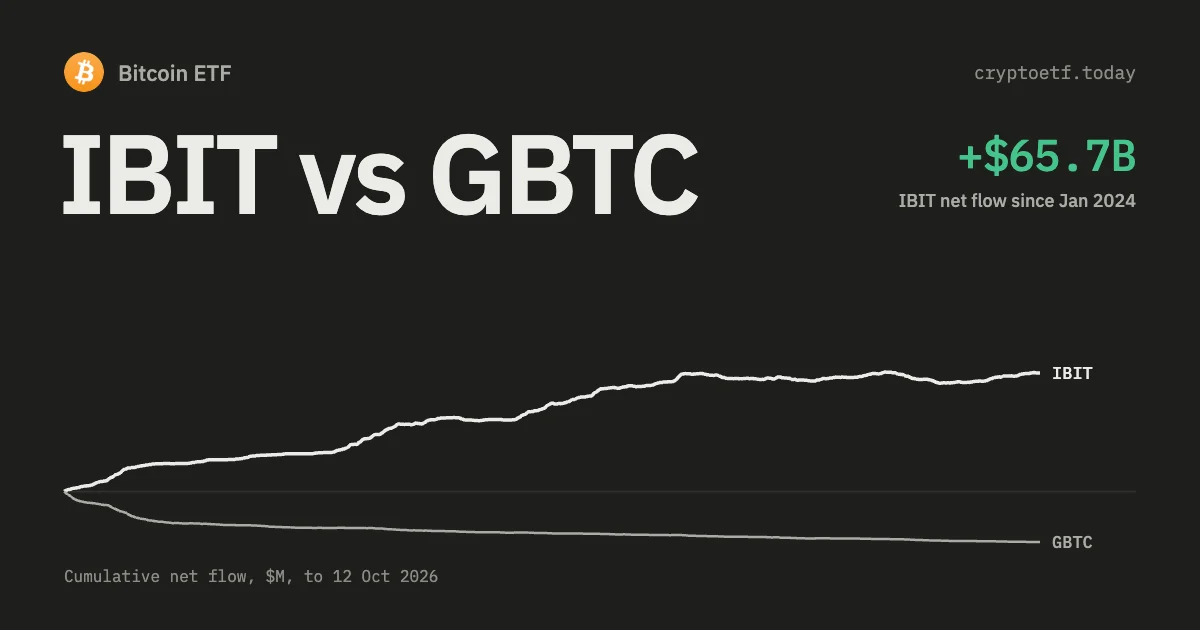
TL;DR. Grayscale Bitcoin Trust (GBTC) was the only US bitcoin investment product available to public-market investors for nearly a decade (2013–2024). After converting to a spot ETF on 11 January 2024, GBTC kept its 1.50% expense ratio — six times more expensive than IBIT or FBTC, and more than ten times the cheapest fund in the category. It has shrunk accordingly: $8.14 billion of net assets and 138,505.76 BTC at 30 June 2026 (Q2 2026 10-Q), against $27.8 billion of cumulative net outflows in our flow series. The reason holders stay: embedded capital gains, where exiting to a cheaper fund triggers a taxable event. For new money, Grayscale's separate Bitcoin Mini Trust (ticker BTC) launched at 0.15% in July 2024. The 2022 GBTC discount story is the canonical lesson in why redemption mechanisms matter.
Contents · 9 sections
 Bitcoin ETFsNet flow Fri 16 Oct−$82.4M
Two products under one Grayscale brand
| Product | Ticker | Fee | Use case |
|---|---|---|---|
| Grayscale Bitcoin Trust | GBTC | 1.50% | Legacy holders with embedded gains |
| Grayscale Bitcoin Mini Trust | BTC | 0.15% | New investors who want Grayscale |
The two products are separate ETFs with different ticker symbols, but Grayscale runs them together as a "convert and stay" path: long-term holders pay the high fee for tax deferral, new entrants get the low fee in the Mini.
GBTC's long history
Grayscale launched the original Bitcoin Trust in 2013 as a closed-end fund — meaning shares were issued via private placements to accredited investors, then traded on OTC markets after a 6-month lockup. For nearly a decade GBTC was the dominant on-ramp for institutional capital that wanted bitcoin exposure but couldn't or wouldn't custody coins directly.
Key dates:
- Sep 2013: Bitcoin Investment Trust launched (later renamed GBTC).
- 4 May 2015: Shares start trading on OTC markets; the OTCQX ticker is GBTC until 10 January 2024 (Q2 2026 10-Q).
- Apr 2021: Grayscale halts new share issuance ahead of planned ETF conversion.
- Oct 2021: Grayscale files SEC application to convert GBTC to spot ETF — rejected.
- Aug 2023: US Court of Appeals rules the SEC denial arbitrary; remand required.
- Jan 11, 2024: GBTC converts to spot ETF alongside 10 other approvals.
- Jul 2024: Grayscale Bitcoin Mini Trust (BTC) launches at 0.15% fee.
Full regulatory history in SEC Bitcoin ETF approval history.
The 2022 discount story
Before conversion, GBTC was a closed-end fund. Shares could be created (in private placements) but not redeemed for the underlying bitcoin. When demand cooled in 2022 after the LUNA collapse and FTX failure, GBTC shares traded at deep discounts to NAV because no arbitrage mechanism existed to close the gap.
Peak discount: −48.9% on 13 December 2022. A share representing $20 of bitcoin traded for ~$10 on the OTC market. Discount stayed below −30% for most of 2022 and the first half of 2023.
The discount only closed when conversion to ETF was approved — by December 2023 it had narrowed to −5%, and within weeks of the January 2024 ETF approval it was at zero.
Lesson: closed-end products can sustain large dislocations because the redemption arbitrage is absent. Spot ETF approvals reintroduce the AP mechanism that keeps price at NAV — see how Authorized Participants work.
The post-conversion outflow wave
After conversion GBTC bled rapidly. Cumulative net outflows in our flow series from the 11 January 2024 conversion to 31 July 2024: $18.9 billion. Three reasons:
- Fee gap. Holders who had been locked in could now exit and rotate to 0.20–0.25% alternatives. The 1.25%+ fee differential is meaningful on multi-year holds.
- Realised discount-closing. Holders who bought at deep discounts in 2022 had embedded gains as the discount closed — taking profits made sense.
- Bankruptcy estate liquidations. FTX, Genesis, BlockFi all held GBTC as collateral or treasury assets and had to liquidate as part of their restructuring proceedings.
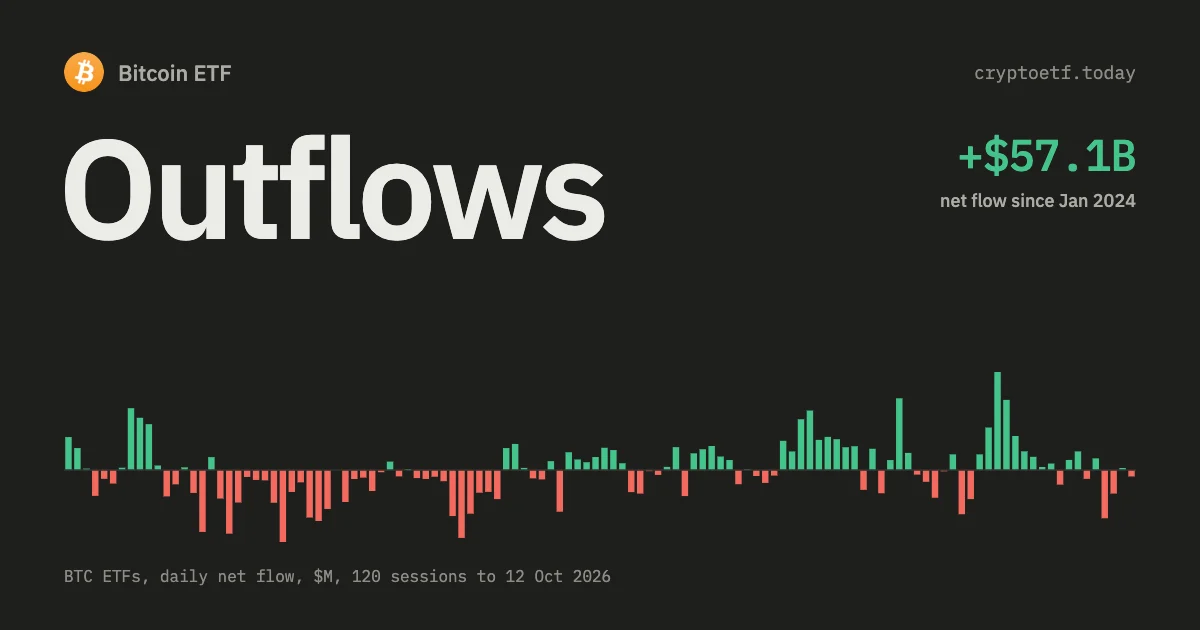
These outflows dominated 2024 headline category data even though net category flow was positive on most of those days — the rotation pattern is the canonical example used in what Bitcoin ETF outflows really mean.
Why GBTC keeps the 1.50% fee
It looks irrational at first glance — competitors charge a fraction of the price. But many GBTC holders are sitting on 10–50× unrealised capital gains from purchases at $5–$15 per share in 2017–2020. Exiting to a 0.25% fund triggers a long-term capital gain on the full appreciation. For those holders:
- Annual fee drag at 1.50% on a $500k position: $7,500/year.
- Cap gains tax on exiting and rotating (at 20% LTCG + 3.8% NIIT): ~$100k–$120k on a typical embedded gain.
- The cap gain breakeven horizon is 12–15 years — long enough that many holders rationally stay put.
Grayscale priced GBTC for those holders. The Mini Trust serves everyone else.
The Bitcoin Mini Trust (BTC) — Grayscale's competitive answer
Spun off from GBTC in July 2024 (existing GBTC holders received Mini shares at a ~10% ratio without realising gain), the BTC ticker is Grayscale's cheap option at 0.15%. It is essentially "Grayscale without the legacy fee."
Key facts on BTC (the Mini):
- Fee: 0.15% — no longer the lowest in the US category. Morgan Stanley's MSBT, which began trading in April 2026, charges 0.14%.
- Custodian: Coinbase Custody Trust.
- Net assets: $3.19 billion and 54,280.40 BTC at 30 June 2026 (Q2 2026 10-Q).
- Liquidity: Modest. Spreads wider than IBIT/FBTC, narrower than the smaller funds.
For investors actively choosing Grayscale for the brand (and there are some — Grayscale has the longest BTC asset-management history in the US), BTC is the rational choice. GBTC is a legacy product.
When GBTC makes sense for new money
Almost never. Two edge cases:
- You inherited shares with stepped-up cost basis and just want to keep them.
- You are intentionally allocating to a specific Grayscale legal trust structure for some non-economic reason (estate planning, legal continuity).
For new bitcoin exposure today, IBIT, FBTC, ARKB, BITB, or the Grayscale Mini Trust (BTC) are all better choices on cost.
FAQ
What is the expense ratio of Grayscale GBTC?
1.50% per year — six times the 0.25% charged by IBIT and FBTC, and more than ten times the 0.14% charged by the cheapest fund in the category, Morgan Stanley MSBT. Grayscale also offers the separate Bitcoin Mini Trust (ticker BTC) at 0.15% for new investors who want the Grayscale brand without the legacy fee.
Why did Grayscale GBTC trade at a discount?
Before its January 2024 conversion to an ETF, GBTC was a closed-end fund without a redemption mechanism — shares could be created but not redeemed for the underlying bitcoin. When demand cooled in 2022, no Authorized Participant arbitrage existed to close the price-to-NAV gap. Discount peaked at −48.9% in December 2022 and only collapsed after ETF conversion.
What is the Grayscale Bitcoin Mini Trust?
A separate ETF (ticker BTC) spun off from GBTC in July 2024 at a 0.15% expense ratio, holding $3.19 billion and 54,280.40 BTC at 30 June 2026. Existing GBTC holders received Mini shares without triggering capital gains. The Mini exists so Grayscale can compete on fees for new money while keeping GBTC at 1.50% for legacy holders with embedded gains.
Why do people still hold GBTC despite the high fee?
Existing holders typically have large unrealised capital gains from purchases at much lower prices. Exiting to a cheaper fund would trigger 20%+ long-term capital gains tax on the full appreciation. For many, the fee drag is cheaper than the tax bill over a 10-year horizon.
Should I buy GBTC or another Bitcoin ETF for new money?
For new money, almost certainly another fund. The Grayscale Bitcoin Mini Trust (BTC) at 0.15% is the cheapest Grayscale option; IBIT, FBTC, ARKB and BITB offer competitive fees with deeper liquidity, and Morgan Stanley MSBT is cheaper still at 0.14%. GBTC at 1.50% is structurally a legacy product for existing holders.
Sources and further reading
- Grayscale Bitcoin Trust 10-K filings — sec.gov/cgi-bin/browse-edgar?action=getcompany&CIK=0001588489.
- Grayscale Investments LLC v. SEC (D.C. Cir.) decision, 29 Aug 2023.
- Internal: IBIT vs GBTC, What Bitcoin ETF outflows mean, SEC Bitcoin ETF approval history.
For information only. Not investment advice.
 ETH
ETH SOL
SOL XRP
XRP HYPE
HYPE LINK
LINK HBAR
HBAR AVAX
AVAX DOGE
DOGE LTC
LTC SUI
SUI DOT
DOT BNB
BNB NEAR
NEAR TRX
TRX ZEC
ZEC