Canary TRXS is the only US spot TRX ETF: Cboe since 9 Sep 2026, 1.10% fee, about 90% of its TRX staked. It opened with roughly $50m and added one $0.49m creation in a month.
TL;DR. The Tron ETF is the Canary Staked TRX ETF, ticker TRXS, the only US spot TRX ETF. It began trading on Cboe BZX on 9 September 2026, charges a 1.10% sponsor fee, holds its TRX at BitGo and stakes about 90% of it through Luganodes. It listed with about 2.01 million shares, roughly $50m, already outstanding. In its first month the share count changed once: a 20,000-share creation worth $0.49m on 15 September. On 7 October 2026 it had $50.3m in net assets and no other flow.
Contents · 11 sections
- What is the Tron ETF?
- TRXS ETF at a glance: ticker, exchange, fee, staking
- TRON in one section: a stablecoin rail with elected validators
- Staking: 90% in, 80% of rewards kept
- TRXS vs NRR: two staked altcoin ETFs side by side
- Tron ETF flows: a starting balance and one creation
- How cryptoetf.today builds the TRXS series
- How to buy the Tron ETF
- Who TRXS is for, and the risks
- FAQ
- Sources and further reading
 Tron ETFsNet flow Mon 19 Oct0
What is the Tron ETF?
The Canary Staked TRX ETF (TRXS) is an exchange-traded trust that holds TRX, the token of the TRON network, and stakes most of it. Each share is a claim on the trust's TRX, net of expenses. Canary's fund page showed a NAV of $24.78 and a market price of $24.80 on 7 October 2026, a premium of 0.07%. The trust held 150.0 million TRX on 8 October, about 74 TRX per share.
Shares are created and redeemed in baskets of 10,000 by authorised participants. The prospectus allows cash orders, where the trust buys the TRX for the basket, and in-kind orders, where the participant delivers the coins. Only those creations and redemptions count as flow; trading between investors on the exchange doesn't. For the plumbing, see how authorised participants work.
TRXS is a digital-asset trust under the Securities Act of 1933, not a 1940-Act fund. Canary's own page puts it plainly: the product isn't subject to the same regulatory requirements as mutual funds or ETFs registered under the 1940 Act.
TRXS ETF at a glance: ticker, exchange, fee, staking
| Item | Canary Staked TRX ETF |
|---|---|
| Ticker / exchange | TRXS / Cboe BZX |
| Inception / first trading day | 8 September 2026 / 9 September 2026 |
| Sponsor fee | 1.10% a year, accrued daily in TRX, paid monthly in TRX or cash |
| Digital-asset custodian | BitGo |
| Cash custodian and administrator | U.S. Bank |
| NAV benchmark | CoinDesk Tron Benchmark Rate 60m NY Rate (60-minute TWAP) |
| Basket | 10,000 shares, cash or in kind |
| Staking | At least 90% expected; 89.91% staked on 7 Oct 2026; provider Luganodes |
| Staking fees | Capped at 20% of rewards; the trust keeps at least 80% |
| Unstaking | 14-day unfreeze |
| Published staking yield | None yet (shown as "--" on 7 Oct 2026) |
| Net assets | $50.3m (7 Oct 2026) |
| 30-day median spread | 0.27% (7 Oct 2026) |
Fee, basket, staking terms and unfreeze period are from the prospectus. The dated rows come from Canary's fund page. Current price and NAV are on the TRXS price and holdings page.
TRON in one section: a stablecoin rail with elected validators
TRON is a layer-1 blockchain founded by Justin Sun. TRX started as an ERC-20 token on Ethereum in 2017 and moved to TRON's own mainnet in June 2018. Blocks are produced by 27 elected Super Representatives under delegated proof-of-stake; elections run every six hours, and TRX holders vote by staking. Staking also gives users the network's two resources, bandwidth and energy, which pay for transfers and smart-contract calls.
In practice TRON is best known as a stablecoin rail. According to the TRXS prospectus, 46% of Tether's USDT market capitalisation, over $85bn, sat on TRON as of the first quarter of 2026, and the network averaged about 14.55 million transactions a day as of June 2026. That gives TRX a use case that doesn't depend on DeFi or NFTs. It also means network activity tracks payments and exchange transfers more than speculation on new applications.
One mechanical detail shapes the ETF: staked TRX stays frozen for 14 days after an unfreeze request before it can move. The prospectus repeats that figure, and it decides how the trust handles redemptions.
Staking: 90% in, 80% of rewards kept
The word "Staked" in the fund's name is literal. Canary expects at least 90% of the trust's TRX to be staked under normal conditions, and on 7 October its page reported 89.91%. The unstaked remainder is a liquidity buffer: with a 14-day unfreeze, the trust can't sell staked coins on the day a redemption arrives.
The prospectus caps aggregate staking fees, shared by the custodian, the staking provider and the sponsor, at 20% of rewards, and expects them to be exactly 20%. So the trust keeps 80%. Accrued rewards are included in the daily NAV. They aren't paid out and don't create new shares.
Canary hadn't published a staking yield by 7 October; both the gross and net yield fields on its page read "--". So we won't guess one. The structure is clear enough: a holder earns the network reward rate on about 90% of the coins, minus a fifth of it, minus 1.10% a year in sponsor fee. Whether that leaves anything positive depends on TRON's reward rate, which moves with voting and network parameters.
Staking also explains a detail on the flows page. TRXS net assets can rise on a day with zero flow, because rewards add TRX to the trust without changing the share count.
TRXS vs NRR: two staked altcoin ETFs side by side
The closest comparison is the Bitwise NEAR ETF, another single-fund staked altcoin ETF, which listed three weeks after TRXS. Their terms differ in ways that matter:
| Term | Canary TRXS | Bitwise NRR |
|---|---|---|
| Sponsor fee | 1.10% | 0.75% |
| Share of coins staked | At least 90% expected | 100% target |
| Share of rewards the trust keeps | 80% | About 67% |
| Unstaking period | 14 days | About 48 hours |
| Published staking rate | None yet | 3.29% net (5 Oct 2026) |
| Net flow, first weeks | +$0.49m (9 Sep–7 Oct) | +$62.2m (29 Sep–7 Oct) |
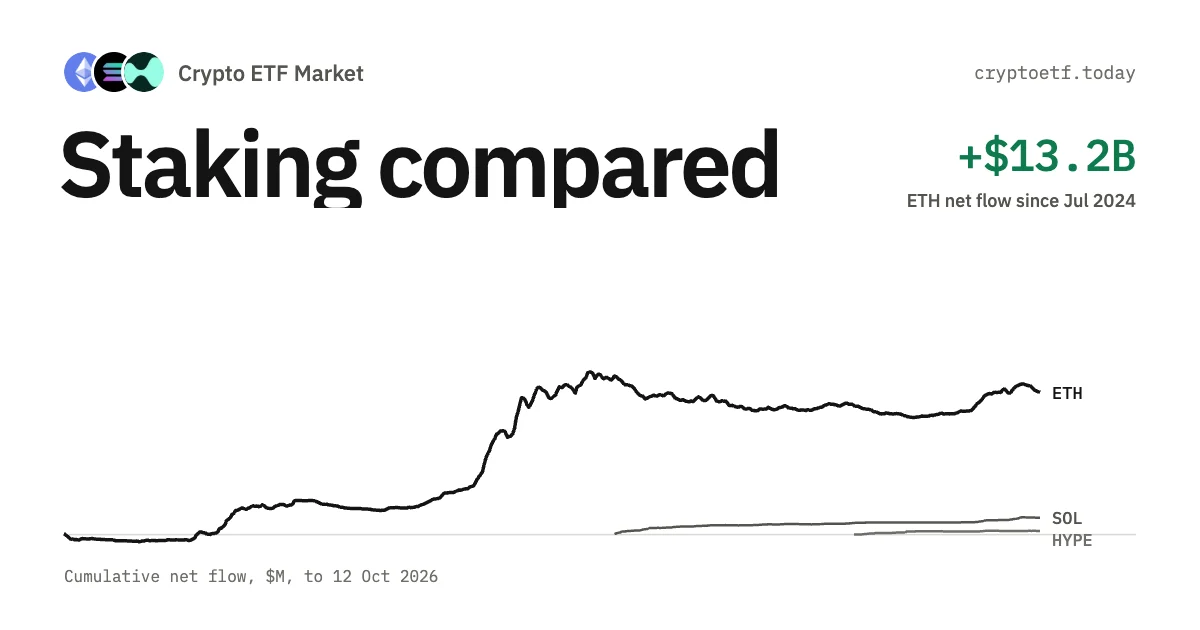
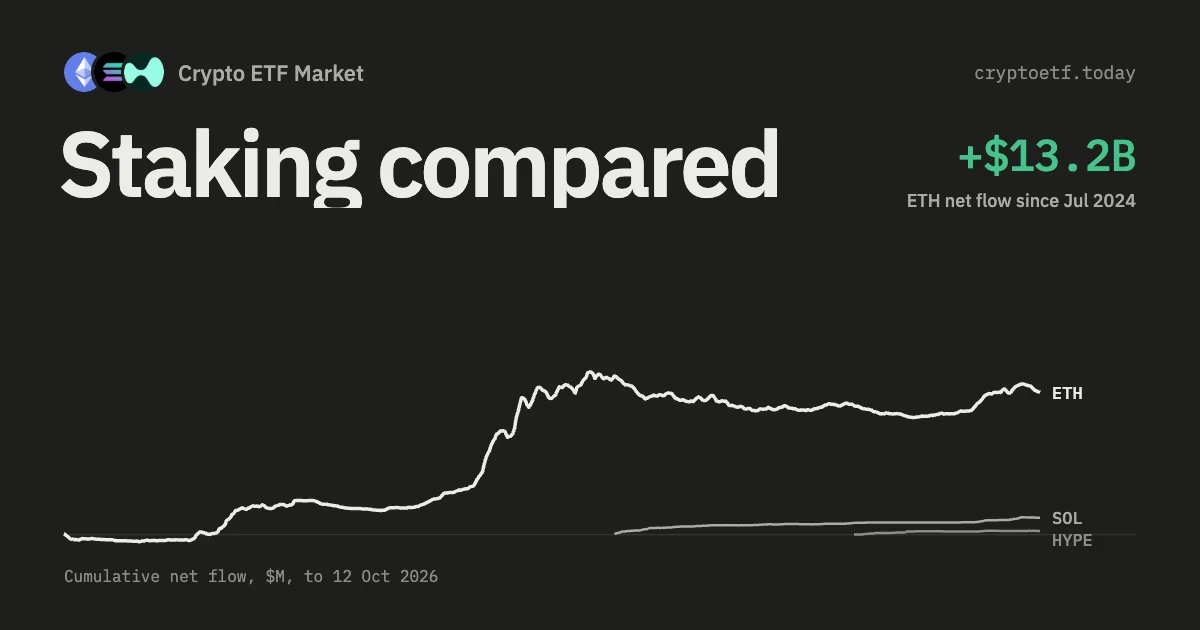
TRXS lets holders keep more of each reward, but it charges a higher fee and has to hold back a bigger unstaked buffer because its coins take two weeks to free up. How both compare with the staking setups of the Ethereum, Solana and other altcoin funds is covered in crypto ETF staking compared.
Tron ETF flows: a starting balance and one creation
TRXS is an unusual case for anyone who reads flow data. The fund began trading with about 2.01 million shares already outstanding, worth roughly $50m. That balance was in place before the first daily comparison, so it shows up as starting assets, not as a creation day. cryptoetf.today treats it that way and records no flow for the listing day.
After that, the record is short:
| Period | Net flow | What happened |
|---|---|---|
| 9 Sep 2026 | n/a | Listing day; no flow recorded by any source |
| 10–14 Sep 2026 | $0.00m | No baskets |
| 15 Sep 2026 | +$0.49m | One creation of 20,000 shares (two baskets) |
| 16 Sep – 7 Oct 2026 | $0.00m every session | No baskets |
Cumulative net flow was therefore $0.49m on 7 October 2026, against $50.3m of assets. The gap is the starting balance, plus price movement and staking income since. It isn't an error in either number.
Why so quiet?
The premium data offers one clue. Canary's page lists the closing premium for every session from 9 September to 7 October, and all of them fell between 0.03% and 0.35%. That's about the size of the 0.27% median spread. A premium that small usually doesn't cover a participant's costs for creating a basket, so there's nothing to arbitrage. Two other explanations fit too. At 1.10% the fee is high, and the obvious buyers were served by the launch allocation. And investors who want TRX tend to already hold it on exchanges, where staking is easy to set up. Flow data alone can't prove any of these. What it shows is that, beyond the launch allocation, demand for TRX through a US brokerage account was close to nil in the first month.
The full series is on the Tron ETF flows page. It updates every business day with a one-day lag (T+1), because a creation shows up in the share count the following session.
How cryptoetf.today builds the TRXS series
- 10–29 September 2026. Canary doesn't keep history on its site, so these days were filled in from a historical record of the fund's daily flows.
- From 30 September 2026. Our own calculation from Canary's daily shares outstanding and NAV: the change in shares times NAV, dated to the session of the creation. When our figure exists it overrides the filled-in one.
- Staking rewards and price. Neither changes the share count, so neither counts as flow.
At about $25 a share, one 10,000-share basket is roughly $250,000. The single creation on 15 September was two baskets.
How to buy the Tron ETF
- Pick a broker that offers Cboe-listed crypto ETPs. Not every platform carries them. Canary describes the fund as eligible for IRAs and brokerage accounts; whether your IRA allows it is up to the provider.
- Search the ticker TRXS and check that the name reads Canary Staked TRX ETF.
- Use a limit order. A 0.27% median spread is fine for small orders, but trading has been thin.
- Know what the fee costs over time. Over ten years a 1.10% annual fee takes roughly a tenth of the position; the fee calculator shows the exact figure for any amount.
Who TRXS is for, and the risks
TRXS is for investors who want TRX in an account that only holds listed securities, such as an IRA or an adviser platform, and who want staking handled for them. Anyone comfortable holding TRX on an exchange or in a wallet can stake it directly and avoid both the 1.10% fee and the 20% of rewards that goes to service providers.
Risks specific to this fund:
- Concentration. TRX's value is tied closely to one network's role in stablecoin settlement, and to a founder with an unusually large public profile.
- Liquidity of staked coins. The 14-day unfreeze means the trust relies on its unstaked buffer, about a tenth of its TRX, for redemptions. A large wave of redemptions could test that.
- Fee drag. Of the US spot crypto ETFs this site tracks, only three charge more than 1.10%: Grayscale's GBTC (1.50%), ETHE and ZCSH (both 2.50%). The fee is charged whether or not staking rewards cover it.
- Closure risk. A fund that doesn't attract new money can be closed by its sponsor, forcing a sale on the sponsor's timetable. Bitwise announced on 10 September 2026 that it would liquidate its Dogecoin ETF, which held about $0.65m; see Dogecoin ETF explained.
- Thin trading. Larger orders should use limit prices.
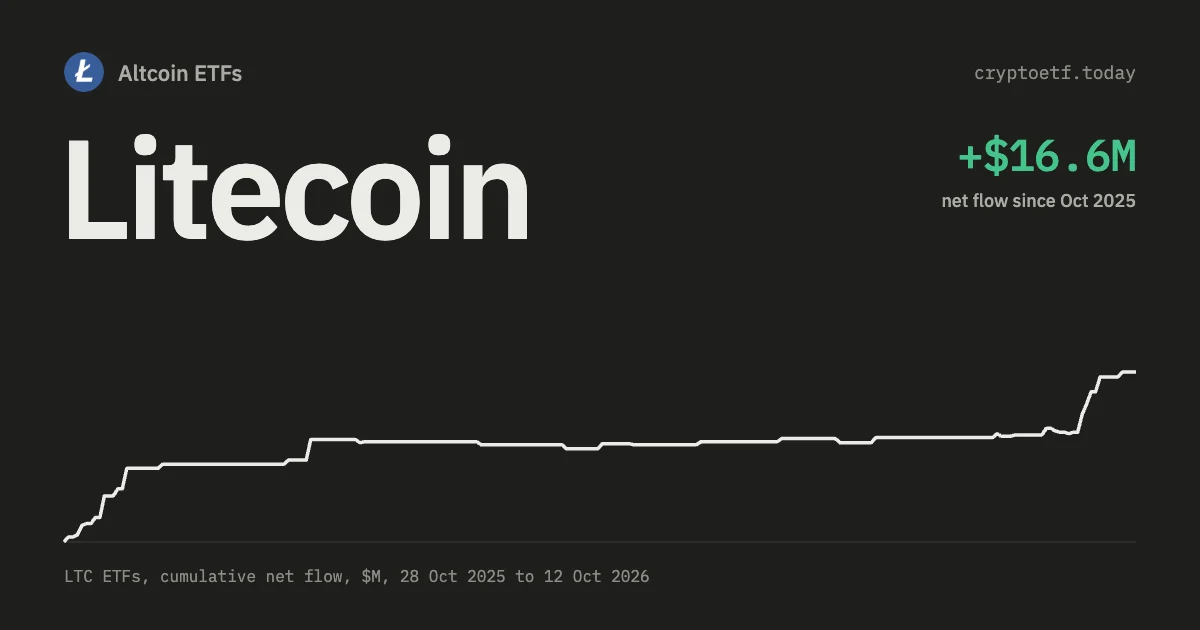
Canary's Litecoin fund shows a similar pattern of long flat stretches; Litecoin ETF explained walks through it. This article explains how TRXS works. It isn't investment advice and doesn't recommend buying or selling TRXS or TRX.
FAQ
Is there a Tron ETF?
Yes. The Canary Staked TRX ETF, ticker TRXS, has traded on Cboe BZX since 9 September 2026. It is the only US spot TRX ETF.
What does TRXS charge?
A sponsor fee of 1.10% a year, accrued daily and paid monthly in TRX or cash. Separately, staking fees take 20% of staking rewards, so the trust keeps 80%.
Does the Tron ETF stake its TRX?
Yes. Canary expects to stake at least 90% of the trust’s TRX through Luganodes; 89.91% was staked on 7 October 2026. Rewards are added to NAV, not paid out. Canary had not published a staking yield by that date.
How much money has flowed into TRXS?
About $0.49m of net inflows from 9 September to 7 October 2026, from a single 20,000-share creation on 15 September. The roughly $50m the fund started with is not counted as inflow.
Why are TRXS net assets so much larger than its cumulative flow?
Because about 2.01 million shares, roughly $50m, were already outstanding when trading began. Net assets also move with the TRX price and staking rewards, which are not flows.
How do I buy the TRX ETF?
Through a brokerage account that allows Cboe-listed crypto ETPs: search the ticker TRXS and use a limit order. The 30-day median spread was 0.27% on 7 October 2026.
How long does it take to unstake TRX inside the ETF?
Fourteen days. Staked TRX stays frozen for 14 days after an unfreeze request, according to the prospectus, so the trust keeps about 10% of its TRX unstaked for redemptions.
Sources and further reading
- Canary Staked TRX ETF, prospectus (Form 424B3, 8 September 2026): fee, basket, staking fee cap, 14-day unfreeze, benchmark, TRON network and USDT figures, sec.gov.
- Canary Staked TRX ETF fund page: custodians, staking provider, share staked, staking yield fields, NAV, premium history, spread and net assets (7 October 2026), holdings (8 October 2026), canaryetfs.com.
- Daily flows: cryptoetf.today, from Canary data, with 10–29 September 2026 filled in from the fund's historical record. Pages: Tron ETF flows tracker, TRXS price and holdings, Canary Capital crypto ETFs.
- Further reading: ETF premium, discount and NAV, every new crypto ETF of 2026.
Live data on this topic
ETFs still waiting for approval: Injective, SEI, Cronos, PEPE, Worldcoin, Canton, Aave, TRUMP, Ondo, Uniswap, Aptos, PENGU
For information only. Not investment advice.
 BTC
 ETH
 SOL
 XRP
 HYPE
 LINK
 HBAR
 AVAX
 DOGE
 LTC
 SUI
 DOT
 BNB
 NEAR
 ZEC