
Ten US spot ether ETFs, fees from 0.15% to 2.50%, five of them paying staking cash. Which to pick, where to buy it (Vanguard included since Dec 2025), and how to place the order.
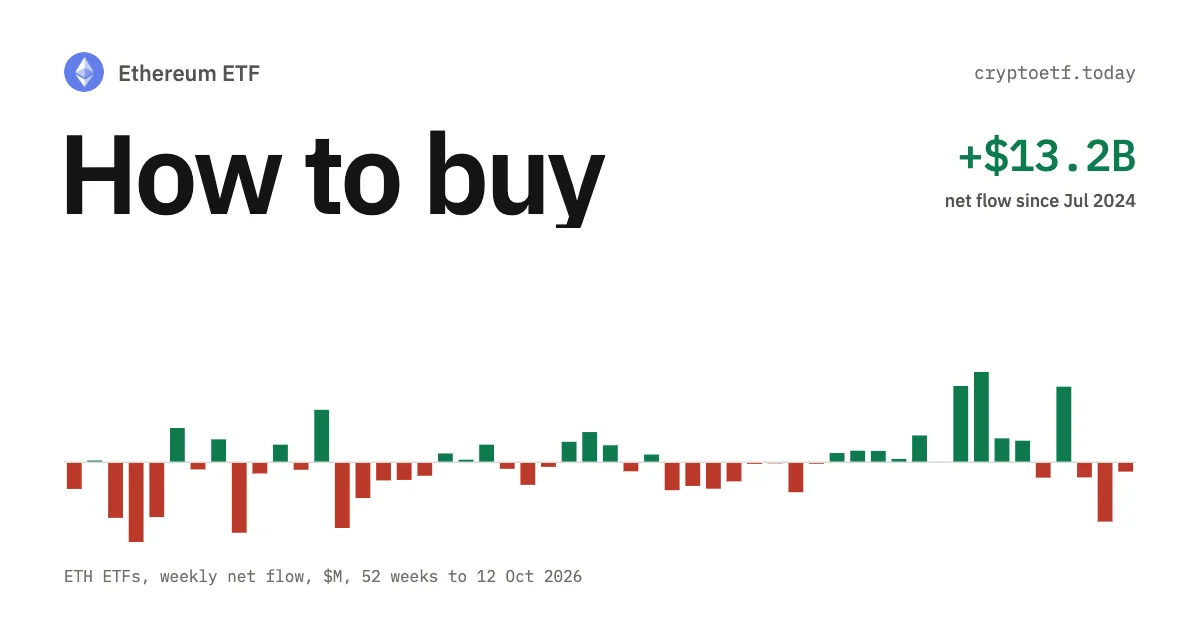
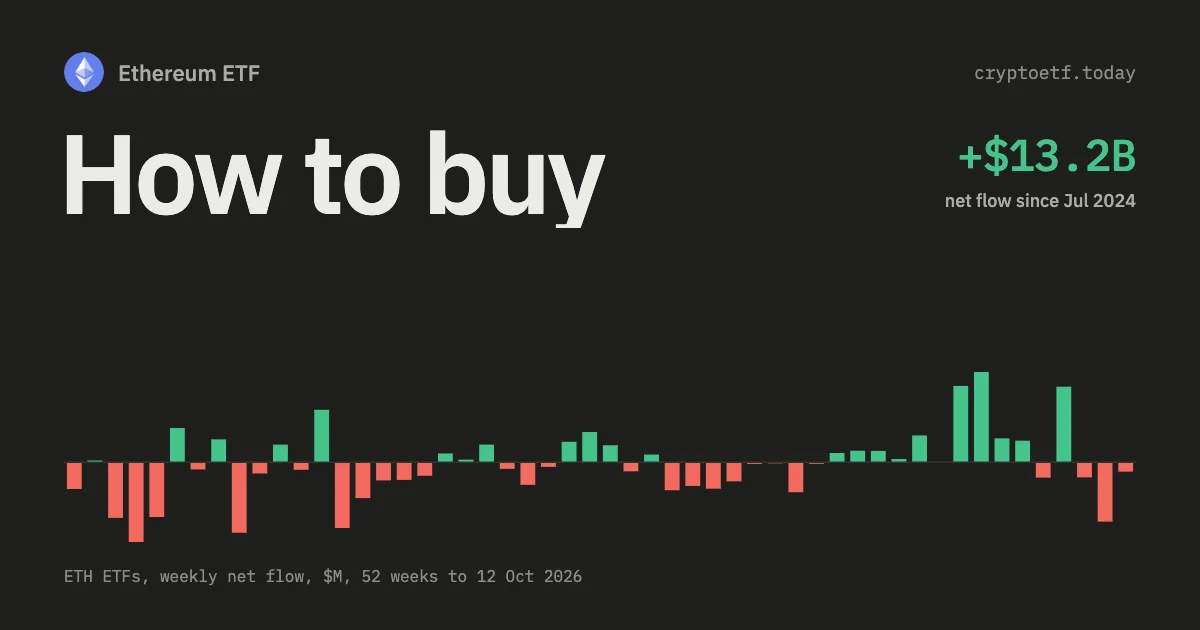
TL;DR. Buying a spot Ethereum ETF takes five decisions. First, staking or not: five of the ten US funds (ETHB, FETH, TETH, ETHE and Grayscale's mini, ticker ETH) pay out staking rewards in cash, five don't. Second, the fund: for most buyers the shortlist is the Grayscale mini at 0.15%, BlackRock's ETHB at a waived 0.12% until March 2027, or ETHA if you want the deepest book ($9.24bn on 18 September 2026, 0.05% median spread). Third, the brokerage: every major US broker now carries them, including Vanguard since 2 December 2025. Fourth, the account: an IRA shelters both the gains and the staking payouts. Fifth, the order: a limit order after 10:00am New York time, never a market order into the open. Then watch what the other holders are doing on the Ethereum ETF flows page.

Ethereum ETF flows, live
as of Fri 20 Nov · updated every trading dayContents · 11 sections
- Step 1: Decide whether you want a fund that stakes
- Step 2: Pick the fund
- Step 3: Choose a brokerage
- Step 4: Choose the account
- Step 5: Place the order
- What it actually costs to hold
- After you buy: three things to check
- How to follow the money afterwards
- Five mistakes on the way in
- FAQ
- Sources and further reading
Step 1: Decide whether you want a fund that stakes
This is the question that didn't exist when we wrote the Bitcoin version of this guide, and it now splits the ether funds down the middle. A staking fund locks most of its ether in validators, earns the network reward, sells the reward for dollars and pays it to you. A non-staking fund holds ether in cold storage and does nothing else.
The reward is small. iShares quoted a 30-day staking rewards rate of 1.42% for ETHB on 18 September 2026, and the sponsor keeps a slice before anything reaches you (6% at the Grayscale mini, 15% at FETH, 18% at ETHB, 23% at ETHE, 25% at TETH, per the June 2026 10-Qs and issuer pages). After the fee, a staking fund nets roughly plus 0.9% to 1.1% a year on ether; a non-staking fund nets minus the fee. That's the whole difference: about 1.2 percentage points a year in favour of staking, in exchange for three things.
- Taxable distributions. Every cash payout is a reportable event in a taxable account. ETHE paid $0.083178 a share on 6 January 2026, ETHB paid $0.02 a share for the second quarter of 2026; small amounts, but each one lands on your 1099.
- Slashing and lock-up risk. Ethereum still slashes misbehaving validators, and staked ether can't be sold the day a redemption arrives. No US fund has had a problem with either yet.
- Fewer choices. Fidelity self-custody means FETH, which stakes; Gemini custody means ETHV, which doesn't.
If you're holding for years in a retirement account, staking is close to free money and the distributions don't matter. If you're in a taxable account and trade actively, a non-staking fund keeps the paperwork simpler. The full grid of who stakes how much, and what they keep, is in staking crypto ETFs compared.
Step 2: Pick the fund
All ten are grantor trusts holding ether, not 1940 Act funds, and nine of them have traded since 23 July 2024 (ETHB listed on 12 March 2026). The detailed reviews are in best Ethereum ETF; this table is the buying decision compressed to one line each.
| Ticker | Exchange | Fee (Nov 2026) | Stakes? | Buy it if |
|---|---|---|---|---|
| ETH (Grayscale mini) | NYSE Arca | 0.15% | Yes, 94% of rewards paid out | You want the lowest all-in cost and will hold |
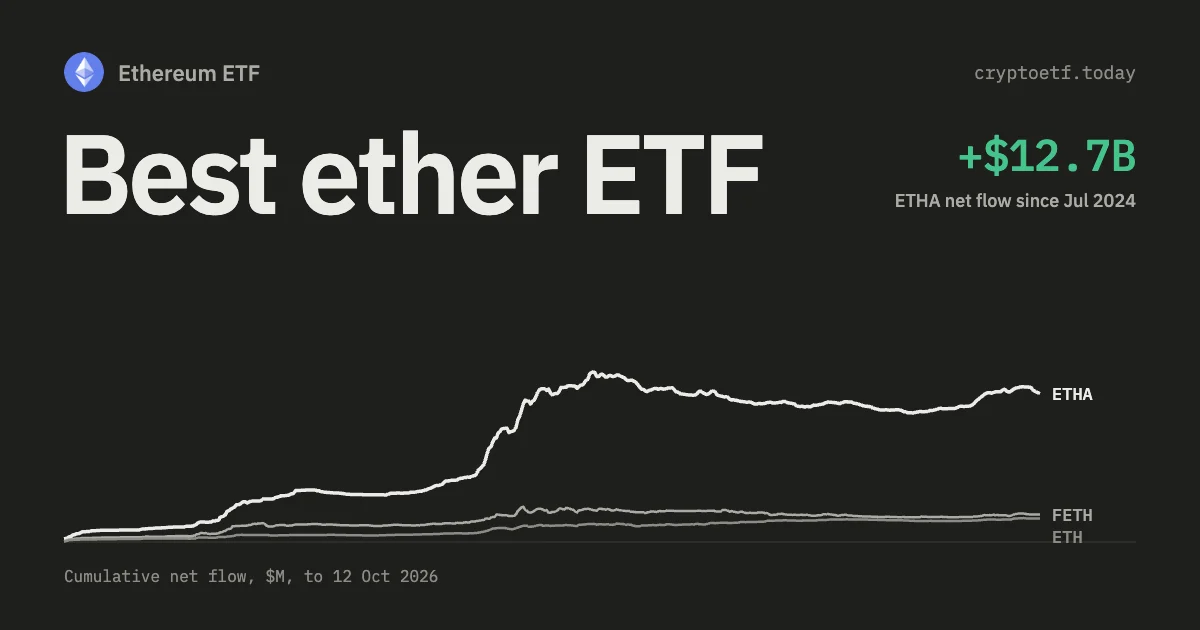
| ETHA (BlackRock) | Nasdaq | 0.25% | No | You trade size, want the tightest spread or the deepest options chain |
| ETHB (BlackRock) | Nasdaq | 0.25%, waived to 0.12% to March 2027 on the first $2.5bn | Yes, 82% paid monthly | You want staking with the BlackRock name and monthly cash |
| FETH (Fidelity) | Cboe BZX | 0.25% | Yes, 85% paid quarterly (staking added under the August 2026 registration) | You bank at Fidelity or want custody outside Coinbase |
| ETHW (Bitwise) | NYSE Arca | 0.20% | No | You want a cheap passive fund with listed options |
| ETHV (VanEck) | Cboe BZX | 0.20% | No | You want Gemini custody |
| EZET (Franklin) | Cboe BZX | 0.19% | No | You want the cheapest non-staking fund |
| TETH (21Shares) | Cboe BZX | 0.21% (the 0% waiver ended 8 October 2026) | Yes, 75% paid out, 40–70% staked | You want a smaller staked share as a liquidity buffer |
| QETH (Invesco) | Cboe BZX | 0.25% | No | No fresh reason; $15.6m at 30 June 2026 |
| ETHE (Grayscale) | NYSE Arca | 2.50% | Yes, 77% paid out | Don't. Same ether as the mini at 16 times the fee |
Two tickers you'll see in a search that aren't on this list: ETHU is a 2x leveraged product that resets daily, and ESK from REX-Osprey is a 1940 Act fund holding staked ether alongside other ETPs. Neither is a spot trust.
One practical note on ETHA. The sponsor approved a 1-for-3 reverse split, effective at the open on 6 October 2026 (8-K of 3 August 2026). Your holding's value didn't change, but the share price tripled overnight, so price alerts, limit orders and share counts from before that date are off by a factor of three.
Step 3: Choose a brokerage
These are exchange-listed US securities, so any broker that offers stocks can, in principle, offer them. In practice the question for two years was Vanguard, which refused to list spot crypto ETFs when they launched. That ended on 2 December 2025, when Vanguard opened its brokerage platform to third-party crypto ETFs and mutual funds that meet its screening, with funds tied to meme coins excluded (Bloomberg, reported by CoinDesk, 1 December 2025). Vanguard still runs no crypto fund of its own.
| Broker | Spot ETH ETFs | Fractional shares | IRA | Verified |
|---|---|---|---|---|
| Fidelity | Yes; sponsors FETH, and the other nine are exchange-listed | Yes | Yes | Sep 2026 (FETH product pages, Fidelity S-3/A) |
| Charles Schwab | Yes, "spot bitcoin and ether ETPs" on schwab.com and thinkorswim | Assume whole shares (Stock Slices has covered S&P 500 stocks, not ETFs) | Yes | Sep 2026, schwab.com/cryptocurrency |
| Vanguard | Yes, third-party funds since 2 Dec 2025; meme-coin funds excluded | Not for third-party ETFs; assume whole shares | Per product eligibility; check before funding | Dec 2025 announcement; ticker-level list not published |
| Interactive Brokers | Yes | Yes | Yes | Sep 2026 |
| Robinhood | Yes; quote pages live for ETHA, ETHE, ETH, TETH | Yes | Robinhood Retirement (traditional and Roth) | Sep 2026, robinhood.com |
Three caveats the table can't carry. Schwab's Stock Slices programme has been limited to S&P 500 stocks, and we couldn't confirm an ETF extension on schwab.com, so plan on whole shares there. Vanguard hasn't published a ticker-by-ticker list, so the honest test is to type the symbol into the app: if it shows a buy button, it's eligible. And employer 401(k) plans run on a fixed menu chosen by the plan sponsor, so availability there is a plan question, not a broker question (how that works). Our broader broker comparison, written for the Bitcoin funds but valid here, is best brokerage for a Bitcoin ETF; the Vanguard row there predates the December 2025 reversal.
Outside the US, EU retail investors generally can't buy US-listed ETFs under PRIIPs rules and use a locally listed ether ETP instead, usually at a higher fee.
Step 4: Choose the account
Account type matters more for an ether fund than for a Bitcoin fund, because of the staking cash. In a taxable account you owe tax on the distributions as they arrive and on the gain when you sell. Inside an IRA neither event is taxed until withdrawal (traditional) or ever (Roth, if qualified). For 2026 the IRA contribution limit is $7,500, or $8,600 if you're 50 or older, per IRS Notice 2025-67.
- Roth IRA first if you expect ether to appreciate and can accept the contribution cap. The mechanics, income phase-outs and the backdoor route are in our Roth IRA guide; the fund is different, the rules aren't.
- Traditional IRA or 401(k) if you want the deduction now. Staking payouts accrue untaxed; withdrawals are ordinary income.
- Taxable brokerage when the retirement accounts are full or you need the money before 59½. If you're here, a non-staking fund (EZET at 0.19%, ETHW or ETHV at 0.20%) avoids a stream of small taxable payouts, at the cost of the roughly 1% net staking carry.
Funding is the same as for any ETF: ACH in one to three business days, and an ACATS transfer of an existing account in five to ten, with no taxable event.
Step 5: Place the order
The funds trade during regular US hours, 9:30am to 4:00pm Eastern, on Nasdaq (ETHA, ETHB), NYSE Arca (ETHW, ETHE, ETH) and Cboe BZX (the other five). Ether trades every hour of every day. That mismatch is where most avoidable cost lives.
When to trade
NAV is struck once a day, at 4:00pm New York time, off the CME CF Ether-Dollar Reference Rate (New York Variant), the benchmark named in the ETHA and ETHB prospectuses. Between opens, the fund's price is whatever the market makers think that 4pm number will be. Avoid the first fifteen to thirty minutes: the overnight ether move is still being priced, spreads are widest, and a market order at 9:31am pays for other people's certainty. Mid-session, 10:30am to 3:30pm, is where ETHA's 0.05% median spread (iShares, 18 September 2026) actually applies.
Which order type
On ETHA or ETHB during the middle of the day, a market order costs a cent or two per share and is fine for a few thousand dollars. On anything smaller (ETHV, QETH, TETH, EZET) use a limit order at or a cent above the ask. A market order into a $25m fund can fill half a percent off fair value, which is more than two years of the fee you spent an hour comparing. The premium-and-discount mechanics that make a limit price sensible are in premium, discount and NAV; ETHA closed at a 0.03% discount and ETHB at 0.08% on 17 September 2026, so on the big funds the gap is a rounding error.
Whole shares or fractions
Fidelity, IBKR and Robinhood sell fractional ETF shares, so you can buy $100 of any fund. At Schwab and Vanguard plan on whole shares, which matters more after ETHA's reverse split: at the 18 September NAV of $19.86, one post-split share is worth about $60 at the same ether price. Settlement is T+1: sell on Tuesday, cash on Wednesday.
What it actually costs to hold
The expense ratio is the visible cost. Two others aren't, and one of them is negative.
| Cost | Non-staking fund (e.g. EZET) | Staking fund (e.g. ETH mini) |
|---|---|---|
| Sponsor fee | 0.19% a year | 0.15% a year |
| Sponsor's cut of staking rewards | None (no rewards) | 6% of a ~1.4% reward, about 0.08% |
| Net staking income | 0 | Roughly +1.1% a year at September 2026 rates and ~83% staked |
| Bid-ask spread on entry and exit | 0.05–0.06% each way on ETHA/ETHB; wider on funds under $100m | |
| Net carry on $10,000 a year | About −$19 | About +$98 |
The arithmetic is gross rate × share staked × (1 − cut) − fee, worked through fund by fund in the staking comparison. The rate moves (iShares showed 1.45% on 16 September and 1.42% two days later) and no issuer guarantees it. Treat the carry as "roughly free to hold", not as yield.
After you buy: three things to check
- Distributions. If you hold a staking fund, cash arrives on the sponsor's schedule: monthly for ETHB, at least quarterly for the Grayscale pair and TETH, quarterly for FETH. Decide up front whether your broker reinvests it or leaves it as cash. It isn't a dividend from a corporation, and the prospectuses say its tax character is unsettled, so don't assume qualified-dividend rates.
- The 1099. Sales in a taxable account appear on Form 1099-B with cost basis; distributions on the same consolidated statement. Grantor trusts also report expense pass-throughs, which is why Bitcoin ETF holders get a supplemental tax letter each spring. Expect the same here, plus a line for the staking cash.
- Cost basis and lots. Set your lot-selection method (FIFO or specific identification) before your first sale, and keep every trade confirmation. If you hold through ETHA's reverse split, your broker adjusts basis per share automatically; check that the total matches what you paid.
A fourth, for the small funds only: closures. QETH held $15.6m at 30 June 2026 and TETH $25.0m on 16 September. A sponsor can liquidate a fund that size, and the payout is a forced sale on its timetable; Bitwise did exactly that with its Dogecoin fund in October 2026.
How to follow the money afterwards
Your brokerage app shows you the price. It doesn't show whether other regulated holders are buying or selling, and for a fund that's the more useful signal. Each business day the issuers publish how much ether their trusts hold; the change in that number, times the day's reference price, is the fund's net flow. The Ethereum ETF flows page computes it for all ten funds from those holdings files, sums the staked and unstaked lines that BlackRock reports separately for ETHB, and shows a per-fund table (price, assets, market share, latest daily flow) plus a chart over any range you pick. It updates after each business day, and weekends are empty because the funds don't trade.
Two habits worth forming. Watch the fund you didn't buy: if you hold the Grayscale mini and ETHB keeps taking inflows while the mini bleeds, that's information about where liquidity is heading. And check the ETH reading of the Crypto ETF Flow Index before adding; it condenses the last month of flows into a 0–100 score (how it's built), so you know whether you're buying alongside a creation streak or against a redemption one.
Five mistakes on the way in
- Buying ETHE because it's the ticker you recognise. It charges 2.50%; the mini from the same sponsor holds the same ether at 0.15%. The ETHE review explains who still holds it and why it's not you.
- Choosing by fee alone. The gap between 0.15% and 0.25% on $10,000 is $10 a year. The staking cut, the spread and the account type each move more than that.
- A market order into Monday's open after a weekend ether move. Wait thirty minutes.
- A staking fund in a taxable account with no plan for the cash. Twelve small payouts a year from ETHB is twelve lines on a tax form.
- Owning three ether ETFs. It's one asset; extra funds add tax lots and nothing else, unless you're deliberately splitting custody.
Whether to hold the ETF at all, rather than ether in a wallet you control, is a separate question we take up in the ETF-versus-spot comparison queued for December. The short version: the wrapper wins inside an IRA and loses if you want to use the ether on-chain.
FAQ
How do I buy an Ethereum ETF?
Search for the ticker (ETHA, ETHB, FETH, ETH, ETHW, ETHV, EZET, TETH, QETH or ETHE) in any US brokerage that offers stocks, and place a limit order during US market hours, ideally after 10:00am Eastern. There is no minimum beyond one share, and Fidelity, IBKR and Robinhood sell fractions.
Which Ethereum ETF should a first-time buyer choose?
For a long hold, the Grayscale Ethereum Staking Mini ETF (ticker ETH) at 0.15%, which stakes and passes on 94% of rewards. For trading size or options, BlackRock ETHA, the largest fund at $9.24bn on 18 September 2026. For staking with BlackRock, ETHB at a waived 0.12% until March 2027.
Can I buy an Ethereum ETF at Vanguard?
Yes, since 2 December 2025. Vanguard opened its brokerage platform to third-party crypto ETFs and mutual funds that pass its screening, excluding funds tied to meme coins. It publishes no ticker list, so confirm eligibility in the app before funding; Vanguard runs no crypto fund of its own.
Can I hold an Ethereum ETF in a Roth IRA or 401(k)?
In an IRA, yes at every major custodian, and it is the best home for a staking fund because the cash distributions accrue untaxed. The 2026 IRA limit is $7,500 ($8,600 at 50+). In a 401(k) it depends on the plan menu; most employer plans do not include crypto ETFs.
Should I buy a staking or a non-staking Ethereum ETF?
Staking funds (ETHB, FETH, TETH, ETHE, ETH mini) net roughly 1% a year after the sponsor cut and fee at September 2026 rates; non-staking funds net minus the fee. In an IRA, take the staking fund. In a taxable account the cash distributions are taxable events, so some buyers prefer EZET, ETHW or ETHV for simpler reporting.
What time of day should I buy an Ethereum ETF?
Between about 10:30am and 3:30pm Eastern. NAV is struck at 4:00pm off the CME CF Ether-Dollar Reference Rate, and spreads are widest in the first and last fifteen minutes while market makers reprice. ETHA showed a 0.05% median bid-ask spread on 18 September 2026 in normal hours.
Why did the ETHA share price triple in October 2026?
A 1-for-3 reverse split took effect at the open on 6 October 2026, per the 8-K of 3 August. Every three shares became one and the price per share tripled; the value of a holding did not change. Limit orders and price alerts set before that date need adjusting.
Sources and further reading
- iShares Ethereum Trust ETF (ETHA): net assets, spread, premium/discount and benchmark, 18 Sep 2026 — ishares.com; reverse split 8-K, 3 Aug 2026 — sec.gov.
- iShares Staked Ethereum Trust ETF (ETHB): fee waiver, staking rate and monthly distributions, 18 Sep 2026 — ishares.com.
- Fidelity Ethereum Fund (FETH): staking, 85% payout and quarterly distributions, 8-K of 7 Aug 2026 — sec.gov.
- Vanguard opens its platform to crypto ETFs, 1 Dec 2025 — coindesk.com; Schwab crypto ETP availability — schwab.com.
- IRS, 2026 retirement plan limits (Notice 2025-67) — irs.gov; Grayscale ETHE first staking distribution 8-K, Jan 2026 — sec.gov.
For information only. Not investment advice.
 BTC
 SOL
 XRP
 HYPE
 LINK
 HBAR
 AVAX
 DOGE
 LTC
 SUI
 DOT
 BNB
 NEAR
 TRX
 ZEC