Five US Ethereum ETFs stake, one is barred from staking by its own 10-K, and the network pays about 1.45%. After the sponsor takes its cut, the best of them nets under 1% a year.
TL;DR. US spot Ethereum ETFs stake. Grayscale's ETHE and its mini trust started on 6 October 2025, 21Shares' TETH on 8 October 2025, BlackRock's ETHB on 12 March 2026 and Fidelity's FETH on 21 August 2026. The one fund that cannot stake is BlackRock's original ETHA — a prohibition written into its own 10-K. The catch is not permission any more, it is arithmetic: Ethereum's network rate was about 1.45% in September 2026, sponsors keep between 6% and 25% of it, and the best US fund nets roughly 1% a year. That is real but small, and it is comfortably better than the European "staking ETPs" that charge 1.49% to deliver 1.69%.
Contents · 9 sections
 Ethereum ETFsNet flow Fri 16 Oct−$69.7M
What staking pays now
Since Ethereum moved to proof-of-stake in September 2022, ether can be committed to validators in exchange for newly issued ETH and a share of transaction fees. The rate is not a constant: it falls as more of the supply is staked, and it has fallen a long way. iShares quoted 1.45% gross on 16 September 2026. Older explainers still say "3–4%", which described 2023.
Which US Ethereum ETFs stake
| Fund | Staking since | Fee | Share staked | Sponsor's cut of rewards | Payout |
|---|---|---|---|---|---|
| ETHE (Grayscale) | 6 Oct 2025 | 2.50% | ~82% | 23% | Cash, at least quarterly |
| ETH (Grayscale mini) | 6 Oct 2025 | 0.15% | ~83% | 6% | Cash, at least quarterly |
| TETH (21Shares) | 8 Oct 2025 | 0.21%, waived to 8 Oct 2026 | 40–70% target, not reported | 25% | Cash, at least quarterly |
| ETHB (BlackRock) | 12 Mar 2026 | 0.25%, waived to 0.12% to Mar 2027 | 86.9% | 18% | Cash, monthly |
| FETH (Fidelity) | 21 Aug 2026 | 0.25% | Up to 100%, not yet reported | 15% | Cash, five times a year |
Morgan Stanley's MSSE, listed on NYSE Arca on 28 July 2026, stakes from day one at a 0.14% fee with providers keeping 5% and the sponsor nothing. It is not in our flow data, so we leave it out of the comparisons below — but on terms it is the most aggressive of the group.
Five of the ten funds our tracker covers hold ether passively and pay nothing: ETHA, ETHW, ETHV, QETH and EZET. ETHA is the notable one, because it is the largest Ethereum ETF in the US and its 10-K explicitly bars the trust from staking. BlackRock's answer was to launch a second, separate fund rather than amend the first — which is why ETHB exists.
What the cut actually costs
The formula every fund obeys: gross network rate × share staked × (1 − sponsor's cut) − fee. On the 1.45% rate:
| Fund | Net staking | Less fee | Net carry on $10,000 a year |
|---|---|---|---|
| ETH (Grayscale mini) | 1.13% | 0.15% | +$98 |
| ETHB (BlackRock) | 1.03% | 0.12% while waived | +$91 |
| FETH (Fidelity) | 1.11% at an assumed 90% staked | 0.25% | +$86 |
| ETHA (passive) | none | 0.25% | −$25 |
| ETHE (Grayscale) | 0.92% | 2.50% | about −$158 |
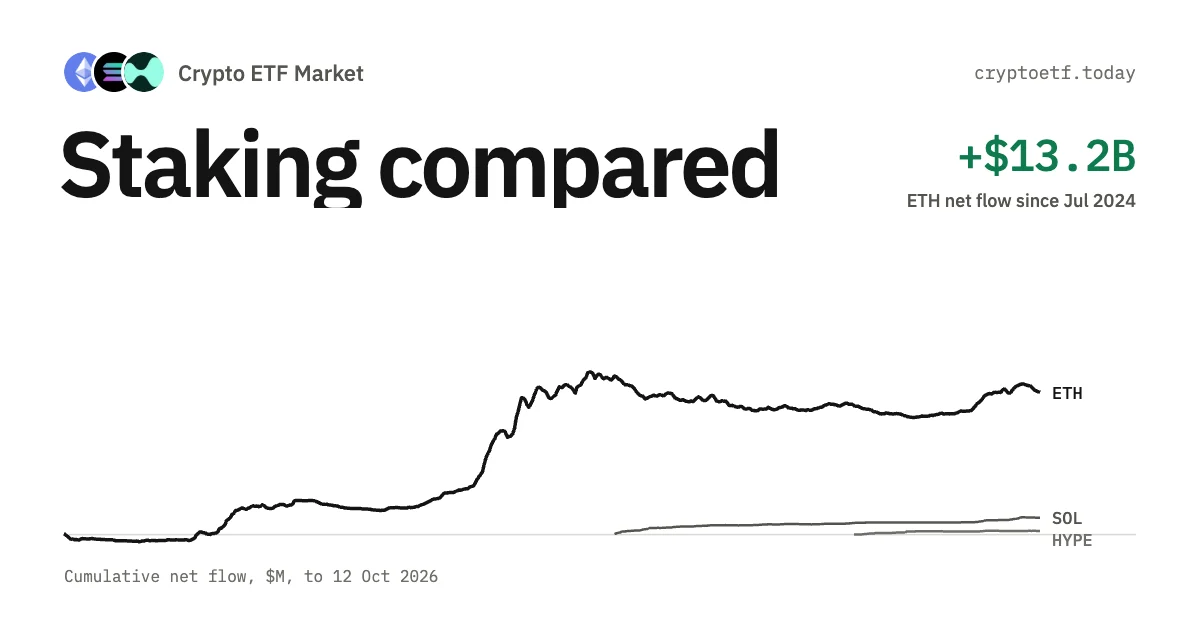
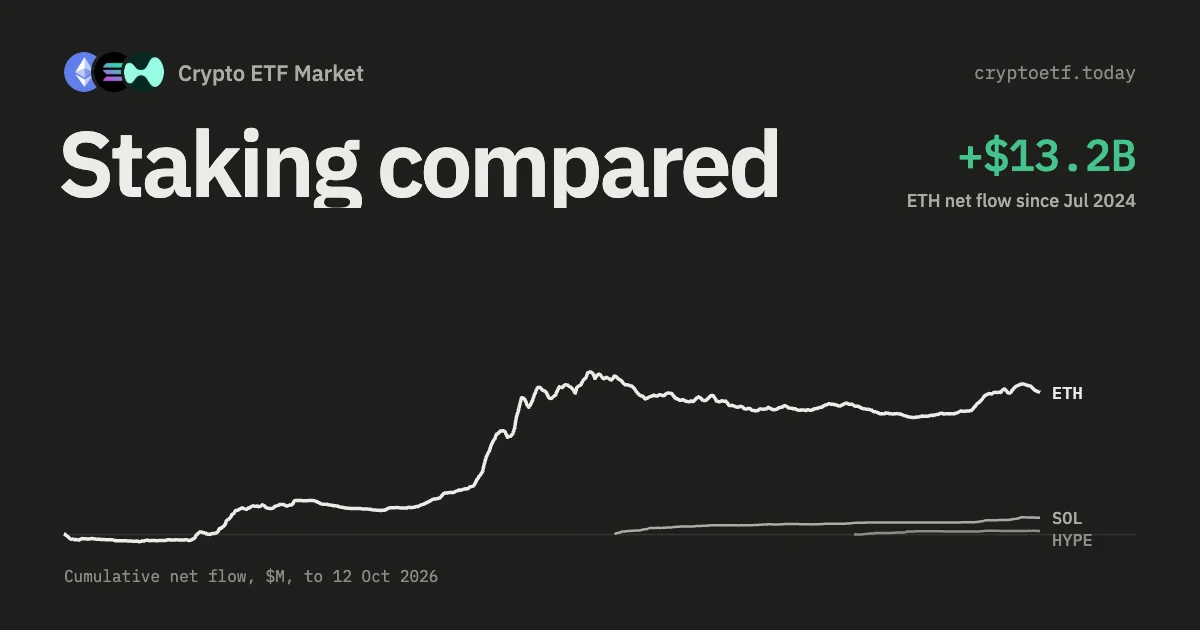
Rank by net carry and the headline fee stops mattering. TETH is free until 8 October 2026 and ETHB is down to 0.12%, yet the Grayscale mini at 0.15% still leads on carry, because a 6% cut is far smaller than 18% or 25%. A waiver is a saving for a fixed term; the cut and the staked share are structural. ETHE stakes as diligently as anyone and still loses money on carry: 1.45% × 82% × (1 − 23%) is 0.92%, and a 2.50% fee is nearly three times that. The full grid across all six staking assets is in staking crypto ETFs compared.
What the difference is worth over ten years
Forget price for a moment — a carry gap compounds the same whatever ether does. Take ETHB at +0.91% a year against ETHA at −0.25%: a spread of 1.16 percentage points. Compounded over a decade that is about 12% more ether per share, or roughly $12,000 on a $100,000 position at an unchanged price. Against a direct staker earning close to the full 1.45%, the same fund gives up roughly half a point a year, or about 5% over ten years.
The ranking is the one you would expect — direct staking, the staking ETFs, the passive ones, ETHE — but the distances are small. Inside a Roth IRA or a 401(k), the sheltering is worth far more than 50 basis points of carry.
Europe is not the answer it used to be
European staking ETPs were once the only way to get the yield inside a listed wrapper, and that argument is now dead. 21Shares' Ethereum Staking ETP (AETH) showed a 1.49% product fee against a 1.69% staking yield on its own product page in late September 2026 — a net of about 0.2 percentage points, well under what the Grayscale mini or ETHB deliver, and before any currency or platform cost. CoinShares and Bitwise run comparable European products. For a US investor, none of this is worth the access problem.
The risks that come with the reward
- Slashing is live on Ethereum, unlike Solana or Avalanche. A validator failure can cost principal, and the fund bears it.
- Exit queues. Staked ether cannot be unstaked instantly; the validator exit queue runs from days to weeks depending on congestion. No US Ethereum fund publishes an expected figure. This is why TETH targets only 40–70% staked and keeps the rest liquid.
- Provider concentration. Coinbase arranges the validators behind ETHB and sits behind staking programmes across much of the wider crypto ETF field, so one vendor's operational failure could touch several tickers in the same week.
- The rate can keep falling. 1.45% is a September 2026 reading, and the trend has been down for three years. None of the cuts above shrink when it does — VanEck's fixed staking fee on Solana is the cautionary shape.
What it means for allocation
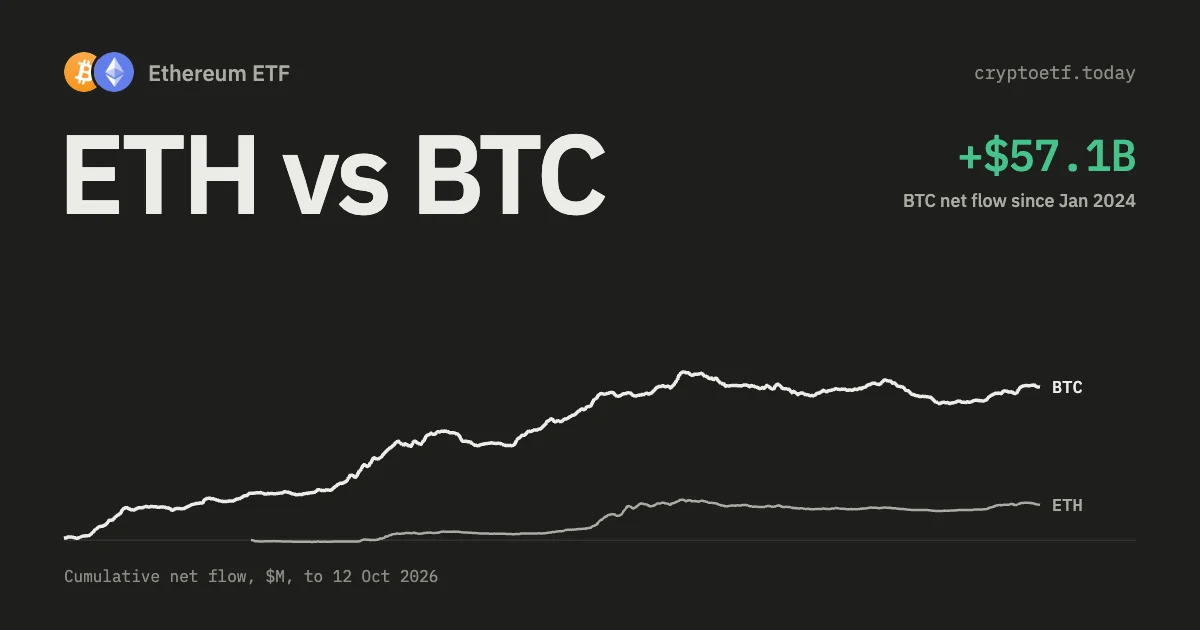
Staking no longer separates the ETF wrapper from direct ownership — it separates funds from each other, by about a percentage point a year at most. Hold a staking fund with a small cut rather than a passive one, and avoid ETHE unless you are locked in for tax reasons. The BTC-versus-ETH weighting question, which this used to distort, is in ETH ETF vs BTC ETF allocation; the fund-by-fund comparison is in best Ethereum ETF.
FAQ
Do US Ethereum ETFs stake?
Yes, five of them. Grayscale's ETHE and its mini trust began staking on 6 October 2025, 21Shares' TETH on 8 October 2025, BlackRock's ETHB on 12 March 2026 and Fidelity's FETH on 21 August 2026. ETHA, ETHW, ETHV, QETH and EZET hold ether passively; ETHA is barred from staking by its own 10-K.
How much does an Ethereum ETF actually pay in staking?
Less than most people expect. The network paid about 1.45% gross in September 2026, sponsors keep 6% to 25% of it, and no fund stakes 100% of its ether. Net of cut and fee, the Grayscale mini nets roughly 0.98% a year, ETHB 0.91% and FETH 0.86%. ETHE nets about −1.6% because its 2.50% fee is nearly three times what its staking delivers.
Which Ethereum ETF has the best staking terms?
On net carry, Grayscale's mini trust: a 0.15% fee and a 6% cut of rewards, the smallest in the Ethereum group. BlackRock's ETHB has the lower headline fee while its waiver runs to March 2027 but keeps 18% of rewards. Morgan Stanley's MSSE, listed 28 July 2026, is cheaper still at 0.14% with a 5% cut, but is outside our flow data.
Is a European staking ETP better than a US Ethereum ETF?
Not any more. 21Shares' AETH charged a 1.49% product fee against a 1.69% staking yield in late September 2026, netting about 0.2 percentage points — less than the Grayscale mini or ETHB deliver in the US, before access and currency costs.
What are the risks of holding a staking Ethereum ETF?
Slashing is live on Ethereum, so validator failure can cost principal and the fund bears it. Staked ether also has an exit queue running from days to weeks, which is why some funds deliberately stake only part of their holdings. Several funds rely on the same staking provider. Your shares still trade normally and settle T+1.
Sources and further reading
- SEC EDGAR, Form 10-Q filings for the quarter ended 30 June 2026 for the Grayscale, BlackRock, Fidelity and 21Shares Ethereum trusts — share staked, sponsor cut, distribution policy.
- SEC EDGAR, iShares Ethereum Trust ETF Form 10-K — the prohibition on staking that applies to ETHA.
- iShares ETHB product page, 16 September 2026 — 1.45% gross network rate.
- 21Shares AETH product page, late September 2026 — 1.49% fee, 1.69% staking yield.
- Internal: Staking crypto ETFs compared, Best Ethereum ETF, ETH ETF vs BTC ETF allocation.
For information only. Not investment advice.
 BTC
BTC SOL
SOL XRP
XRP HYPE
HYPE LINK
LINK HBAR
HBAR AVAX
AVAX DOGE
DOGE LTC
LTC SUI
SUI DOT
DOT BNB
BNB NEAR
NEAR TRX
TRX ZEC
ZEC