IBIT charges 0.25%; GBTC charges 1.50%. Switching saves $12,500 a year on a $1M position — unless the capital gains bill is bigger. Here is the math.
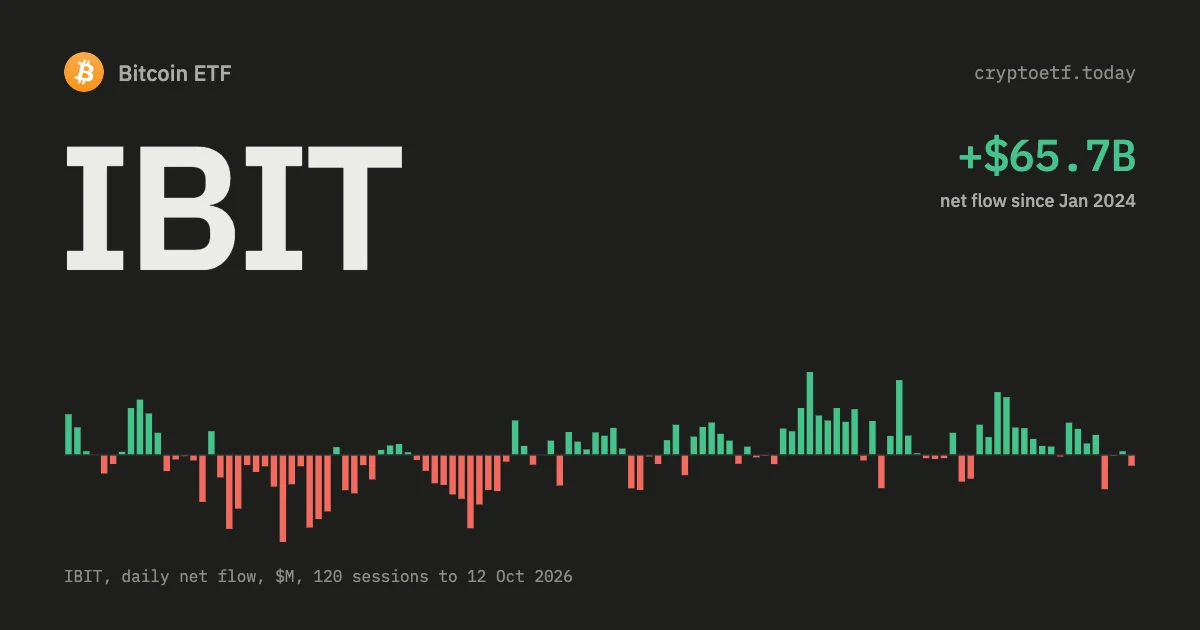
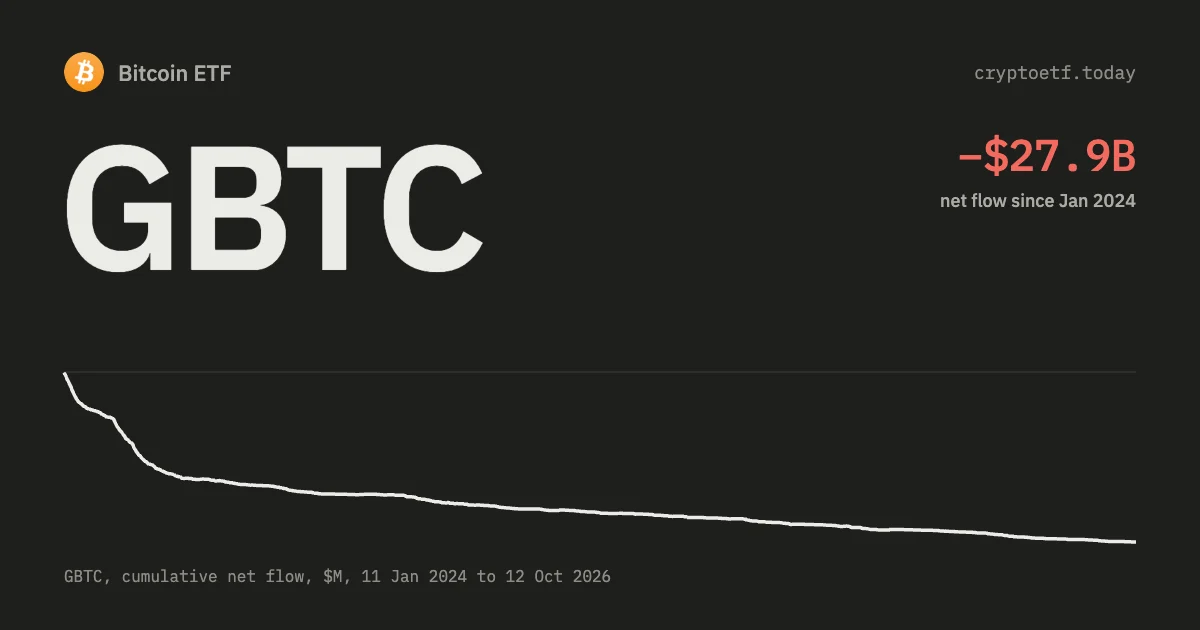
TL;DR. IBIT charges 0.25%; GBTC charges 1.50%. The 1.25 percentage point gap costs $12,500 a year on a $1M position, and the market has voted with its feet: GBTC has shed $27.8 billion of net outflows since January 2024, by far the largest of any fund in the category. Most remaining holders should switch — but the switch triggers capital gains tax on embedded appreciation, and for early holders that bill is large. The break-even depends entirely on your cost basis. The Grayscale Bitcoin Mini Trust (ticker BTC) at 0.15% is the Grayscale-brand alternative.
Contents · 8 sections
 Bitcoin ETFsNet flow Fri 16 Oct−$82.4M
The fee math
| Position size | IBIT annual fee (0.25%) | GBTC annual fee (1.50%) | Annual saving by switching |
|---|---|---|---|
| $50,000 | $125 | $750 | $625 |
| $250,000 | $625 | $3,750 | $3,125 |
| $1,000,000 | $2,500 | $15,000 | $12,500 |
| $5,000,000 | $12,500 | $75,000 | $62,500 |
Over ten years on a $1M position the raw fee difference is roughly $125,000, before compounding. In absolute terms the switch is obviously valuable.
What the outflows say
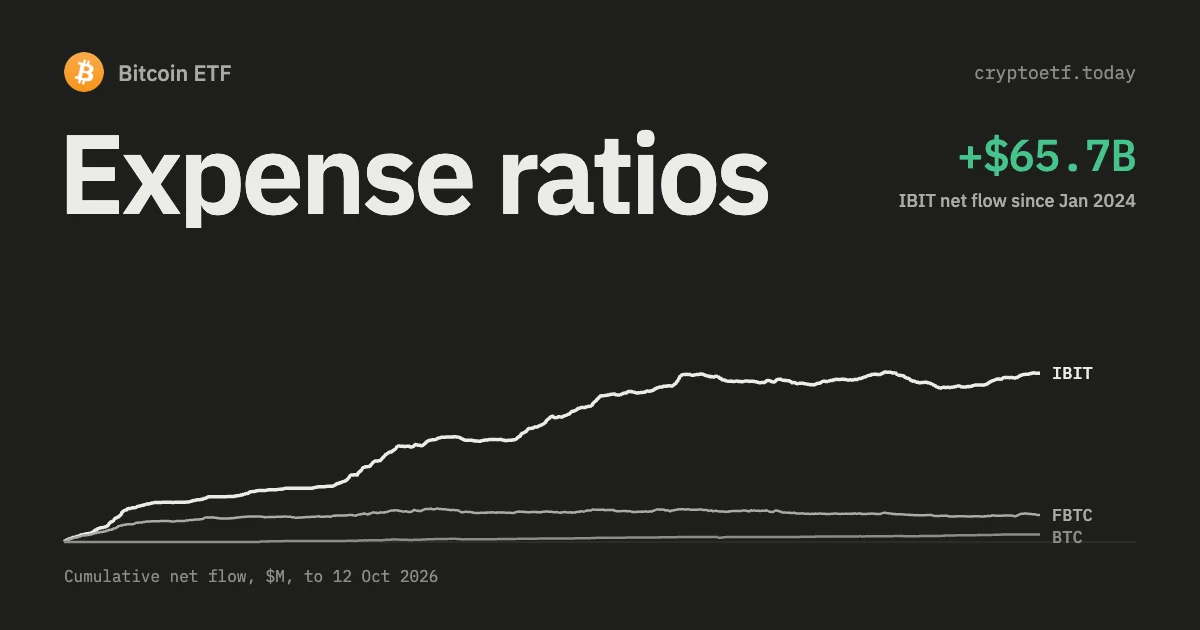
GBTC entered the ETF era in January 2024 as the largest bitcoin fund in the world. It has since seen $27.8 billion of cumulative net outflows — the only fund in the category deep in the red — and held roughly $11.0 billion as of 24 September 2026, against IBIT's $67.9 billion. The fee gap is the single best explanation. Anyone still weighing the decision should know that most of the money has already made it.
The capital gains problem
The holders who stayed are mostly the ones who cannot leave cheaply. Take a $1M GBTC position in a taxable account and run it at two different cost bases, using the top long-term rate of 20% plus the 3.8% net investment income tax, or 23.8%:
- Early holder, basis $400k. Embedded gain $600k → tax $142,800. You reinvest $857,200 into IBIT. Fee saving 1.25% × $857,200 = $10,715 a year. Time to work off the tax bill: about 13 years.
- Recent holder, basis $850k. Embedded gain $150k → tax $35,700. You reinvest $964,300. Fee saving $12,054 a year. Time to work off the tax bill: about 3 years.
That is the whole decision in two lines. The lower your basis, the longer the switch takes to pay for itself — and the more attractive it becomes to simply hold.
The Grayscale Mini Trust alternative
In July 2024 Grayscale spun a portion of GBTC's bitcoin into the Grayscale Bitcoin Mini Trust (ticker BTC), which began trading on 31 July 2024 at a 0.15% fee — one tenth of GBTC's. Existing GBTC holders received Mini Trust shares in the distribution, which Grayscale described as intended to be non-taxable for US holders. The Mini Trust held roughly $5.4 billion as of 24 September 2026.
- If you held GBTC through the spin-off, part of your bitcoin exposure is already sitting at 0.15%, and the question is what to do with the rest.
- If you bought GBTC afterwards, you got no such benefit — and for new money there is no argument at all for GBTC over the Mini Trust from the same sponsor.
The conversion decision framework
- Your cost basis. Lower basis = bigger embedded gain = bigger tax bill = longer break-even.
- Your holding horizon. A 20-year horizon makes almost any conversion worthwhile. A 5-year horizon often does not.
- Account type. In an IRA or 401(k) there is no tax event at all. Switch immediately; no math required.
- Estate planning. Under current law the basis of inherited property is stepped up to fair market value at death (IRC §1014). For an elderly holder with very low basis, holding GBTC and letting heirs take the step-up can beat converting.
- Loss offsets. Realised losses elsewhere in the same tax year can absorb part of the conversion gain.
What about partial conversions?
You do not have to move all at once. Converting $200k a year over five years instead of $1M in one go realises smaller annual gains and may keep you below higher bracket thresholds.
The cost of going slowly: you keep paying 1.50% on whatever is still in GBTC. On a $1M position spread over five years the average unconverted balance is about $500k, so the transition costs roughly $500k × 1.25% × 5 ≈ $31,000 in extra fees — against whatever bracket management saves you.
FAQ
What is the difference between IBIT and GBTC fees?
IBIT charges 0.25% a year, GBTC charges 1.50% — a 1.25 percentage point gap, or six times the cost. On a $1M position that is $12,500 a year, and roughly $125,000 over a decade before compounding.
Why would anyone still hold GBTC at 1.50%?
Because leaving costs money. Long-standing holders bought at much lower prices, and selling realises long-term capital gains at up to 23.8% including the net investment income tax. For a holder whose basis is 40% of current value, the fee saving takes around 13 years to work off that one-time bill.
Should I switch from GBTC to IBIT?
In a tax-advantaged account, yes, immediately — there is no tax consequence. In a taxable account, run your own cost-basis math: recent buyers with small embedded gains usually should; very-low-basis holders may do better staying put, converting in slices, or holding for the step-up at death.
What is the Grayscale Bitcoin Mini Trust?
A separate ETF (ticker BTC) charging 0.15%, created in July 2024 by spinning a portion of GBTC’s bitcoin into a new trust and distributing its shares to GBTC holders. Grayscale described that distribution as intended to be non-taxable for US holders. It began trading on 31 July 2024 and held about $5.4 billion in September 2026.
Can I convert GBTC to IBIT in my IRA without paying tax?
Yes. In any Roth IRA, traditional IRA or 401(k), selling GBTC and buying IBIT is not a taxable event. There is no reason to pay 1.50% inside a retirement account when 0.25% — or 0.15% in the Grayscale Mini Trust — is one trade away.
Sources and further reading
- Grayscale Investments LLC v. SEC (D.C. Cir.), decided 29 August 2023.
- Grayscale Bitcoin Trust ETF annual and quarterly reports — sec.gov.
- Fund size and fees — stockanalysis.com, 24 September 2026. Cumulative flows — our own daily series, Bitcoin ETF flows.
- Internal: BlackRock IBIT review, Grayscale GBTC analysis, Expense ratios compared.
For information only. Not investment advice.
 ETH
ETH SOL
SOL XRP
XRP HYPE
HYPE LINK
LINK HBAR
HBAR AVAX
AVAX DOGE
DOGE LTC
LTC SUI
SUI DOT
DOT BNB
BNB NEAR
NEAR TRX
TRX ZEC
ZEC