On $10,000 held five years, GDOG costs about $195 and TDOG $273; DOGE bought on an order book costs $80 to $160 once and nothing after. Break-even, custody, IRA access, tax.
TL;DR. Two spot Dogecoin ETFs remain after Bitwise closed BWOW in October 2026: Grayscale's GDOG at 0.35% a year and 21Shares' TDOG at 0.50%. On $10,000 held five years at a flat price, GDOG costs about $195 and TDOG $273 including the bid-ask spread. Buying the coin on an exchange order book costs $80 to $160 in fees once and nothing per year after, so the coin is cheaper for any hold longer than about two years. Neither route earns anything: Dogecoin is proof-of-work and there's no staking. The ETF wins where the coin can't go, which is an IRA or 401(k), and for anyone who won't hold keys. The coin wins on cost over time, on 24/7 trading against a fund that did 132 shares in a day, and on being usable as Dogecoin.
Contents · 10 sections
- The arithmetic on $10,000
- Nothing to earn, either way
- Custody: three different ways to lose it
- Retirement accounts end most of these debates
- Tax: same rates, different paperwork
- Liquidity: a $9m fund against a 24/7 market
- Choose the ETF if, choose the coin if
- How this compares with Bitcoin and HYPE
- FAQ
- Sources and further reading

The arithmetic on $10,000
Fund marketing quotes the management fee and stops. The honest version needs the cost to get in, the cost per year to stay, the cost to get out, and the holding period. Here they are for $10,000 with the DOGE price held flat so the fee drag shows on its own; every fee was read from an issuer or exchange page in September 2026 and is cited at the end.
| Route | Entry + exit | Per year | 1 year | 3 years | 5 years |
|---|---|---|---|---|---|
| GDOG (0.35%) | $20 (0.20% spread) | $35 | $55 | $125 | $195 |
| TDOG (0.50%) | $23 (0.23% spread) | $50 | $73 | $173 | $273 |
| Coin, order book, maker orders | $80 (0.40% × 2) | $0 | $80 | $80 | $80 |
| Coin, order book, taker orders | $120 to $160 (0.60% to 0.80% × 2) | $0 | $120 to $160 | $120 to $160 | $120 to $160 |
| Coin, self-custody | Order-book fees + 4 DOGE withdrawal + a wallet | $0 | Same as the order-book rows, plus the wallet | ||
The ETF rows assume a zero-commission broker and charge one full 30-day median spread, because you cross half of it buying and half selling. The coin rows use the bottom volume tier at Coinbase Exchange (0.40% maker, 0.60% taker) and Kraken Pro (0.40% maker, 0.80% taker) as published on 19 September 2026, and ignore the spot bid-ask on DOGE-USD, a fraction of the fee on a major pair.
Two things fall out. For a short hold the ETF isn't the expensive option: at GDOG's 0.35% it takes about 1.7 years of fee drag to overtake an $80 maker round trip and 2.9 years to overtake $120 of taker fees. Past that point the gap widens by $35 to $50 a year, forever, while the coin's cost is already paid. GDOG's own shareholders averaged in for ten months through a near-50% decline; people who hold like that are cheaper in the coin.
The route I can't put a number on is the simple buy button. Coinbase's pricing page says a retail buy includes a spread plus a fee that varies by payment method, with a separate 1% charge on simple limit orders; Kraken's says Instant Buy carries a fixed trading fee plus a spread that "may vary for similar transactions". Neither prints the all-in figure, and it's reliably higher than the order book. Buy DOGE through a button and most of the ETF's cost disadvantage disappears on day one.
Nobody sends Grayscale $35, either. The sponsor fee is paid in Dogecoin out of the trust, so the number that falls is DOGE per share: GDOG showed 117.35 on 18 September 2026, TDOG 201.15 on 16 September, and both drift down by the fee each year. A coin in a wallet carries no annual charge, and Kraken's 4 DOGE withdrawal fee is under fifty cents at the September price of about nine cents.
Nothing to earn, either way
With Hyperliquid or Solana, the wrapper decision hinges on staking: the fund keeps a slice of the reward and the self-custodied holder keeps all of it. That argument doesn't exist here. Dogecoin is a proof-of-work chain merge-mined with Litecoin: no staking, no validator reward, no fee burn, no protocol revenue. A DOGE ETF has nothing to pass through and a wallet has nothing to collect. Where an exchange advertises a yield on DOGE, it's a lending product with the exchange as counterparty.
What both routes share is dilution. The chain pays 10,000 DOGE a block, about 3.4% annual inflation against a supply near 155 billion, as set out in Dogecoin ETF explained, and neither wrapper escapes it. So the DOGE comparison is unusually clean: fees, custody, access, tax and liquidity, with no yield to muddy it.
Custody: three different ways to lose it
The ETF. GDOG's Dogecoin sits at Coinbase Custody Trust Company in a segregated account; TDOG's prospectus names Coinbase Custody, BitGo Bank & Trust and Anchorage Digital Bank. Your shares sit at a broker as securities. The coins aren't insured on your behalf, the trusts aren't 1940-Act funds, and every prospectus says shareholders don't get mutual-fund protections. The risk is institutional: a custodian breach, a sponsor error, or the fund closing under you. BWOW listed in November 2025 and was gone by 14 October 2026 with a forced cash payout, and GDOG at $9.3m is small enough that Grayscale could make the same call. The plumbing is in how Bitcoin ETF custody works.
The exchange. DOGE in a Coinbase or Kraken account is held under the venue's terms of service. The survivors of 2022 run segregated customer accounts, but a crypto balance there is neither a bank deposit nor a brokerage security; if the venue fails you're a creditor. Most convenient of the three, least legal structure around it.
Your own keys. Nobody can freeze it, close it or lend it out. Equally, nobody can help: a lost seed phrase or a phishing signature is a total loss with no support line. Self-custody is a skill, and a cheap coin doesn't make it easier.
On safety the honest ranking is ETF, exchange, then self-custody; on sovereignty it's the reverse. Which end you weight is the decision.
Retirement accounts end most of these debates
An IRA or 401(k) can hold GDOG or TDOG because they're listed securities. It generally can't hold DOGE. Specialised crypto IRA custodians will hold coins at their own fee schedule, a trade-off covered in crypto IRA versus Bitcoin ETF IRA, but for a standard brokerage IRA the ETF is the only door. That rewrites the cost table: inside a tax-advantaged account, 0.35% a year buys a position that rebalances without capital gains tax. If most of your investable money is retirement money, the five-year comparison never applied, because the coin was never an option.
Tax: same rates, different paperwork
In a US taxable account the rates are identical. The IRS treats digital assets as property, and a grantor trust holding DOGE passes the same character to shareholders: short-term gains at ordinary income rates under a year, long-term rates over it. What differs is who does the accounting.
| ETF shares | DOGE at an exchange | DOGE in your wallet | |
|---|---|---|---|
| Legal character | Security | Property (digital asset) | Property (digital asset) |
| Broker reporting | Form 1099-B with cost basis | Form 1099-DA: gross proceeds from 2025 sales, basis from 2026 | None; you keep every record |
| Wash-sale rule (§1091) | Applies | Not currently, as of September 2026 | Not currently, as of September 2026 |
| Fee inside the wrapper | Trust sells DOGE to pay it; small pro-rata gain or loss each year | None | None |
The ETF is the low-effort route: the broker tracks basis, issues a 1099-B, and the numbers drop into tax software. The one wrinkle is that the trust sells a little DOGE to pay its fee and shareholders report their share of those tiny dispositions; Grayscale publishes an annual tax letter for it. The coin is catching up: per the IRS's digital-assets page, exchanges report gross proceeds on Form 1099-DA for sales from calendar 2025 and add basis from 2026, but only for coins bought and sold at one venue. Move DOGE to a wallet and back and you reconstruct the basis yourself. The fund-side rules in Bitcoin ETF tax in the USA apply unchanged.
The wash-sale point cuts the other way. Section 1091 disallows a loss if you buy "substantially identical" stock or securities within 30 days either side of the sale. ETF shares are securities, so selling GDOG at a loss and rebuying inside the window forfeits the loss. Dogecoin is property, and as of September 2026 the IRS's guidance doesn't extend the rule to it, so the same trade in coins keeps the loss. Bills to close that gap have been introduced and none had passed at the time of writing; confirm the position for the year you file, and don't assume a GDOG-for-DOGE swap is safe in either direction. None of this is tax advice; the mechanics are in tax-loss harvesting a Bitcoin ETF.
Liquidity: a $9m fund against a 24/7 market
This is where the wrapper is weakest. The two DOGE funds held $9.34m and $2.46m in mid-September 2026. GDOG traded 92,966 shares on 18 September, about $960,000 at $10.34, fine for a retail order; TDOG traded 132 shares for the whole of 16 September. Median spreads were 0.20% and 0.23%, and a market order of any size in TDOG will move the price. Use limits.
Add the calendar. The funds trade 9:30 to 4:00 Eastern, five days a week; DOGE trades continuously, so a 15% weekend move shows up as a gap at Monday's open in the fund. For a coin whose biggest moves have historically come from a Saturday post, that's a real cost. Add the creation mechanics: both funds deal in 10,000-share baskets, and through mid-September GDOG had changed its share count on 25 of 202 trading days, TDOG on 6 of 163, which is why reading Dogecoin ETF flows needs its own rules. A buyer at a 1% premium on a fund this small has paid three years of fee in one trade. DOGE-USD on a major venue absorbs a $10,000 order without noticing, at 3am on a Sunday, with instant settlement.
There's also what a share can't do. Dogecoin was built as a tipping currency and still gets used as one; a fund share can't tip a creator, pay a merchant or be sent to a friend, and the prospectuses let the sponsor abandon any forked or airdropped asset. If DOGE is an allocation on a statement, none of that matters. If it's a currency you use, the ETF was never the right tool.
Choose the ETF if, choose the coin if
| If you... | Choose | Because |
|---|---|---|
| Invest through an IRA or 401(k) | ETF | The coin generally can't be held there; the fee buys tax-sheltered compounding |
| Will hold five years or more in a taxable account | Coin | $80 to $160 once beats $195 to $273 and rising |
| Would buy through a simple-buy button | ETF | Spread plus fee on retail buys erases most of the coin's cost edge |
| Don't want to hold keys or run an exchange account | ETF | Custody, reporting and basis tracking are done for you |
| Trade around weekend moves | Coin | 24/7 market versus a fund that gaps on Monday |
| Actually use DOGE to pay or tip | Coin | A share can't be spent |
| Want to harvest a loss and rebuy quickly | Coin | Wash-sale rule applies to the shares, not (currently) to the coin |
| Worry the product might close | Coin | BWOW shut in under a year; a wallet can't be liquidated by a sponsor |
The two routes aren't exclusive. The split that fits most US investors with retirement savings is the fund in the IRA, where it's the only permitted route, and the coin in the taxable account, where the cost advantage compounds. It doubles what you track and splits your exposure across two liquidity regimes; if you ever need out fast, know in advance which half sells at 3am.
How this compares with Bitcoin and HYPE
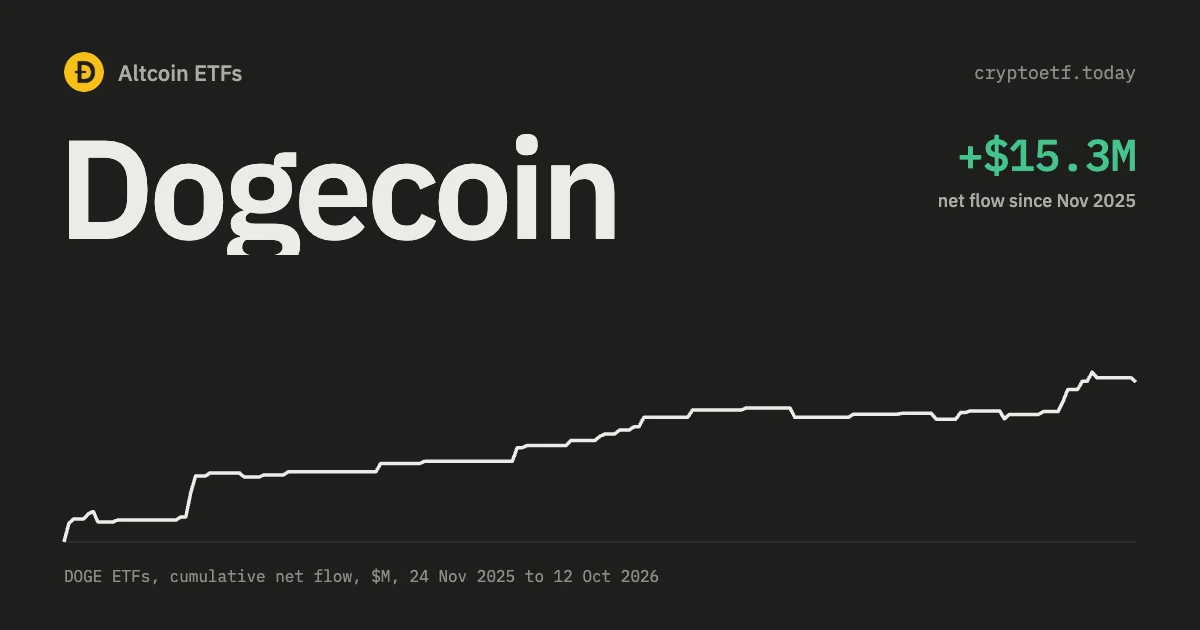
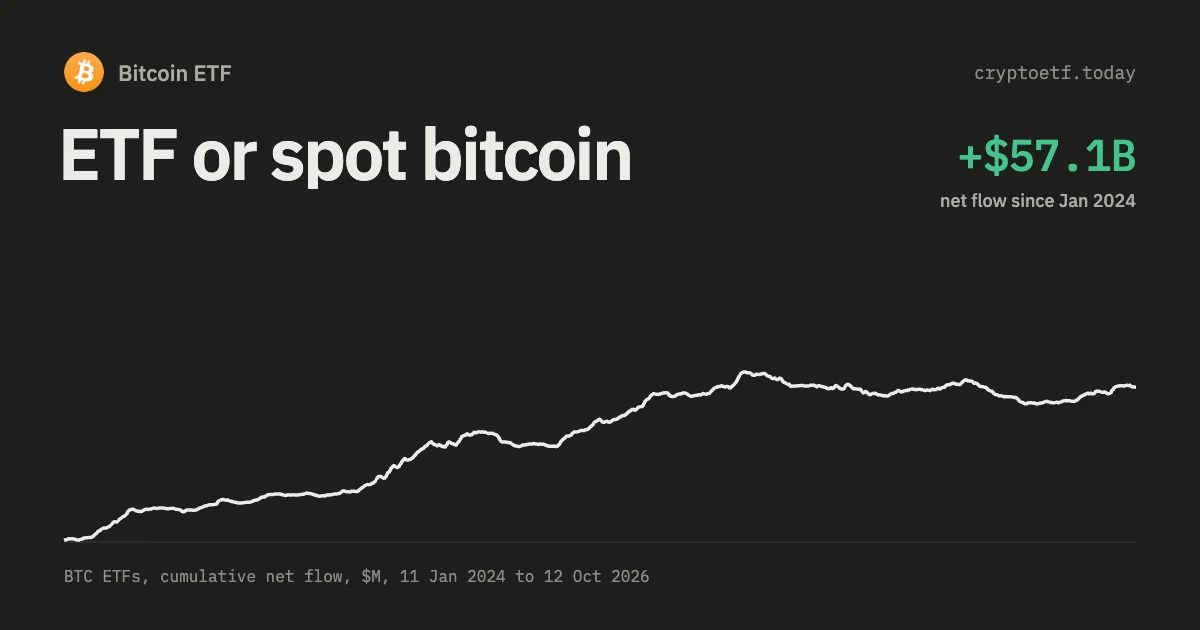
The same decision on Bitcoin is easier for the fund: fees of 0.19% to 0.25%, tens of billions in assets, spreads of a basis point or two, so Bitcoin ETF versus spot Bitcoin lands close to a coin toss. For HYPE it tilts toward the token, which keeps the full staking reward and earns fee discounts on the platform. Dogecoin sits between: 35 to 50 basis points against Bitcoin's 19 to 25, funds a thousandth of the size, spreads ten times wider, one of three products already closed, and no utility argument beyond spending the coin. The wrapper's case is the Bitcoin one, access from accounts the coin can't reach and no keys to hold, just narrower. To see whether anyone is buying it this month, the Dogecoin ETF flows page shows daily creations and redemptions for GDOG and TDOG, updated every business day.
FAQ
Is it cheaper to buy a Dogecoin ETF or Dogecoin itself?
Over a long hold, the coin. GDOG charges 0.35% a year and TDOG 0.50%, so $10,000 costs about $195 or $273 over five years including spreads, while DOGE bought on an order book costs $80 to $160 once. Under about two years the ETF is comparable or cheaper, especially against taker fees or a retail buy button.
Does a Dogecoin ETF pay any yield or staking reward?
No. Dogecoin is a proof-of-work chain with no staking, so there is no reward for the fund to earn or pass on, and none for a self-custodied holder either. Any DOGE yield an exchange advertises is a lending product with the exchange as counterparty.
Can I hold Dogecoin in an IRA or 401(k)?
Not through a standard brokerage retirement account, which holds listed securities such as GDOG and TDOG but not the coin. Specialised crypto IRA custodians exist with their own fees. This is the strongest single argument for the ETF.
How are Dogecoin ETF shares taxed compared with DOGE?
At the same capital gains rates in a US taxable account. ETF shares are securities reported on Form 1099-B by your broker with cost basis. DOGE is property: exchanges report sales on Form 1099-DA (gross proceeds from 2025, basis from 2026), and self-custodied coins are entirely self-reported on Form 8949.
Does the wash-sale rule apply to Dogecoin?
As of September 2026, section 1091 covers stock and securities, which includes ETF shares like GDOG, while the IRS treats digital assets as property, so the rule does not currently reach DOGE held directly. Legislation to change that has been proposed and not enacted; confirm the position for your tax year. This is not tax advice.
Sources and further reading
- GDOG fee, custodian, AUM, DOGE per share and spread (18 September 2026), etfs.grayscale.com; prospectus (Form 424B3, March 2026), sec.gov.
- TDOG fee, NAV, AUM and spread (17 September 2026), 21shares.com; prospectus (Form 424B3, 2026), sec.gov.
- Coinbase Exchange fee tiers and retail pricing disclosures, read 19 September 2026, help.coinbase.com.
- Kraken Pro fee tiers, Instant Buy overview (6 March 2026) and DOGE withdrawal fee (31 December 2025), kraken.com.
- IRS, digital assets: property treatment and Form 1099-DA timeline, irs.gov.
- Bitwise BWOW, Form 8-K on liquidation (September 2026), sec.gov.
For information only. Not investment advice.
 BTC
 ETH
 SOL
 XRP
 HYPE
 LINK
 HBAR
 AVAX
 LTC
 SUI
 DOT
 BNB
 NEAR
 TRX
 ZEC