The only US spot Litecoin ETF: 0.95% fee, Coinbase and BitGo custody, $7.8m across 560,000 shares on 18 Sep 2026. NAV is down 44% from the $25 seed; the share count rose 14-fold.
TL;DR. The Canary Litecoin ETF (LTCC) is the only spot Litecoin fund listed in the United States, on Nasdaq since 28 October 2025. It charges 0.95% a year, the top of the US spot crypto range and roughly four to five times what a Bitcoin fund costs, and there's no staking to soften that because Litecoin is proof-of-work. On 18 September 2026 it held $7.77m across 560,000 shares at a $13.88 NAV, 44.5% below the $25 that Charlie Lee paid for the 40,000 seed shares. The share count has grown every quarter through that drawdown: 370,000 at the end of 2025, 470,000 in March, 520,000 in June. Median daily volume is about 14,000 shares and the 30-day spread is 0.46%, so this is a fund you buy with a limit order and hold, not one you trade. Worth owning if you need Litecoin inside an IRA or a mandate that requires listed securities. Not worth 0.95% for anyone who can hold the coin.
Contents · 12 sections
- Fund at a glance
- Who Canary Capital is
- Legal shape: a grantor trust, not a 1940 Act fund
- Creations, redemptions and what the fund page tells you
- The 0.95% fee against everything it competes with
- Liquidity: a fund you buy with a limit order
- Share count since listing
- Who it's for
- Pros and cons
- Verdict
- FAQ
- Sources and further reading

Fund at a glance
| Item | Canary Litecoin ETF (LTCC) |
|---|---|
| Sponsor | Canary Capital Group LLC, Brentwood, Tennessee |
| Exchange / CUSIP | Nasdaq / 137221107 |
| Inception / first trade | 27 October 2025 / 28 October 2025 |
| Sponsor fee | 0.95% a year, unified; no waiver in force |
| Legal form | Delaware statutory trust, grantor trust for US tax; not a 1940 Act fund, not a commodity pool |
| Digital asset custodians | Coinbase Custody Trust Company and BitGo Trust Company |
| Cash custodian / administrator / trustee | U.S. Bank N.A. / U.S. Bank Global Fund Services / CSC Delaware Trust Company |
| Marketing agent / auditor | Paralel Distributors LLC / Cohen & Company |
| NAV benchmark | CoinDesk Litecoin CCIXber 60m New York Rate, 3–4pm ET time-weighted average |
| Creation unit | 10,000 shares, in kind or cash |
| Staking | None (proof-of-work asset) |
| Seed | 40,000 shares at $25 bought by Charlie Lee, 22 September 2025 |
| Net assets / NAV / market price (18 Sep 2026) | $7,772,919 / $13.88 / $13.91 (premium 0.19%) |
| Shares outstanding (18 Sep 2026) | 560,000 |
| NAV return since inception (18 Sep 2026) | −44.48% |
| 30-day spread (18 Sep 2026) | 0.46% |
Sources: Canary's LTCC fund page on 18 September 2026, the 2025 Form 10-K and the June 2026 Form 10-Q. The basics of what a spot Litecoin fund is, and why Litecoin got one before larger coins, are in the Litecoin ETF explainer; this piece is about whether this particular fund is worth owning.
Who Canary Capital is
Canary Capital Group is a small crypto asset manager founded in 2024 by Steven McClurg, who co-founded Valkyrie Investments and ran it as chief investment officer until CoinShares bought Valkyrie's public funds business in 2024. Valkyrie's BRRR, one of the original eleven US spot Bitcoin ETFs from January 2024, still trades under the CoinShares name, so the LTCC sponsor is a second act by someone who has already launched a Bitcoin fund through the SEC. The company's own page lists ten people, at an office in Brentwood, a suburb of Nashville.
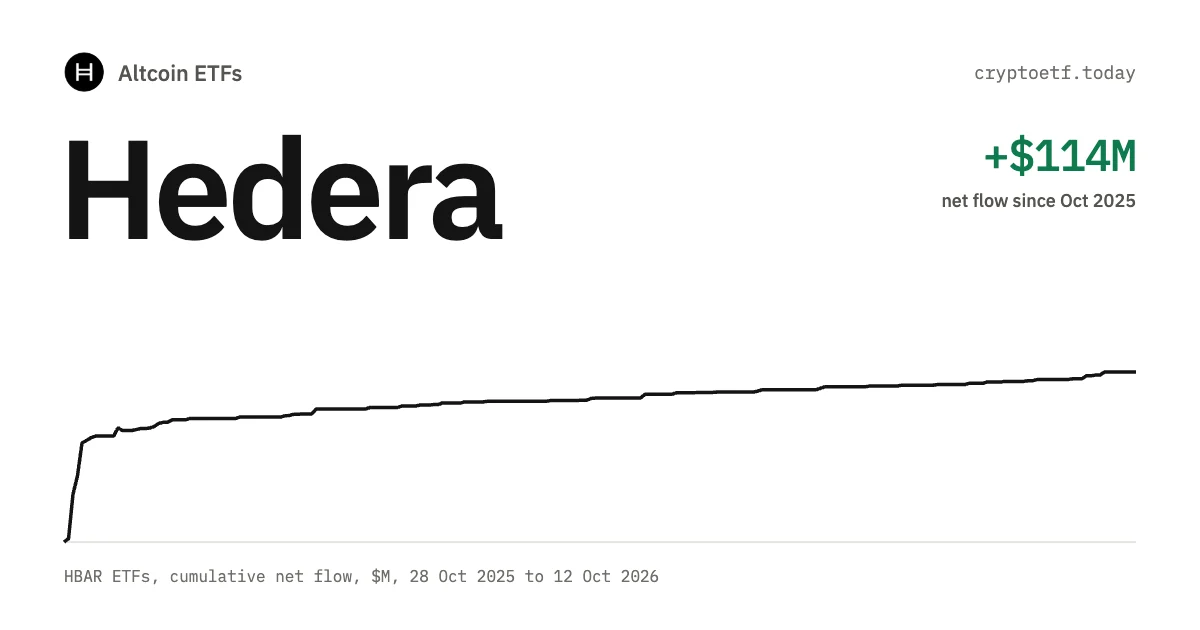
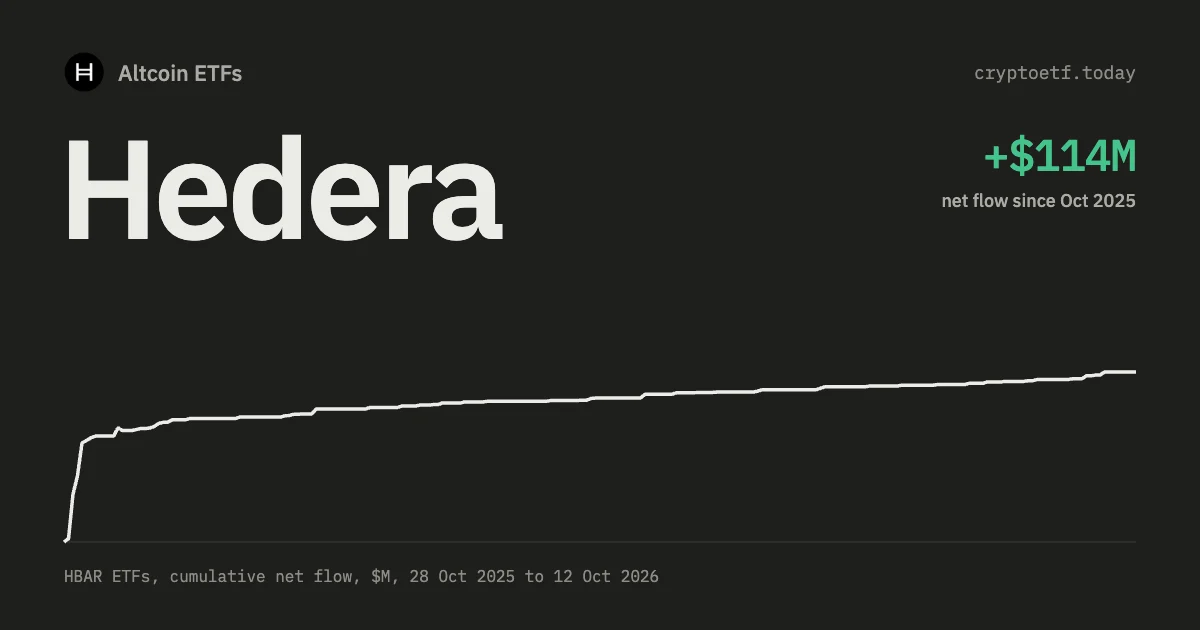
Canary's method has been to file first for coins that bigger issuers ignored and to charge for the privilege. Its September 2026 lineup is six ETFs: HBR (Hedera), LTCC (Litecoin), SOLC (Solana, staked through Marinade), SUIS (Sui, staked), TRXS (Tron, staked) and XRPC (XRP), plus two private funds. Five of those six are in this site's fund registry; the Tron fund isn't, because TRX isn't among the 13 assets we track. HBR and LTCC listed on the same morning by the same route, a registration statement refiled without the delaying amendment during the October 2025 government shutdown so it went effective on its own after 20 days. The Hedera ETF explainer covers the twin, and the contrast is instructive: HBR had $55.2m of assets on 16 September 2026, nearly eight times LTCC, and it stakes. Litecoin got Canary's first-mover fee without Canary's first-mover demand.
Two things follow from the sponsor's size. Canary's fee revenue from LTCC was $30,676 for the first half of 2026 per the 10-Q, about $57,000 a year at the June run rate, which doesn't cover two custodians, an administrator, an auditor and a Nasdaq listing. The unified fee means Canary, not the trust, eats that gap. And a sponsor that small has less to lose from closing a fund than BlackRock does. Funds of this size do get closed: Bitwise liquidated its Dogecoin fund BWOW, which held about $0.65m, in October 2026.
Legal shape: a grantor trust, not a 1940 Act fund
LTCC is a Delaware statutory trust whose only asset is Litecoin. The 10-K says it plainly: the trust isn't registered under the Investment Company Act of 1940, so shareholders don't get the board, the diversification rules or the leverage limits that apply to a mutual fund, and it isn't a commodity pool, so the CFTC doesn't supervise the sponsor either. What you get is a trustee (CSC Delaware Trust Company), an administrator that strikes NAV every day, two custodians and an annual audit by Cohen & Company.
For tax, Canary takes the position that LTCC is a grantor trust, which means each shareholder is treated as directly owning a pro rata slice of the Litecoin. In practice, when the trust sells a little LTC to pay the sponsor fee, that sale flows through to you as a small taxable event each year even if you never sold a share; how that lands on a US return is in Bitcoin ETF tax in the USA, and the rules are the same for a Litecoin trust. The fee accrues daily in LTC and is payable monthly in LTC or cash, so the number of coins behind each share only ever falls.
One line in the 10-K worth knowing before you rely on the two-custodian setup: Canary "does not intend to disclose the amount or percentage of the Trust's LTC held at either Custodian". You know the coins are split between Coinbase and BitGo, both in cold storage with a hot-wallet sleeve for creations, redemptions and fee sales. You don't know the split. How that compares with single-custodian Bitcoin funds is in how Bitcoin ETF custody works.
Creations, redemptions and what the fund page tells you
Only authorised participants can deal with the trust, and only in baskets of 10,000 shares. An AP that wants new shares delivers either LTC to the custodians (an in-kind creation) or cash to U.S. Bank, which the trust uses to buy LTC (a cash creation); redemptions run the same way in reverse. The AP pays the transaction fee, network costs and any stamp taxes. Orders are priced at the 4pm ET benchmark on the day they're received. That's the arbitrage that holds the share price near NAV, and the general mechanics are in how authorised participants work.
Canary doesn't publish a flow history or a running share count. What its page shows each day is NAV, net assets, market price, the premium or discount and the 30-day spread, with an as-of date. That's enough to reconstruct the share count, because creations only happen in whole baskets: divide net assets by NAV and round to the nearest 10,000. On 18 September 2026, $7,772,919 divided by $13.88 gives 560,008, which is 560,000 shares. The check is that $7,772,919 divided by 560,000 gives $13.88 back to the cent, and it does.
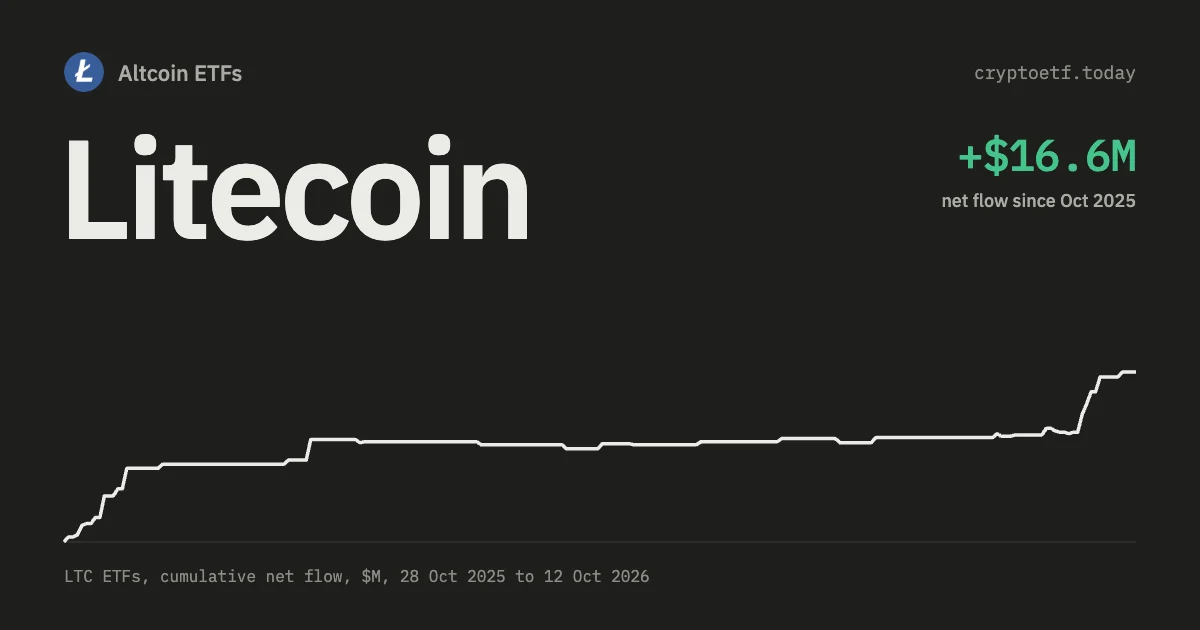
That's exactly what cryptoetf.today does every business day for the Litecoin ETF flows page: snapshot the page, derive the share count, and book the change in shares times NAV as that day's flow. Canary's count already includes the day's orders, so a Tuesday flow is known on Tuesday evening rather than the next day. Most days print zero, because one basket is 1.8% of the fund and nobody creates one on an average session. Weekends and US holidays are empty. Nothing about it is real-time, and nothing about it is estimated beyond the basket rounding.
The 0.95% fee against everything it competes with
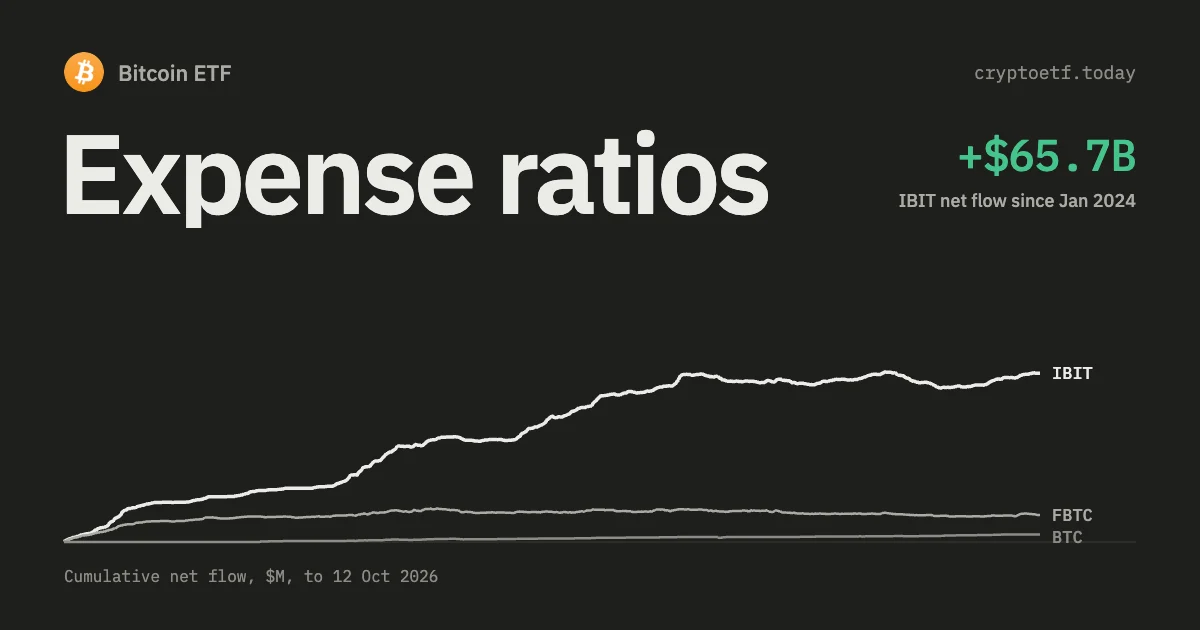
The sponsor fee is the reason to hesitate, and it's easier to see in a table than in an argument. Fees below are as of September 2026 from issuer pages and filings; the Bitcoin figures are the standard rates after launch waivers expired, detailed in our expense ratio comparison.
| Fund | Asset | Sponsor fee | Cost on $10,000 a year | Fee drag over 5 years, flat price |
|---|---|---|---|---|
| Franklin EZBC | BTC | 0.19% | $19 | 0.9% |
| Bitwise BITB / VanEck HODL | BTC | 0.20% | $20 | 1.0% |
| BlackRock IBIT / Fidelity FBTC | BTC | 0.25% | $25 | 1.2% |
| 21Shares TDOT | DOT | 0.30% | $30 | 1.5% |
| Grayscale GDOG / GLNK | DOGE / LINK | 0.35% | $35 | 1.7% |
| Canary XRPC | XRP | 0.50% | $50 | 2.5% |
| Canary SUIS | SUI | 0.75% | $75 | 3.7% |
| Canary LTCC | LTC | 0.95% | $95 | 4.7% |
| Canary HBR | HBAR | 0.95% | $95 | 4.7% |
| CoinShares LITE (Europe) | LTC | 1.50% | $150 | 7.3% |
| Grayscale LTCN (OTC, not an ETF) | LTC | 2.50% | $250 | 11.9% |
Read the last column. Hold LTCC for five years through a flat Litecoin price and the fee alone takes 4.7% of your coins; the same position in IBIT loses 1.2%. On a staking fund the reward can offset the fee; on LTCC nothing does. The 10-Q financial highlights confirm the arithmetic from the other side: the expense ratio to average net assets is 0.95% in every period, and net investment income is −0.95% in every period, because the trust has no income at all.
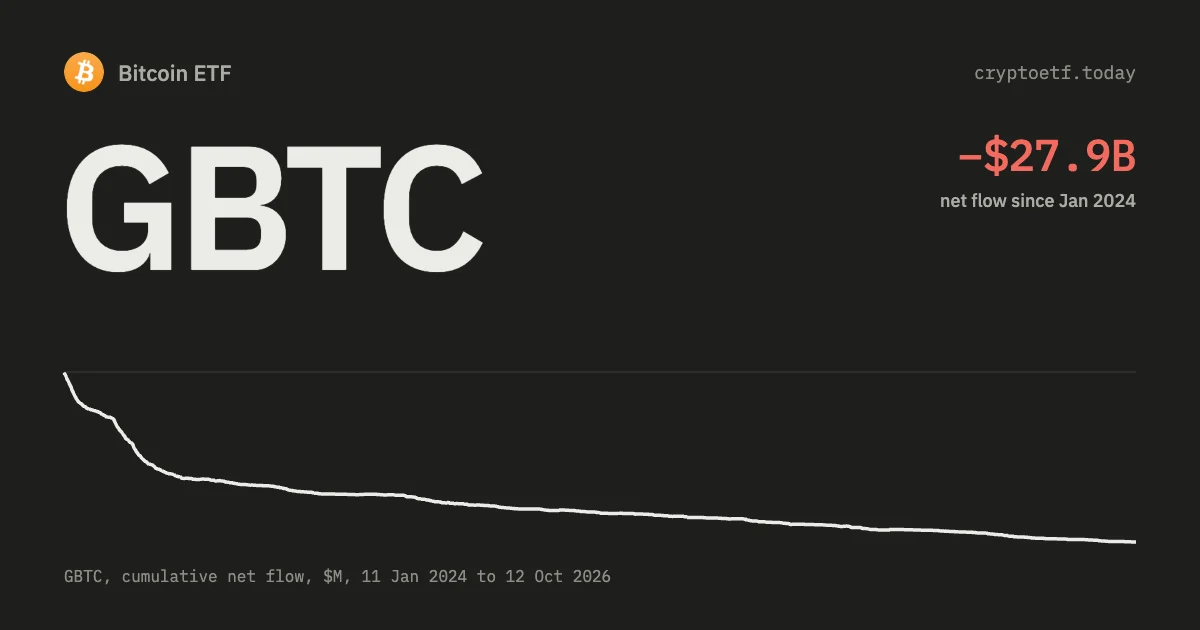
Canary can charge it because nobody else lists a US Litecoin ETF. Grayscale's LTCN, which holds roughly ten times as much LTC, filed on 11 September 2026 to convert into an exchange-traded product on NYSE Arca with the fee field left blank, the same conversion it ran for GBTC in January 2024 and that we took apart in our GBTC analysis. If that lists at 0.35%, the rate Grayscale put on its Dogecoin and Chainlink funds, LTCC's price becomes hard to defend overnight. Whether Canary would cut in response is the biggest open question in this review; the prospectus allows a waiver at the sponsor's discretion, and none has been used so far.
Liquidity: a fund you buy with a limit order
LTCC's 30-day average spread was 0.46% on 18 September 2026, per the fund page. On a $13.91 share that's about six cents, or roughly half a year of the sponsor fee paid on the way in and again on the way out. Volume is thin. Over the fund's 224 trading sessions from 28 October 2025 to 18 September 2026, median daily volume on Yahoo Finance's daily data was about 14,000 shares, under $200,000 at September prices, and the median over the last 60 sessions was 12,300. The busiest day was 10 November 2025, when 223,500 shares changed hands as LTCC closed at its high of $26.31; the quietest month was April 2026, under 10,000 shares a day on average.
Set that against the creation unit. One basket is 10,000 shares, about $139,000 at the September NAV, so a single basket is close to a normal day's turnover. That matters two ways. A retail order of a few hundred shares is fine; an order for 5,000 shares is a third of the day's volume and will move the price unless an AP steps in, which happens only when the premium justifies assembling a basket.
On 18 September the premium to NAV was 0.19%, well within normal. With a book this thin, though, a market order at the open, before the overnight Litecoin move is priced in, can cost more than the fee does in a year; premium, discount and NAV explains the mechanics. For scale, the 10-K counted about 42 DTC participants of record on 25 February 2026, which says how few brokers were holding the fund for clients three months after launch.
Share count since listing
Canary doesn't publish flows, but the trust's quarterly filings do publish creations and redemptions, and the fund page gives the current count. Together they're the fund's whole demand history.
| Date | Shares outstanding | LTC held | Net assets | NAV | LTC per share | Source |
|---|---|---|---|---|---|---|
| 22 Sep 2025 (seed) | 40,000 | n/a | $1.00m | $25.00 | n/a | 10-Q, Sep 2025 |
| 31 Dec 2025 | 370,000 | 90,747 | $6.96m | $18.81 | 0.2453 | 10-K |
| 31 Mar 2026 | 470,000 | 115,005 | $6.22m | $13.23 | 0.2447 | 10-Q, Q1 |
| 30 Jun 2026 | 520,000 | 126,930 | $5.30m | $10.20 | 0.2441 | 10-Q, Q2 |
| 29 Jul 2026 | 520,000 | n/a | n/a | n/a | n/a | 10-Q cover |
| 16 Sep 2026 | 570,000 | n/a | $7.04m | $12.35 | n/a | fund page |
| 18 Sep 2026 | 560,000 | n/a | $7.77m | $13.88 | n/a | fund page |
The gross numbers behind the net ones: 370,000 shares were created and none redeemed in the launch quarter, then 150,000 created against 50,000 redeemed in Q1 2026, then 90,000 against 40,000 in Q2. Creations have slowed each quarter, 330,000 shares in the two months after launch, 150,000 in Q1 and 90,000 in Q2, while redemptions have stayed small, which is a fund settling into a base rather than one being abandoned. Between June and mid-September another 50,000 net shares arrived, and one basket left between the 16 and 18 September snapshots as the share price jumped 12% in two days. In baskets: 33 net in the two months after listing, ten in the spring quarter, five in the summer one.
Now read the NAV column against it. NAV went $25.00, $18.81, $13.23, $10.20, then back to $13.88, and closed as low as $9.77 on 24 June 2026. The share count rose through every one of those steps. Whoever is buying LTCC is averaging into a coin that lost more than half its dollar value, and the 10-Q's average creation prices tell you where: $17.64 a share in Q1, $12.58 in Q2. The filings can't tell you whether that's conviction or stubbornness. They do tell you the buyers didn't leave when the price halved.
The last column is the fee made visible. LTC per share fell from 0.2453 to 0.2447 to 0.2441 across two quarters, about 0.24% each quarter, which is 0.95% a year and nothing else. That decline continues regardless of price, and it's the number an LTCC holder should compare with zero, the decay rate of a coin in a wallet.
Who it's for
Three buyers get value from LTCC that they can't get from an exchange account.
- Retirement accounts. An IRA or 401(k) can hold a Nasdaq-listed share; it generally can't hold LTC. If Litecoin exposure has to sit in tax-deferred money, this is the only US wrapper, and 0.95% is the price of admission.
- Mandated portfolios. Advisers and trusts restricted to listed securities have no other route to Litecoin in the US. The wrapper is the product.
- People who won't self-custody. If losing a seed phrase is a realistic risk for you, paying Coinbase and BitGo through Canary is a reasonable trade, though it's the most expensive version of that trade in the US spot crypto market.
It's a poor fit for a trader, because the spread and the book punish turnover, and for a long-term holder in a taxable account, because 4.7% of coins over five years buys a lot of hardware wallet. It's also a poor fit for anyone who expects a competitor: if LTCN converts at a lower fee, the right move is to switch, and switching in a taxable account is itself a taxable sale.
Pros and cons
| For | Against |
|---|---|
| The only US spot Litecoin ETF: IRA-eligible, brokerage-held, no keys | 0.95% fee, highest in the US spot crypto range, with no staking to offset it |
| Two regulated custodians (Coinbase Custody, BitGo) and a U.S. Bank cash custodian | Custodian split isn't disclosed; the sponsor says it won't be |
| Clean structure: 10,000-share baskets, CoinDesk 4pm benchmark, quarterly 10-Qs with creation and redemption counts | Thin market: ~14,000 shares a day, 0.46% spread, one basket close to a day's volume |
| Share count has risen every quarter through a 44–59% NAV drawdown | $7.8m of assets is small enough to be closed; Bitwise shut a smaller Dogecoin fund in 2026 |
| Sponsor with a track record of getting a Bitcoin ETF listed (Valkyrie BRRR) | Single-issuer market until Grayscale LTCN converts, and a conversion would undercut the fee |
| Grantor-trust tax treatment is simple and well understood | Annual fee sales pass through as small taxable events in a taxable account |
Verdict
LTCC does what it says. It holds Litecoin at two good custodians, prices it off a benchmark you can check, files audited numbers every quarter, and its market-price return since inception (−44.36%) sits within 0.12 points of its NAV return (−44.48%), which means the arbitrage is working. Nothing in the filings suggests the wrapper is broken. The problem is the price of the wrapper. At 0.95%, with no yield to offset it, a five-year holder hands Canary nearly 5% of their coins for a service that Bitcoin investors get for a quarter of the cost, and the sponsor's own income statement shows the fee doesn't even cover running the fund at this size.
So: buy it if the account can't hold the coin, size it as a satellite, use limit orders, and keep an eye on two things. The first is the Grayscale LTCN conversion, which would either give you a cheaper fund to move to or force Canary's hand. The second is the share count, because a fund this small stays open only while baskets keep arriving; through September 2026 they still were. Both show up day by day on the Litecoin ETF flows page, and the wider field of single-issuer altcoin funds is in the full list of 2026 crypto ETFs.
FAQ
What is the Canary Litecoin ETF expense ratio?
0.95% a year, charged as a unified sponsor fee that covers custody, administration, audit and listing. No waiver was in force as of September 2026. It is the highest fee of any US spot crypto ETF, matched only by Canary’s Hedera fund HBR, and there is no staking reward to offset it because Litecoin is proof-of-work.
Who holds the Litecoin in LTCC?
Two custodians, Coinbase Custody Trust Company and BitGo Trust Company, keep the coins mostly in cold storage, with a hot-wallet portion used for creations, redemptions and fee payments. U.S. Bank N.A. holds any cash. Canary says in its 10-K that it will not disclose how the LTC is split between the two custodians.
How big is the Canary Litecoin ETF?
On 18 September 2026 it held $7,772,919 of net assets across 560,000 shares at a $13.88 NAV. At 30 June 2026 the 10-Q showed 126,930 LTC behind 520,000 shares, about 0.244 LTC per share. It started with 40,000 seed shares bought by Litecoin creator Charlie Lee for $1m.
Why is LTCC down so much since launch?
Because Litecoin fell. NAV per share went from $25 at the September 2025 seed to $10.20 on 30 June 2026 and $13.88 on 18 September, a 44.5% decline since inception on Canary’s own figures. The fee accounts for under 1% of that; the rest is the coin. The share count rose the whole time, from 40,000 to 560,000.
Is LTCC liquid enough to trade?
Only in small size. Median daily volume over its first 224 sessions was about 14,000 shares on Yahoo Finance data, under $200,000 a day, and the 30-day average spread was 0.46% on 18 September 2026. Use limit orders and avoid the first minutes after the open.
Is there a cheaper Litecoin ETF?
Not in the United States as of September 2026. Grayscale’s Litecoin Trust (LTCN) charges 2.5% and trades over the counter, though Grayscale filed on 11 September 2026 to convert it into an exchange-listed product. In Europe, CoinShares LITE charges 1.5% and Bitwise ELTC 2.0%, both more than LTCC.
How does cryptoetf.today calculate LTCC flows?
Each business day the site reads net assets and NAV from Canary’s fund page, derives shares outstanding by rounding net assets divided by NAV to the nearest 10,000-share basket, and books the change in shares times NAV as that day’s flow. The figure is published after the close at /en/litecoin-etf-flows.
Sources and further reading
- Canary Litecoin ETF fund page: NAV, net assets, market price, premium, 30-day spread, since-inception return (18 September 2026) — canaryetfs.com.
- Canary Litecoin ETF, Form 10-Q for the quarter ended 30 June 2026: LTC held, creations and redemptions, sponsor fee accrued, financial highlights — sec.gov.
- Canary Litecoin ETF, Form 10-K for 2025: legal structure, custodians, grantor-trust tax position, seed shares, DTC holders of record, December 2025 holdings — sec.gov.
- Canary Litecoin ETF, Form 10-Q for the quarter ended 31 March 2026: Q1 creations and redemptions, March holdings — sec.gov.
- Canary Capital, company overview: founder, Valkyrie background, fund lineup — canary.capital.
- LTCC daily price and volume history, 28 October 2025 to 18 September 2026 — finance.yahoo.com.
For information only. Not investment advice.
 BTC
 ETH
 SOL
 XRP
 HYPE
 LINK
 HBAR
 AVAX
 DOGE
 SUI
 DOT
 BNB
 NEAR
 TRX
 ZEC