A spot Bitcoin ETF is a listed trust that owns bitcoin and nothing else. What a share holds, who issues them, what they cost, and what you give up by not holding keys.
TL;DR. A spot Bitcoin ETF is a listed trust whose only asset is bitcoin, and whose shares are a proportional claim on those coins. Twelve trade in the United States as the category is usually counted, at sponsor fees from 0.14% (Morgan Stanley's MSBT) to 1.50% (Grayscale's GBTC). The biggest, BlackRock's IBIT, held $68.34bn of net assets across 1,396,640,000 shares on 22 September 2026, so one share stood for roughly 0.00057 bitcoin. That number only falls: IBIT's filings show 0.00056731 BTC per share at the end of 2025 and 0.00056654 six months later, a slide that is the fee and nothing else. Our daily flow series counts $56.94bn of net money into the group since the first session on 11 January 2024, of which $64.86bn went into IBIT while $27.84bn came out of GBTC. You never hold a key, and the shares sit still for the 310 calendar days out of the last 986 when US markets were shut and bitcoin kept trading.
Contents · 11 sections
- The short answer
- What one share actually holds
- Spot ETF, futures ETF, European ETP: three different things
- Every US spot Bitcoin ETF, side by side
- How shares get made, and why the price tracks NAV
- The legal wrapper: a trust, not a 1940 Act fund
- What you don't get
- What the flow data says about who's buying
- Who it's for, and who should skip it
- FAQ
- Sources and further reading
 Bitcoin ETFsNet flow Fri 16 Oct−$82.4M
Figures are current as of September 2026, sourced to issuer pages, SEC filings and our own flow data, and updated as funds list or change fees.
The short answer
An exchange-traded fund is a pooled vehicle whose shares trade on a stock exchange all day, like a share of Apple. A spot Bitcoin ETF is one where the pool holds actual bitcoin, bought and kept by a custodian, rather than derivatives referencing the price. Buy a share through an ordinary brokerage account and you own a slice of that pile.
The word "spot" is doing real work. Before January 2024 the only US-listed bitcoin funds held CME futures, which track the price badly and cost more than the headline fee suggests. Three other things share the name: futures ETFs, European exchange-traded products, and companies holding bitcoin on their balance sheet. The table two sections down separates the first two; the third is in our comparison of MicroStrategy against a Bitcoin ETF.
What you're buying, then, is a wrapper: the same exposure you'd get from an exchange account, minus the fee, minus the keys, plus the ability to hold it in a retirement account. Whether that trade is worth making is taken apart in Bitcoin ETF vs spot bitcoin. This page is about what the thing is.
What one share actually holds
Every spot Bitcoin fund publishes the arithmetic daily. Take IBIT, the largest. On 22 September 2026 BlackRock's fund page showed $68.34bn of net assets, 1,396,640,000 shares outstanding and a NAV of $48.9352. Divide net assets by the bitcoin reference price and you get roughly 790,900 coins behind those shares, about 0.00057 BTC each. No leverage, no cash sleeve to speak of, no second asset: net assets are coins times price, less accrued fees.
The interesting number is how coins per share move. That figure doesn't respond to the bitcoin price at all, and it never goes up. IBIT's Form 10-Q for the quarter ended 30 June 2026 reports 770,792 BTC behind 1,358,680,000 shares at the end of 2025, and 734,261 BTC behind 1,296,040,000 shares six months later: 0.00056731 BTC per share falling to 0.00056654, a decline of 0.135% in 181 days, or about 0.27% a year. The sponsor fee is 0.25%. The gap is rounding.
Where do the coins go? The trust sells them. The same filing shows $72,112,039 of sponsor fees charged in the first half of 2026 and 1,062 bitcoin sold to pay expenses, at a realised loss of $12,472,332. That's the mechanism behind every spot crypto ETF: the fee is paid in the asset, the coin count per share erodes on a fixed schedule, and your return is the bitcoin return minus that erosion.
| IBIT, from its own filings | 31 Dec 2025 | 30 Jun 2026 |
|---|---|---|
| Bitcoin held | 770,792 | 734,261 |
| Shares outstanding | 1,358,680,000 | 1,296,040,000 |
| Net assets | $67,401,155,244 | $43,386,012,125 |
| NAV per share | $49.61 | $33.48 |
| Implied bitcoin price | $87,463 | $59,101 |
| Bitcoin per share | 0.00056731 | 0.00056654 |
Read the rows in order and the whole product is visible. Net assets fell 36% while the coin count fell under 5%, because the price did the damage; shares outstanding fell too, so some holders redeemed. The last row, the only one a fee can touch, ticked down by 77 hundred-millionths of a bitcoin. Compare that with zero, the rate at which a coin in a wallet decays.
Spot ETF, futures ETF, European ETP: three different things
These get confused constantly, including by brokers' search results. The distinctions are structural.
| US spot Bitcoin ETF | US futures Bitcoin ETF | European bitcoin ETP / ETN | |
|---|---|---|---|
| What it owns | Bitcoin, held by a custodian | CME bitcoin futures contracts | Bitcoin, held by a custodian |
| Legal form | Delaware statutory trust, grantor trust for tax | Usually a 1940 Act fund holding futures via a subsidiary | Debt security (a note) issued by a special-purpose vehicle, collateralised with coins |
| Main cost beyond the fee | Bid-ask spread | Roll cost when the futures curve is in contango | Spread, plus FX |
| Tracking | Close to spot, less the fee | Can lag spot by several percent a year | Close to spot, less the fee |
| Credit risk | None beyond custody failure | Clearing house | Issuer credit risk, mitigated by collateral |
| Why it exists in this form | SEC approved spot listings in January 2024 | Only route the SEC allowed before 2024 | UCITS rules bar a fund from holding one asset, so issuers use notes |
The futures version is the one that quietly costs money, and the roll mechanics are worth understanding before you buy anything with "bitcoin strategy" in its name: see spot vs futures Bitcoin ETFs. The European point is a legal accident, not a quality difference. Products like 21Shares' ABTC hold real coins with an independent custodian; they just can't be called ETFs, because a UCITS fund has to diversify and a bitcoin fund doesn't.
Every US spot Bitcoin ETF, side by side
Twelve funds trade in the United States as of September 2026, and a thirteenth, Osprey's OBTC, uplisted to Nasdaq on 19 December 2025 at 0.49% without joining the flow data this site publishes. Ten of the twelve listed on the same morning, 11 January 2024, the day after the SEC approved the category; Grayscale's mini trust followed that July, and Morgan Stanley arrived in April 2026 at the lowest fee in the group. Fees and custodians below come from issuer pages and filings.
| Ticker | Fund | Exchange | First traded | Sponsor fee | Bitcoin custodian |
|---|---|---|---|---|---|
| MSBT | Morgan Stanley Bitcoin Trust | NYSE Arca | 8 Apr 2026 | 0.14% | Coinbase Custody |
| BTC | Grayscale Bitcoin Mini Trust | NYSE Arca | 31 Jul 2024 | 0.15% | Coinbase Custody |
| EZBC | Franklin Bitcoin ETF | Cboe BZX | 11 Jan 2024 | 0.19% | Coinbase Custody |
| BITB | Bitwise Bitcoin ETF | NYSE Arca | 11 Jan 2024 | 0.20% | Coinbase Custody |
| HODL | VanEck Bitcoin ETF | Cboe BZX | 11 Jan 2024 | 0.20% | Gemini Trust, plus Coinbase Custody |
| ARKB | ARK 21Shares Bitcoin ETF | Cboe BZX | 11 Jan 2024 | 0.21% | Coinbase Custody |
| IBIT | iShares Bitcoin Trust ETF | Nasdaq | 11 Jan 2024 | 0.25% | Coinbase Custody, Anchorage Digital as backup |
| FBTC | Fidelity Wise Origin Bitcoin Fund | Cboe BZX | 11 Jan 2024 | 0.25% | Fidelity Digital Assets, BitGo added 2026 |
| BTCO | Invesco Galaxy Bitcoin ETF | Cboe BZX | 11 Jan 2024 | 0.25% | Coinbase Custody |
| BRRR | CoinShares Bitcoin ETF | Nasdaq | 11 Jan 2024 | 0.25% | Coinbase Custody, BitGo, Komainu |
| BTCW | WisdomTree Bitcoin Fund | Cboe BZX | 11 Jan 2024 | 0.25% | Coinbase Custody |
| GBTC | Grayscale Bitcoin Trust ETF | NYSE Arca | 11 Jan 2024 | 1.50% | Coinbase Custody |
Three things stand out. Nine of the twelve sit within seven basis points of each other, so fee is barely a differentiator at the top of the table. GBTC is the outlier at 1.50%, a legacy of the trust that ran for a decade before converting, and the reason it has bled assets ever since: see our GBTC analysis. And the custodian column is more concentrated than the issuer column, because most of the category's coins sit at one company. Profiles and AUM are on our fund directory.
One caveat: our daily flow series tracks these twelve, so other US-listed products offering bitcoin exposure in different wrappers don't appear in the cumulative numbers below.
A sponsor fee is small per year and not small per decade, because it compounds against the coin count rather than the dollar value. Here's the drag on a position held through a flat bitcoin price, which isolates the fee; waivers that have come and gone are in expense ratios compared.
| Sponsor fee | Example fund | Cost on $10,000 in year one | Coins lost over 5 years | Coins lost over 10 years |
|---|---|---|---|---|
| 0.14% | MSBT | $14 | 0.70% | 1.39% |
| 0.15% | BTC (mini) | $15 | 0.75% | 1.49% |
| 0.19% | EZBC | $19 | 0.95% | 1.88% |
| 0.20% | BITB, HODL | $20 | 1.00% | 1.98% |
| 0.21% | ARKB | $21 | 1.05% | 2.08% |
| 0.25% | IBIT, FBTC, BTCO, BRRR, BTCW | $25 | 1.24% | 2.47% |
| 1.50% | GBTC | $150 | 7.28% | 14.03% |
The spread between the cheapest and dearest mainstream fund is about 1.1 percentage points over a decade. That's real but not decisive, and often smaller than the bid-ask cost of switching. The gap between any of them and GBTC is a different order of magnitude.
How shares get made, and why the price tracks NAV
You can't send money to BlackRock and get IBIT shares. Only a small set of large broker-dealers, called authorized participants, deal directly with the trust, and only in blocks called creation units. When demand pushes the share price above the value of the underlying coins, an AP delivers bitcoin (or cash), receives new shares and sells them into the market; when the price sags below, the AP buys shares cheaply, hands them back and takes coins out. Supply expands and contracts to meet demand.
For the first eighteen months the US funds could only do this in cash: the AP wired dollars, the trust bought coins through an agent, which added a step, a spread and a taxable sale inside the trust. On 29 July 2025 the SEC approved orders permitting in-kind creations and redemptions for bitcoin and ether products, so APs now deliver and receive coins themselves. It went live at scale: IBIT's June 2026 10-Q records $9,362,376,537 of bitcoin purchased in kind for shares issued in six months. The walkthrough, including who the APs are, is in how authorized participants work.
That machinery also keeps an ETF's two prices together. NAV is what the coins are worth, struck once a day against a reference rate, typically a time-weighted average around 4pm New York time; market price is whatever the last trade was. A gap between them is free money for anyone with a creation account, so it closes, and the large spot funds trade within a few basis points of NAV on a normal day. Gaps open in the first minutes after the bell, before overnight bitcoin moves are priced in, and in genuine stress, when APs widen their quotes. The practical rule is dull and effective: use limit orders, skip the first and last minutes of the session, and check the premium on the issuer's page before a large trade. What a normal spread looks like is in premium, discount and NAV.
The legal wrapper: a trust, not a 1940 Act fund
Each fund is a Delaware statutory trust with a sponsor, a trustee, an administrator that strikes NAV daily, one or more custodians and an annual audit. None is registered under the Investment Company Act of 1940. IBIT's filings say so directly, and every competitor says the same.
That matters more than it sounds. A 1940 Act fund gives you a board with fiduciary duties, leverage limits, diversification requirements and rules on affiliated transactions. A commodity trust gives you none of those. The promise is narrower: the trust holds one asset, publishes what it holds, and pays the sponsor a single fee. Simplicity substitutes for governance.
For US tax the trusts take the position that they're grantor trusts, so you're treated as owning your slice of the bitcoin directly. The practical consequence is the fee sales described earlier: a small proportional gain or loss flows through to you even in a year when you never traded a share. Reporting mechanics, the wash-sale question and holding-period rules are in Bitcoin ETF tax in the USA. Nothing here is tax advice.
What you don't get
The wrapper takes things away as well as adding them. Four losses are worth naming.
- No keys, and no way to get them. The trust won't deliver bitcoin to a shareholder; redemption happens in creation units through APs. If the appeal of bitcoin for you is an asset nobody can freeze, an ETF share is the opposite: an entry in a brokerage system. How the coins are held, and what insurance does and doesn't cover, is in how Bitcoin ETF custody works.
- No spending, lending or collateral use of the coins. The bitcoin sits in cold storage. You can borrow against the shares on margin, which is a different thing entirely.
- No weekends. Bitcoin trades continuously; the funds trade when US exchanges are open. Between 11 January 2024 and 22 September 2026 there were 986 calendar days and 676 trading sessions, so on 310 of them the coin moved and the wrapper didn't. Gaps show up at Monday's open.
- No yield, forks or airdrops. Bitcoin has no staking, so nothing is lost there, but the trusts generally disclaim rights to forked assets. A bitcoin fund earns nothing, so no reward offsets the fee, unlike some Ethereum and Solana products.
Against that, four gains: the position fits inside an IRA or a 401(k), it settles through a broker you already use, the cost basis lands on a normal tax form, and there's no seed phrase to lose.
What the flow data says about who's buying
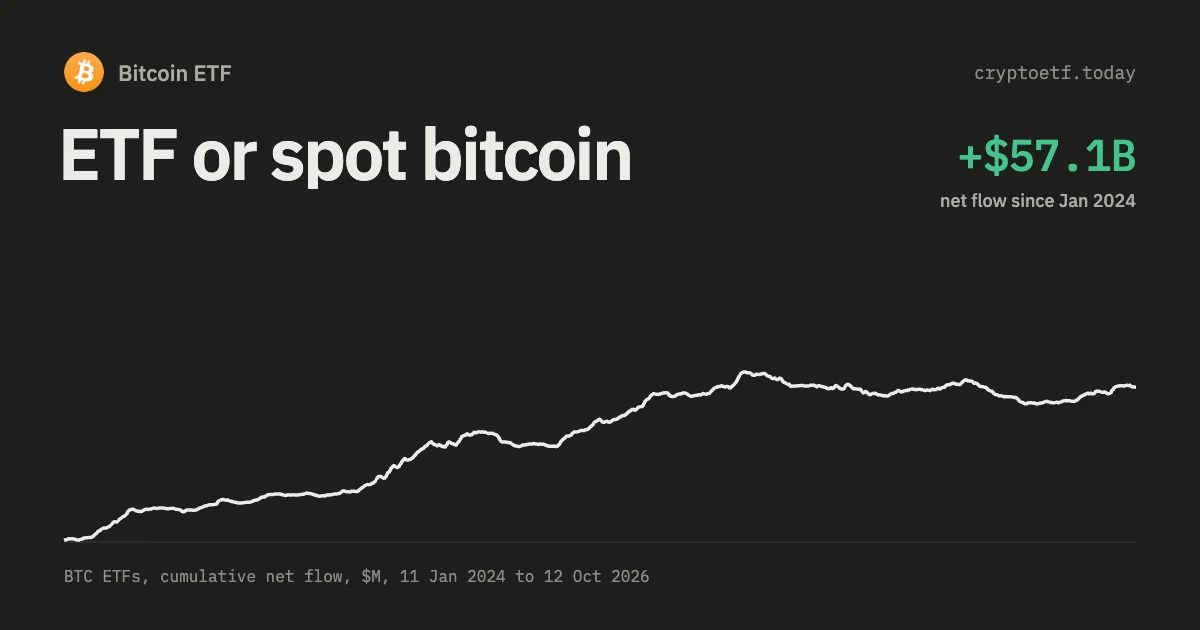
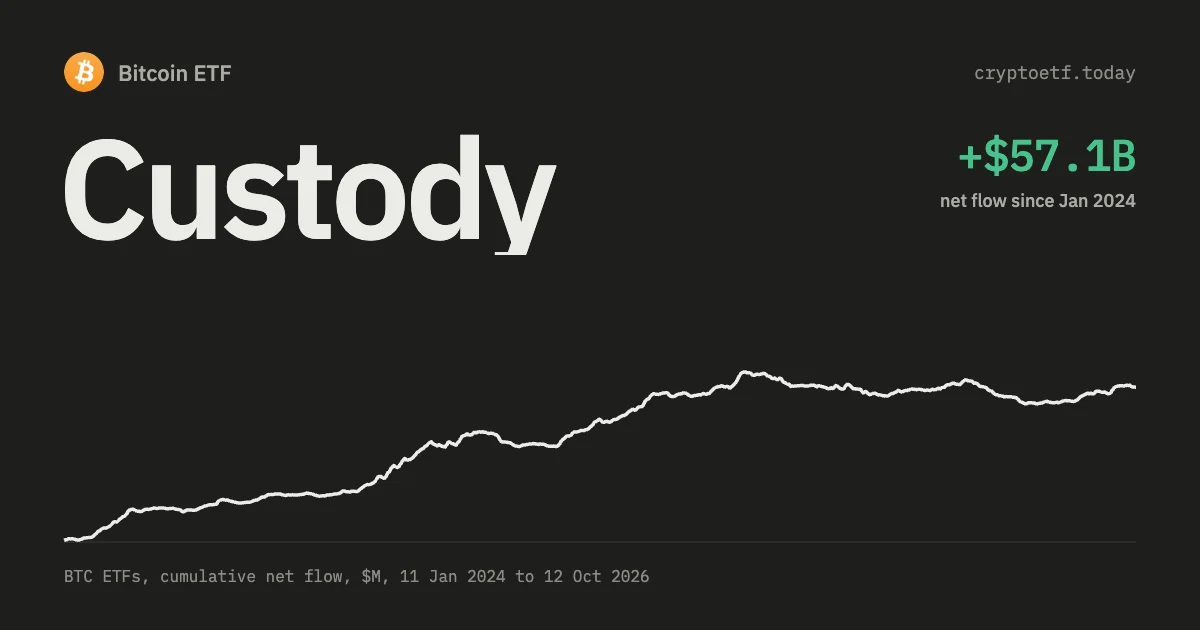
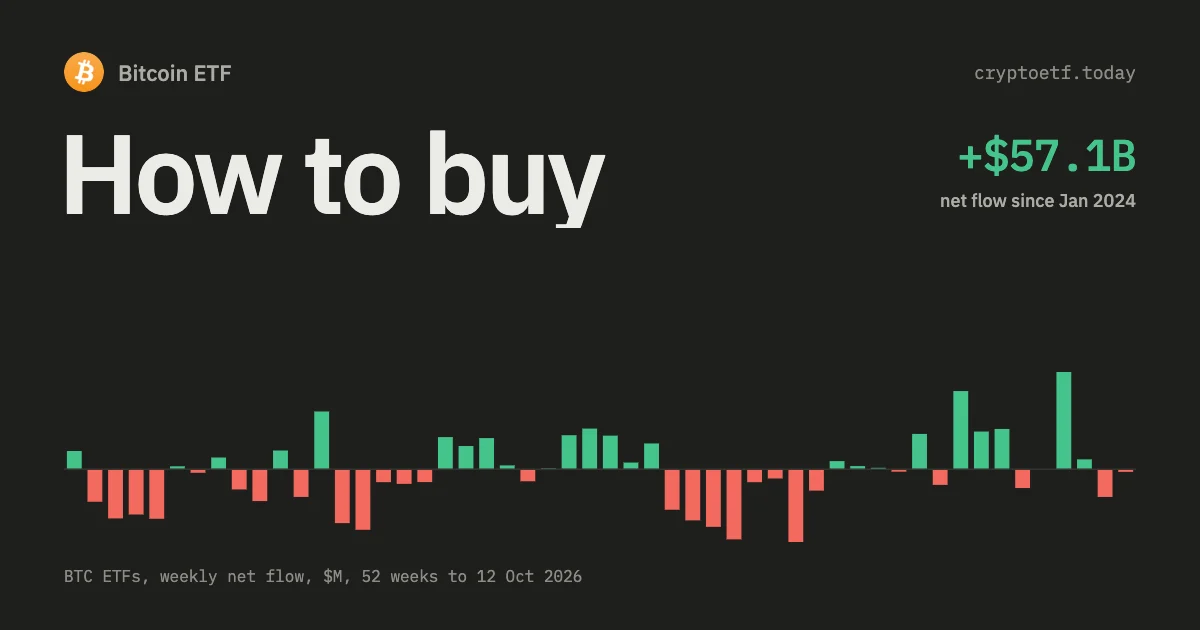
Because APs create and redeem in response to demand, the daily change in shares outstanding is a direct readout of net money moving into or out of the category. We publish it every business day on the Bitcoin ETF flows page; the totals below cover the twelve funds through 22 September 2026.
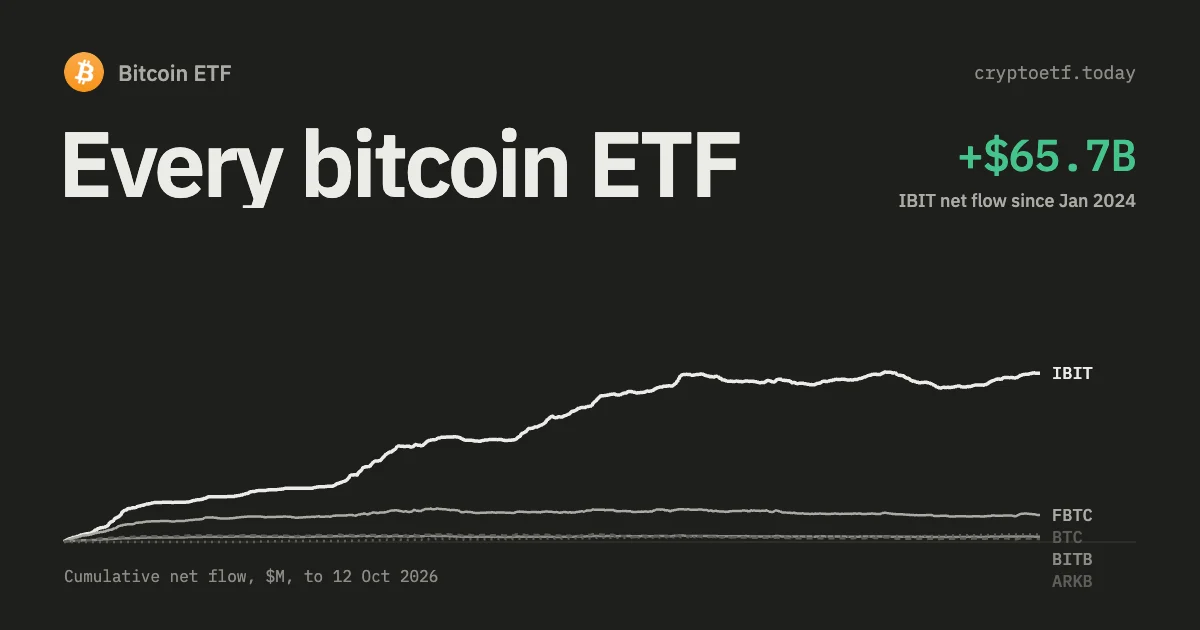
Cumulatively, $56.94bn of net inflow across 676 sessions, and the distribution is extreme. IBIT alone took $64.86bn, more than the category total, while GBTC lost $27.84bn as holders of the old trust cashed out or rotated into cheaper funds. FBTC is a distant second at $10.87bn, the mini trust picked up $2.93bn, and the four smallest funds took under $900m between them.
The time pattern matters as much as the ranking. 2024 brought $35.25bn over 245 sessions, 2025 added $21.35bn over 250, and 2026 through 22 September is flat: net $1.2m of outflow across 181 sessions, though the last 30 were positive at $4.50bn. Of the 676 days, 402 were net inflows and 274 net outflows; the best was 7 November 2024 at $1.37bn in, the worst 25 February 2025 at $1.11bn out. Anyone who says these funds only take money in hasn't looked at the daily series. Flow also gets misread as a price signal, which it isn't reliably: see how to read Bitcoin ETF flows.
Who it's for, and who should skip it
The wrapper earns its fee in three situations. First, tax-advantaged accounts: an IRA or a workplace plan can hold a listed share and generally can't hold a coin. Second, mandate: advisers and institutions restricted to listed securities have no other clean route. Third, self-custody risk. If losing a seed phrase or falling for a phishing site is a plausible outcome for you, 20 basis points a year is cheap insurance.
It's a poor fit in two cases. If you want bitcoin specifically because it settles without an intermediary, an ETF removes exactly that property and keeps the price risk. And if you trade actively, the closed hours are a handicap: bitcoin's biggest moves have a habit of landing on weekends.
If the wrapper suits you, two things remain: picking a fund and placing the order. Fund choice is mostly fee, liquidity and custodian preference, and our overview of the major funds covers the field. The mechanics are in how to buy a Bitcoin ETF.
FAQ
What does a Bitcoin ETF actually hold?
Bitcoin, and essentially nothing else. The trust buys coins, a qualified custodian keeps them mostly in cold storage, and each share is a proportional claim on the pile. On 22 September 2026 BlackRock’s IBIT held $68.34bn of net assets across 1,396,640,000 shares, or roughly 0.00057 bitcoin per share. There is no leverage, no futures position and no meaningful cash holding.
What is the difference between a spot Bitcoin ETF and a futures Bitcoin ETF?
A spot fund owns bitcoin at a custodian. A futures fund owns CME contracts and must roll them forward as they expire, which costs money whenever the curve is in contango. That roll cost is invisible in the expense ratio but shows up as tracking error, historically several percent a year.
Can I redeem Bitcoin ETF shares for actual bitcoin?
Not as an individual. Only authorized participants deal directly with the trust, in creation units of tens of thousands of shares. Since the SEC approved in-kind creations and redemptions on 29 July 2025 those APs can settle in coins, but a retail shareholder still sells shares for dollars through a broker.
Why does the bitcoin per share keep going down?
Because the sponsor fee is paid in bitcoin. The trust sells a small amount of coin continuously to cover the fee, so the coin count behind each share erodes at roughly the fee rate. IBIT’s filings show 0.00056731 BTC per share on 31 December 2025 falling to 0.00056654 on 30 June 2026, a 0.14% decline over six months against a 0.25% annual fee.
Which Bitcoin ETF has the lowest fee?
Morgan Stanley’s MSBT at 0.14%, which listed on NYSE Arca on 8 April 2026, followed by the Grayscale Bitcoin Mini Trust (BTC) at 0.15% and Franklin’s EZBC at 0.19%. The largest funds, IBIT and FBTC, both charge 0.25%. Grayscale’s original GBTC still charges 1.50%, which over ten years costs about 14% of your coins against 2.5% for a 0.25% fund.
Are Bitcoin ETFs regulated like normal ETFs?
Not exactly. They are Delaware statutory trusts registered under the Securities Act, listed on a national exchange and filing 10-Ks and 10-Qs, but not registered under the Investment Company Act of 1940. That means no fund board, no diversification requirements and no leverage limits. For US federal tax they are treated as grantor trusts.
How much money has gone into Bitcoin ETFs?
Net $56.94bn across the twelve US spot funds from 11 January 2024 through 22 September 2026, on our own daily flow data. IBIT accounted for $64.86bn of inflow and GBTC for $27.84bn of outflow. Inflows were heaviest in 2024 ($35.25bn) and 2025 ($21.35bn); 2026 has been roughly flat through September.
Sources and further reading
- iShares Bitcoin Trust ETF fund page: net assets, shares outstanding, NAV, sponsor fee and year-to-date return as of 22 September 2026 — ishares.com.
- iShares Bitcoin Trust ETF, Form 10-Q for the quarter ended 30 June 2026: bitcoin held, shares outstanding, sponsor fee charged, bitcoin sold to pay expenses, in-kind creations, custodian and legal structure — sec.gov.
- SEC Release No. 34-103571 (29 July 2025), the order granting accelerated approval of the rule changes that permit in-kind creations and redemptions for bitcoin and ether trust shares on Nasdaq, Cboe BZX and NYSE Arca — sec.gov.
- Morgan Stanley Investment Management press release on the launch of the Morgan Stanley Bitcoin Trust: fee, exchange, custodian and benchmark — morganstanley.com.
- VanEck Bitcoin ETF (HODL) fund page: 0.20% sponsor fee following the expiry of the waiver on 31 July 2026, and custodian arrangements — vaneck.com.
For information only. Not investment advice.
 ETH
 SOL
 XRP
 HYPE
 LINK
 HBAR
 AVAX
 DOGE
 LTC
 SUI
 DOT
 BNB
 NEAR
 TRX
 ZEC