US spot Bitcoin ETFs held about 1.287 million BTC on 12 October 2026, roughly 6.4% of the 20.1 million coins mined. BlackRock’s IBIT alone held about 805,000 BTC.
TL;DR. The twelve US spot Bitcoin ETFs we track held about 1,287,000 BTC at the close on 12 October 2026, worth $106.2bn at net asset value. That's roughly 6.4% of the 20.10 million bitcoin mined so far. BlackRock's IBIT accounts for about 805,000 BTC, or 62.6% of everything the group holds, and IBIT, FBTC and GBTC together hold 86%. Six funds publish their coin count directly; for the other six we divide net assets by $82,524, the per-coin NAV price implied by ARKB and BITB that day (MSBT agrees within $11).
Contents · 10 sections
 Bitcoin ETFsNet flow Fri 16 Oct−$82.4M
The short answer
On 12 October 2026, US spot Bitcoin ETFs held approximately 1.287 million BTC. At the NAV price of about $82,520 per coin that day, the holdings were worth $106.2bn. The figure covers the twelve funds on this site's Bitcoin ETF flows tracker: IBIT, FBTC, GBTC, Grayscale's Bitcoin Mini Trust (ticker BTC), BITB, ARKB, HODL, MSBT, BRRR, EZBC, BTCO and BTCW.
One fund is missing. The Osprey Bitcoin Trust (OBTC) uplisted to Nasdaq in December 2025 and reported $55.4m of net assets on 30 June 2026 in its quarterly filing. That's well under a thousand coins, so it doesn't change the rounded total, but it isn't in our feed and it isn't in the table below.
For scale: the Bitcoin network had issued 20,097,481 BTC by block 971,199 on 13 October 2026, according to blockchain.com's supply counter. The ETFs therefore hold about 6.4% of the coins in existence, or 6.1% of the 21 million that will ever exist.
Bitcoin held by each US spot ETF
Coin counts are for 12 October 2026 unless marked. "Published" means the issuer states the number of bitcoin in the trust. "Derived" means net assets divided by $82,524, the per-coin price implied by ARKB and BITB that day (method in the next section).
| Ticker | Issuer | BTC held | Share of ETF total | Net assets | Source of coin count |
|---|---|---|---|---|---|
| IBIT | BlackRock | ≈805,000 | 62.6% | $66.43bn | Derived |
| FBTC | Fidelity | ≈179,200 | 13.9% | $14.79bn | Derived |
| GBTC | Grayscale | ≈126,300 | 9.8% | $10.43bn | Derived |
| BTC (Mini Trust) | Grayscale | ≈63,300 | 4.9% | $5.22bn | Derived |
| BITB | Bitwise | 37,291 | 2.9% | $3.08bn | Published |
| ARKB | ARK / 21Shares | 32,024 | 2.5% | $2.64bn | Published |
| HODL | VanEck | 14,639 | 1.1% | $1.21bn | Published, 9 Oct |
| MSBT | Morgan Stanley | 10,639 | 0.8% | $0.88bn | Published |
| EZBC | Franklin Templeton | ≈5,700 | 0.4% | $0.47bn | Derived |
| BRRR | CoinShares | 5,679 | 0.4% | $0.47bn | Published, 9 Oct |
| BTCO | Invesco Galaxy | 5,052 | 0.4% | $0.42bn | Published |
| BTCW | WisdomTree | ≈2,100 | 0.2% | $0.17bn | Derived |
| Total | ≈1,287,000 | 100% | $106.2bn |
The concentration is the first thing that stands out. FBTC, GBTC and the Mini Trust hold about 368,800 BTC between them, and IBIT holds a little over twice that on its own. The seven smallest funds, ARKB down to BTCW, hold about 76,000 BTC together, less than a tenth of IBIT.
How much Bitcoin does BlackRock own?
Through IBIT, BlackRock's trust held about 805,000 BTC on 12 October 2026, worth $66.43bn at NAV. BlackRock runs three crypto ETFs on this site, IBIT, ETHA and ETHB, but only IBIT holds bitcoin. Strictly, the coins belong to the trust and its shareholders, not to BlackRock Inc.; BlackRock is the sponsor that earns the 0.25% fee on them.
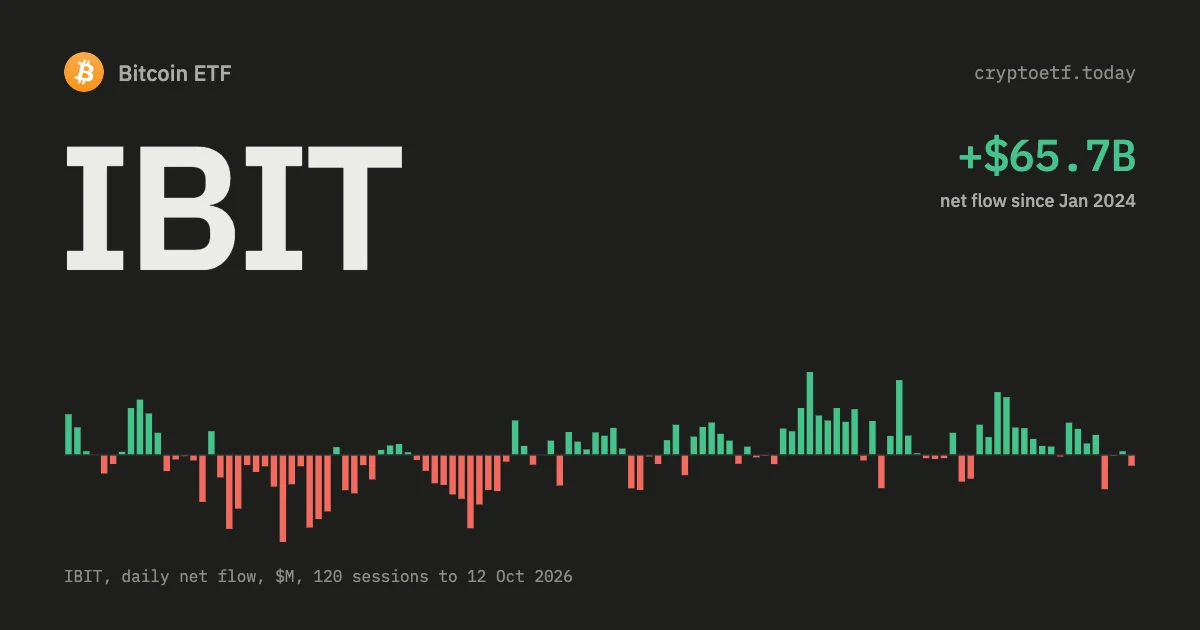
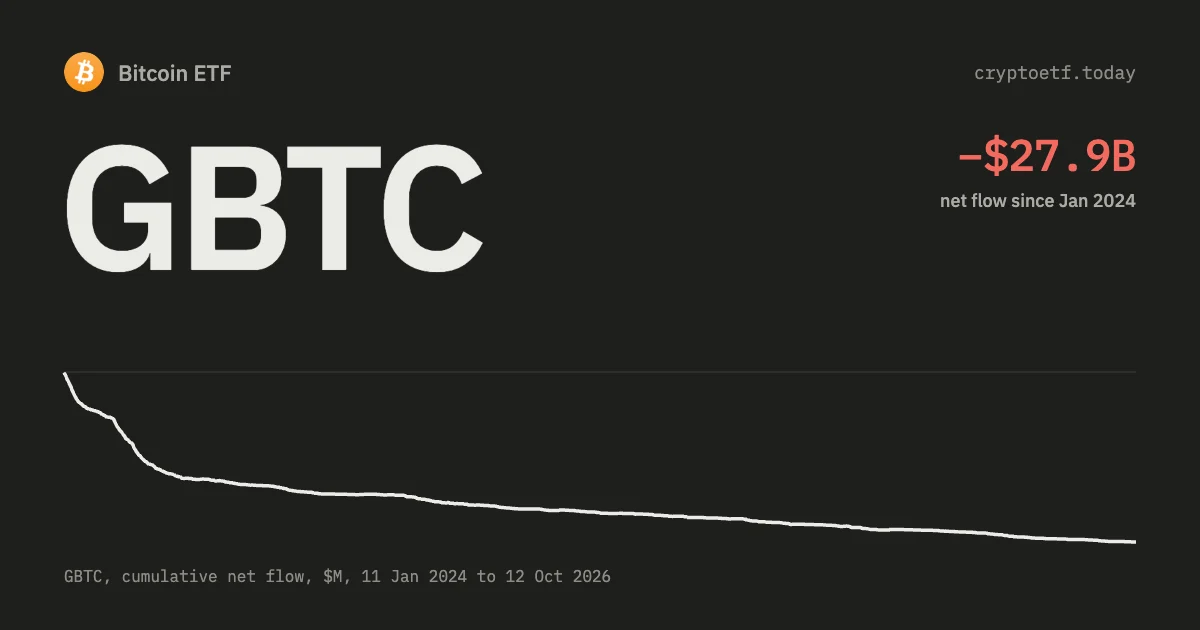
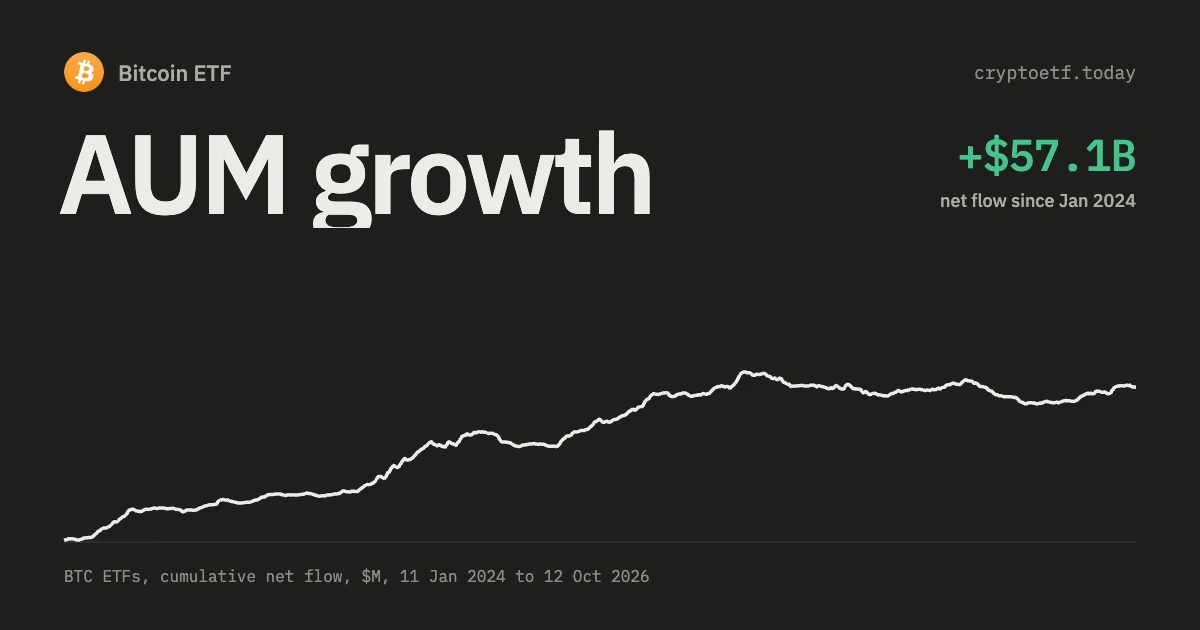
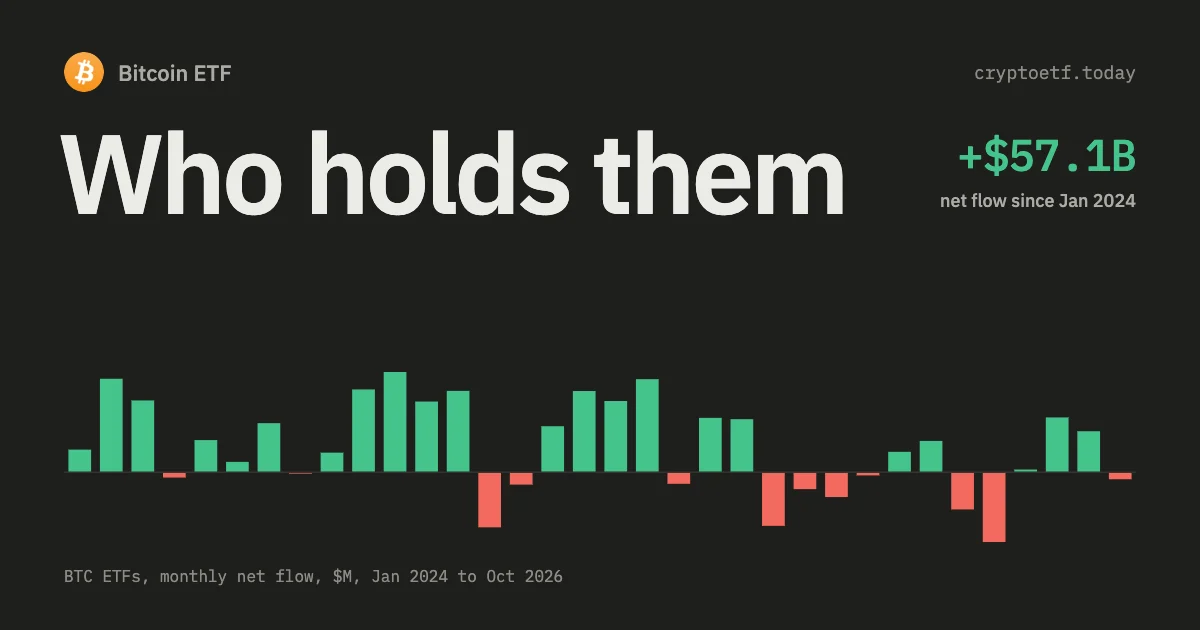
IBIT has taken $65.67bn of net inflows since it listed on 11 January 2024, more than the whole group combined. The twelve funds together show $57.12bn of cumulative net inflows, because GBTC has lost $27.94bn to outflows over the same period. Much of that money moved fund to fund rather than leaving bitcoin: GBTC charges 1.50% a year against 0.25% at IBIT and FBTC and 0.14% at MSBT (per each fund's prospectus), so holders who sold GBTC had cheap alternatives one ticker away. Our GBTC analysis walks through that migration, and the IBIT review covers the fund itself.
On the most recent day in this snapshot, 12 October, IBIT saw a net outflow of $65.4m, and no other Bitcoin fund had reported a flow in our data when we took it. At $82,524 a coin that's roughly 790 BTC leaving the trust in one session, about 0.1% of its holdings.
How we count the coins
Funds that publish a number
Six issuers report the bitcoin in the trust alongside NAV and shares outstanding: Bitwise (BITB), 21Shares (ARKB), VanEck (HODL), Morgan Stanley (MSBT), CoinShares (BRRR) and Invesco (BTCO). Our collector stores those daily snapshots straight from the issuer pages. VanEck and CoinShares post with a lag, so their latest counts are for 9 October.
Funds that don't
For IBIT, FBTC, GBTC, the Mini Trust, EZBC and BTCW, the daily data we collect carries net assets (and, for most, NAV per share and shares outstanding) but no coin count. For those, we use a simple identity. A spot Bitcoin ETF holds bitcoin and very little else, so net assets ≈ coins × the price used to strike NAV. Divide net assets by that price and you get the coins.
The price comes from the funds that publish both numbers. On 12 October:
| Fund | Net assets | BTC in trust | Implied price per BTC |
|---|---|---|---|
| ARKB | $2,642.8m | 32,024.37 | $82,525 |
| BITB | $3,077.3m | 37,290.75 | $82,522 |
| MSBT | $878.1m | 10,639 | $82,533 |
| BTCO | $415.5m | 5,051.61 | $82,247 |
Three of the four land within $11 of each other, which is what you'd expect if they all strike NAV off a 4 p.m. New York benchmark rate. BTCO comes out $280 lower; Invesco's NAV may net out more accrued expenses or use a different pricing source, and we haven't pinned down which. We used $82,524, the ARKB/BITB average. Switching to the BTCO figure would add about 4,000 BTC to the total, so treat the derived rows as accurate to a fraction of a percent, not to the coin.
Why our cost-basis page shows a smaller number
If you've looked at the crypto ETF cost basis page, you'll have seen about 1.14 million BTC for the same date. That isn't a contradiction; it's a different question.
The cost-basis figure asks: how many coins did ETF investors buy with the money they put in, and at what average price? It walks through each day's net flow, converts inflows into coins at that day's price and removes coins on outflows at the running average. On 12 October it put the average entry at $80,175 per BTC across 11 funds.
That method deliberately leaves out coins that were sitting in the Grayscale trusts before they became ETFs. Those bitcoin never passed through an ETF creation, so there's no dollar flow to convert. GBTC isn't in the cost-basis set at all for that reason, while its holdings are very much in the table above. The gap between 1.14 million and 1.29 million is mostly that legacy position, plus small differences between converting flows at a daily price and reading the coin count off the trust.
Use the holdings number when the question is "how much bitcoin is locked in ETFs". Use the cost-basis number when it's "are ETF buyers in profit". With bitcoin around $83,700 on the morning of 13 October (05:50 UTC, the Binance spot price this site uses), against that $80,175 average entry, the answer to the second one was yes, by about 4%.
What moves the number
ETF holdings change only through creations and redemptions. An authorised participant who wants new IBIT shares delivers cash or bitcoin to the trust; one who redeems takes it back out. Price doesn't change the coin count at all, only the dollar value. A $100m net inflow at today's price adds roughly 1,200 BTC; the same outflow removes it.
That's why flows in dollars and holdings in coins can tell different stories. A month of steady inflows during a falling market can leave AUM flat while the coin count rises. Our AUM growth analysis splits the dollar figure into price and new money for exactly this reason, and how to read Bitcoin ETF flows explains the creation mechanics in more detail.
Two things don't show up as flows but do affect the count slightly. Sponsor fees come out of the trust's bitcoin, so every fund sheds a sliver of coins each day: 0.25% a year on 805,000 BTC is about 2,000 BTC a year out of IBIT. And a fund that changes custody or merges doesn't add coins to the group total, it only moves them between rows.
How this compares with the other crypto ETFs
Bitcoin dominates the US spot market in dollars, but the gap is worth seeing next to the other assets. Net assets on 12 October 2026:
| Asset | Funds tracked | Net assets | Approx. coins held |
|---|---|---|---|
| Bitcoin | 12 | $106.2bn | ≈1.287m BTC |
| Ether | 11 | $16.0bn | ≈6.37m ETH |
| Solana | 9 | $1.71bn | not computed |
| XRP | 5 | $1.55bn | not computed |
| Hyperliquid (HYPE) | 3 | $0.45bn | not computed |
The ether figure uses the same method: Bitwise's ETHW and 21Shares' TETH publish their coin counts, and both imply about $2,514 per ETH on 12 October. We haven't computed coin counts for the smaller assets because too few of their funds publish one to cross-check the price. For a cross-asset view in dollars, see ETH ETF vs BTC ETF allocation, and for the newer funds, the full list of 2026 crypto ETFs.
Where to check the current figure
Holdings change every trading day, so the table above will drift. The live numbers sit in three places on this site:
- Bitcoin ETF flows: daily net flow per fund and per day, with history back to January 2024.
- BlackRock's issuer page and the other issuer pages: net assets, latest flow and cumulative flow per fund.
- Crypto ETF cost basis: the flow-based coin estimate and average entry price per asset.
If you're quoting the number, cite the date with it. "ETFs hold 6.4% of all bitcoin" was true on 12 October 2026; it won't be exactly true a month later.
FAQ
How much Bitcoin do ETFs hold in total?
The twelve US spot Bitcoin ETFs tracked on CryptoETF.today held about 1,287,000 BTC on 12 October 2026, worth $106.2bn at net asset value. Six funds publish their coin count; for the other six the count is net assets divided by the NAV price implied by the publishing funds.
How much Bitcoin does BlackRock own?
BlackRock’s iShares Bitcoin Trust (IBIT) held about 805,000 BTC on 12 October 2026, worth $66.43bn. That is 62.6% of all bitcoin held by US spot ETFs. The coins belong to the trust and its shareholders; BlackRock is the sponsor and charges a 0.25% annual fee.
What percentage of Bitcoin supply do ETFs hold?
About 6.4% of the 20,097,481 BTC mined by block 971,199 on 13 October 2026, or about 6.1% of the 21 million maximum supply.
Which Bitcoin ETF holds the most Bitcoin?
IBIT, by a wide margin, with about 805,000 BTC. Fidelity’s FBTC is second with about 179,200 BTC and Grayscale’s GBTC third with about 126,300 BTC. Together the three hold about 86% of the group’s bitcoin.
Why do different websites show different ETF holdings?
Three common reasons: different fund lists (some include OBTC or exclude the Grayscale Mini Trust), different dates (VanEck and CoinShares publish with a lag), and different methods. A flow-based estimate that converts daily dollar flows into coins leaves out coins the Grayscale trusts held before converting to ETFs, so it comes out lower than the coins actually in the trusts.
Does the Bitcoin price change how much Bitcoin ETFs hold?
No. Only creations and redemptions change the number of coins in a trust, plus a small daily deduction for the sponsor fee, which is paid out of the trust’s bitcoin. Price changes the dollar value of the holdings, not the coin count.
Sources and further reading
- Bitcoin issued to date and block height — blockchain.com.
- iShares Bitcoin Trust ETF daily net assets, NAV and shares outstanding — ishares.com.
- Bitwise Bitcoin ETF holdings — bitwiseinvestments.com.
- Daily coin counts for the publishing funds: 21shares.com (ARKB), vaneck.com (HODL), morganstanley.com (MSBT), coinshares.com (BRRR), invesco.com (BTCO).
- Grayscale Bitcoin Trust ETF and Bitcoin Mini Trust ETF daily data — grayscale.com.
- Registration statements and periodic reports of the spot Bitcoin trusts — sec.gov EDGAR.
For information only. Not investment advice.
 ETH
ETH SOL
SOL XRP
XRP HYPE
HYPE LINK
LINK HBAR
HBAR AVAX
AVAX DOGE
DOGE LTC
LTC SUI
SUI DOT
DOT BNB
BNB NEAR
NEAR TRX
TRX ZEC
ZEC