
VBNB is the only US spot BNB ETF: 0.39% fee, Anchorage custody (BitGo added Aug 2026), no staking, 90,000 shares, 3,496 BNB worth $2.55m on 17 Sep 2026, about 40% owned by VanEck.
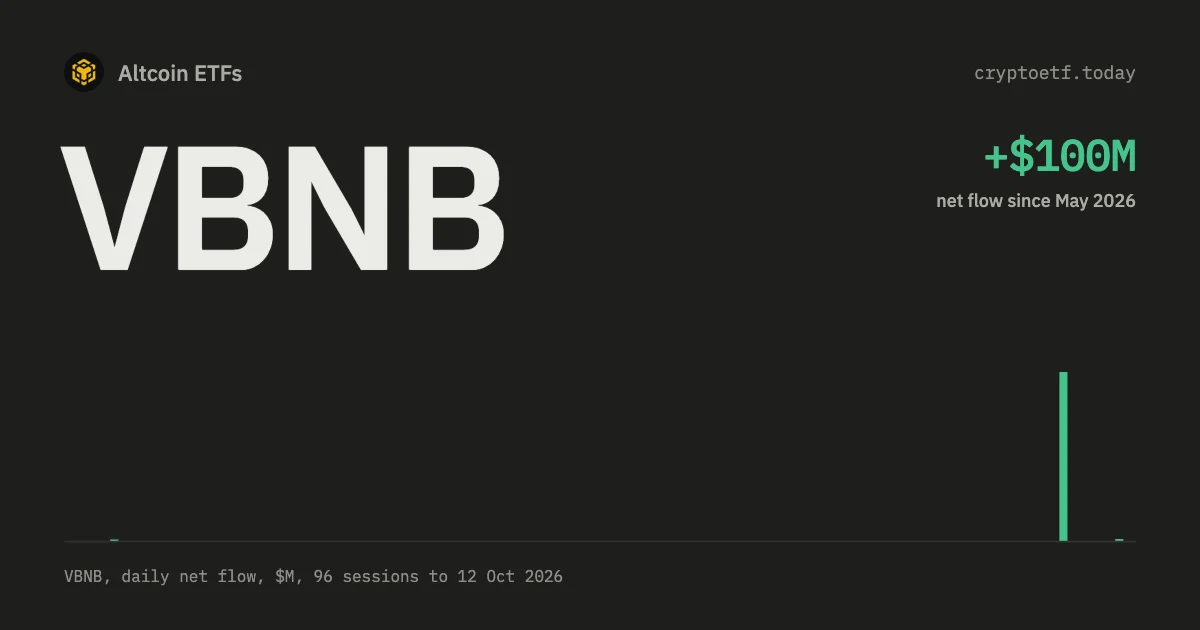
TL;DR. The VanEck BNB ETF (VBNB) is the only spot BNB fund listed in the United States. It began trading on Nasdaq on 28 May 2026, charges a 0.39% sponsor fee with no waiver, keeps its BNB at Anchorage Digital Bank (BitGo was added as a second custodian in August 2026, with nothing moved there yet) and does not stake. Its first annual report, filed 17 September 2026, shows 3,887.70 BNB across 100,000 shares at 30 June, a NAV of $21.41 against $25.00 at seeding, and VanEck's parent company owning about 40% of the fund. By 31 August the share count was 90,000 after one redemption, and on 17 September the trust held 3,496 BNB worth $2.55m. The share count has moved on three days since listing. Median daily volume is about 1,150 shares.

BNB ETF flows, live
as of Wed 25 Nov · updated every trading dayContents · 13 sections
- Fund at a glance
- What you own, and who else owns it
- The fee, and what it buys VanEck
- VanEck's five spot crypto funds compared
- Custody: Anchorage, and now BitGo
- Staking: promised in the objective, absent in practice
- Creations and redemptions: three days in four months
- Liquidity: what a $2.5m fund trades like
- The Binance risk, in the fund's own words
- Who it's for
- Verdict
- FAQ
- Sources and further reading
Fund at a glance
| Item | Detail (source and date) |
|---|---|
| Ticker | VBNB, Nasdaq, Rule 5711(d) commodity-based trust shares |
| Listed | 28 May 2026; first and only US spot BNB ETF |
| Structure | Delaware statutory trust, intended to qualify as a grantor trust; not a 1940 Act fund |
| Sponsor | VanEck Digital Assets, LLC; trustee CSC Delaware Trust Company |
| Sponsor fee | 0.39% of average daily net assets, accrues daily, paid monthly; no waiver (10-K, fund page 19 Sep 2026) |
| Custody | Anchorage Digital Bank N.A. (all BNB); BitGo Bank & Trust N.A. appointed second custodian 5 August 2026, no BNB transferred as of 11 September |
| Administrator, transfer agent, cash custodian | State Street Bank and Trust Company |
| Pricing benchmark | MarketVector BNB Benchmark Rate at 4:00 pm ET (Coinbase, Binance, Gate, Bybit, Kraken) |
| Staking | None; the trust had not commenced staking at 30 June 2026 (10-K) |
| Basket | 10,000 shares, cash or in-kind; APs Jane Street Capital and Macquarie Capital (USA); liquidity providers Nonco LLC and Wincent Investment Fund PCC |
| Holdings | 3,887.70 BNB, 100,000 shares, NAV $21.41, net assets $2,140,751 (30 June 2026, 10-K); 3,496 BNB worth $2,550,031 (17 September 2026, VanEck holdings feed) |
| Shares outstanding | 90,000 at 31 August 2026 (10-K cover page) |
What you own, and who else owns it
A share of VBNB is a claim on a fixed slice of the trust's BNB, and the slice shrinks slowly as the fee comes out. At seeding on 7 May 2026 each share represented 0.03888 BNB; at 30 June it was 0.038877 and on 17 September about 0.03884. That drift of roughly 0.1% over four months is the 0.39% fee being paid in coin, and it will continue for as long as you hold.
The annual report tells you something the launch coverage didn't. VanEck's parent, Van Eck Associates Corporation, put in $100,000 of seed capital in November 2025, redeemed it for cash on 7 May 2026, and the same day bought 40,000 shares at $25.00 for $1,000,000, receiving 1,555.16 BNB at the benchmark rate of $643.15. The 10-K states that at 30 June the seed investor's stake "represents approximately 40% of net assets." With 90,000 shares outstanding since August, and no disclosure of a sale, that stake would be about 44% if it hasn't moved. The rest sits with roughly 23 holders of record, mostly brokers whose underlying client count the trust says it can't estimate.
Legally this is the same wrapper as every US spot crypto fund: a grantor trust under the 1933 Act with no board and no 1940 Act protections. Creations and redemptions work as in our authorized participants guide; the two named APs are Jane Street and Macquarie, and cash orders are filled by the trust buying BNB from Nonco or Wincent.
The fee, and what it buys VanEck
The unitary fee is 0.39% a year, the highest in VanEck's spot crypto line and above the 0.30% that 21Shares charges on TDOT and TSUI. It accrues in dollars each day on that day's NAV, is paid monthly, and is settled by selling BNB, so the coin count declines rather than a cash balance. There is no waiver. Every other VanEck spot fund launched with one: HODL was still at 0% until 31 July 2026 or the first $2.5bn, according to the VBNB launch release itself; ETHV waived on the first $1.5bn to 22 July 2025; VSOL waived its fee on the first $1bn to 17 February 2026; VAVX waived on the first $500m to 28 February 2026. BNB got the full rate from day one.
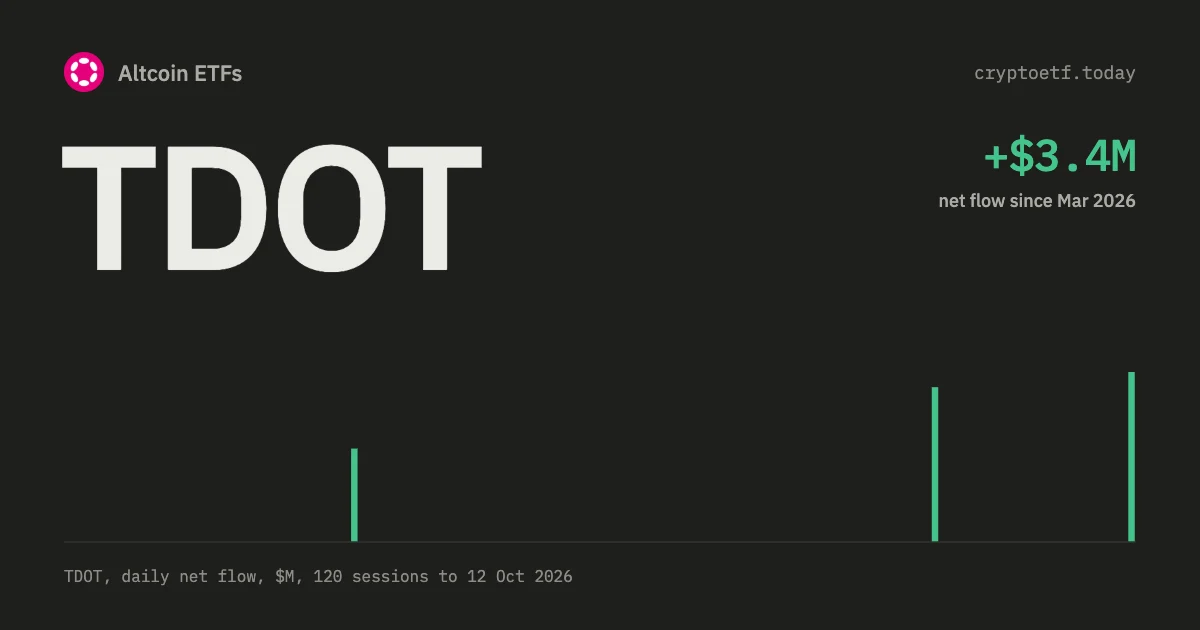
What that rate earns is small. For the period from 22 April to 30 June 2026 the sponsor fee came to $712, still accrued and unpaid at the balance-sheet date. On $2.55m of assets the run-rate is about $10,000 a year. Set that against the $53,000 audit fee Cohen & Company charged for the year, which the sponsor pays because it has assumed the trust's ordinary expenses. VanEck is losing money on VBNB and will until the fund is several times its current size. Normal for a first-year launch, but it's also the arithmetic behind fund closures, and the pattern matches the 21Shares TDOT review: a $7,561 quarterly fee there, $712 here.
VanEck's five spot crypto funds compared
VanEck now runs spot funds on five assets. The fees below are from the fund pages on 19 September 2026; custodians and staking from each trust's filings.
| Fund | Asset, exchange | Listed | Fee | Waiver at launch | Primary custodian | Staking |
|---|---|---|---|---|---|---|
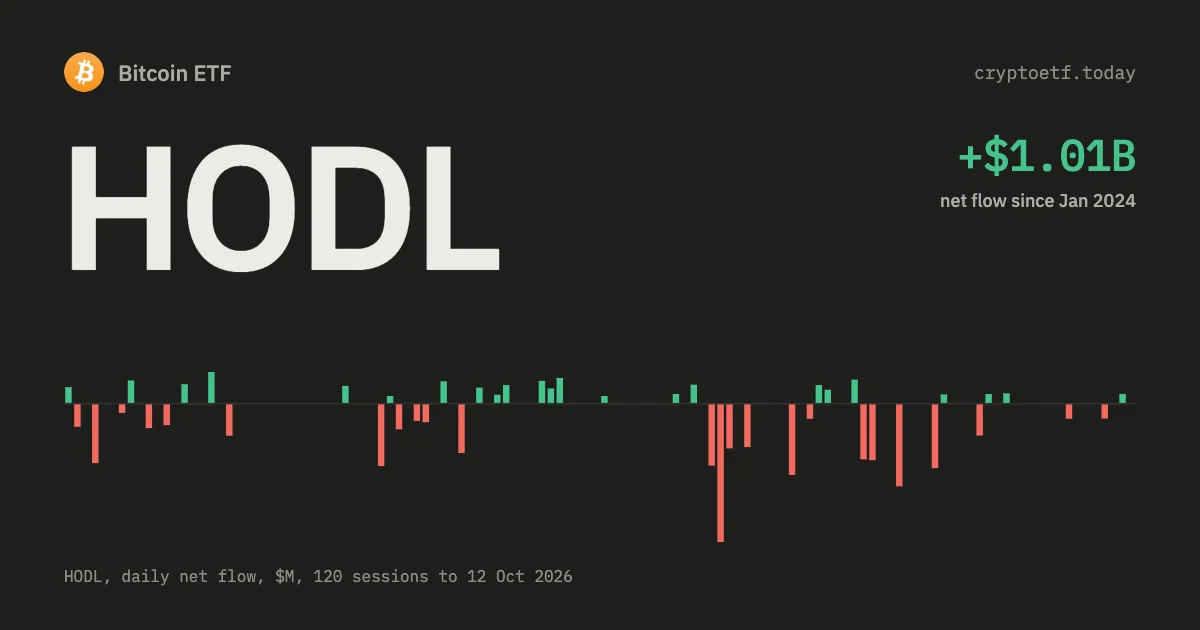
| HODL | BTC, Cboe BZX | 11 Jan 2024 | 0.20% | Yes; a 0% waiver to 31 Jul 2026 or $2.5bn was in place per the May 2026 release | Gemini Trust Company | n/a |
| ETHV | ETH, Cboe BZX | 23 Jul 2024 | 0.20% | Yes, first $1.5bn to 22 Jul 2025 | Gemini Trust Company | No |
| VSOL | SOL, Cboe BZX | 17 Nov 2025 | 0.30% | Yes, first $1bn to 17 Feb 2026 | Gemini Trust Company | Yes, 73.3% at 30 Jun 2026 |
| VAVX | AVAX, Nasdaq | 26 Jan 2026 | 0.20% | Yes, first $500m to 28 Feb 2026 | Coinbase Custody (Anchorage backup) | Yes, 85% at 30 Jun 2026 |
| VBNB | BNB, Nasdaq | 28 May 2026 | 0.39% | None | Anchorage Digital Bank (BitGo second) | No |
Two things separate VBNB from its siblings. It is the only one priced above 0.30% and the only one that never had a promotional period. And it is the only one whose primary custodian is a national bank rather than a New York trust company. The Bitcoin fund is reviewed in our VanEck HODL review, the Avalanche fund in Avalanche ETF explained, and the Solana fund's staking terms in crypto ETF staking compared.
Custody: Anchorage, and now BitGo
VanEck's Bitcoin, Ether and Solana trusts all sit at Gemini Trust Company; the Avalanche trust went to Coinbase Custody with Anchorage as backup. For BNB the firm chose Anchorage Digital Bank N.A. as sole custodian, described in the prospectus as "a regulated third-party custodian that carries insurance and is a National Trust Bank regulated by the Office of the Comptroller of the Currency." Anchorage holds the trust's BNB in segregated cold-storage addresses on BNB Smart Chain, separate from other clients and verifiable on-chain.
VanEck doesn't say in any filing why Gemini wasn't used, so we won't guess. What the filings do show is that the VBNB prospectus carries risk-factor language about Gemini's own history (the SEC's January 2023 charges over Gemini Earn and the New York Attorney General's October 2023 action), and that Anchorage was already the backup custodian on VAVX and custodies two of the three Hyperliquid funds. An existing relationship, applied to a new asset.
Then, on 5 August 2026, the sponsor signed a second custody agreement with BitGo Bank & Trust, National Association, an OCC-supervised national bank based in Sioux Falls. The 8-K went in on 7 August and a prospectus supplement on 11 September formalised the arrangement: Anchorage is now the "First BNB Custodian", BitGo the "Second", and the sponsor may split holdings between them. As of 11 September the trust "has not transferred any BNB to the Second BNB Custodian." Neither custodian may lend, pledge or rehypothecate the coins. The practical effect is a fallback if one custodian fails, the concentration risk described in how Bitcoin ETF custody works. For a $2.5m fund it's more plumbing than the assets justify, which suggests VanEck is building the fund it hopes to have rather than the one it has.
Staking: promised in the objective, absent in practice
The trust's stated objective is to reflect the price of BNB "and rewards from staking a portion of the Trust's BNB", but only "to the extent the Sponsor in its sole discretion determines that the Trust may do so without undue legal or regulatory risk". The prospectus is blunter: at listing the trust "will not employ its BNB in Staking Activities and accordingly will not earn any form of staking rewards". The 10-K confirms nothing had changed by 30 June 2026, and no supplement announcing staking had been filed by mid-September.
The cost of that gap is real because BNB stakes natively. A holder who delegates on BNB Chain earns a reward; a VBNB holder earns nothing and pays 0.39%. Compare TDOT, with 79.72% of its DOT staked at 30 June and 73.5% of rewards paid out in cash, or VanEck's own VSOL at 73.3% staked. A liquidity policy for a future staking programme (keep enough BNB unstaked to pay fees and meet redemptions) is already written into the 10-K. So the framework exists; the switch hasn't been flipped. If it is, the notice will come as a prospectus supplement or 8-K under CIK 2066824, and the fund's economics change that day.
Creations and redemptions: three days in four months
Because VanEck publishes the coin count but not shares outstanding, our BNB ETF flow tracker derives daily flow as the change in BNB held times that day's price, as explained in BNB ETF explained. The 10-K lets us reconcile that series to actual baskets:
| Date (2026) | Event | Shares after | Value |
|---|---|---|---|
| 7 May | Seed creation baskets bought by VanEck's parent (4 baskets) | 40,000 | $1,000,000 for 1,555.16 BNB |
| 28 May | Listing on Nasdaq | 40,000 | n/a |
| 3 June | Creation, about 5 baskets (flow series) | ~90,000 | +$1.2m at $620.63 per BNB |
| 11 June | Creation, 1 basket (flow series) | 100,000 | +$0.2m at $605.76 |
| 30 June | Fiscal year end: 10 baskets created in total (10-K) | 100,000 | NAV $21.41, $2.14m |
| 21 August | Redemption, 1 basket | 90,000 | −$0.26m at $687.00 |
| 31 August | 10-K cover date | 90,000 | n/a |
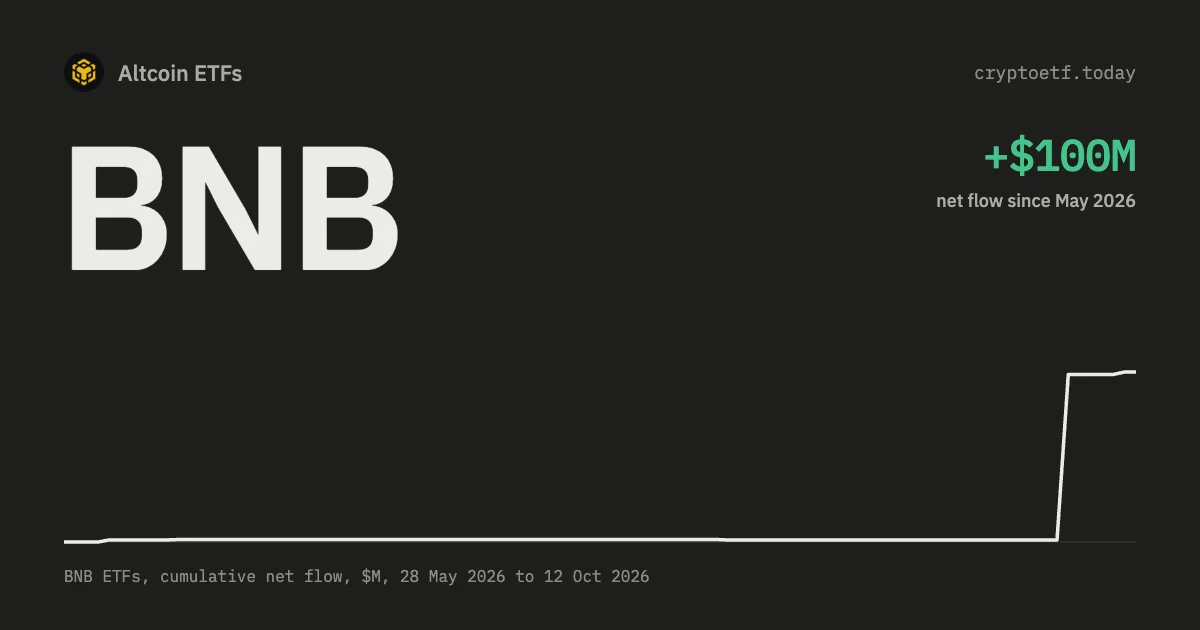
The 10-K gives the totals (100,000 shares, ten baskets, $2,450,388 of contributions); the split between 3 and 11 June is inferred from the flow series and the NAV on those days. Net of seed, outside money created 60,000 shares for $1,450,388 in the first two weeks of trading and nothing since. The 21 August redemption of one basket, about 389 BNB, is the only outflow. Cumulative flow since listing is roughly +$1.1m over 79 trading days to 18 September, and 75 of those days are zero.
Price has done the rest. NAV went from $25.00 at seeding to $26.95 on 1 June, $21.41 on 30 June (BNB at $550.83, down 14.35% from the seed-day rate) and about $28.33 on 17 September, implied by $2.55m of holdings over 90,000 shares. A holder since listing is up; the fund hasn't grown.
Liquidity: what a $2.5m fund trades like
VanEck doesn't publish spread or premium data for VBNB, so this is from Yahoo Finance daily bars for the 78 sessions from 29 May to 18 September 2026:
- Volume. The median session traded 1,150 shares, about $30,000 at recent prices. Thirty-five sessions traded under 1,000 shares and 23 under 500; the quietest, 17 June, printed 100 shares. The busiest was 5 August at 24,900 shares, roughly $580,000, with no creation behind it.
- Premium and discount. Two spot checks against NAV: the 30 June close of $21.22 sat 0.9% below the audited NAV of $21.41, and the 17 September close of $28.44 was about 0.4% above the NAV implied by that day's holdings. Neither is alarming, but with one basket equal to a tenth of the fund, a single AP order moves the whole book.
The rule for a fund this size is the one in our premium and discount guide: limit orders only, and don't try to trade more than a few thousand shares in one print. On most days you'd be the day's volume.
The Binance risk, in the fund's own words
No other US crypto ETF holds a token issued by an exchange, and the 10-K's risk factors treat that as the fund's defining exposure. Binance "exerts centralized control over critical token attributes including burn mechanisms, distribution protocols, utility features, staking rewards, and technological infrastructure", "may hold a significant quantity of BNB and may influence validator participation, governance dynamics, and market liquidity", and as a result "the market value of BNB may be disproportionately affected by events related to Binance, including regulatory actions, enforcement proceedings, litigation, operational disruptions, reputational harm, or changes in Binance's business practices."
The filing lists the 2023 settlements with the Department of Justice and other US agencies, notes that founder Changpeng Zhao "has received a pardon from the current president" for the anti-money-laundering conviction, and warns that political developments could affect BNB's value. It also recalls what happened when the SEC sued Ripple: the sponsor of the Grayscale XRP Trust dissolved it. If a court or the SEC were to find BNB a security, "the Trust itself may" face the same fate. The SEC's own BNB claim was dismissed in 2025 at the agency's request, which is why the fund could list at all, and a future administration could revisit that in a way no Bitcoin risk factor has to contemplate. The burn, the 100 million supply target and Grayscale's unlisted GBNB are covered in BNB ETF explained; BNB's place among the year's launches is in the 2026 crypto ETF list.
Who it's for
| Pros | Cons |
|---|---|
| Only US spot BNB ETF; Grayscale's GBNB had not listed as of September 2026 | No competitor means no fee pressure: 0.39% with no waiver, the highest in VanEck's line |
| Two OCC-supervised custodians, segregated cold storage, on-chain verifiable addresses | No staking, so holders forgo the reward a direct BNB staker earns, on top of the fee |
| Audited 10-K, daily coin count published, State Street as administrator | $2.55m in assets, 90,000 shares, about 40% held by the sponsor's parent |
| Nasdaq listing works in IRAs and mandate-restricted accounts where a wallet doesn't | Median volume around 1,150 shares a day; one basket is a tenth of the fund |
| Established sponsor with four other spot crypto trusts and $224.8bn under management | Single-company risk on Binance that the sponsor's own risk factors call "disproportionate" |
VBNB makes sense for one kind of buyer: someone who wants BNB inside a retirement account or an institutional mandate that can hold listed securities and can't hold tokens, and who buys in sizes the book can absorb. For anyone else the token is cheaper to hold, earns staking rewards and Binance fee discounts the fund can't pass on, and trades around the clock.
Verdict
As a piece of construction, VBNB is fine. Custody is conservative to the point of redundancy, the administrator is State Street, the accounts are audited, and the sponsor has run spot crypto trusts since January 2024. Nothing in the filings suggests a corner was cut.
As an investment product, it's expensive for what it does. It charges almost twice HODL's rate for an asset that could pay a staking yield and doesn't, in a wrapper that trades $30,000 on a typical day. The flow series says buyers agree: outside money arrived in the first two weeks and hasn't come back, and the one redemption since was the sponsor's own basket size, not a rush for the exit. Four things would change the picture, and they're all in the filings' hands rather than the market's: a staking supplement, a fee cut or waiver, a second US BNB fund, or a move of the seed stake to outside holders. Until one of them happens, the daily number to watch is on the BNB ETF flows page, and the next set of audited figures arrives with the 10-Q for the quarter to 30 September, due in November.
FAQ
What is the VanEck BNB ETF fee?
VBNB charges a unitary sponsor fee of 0.39% of average daily net assets, accrued daily and paid monthly by selling BNB. There is no waiver. That compares with 0.20% on VanEck HODL, ETHV and VAVX and 0.30% on VSOL, per the fund pages on 19 September 2026.
Who is the custodian for VBNB?
Anchorage Digital Bank N.A., an OCC-regulated national trust bank, holds all of the trust’s BNB in segregated cold storage. On 5 August 2026 VanEck appointed BitGo Bank & Trust as a second custodian; as of the 11 September 2026 prospectus supplement no BNB had been transferred to BitGo.
Does the VanEck BNB ETF stake its BNB?
No. The prospectus says the trust will not stake at listing and will not earn staking rewards, and the 10-K for the year to 30 June 2026 confirms staking had not commenced. The sponsor may add it later at its discretion, which would be announced in a prospectus supplement or 8-K.
How big is VBNB?
Small. At 30 June 2026 the trust held 3,887.70 BNB across 100,000 shares, net assets $2,140,751 and NAV $21.41. After a one-basket redemption on 21 August it had 90,000 shares, and on 17 September 2026 VanEck reported 3,496 BNB worth $2,550,031. The sponsor’s parent owned about 40% at 30 June.
How many shares are in a VBNB creation basket?
Ten thousand. The 10-K and the body of the prospectus both use 10,000-share baskets, and the 21 August 2026 redemption reduced the count from 100,000 to 90,000. One note in the prospectus financial statements says 25,000, which appears to be a drafting inconsistency.
Is VBNB liquid enough to trade?
For small orders. Yahoo Finance data for the 78 sessions to 18 September 2026 shows a median volume of about 1,150 shares, 35 sessions under 1,000 shares and a low of 100. Use limit orders and expect that a few thousand shares can be the whole day’s volume.
Sources and further reading
- VanEck BNB ETF, Form 10-K for the fiscal year ended 30 June 2026, filed 17 September 2026 (holdings, NAV, seed investor stake, fee, custodians, risk factors) — sec.gov.
- VanEck BNB ETF, Form 8-K of 7 August 2026 (BitGo custody agreement) and prospectus Supplement No. 1 of 11 September 2026 — sec.gov, sec.gov.
- VanEck BNB ETF prospectus dated 27 May 2026 (Rule 424(b)(3)): custodian description, staking language, authorized participants — sec.gov.
- VanEck launch release, 28 May 2026, and VBNB fund page with daily holdings — vaneck.com, vaneck.com.
- Grayscale BNB ETF (GBNB), Form S-1/A, Amendment No. 3, 3 June 2026 — sec.gov.
- Internal: BNB ETF explained, VanEck HODL review, 21Shares TDOT review, daily BNB ETF flows.
Live data on this topic
ETFs still waiting for approval: Injective, SEI, Cronos, PEPE, Worldcoin, Canton, Aave, TRUMP, Ondo, Uniswap, Aptos, PENGU
For information only. Not investment advice.
 BTC
 ETH
 SOL
 XRP
 HYPE
 LINK
 HBAR
 AVAX
 DOGE
 LTC
 SUI
 DOT
 NEAR
 TRX
 ZEC