Five US spot XRP ETFs charge 0.19% (XRPZ) to 0.50% (XRPC), and every launch waiver has expired. On $10,000 over five years the gap is $153, before spreads and premiums.
TL;DR. The five US spot XRP ETFs charge between 19 and 50 basis points a year: Franklin XRPZ 0.19%, 21Shares TOXR 0.30% per its SEC filings, Bitwise XRP 0.34%, Grayscale GXRP 0.35% and Canary XRPC 0.50%. Every launch waiver has expired, the last one (Franklin's) on 31 May 2026. On a $10,000 position held five years at a flat price, the cheapest fund costs $95 and the priciest $248. Those are small numbers next to XRP's volatility, but the fee is the only cost you choose, and two other costs hide behind it: bid-ask spreads of 0.06% to 0.07% on the liquid funds, and premiums that ran from 0.13% to 0.82% on 16–18 September 2026. All five pay the fee by shedding XRP, so each share represents a little less XRP every day, and in a taxable account each of those sales is a taxable event.
Contents · 11 sections
- The fee table, in basis points
- What the sponsor fee actually covers
- Waiver history: who paid nothing, and until when
- The $10,000 example: one, three and five years
- How the fee is paid: the coin-per-share leak
- The two costs the fee table hides
- Fee erosion and tax: why the coin leak is also a tax event
- Does the extra fee buy anything?
- What to check before you buy
- FAQ
- Sources and further reading

The fee table, in basis points
The figures come from the funds' SEC filings and product pages as of 17–18 September 2026. Where a filing and a product page disagree, the filing is shown with the page in a footnote. This piece is the cost companion to our ranking of the five XRP ETFs; that one picks a fund, this one prices it.
| Fund | Ticker | Sponsor fee | In bps | Source | Fee paid in |
|---|---|---|---|---|---|
| Franklin XRP ETF | XRPZ | 0.19% | 19 | 10-Q, Q2 2026 | US dollars, from XRP the fund sells |
| 21Shares XRP ETF | TOXR | 0.30%* | 30 | 10-K FY2025 | XRP, weekly in arrears |
| Bitwise XRP ETF | XRP | 0.34% | 34 | Product page, 17 Sep 2026 | XRP sold from the trust |
| Grayscale XRP Trust ETF | GXRP | 0.35% | 35 | 10-Q, Q2 2026 | XRP, daily in arrears |
| Canary XRP ETF | XRPC | 0.50% | 50 | Product page, 18 Sep 2026 | XRP sold from the trust |
* TOXR's FY2025 Form 10-K states a sponsor fee of 0.30% of NAV, cut from 2.50% on the listing day of 11 December 2025. The 21Shares product page showed a 0.50% management fee and 0.50% expense ratio on 18 September 2026. We can't tell you which the fund is actually charging; the filing is the legal document, so we use it, and anyone buying TOXR should read the current prospectus before assuming either number.
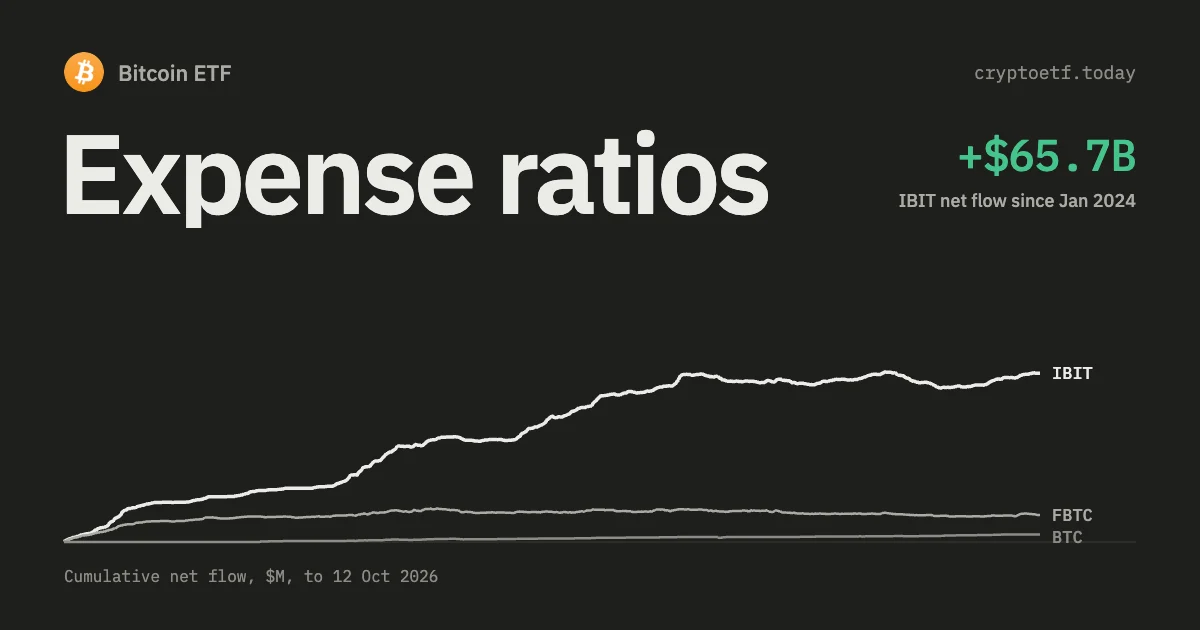
The spread between cheapest and priciest is 31 basis points. For context, the Bitcoin ETF field compressed to a 0.19%–0.25% band within its first year, with only Grayscale's legacy GBTC sitting outside it at 1.50%; the history is in Bitcoin ETF expense ratios compared. XRP hasn't had that compression round. Three of five funds still charge more than any mainstream Bitcoin fund, ten months after listing.
What the sponsor fee actually covers
All five are grantor trusts with a unitary fee: the sponsor collects one percentage and pays the running costs out of it. The Franklin 10-Q lists what that means for XRPZ. The sponsor assumes "the fees charged by the Administrator, the Marketing Agent, the Custodians (the Cash Custodian and XRP Custodian, collectively) and the Trustee, Exchange listing fees, typical maintenance and transaction fees of the DTC, SEC registration fees, printing and mailing costs, tax reporting fees, audit fees, license fees and expenses, and up to $500,000 per annum in ordinary legal fees and expenses." 21Shares' 10-K says the same in fewer words: the sponsor "assumes and pays all operating expenses (except for litigation expenses and other extraordinary expenses)."
So Coinbase Custody's bill for holding Bitwise's 375m XRP, BNY Mellon's administration fee, BitGo's and Gemini's custody of Canary's coins: all of that is the sponsor's problem, already inside the headline number. A 0.19% fund and a 0.50% fund don't differ in what you get. The difference is the sponsor's margin.
What sits outside the fee is the list of things that shouldn't happen. Franklin's filing names "legal claims and liabilities and litigation costs or indemnification or other unanticipated expenses", taxes, brokerage commissions and XRP Ledger transaction fees, plus legal costs above the $500,000 cap. Grayscale's structure is slightly different: GXRP's 10-Q has the trust bearing ordinary expenses up to $600,000 a year with the sponsor covering them, and "Additional Trust Expenses" beyond that. The Franklin, Grayscale and 21Shares filings we read show no extraordinary expense since listing, so the sponsor fee has been the whole cost so far. A lawsuit against a trust would change that, and it would be paid in the trust's XRP.
Waiver history: who paid nothing, and until when
Four of the five funds came to market with a discount of some kind. None is still running.
| Fund | Listed | Launch terms | Waiver ended | Fee since |
|---|---|---|---|---|
| XRPC (Canary) | 13 Nov 2025 | 0.50%, no waiver | n/a | 0.50% |
| XRP (Bitwise) | 20 Nov 2025 | 0% for the first month on the first $500m of assets | December 2025 | 0.34% |
| XRPZ (Franklin) | 24 Nov 2025 | Entire fee waived on the first $5bn of assets | 31 May 2026 | 0.19% |
| GXRP (Grayscale) | 24 Nov 2025 (uplisting) | 2.50% cut to 0.35%; promotional 0% until the earlier of 25 Feb 2026 or $1bn NAV | 25 Feb 2026 | 0.35% |
| TOXR (21Shares) | 11 Dec 2025 | 2.50% cut to 0.30% on listing day; no waiver | n/a | 0.30% per filings |
Franklin's was the only waiver that mattered for long. Six months of zero fee on a fund that reached $363.8m of assets by 17 September 2026 is a real subsidy, and it explains part of why XRPZ became the second-largest XRP fund from a standing start. Bitwise's one-month waiver was a launch-week gesture. Grayscale's three months were the price of persuading private-trust holders not to redeem on the uplisting day, and judging by the $51.5m that left GXRP on 29 January 2026, it only half worked.
The practical point: a waiver you didn't hold the fund through is worth nothing to you. If you're buying in November 2026, all five funds cost sticker price, and any 0% in an old headline is history. Watch for the next round, though. Bitcoin ETF fee cuts came in a burst in the weeks around the January 2024 launch, one issuer moving and the rest matching. With XRPZ at 0.19% holding more assets than any fund except Bitwise's, the 0.34% to 0.50% funds have a reason to move, and the fund most likely to blink is Bitwise, which priced its own Bitcoin ETF at 0.20% in January 2024 precisely to undercut the field.
The $10,000 example: one, three and five years
The fee accrues daily as a fraction of net assets, so the honest way to model it is compounding, not simple multiplication. The table assumes $10,000 invested and a flat XRP price, which isolates the fee. The gaps shrink slightly at a falling price and grow at a rising one.
| Fund | Fee | Cost after 1 year | After 3 years | After 5 years | 5 years if XRP doubles |
|---|---|---|---|---|---|
| XRPZ | 0.19% | $19 | $57 | $95 | ~$189 |
| TOXR | 0.30% | $30 | $90 | $149 | ~$298 |
| XRP (Bitwise) | 0.34% | $34 | $102 | $169 | ~$338 |
| GXRP | 0.35% | $35 | $105 | $174 | ~$348 |
| XRPC | 0.50% | $50 | $149 | $248 | ~$495 |
The last column is a reminder that a percentage fee is a bet on your own success: if the position doubles, the sponsor's take doubles with it, and the five-year gap between XRPZ and XRPC becomes $306 rather than $153. Scale it to $100,000 and the cheapest-to-priciest difference over five years is $1,529 at a flat price and roughly $3,060 if XRP doubles.
Is that decisive? Against XRP's price, no. TOXR's NAV fell from $17.83 to $10.16 in the first half of 2026, a 43% move that no fee comparison survives. But the fee is the only line in this arithmetic you get to pick, it's charged whether the price rises or falls, and over a decade 31 basis points compounds into about 3% of the position. Giving that away makes sense only if the pricier fund delivers something for it, which is the question the last sections take up.
How the fee is paid: the coin-per-share leak
An XRP trust earns nothing. The XRP Ledger has no staking, so unlike the Solana or Hyperliquid funds covered in our staking comparison, there's no reward stream to pay the sponsor from. The fee therefore comes out of the only asset the trust has. Franklin's 10-Q states it directly: the fund "will sell XRP as needed to pay the Sponsor's fee", which is accrued daily and payable at least quarterly in dollars. 21Shares takes it in kind, "payable in XRP weekly in arrears", with the sponsor free to sell that XRP or keep it. Grayscale's fee "accrues daily in U.S. dollars and is payable in XRP, daily in arrears", delivered to the sponsor from the custodian.
Either way, the result is the same. The number of XRP behind each share falls at the fee rate, every day, forever. Grayscale's own filing shows it cleanly. GXRP held 19.4013 XRP per share on 31 December 2025 and 19.3781 on 30 June 2026. The fee was waived until 25 February, so the trust paid 0.35% a year for 125 days: 19.4013 × (1 − 0.0035 × 125/365) = 19.3780. The filing matches the formula to the fourth decimal place, which tells you two things. The fee is the only leak, and the waiver really was zero.
Projecting forward from the September 2026 figures:
| Fund | XRP per share (Sep 2026) | After 1 year | After 3 years | After 5 years |
|---|---|---|---|---|
| XRPZ (0.19%) | 10.963 (17 Sep) | 10.942 | 10.901 | 10.859 |
| XRP, Bitwise (0.34%) | 11.1692 (17 Sep) | 11.131 | 11.056 | 10.981 |
| GXRP (0.35%) | 19.3781 (30 Jun) | 19.310 | 19.175 | 19.041 |
Canary and 21Shares don't publish a per-share coin figure on their summary pages, so they're left out rather than estimated. The mechanics are identical: at 0.50%, XRPC's share loses a quarter of a percent of its XRP every six months.
This is also why share prices don't compare. A GXRP share holds about 19.4 XRP and a Bitwise share about 11.2, so the GXRP share costs more for the same reason a two-litre bottle does. The number to watch is coin per share on each issuer's page, and the direction it moves is the fee.
The two costs the fee table hides
Bid-ask spread
Every ETF trade crosses a spread, and on a crypto fund the spread is set by how much the authorised participants and market makers can hedge cheaply. The issuers publish a 30-day median: Bitwise reported 0.06% on 17 September 2026, Canary 0.07% on 18 September and Franklin 0.07% on 16 September. Those are tight, and they mean a round trip costs $6 to $7 per $10,000. On XRPZ that's about four months of sponsor fee; on XRPC it's seven weeks. Trade once a year and the spread is a rounding error; trade monthly and it roughly matches the fee.
The two smaller funds are a different case. TOXR traded 18,612 shares on 18 September 2026, about $250,000 at its $13.63 NAV, and 3,319 shares two days earlier. 21Shares' page showed no spread figure at all that day. GXRP traded 43,958 shares on 16 September. On funds that thin, the quoted spread is whatever the market maker feels like showing, and a market order for $50,000 can move the price more than a year of fee. Use limit orders, and treat the spread as unknown until you see the book.
Premium and discount
A fund's share price and its NAV aren't the same number, and the gap is a cost you pay on entry and get back (or don't) on exit. Canary reported XRPC at a market price of $14.97 against a NAV of $14.85 on 18 September 2026, a premium of 0.82%. Bitwise's fund closed at a premium of 0.13% on 16 September. Buy XRPC at that 0.82% and sell it later at NAV and you've paid $82 per $10,000, more than a year and a half of the 0.50% fee, on top of the fee.
Premiums on a $346m fund with 0.07% spreads shouldn't persist, because an AP can create shares at NAV and sell them at the premium. That one existed on a single closing print suggests a timing gap between the 4pm share price and the XRP reference rate rather than a structural problem, and single-day premiums flip sign constantly. But the direction of the lesson doesn't change: check the issuer's premium/discount page before a large order, and the general mechanics are in how premium and discount to NAV work.
Fee erosion and tax: why the coin leak is also a tax event
Here's the part that separates a spot crypto trust from an ordinary fund. Because the five XRP ETFs are grantor trusts, you're treated for US federal tax purposes as owning your pro rata share of the XRP directly. Franklin's 10-Q puts it as "the Fund's income, gains, losses, and expenses will 'flow through' to the Shareholders." That includes the XRP the trust disposes of to pay the sponsor. 21Shares' 10-K says it in one sentence: "The sale of XRP by the Trust is a taxable event to its shareholders."
So every time the trust sells XRP for the fee (Franklin) or hands XRP to the sponsor in kind (Grayscale, 21Shares), you've disposed of a sliver of your XRP at that day's price, and you have a tiny capital gain or loss on it. The amounts are small. On a $10,000 position in a 0.34% fund, the fee sales in a year total $34 of XRP, and the gain or loss is the difference between $34 and the cost basis of that sliver. But it's reportable, it lands in a taxable account whether or not you sold a single share, and the issuers publish annual tax information statements precisely so holders can work it out. Your broker's 1099-B may show these as proceeds from a widely held fixed investment trust, which surprises people who thought they'd bought and held.
Compare that with a fund that charges its fee in cash, such as an actively managed 1940-Act fund or an advisory fee billed to your account. The fee still reduces your return, but it isn't a disposal of the underlying asset, so it creates no gain to report. That's a quirk of the grantor-trust wrapper and it applies equally to every spot Bitcoin ETF; the fuller US picture is in Bitcoin ETF tax in the USA.
Two consequences worth stating. First, the higher the fee, the more XRP is sold: XRPC's fee sales run at roughly two and a half times XRPZ's, and so does whatever gain or loss they carry. Second, inside an IRA or 401(k) all of this vanishes, which is one more reason the wrapper makes most sense in a retirement account. None of this is tax advice; the character of gains on a grantor trust's sales depends on your holding period and basis, and the fund's own tax disclosure is the document to read.
Does the extra fee buy anything?
A fair fee comparison asks what the extra basis points over XRPZ purchase, since the custodian, administrator and auditor are paid either way. With the September 2026 data the answer is a custodian, some liquidity, or nothing. Which fund suits which buyer is the job of the ranking; here it's enough to price the premium.
| Fund | Extra fee vs XRPZ | What it buys | Worth paying if |
|---|---|---|---|
| TOXR | +11 bps | Three-custodian split | You want custody diversified and accept thin trading |
| XRP (Bitwise) | +15 bps | Deepest volume, 0.06% spread; costs $74 per $10,000 over five years, saves about $1 per round trip | You'll trade the position rather than park it |
| GXRP | +16 bps | Nothing distinct: same custodian as XRPZ, a quarter of the assets | You already hold it from the private trust and a switch would be taxable |
| XRPC | +31 bps | Non-Coinbase custody (BitGo, Gemini); $153 per $10,000 over five years | Coinbase concentration across your Bitcoin, Ether and XRP ETFs worries you |
What to check before you buy
The fee is fixed the day you buy; the other costs move. Before an order: read the sponsor fee in the current prospectus rather than the product page, especially for TOXR; look at the issuer's premium/discount for the last few sessions; check the 30-day median spread and yesterday's volume; and decide which account the fund lives in, because in a taxable account the fee-sale reporting is a small annual chore and in an IRA it's nothing.
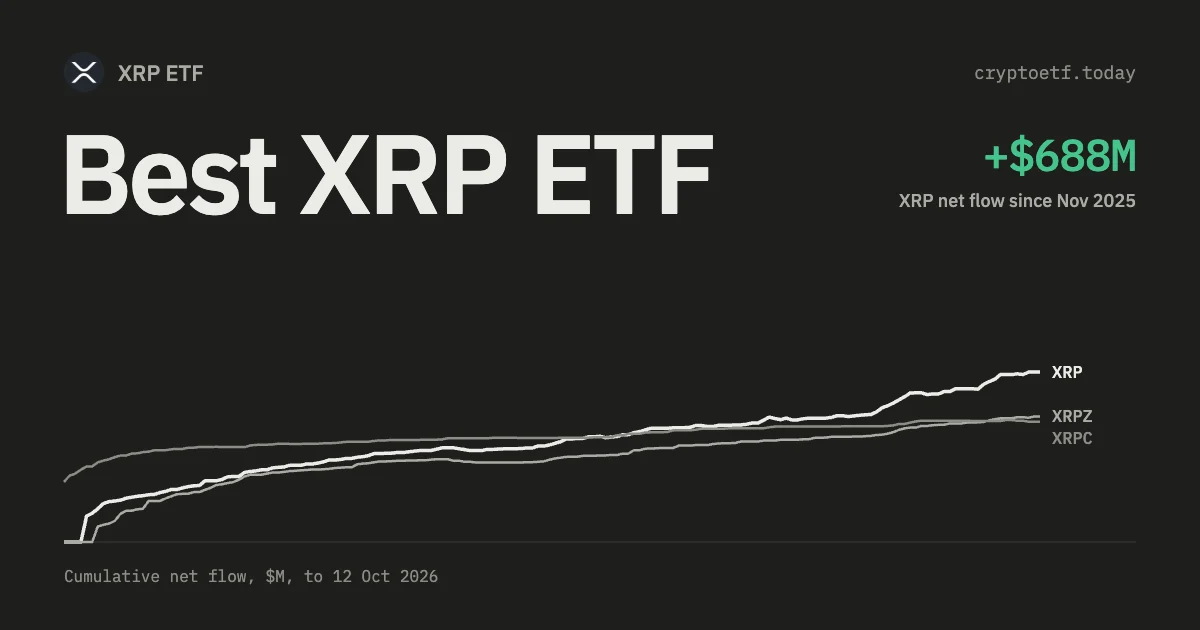
Then watch the number that reflects all of it: the daily creations and redemptions. Money moving into the cheapest fund and out of the priciest is the market pricing the same 31 basis points this article does, and you can see it fund by fund on our XRP ETF flows tracker, updated every business day. The approval story that produced these five funds is in the XRP ETF outlook; the buying mechanics, broker by broker, follow in a separate guide.
FAQ
Which XRP ETF has the lowest expense ratio?
Franklin Templeton's XRPZ at 0.19% a year, per its Form 10-Q for the quarter ended 30 June 2026. The next cheapest is 21Shares TOXR at 0.30% according to its FY2025 10-K, though the product page showed 0.50% in September 2026. Bitwise XRP charges 0.34%, Grayscale GXRP 0.35% and Canary XRPC 0.50%.
Are any XRP ETF fee waivers still active?
No, as of September 2026. Franklin waived XRPZ's entire fee on the first $5bn of assets from 24 November 2025 to 31 May 2026. Grayscale's promotional rate on GXRP ended 25 February 2026. Bitwise waived its fee for one month on the first $500m after its 20 November 2025 launch. Canary and 21Shares never offered one.
How much does an XRP ETF fee cost over five years?
On $10,000 at a flat XRP price, about $95 at 0.19% (XRPZ), $149 at 0.30% (TOXR), $169 at 0.34% (Bitwise), $174 at 0.35% (GXRP) and $248 at 0.50% (XRPC), compounding daily. If XRP doubles over the period the dollar cost roughly doubles too, because the fee is a percentage of assets.
What does the sponsor fee cover?
Everything ordinary: custody of the XRP, cash custody, fund administration, the trustee, the marketing agent, exchange listing, SEC registration, audit, tax reporting and, at Franklin, up to $500,000 a year of legal fees. Only extraordinary items such as litigation, taxes and indemnification fall on the trust itself.
How is the XRP ETF fee paid if the fund earns nothing?
By giving up XRP. Franklin sells XRP as needed and pays the sponsor in dollars; 21Shares pays the sponsor in XRP weekly and Grayscale daily, in arrears. Either way the XRP behind each share falls at the fee rate: GXRP went from 19.4013 to 19.3781 XRP per share in the first half of 2026, exactly what 125 days at 0.35% predicts.
Is the fee a taxable event for shareholders?
In a US taxable account, yes. The funds are grantor trusts, so the trust's sale or in-kind transfer of XRP to pay the sponsor is treated as a disposal of your pro rata share, creating small capital gains or losses each year even if you never sell. 21Shares' 10-K states that the sale of XRP by the trust is a taxable event to shareholders. In an IRA the question doesn't arise.
Are bid-ask spreads a bigger cost than the fee?
It depends how often you trade. The liquid XRP funds published 30-day median spreads of 0.06% to 0.07% in September 2026, so one round trip costs about four months of XRPZ's fee. On TOXR and GXRP, which trade a few thousand to a few tens of thousands of shares a day, the effective spread on a large order can exceed a year of fees.
Sources and further reading
- Franklin XRP ETF, Form 10-Q for the quarter ended 30 June 2026: 0.19% fee, expenses covered, waiver terms to 31 May 2026, XRP sales to pay the fee, grantor-trust treatment — sec.gov.
- 21Shares XRP ETF, Form 10-K for FY2025: 0.30% sponsor fee, payment in XRP weekly in arrears, listing date, taxable-event language — sec.gov; product page showing 0.50%, net assets and volume as of 18 Sep 2026 — 21shares.com.
- Grayscale XRP Trust ETF, Form 10-Q for the quarter ended 30 June 2026: 0.35% fee, promotional waiver to 25 Feb 2026, fee payable in XRP daily in arrears, XRP per share at 31 Dec 2025 and 30 Jun 2026 — sec.gov.
- Bitwise XRP ETF product page: 0.34% expense ratio, 11.1692 XRP per share, 0.06% median spread, 0.13% premium, volume, as of 16–17 Sep 2026 — bitxrpetf.com.
- Canary XRP ETF product page: 0.50% sponsor fee, NAV $14.85 against a $14.97 market price, 0.07% median spread, custodians, as of 18 Sep 2026 — canaryetfs.com.
- Daily creations and redemptions per fund: XRP ETF flows. Internal: best XRP ETF, Bitcoin ETF expense ratios compared.
For information only. Not investment advice.
 BTC
 ETH
 SOL
 HYPE
 LINK
 HBAR
 AVAX
 DOGE
 LTC
 SUI
 DOT
 BNB
 NEAR
 TRX
 ZEC