
FETH keeps its ether away from Coinbase, charges 0.25% and stakes since August 2026, paying out 85% of rewards. $758.6m and 476,311 ETH at 30 June 2026; $2.26bn of inflows.
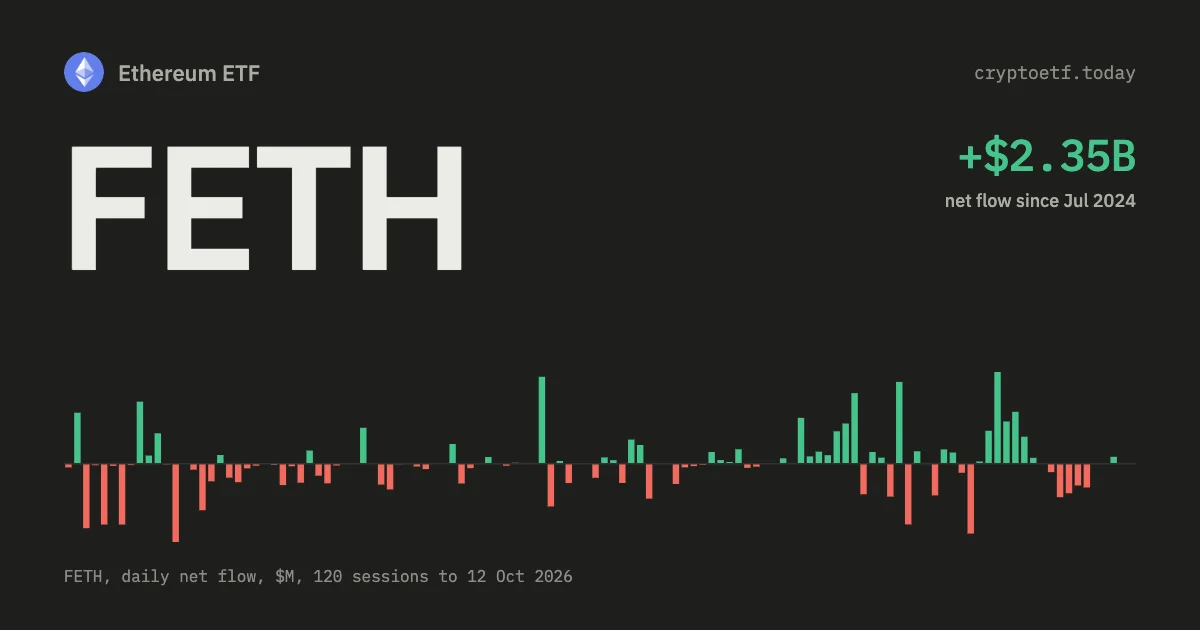
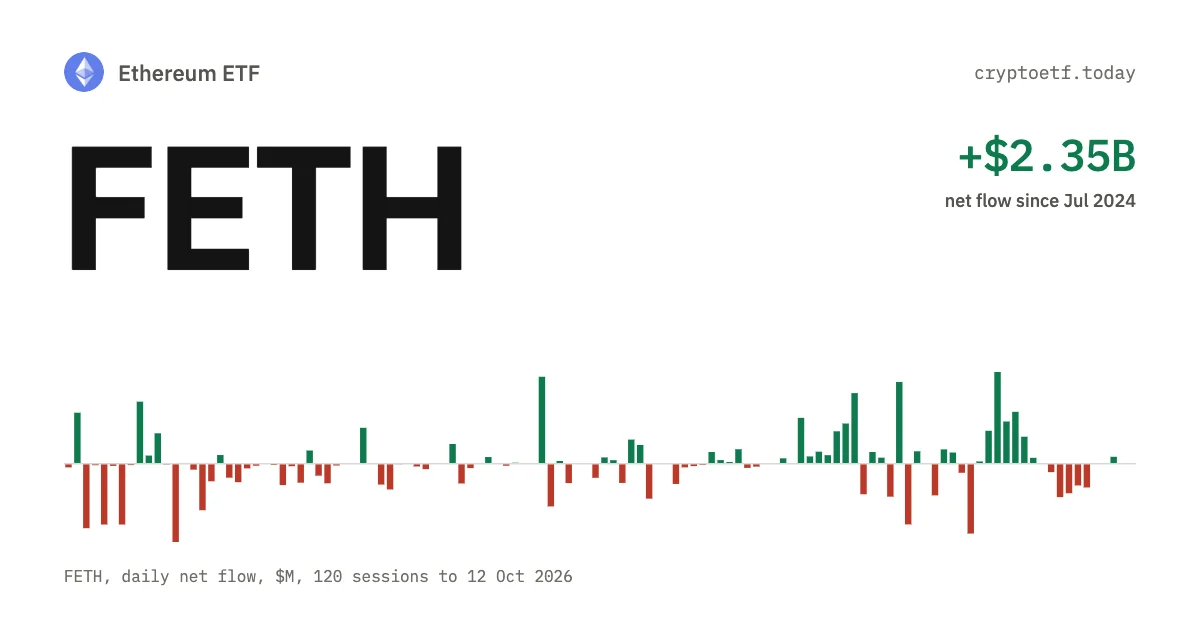
TL;DR. The Fidelity Ethereum Fund (FETH) is the ether twin of FBTC: a 0.25% grantor trust on Cboe BZX whose ether has sat with Fidelity's own custodian since it listed on 23 July 2024. It held 476,311 ETH worth $758.6m at 30 June 2026 per its 10-Q, and has taken in $2.26bn of net creations since launch, second only to BlackRock's ETHA. In August 2026 Fidelity rewrote the trust to stake up to 100% of its ether and pay out 85% of the rewards in cash, and in doing so added Anchorage Digital and BitGo as custodians alongside Fidelity Digital Assets. So the custody pitch has changed from "only Fidelity" to "Fidelity plus two OCC-chartered banks, none of them Coinbase". For a Fidelity account holder who wants ether exposure with staking income and no Coinbase dependency, it is the natural pick. For the lowest fee, Grayscale's mini at 0.15% still wins; for the deepest liquidity, ETHA.

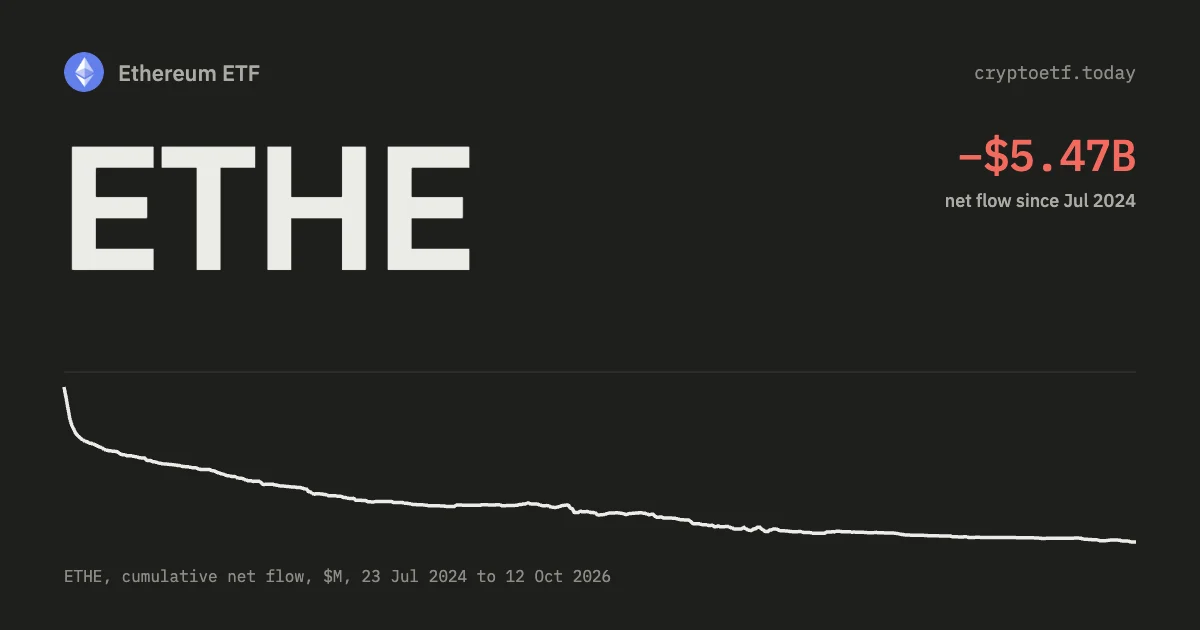
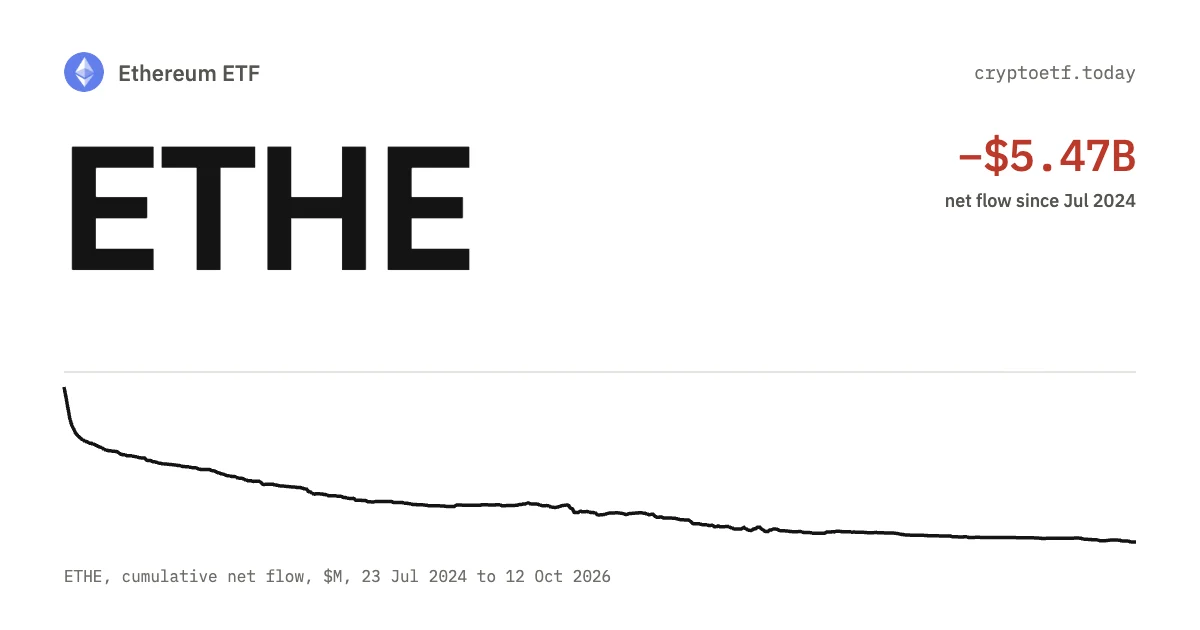
Ethereum ETF flows, live
as of Wed 25 Nov · updated every trading dayContents · 12 sections
- Fund at a glance
- The custody model, before and after August 2026
- The fee: 0.25%, and what it has cost so far
- Staking: the terms and a $10,000 example
- Flows since listing: what Fidelity's column shows
- Liquidity and options
- FETH against the funds it competes with
- Who FETH is for
- Pros and cons
- Verdict
- FAQ
- Sources and further reading
Fund at a glance
| Item | Detail (source and date) |
|---|---|
| Name / ticker | Fidelity Ethereum Fund, FETH, Cboe BZX |
| Sponsor | FD Funds Management LLC, a wholly owned subsidiary of FMR LLC |
| Seeded / first trade | 24 May 2024 / 23 July 2024, NAV $34.87 on day one (FY2025 10-K) |
| Structure | Delaware grantor trust; not a 1940 Act fund; baskets of 25,000 shares |
| Sponsor fee | 0.25% of ether holdings a year; waived in full to 31 December 2024, accruing since 1 January 2025 |
| Ether custodians | Fidelity Digital Assets, N.A. (formerly Fidelity Digital Asset Services, LLC; a Fidelity affiliate); since 7 August 2026 also Anchorage Digital Bank N.A. and BitGo Bank & Trust, N.A. |
| Staking | Authorised by the trust agreement of 7 August 2026; up to 100% of ether, no minimum; trust keeps 85% of rewards, 15% to sponsor, custodians and node operators (Blockdaemon, Figment, Galaxy) |
| Distributions | Cash; "at least quarterly" in the prospectus, "five distributions per year" on Fidelity's fund page |
| Net assets | $758.6m, 476,311 ETH, 47,800,000 shares, NAV $15.87 (30 June 2026 10-Q); about $898m in mid-August 2026 (CoinDesk) |
| Index | Fidelity Ethereum Reference Rate, calculated by Coin Metrics |
| Options | Approved by the SEC on 9 April 2025 alongside ETHA, ETHW, ETHE and the Grayscale mini |
The custody model, before and after August 2026
FETH is one of the nine spot ether ETFs that began trading on 23 July 2024 (the ranking of all ten puts it in context), and what's specific to Fidelity's version starts with custody. The argument for FBTC over IBIT was custody, and it carried over to FETH: where eight of the ten ether ETFs keep their coins at Coinbase Custody Trust Company, FETH used Fidelity Digital Assets, an affiliate of the sponsor. The entity has since changed form. The FY2025 10-K names it as Fidelity Digital Assets, N.A., "formerly Fidelity Digital Asset Services, LLC", a national trust bank supervised by the Office of the Comptroller of the Currency, rather than the New York trust company it was when the FBTC review was written.
Then the staking amendment rewrote the roster. The 8-K of 10 August 2026 records two new custodial agreements signed on 7 August, with Anchorage Digital Bank N.A. and BitGo Bank & Trust, N.A., both OCC-supervised, and says the sponsor "will utilize the services of the Custodians to stake" the trust's ether. Fidelity Digital Assets' arrangement is described as "unaffected". The 21 August prospectus lists all three as custodians holding "a portion" of the ether each, with the split at the sponsor's discretion and based on, among other things, "the ability of each Custodian to implement the Trust's staking program".
Read plainly: the staking is being run through Anchorage and BitGo, and the ether that stakes will sit with them. How much stays at Fidelity Digital Assets isn't disclosed, and the prospectus lets the sponsor move it. The honest description of FETH's custody today is "no Coinbase" rather than "self-custodied". That still separates it from ETHA, ETHB, ETHW, QETH, EZET, ETHE and the mini, all of which use Coinbase as primary custodian. Whether the difference matters is the question worked through in how ETF custody works; the short version is that a Coinbase failure would hit most of the category at once, and FETH is one of two ether funds (VanEck's ETHV on Gemini is the other) that would sit it out.
The flip side is the same as with FBTC. Sponsor, administrator (Fidelity Service Company), distributor (Fidelity Distributors), index provider (Fidelity Product Services) and one of three custodians all report to FMR LLC. The prospectus says so itself, in its conflicts section: the sponsor "is disincentivized from replacing them". The trust is bankruptcy-remote and the ether belongs to shareholders, so this is a governance point rather than a solvency one, but it's a real difference from the BlackRock-plus-Coinbase model where two unrelated firms watch each other.
The fee: 0.25%, and what it has cost so far
Fidelity waived the entire sponsor fee from launch to 31 December 2024; the FY2025 10-K shows $644,000 waived in 2024. From 1 January 2025 the fee accrued at 0.25%, and it came to $4.6m for 2025 and $1.6m for the first half of 2026. On $10,000 that's $25 a year, paid in ether, which the trust transfers to the sponsor monthly. The fee is unified: the sponsor pays the administrator, transfer agent, custodians and auditors out of it, so there are no other ordinary expenses.
Against the field it's mid-table. ETHA charges the same 0.25%; ETHW and ETHV 0.20%; EZET 0.19%; the Grayscale mini 0.15%; ETHB 0.25% waived to 0.12% until March 2027; ETHE 2.50%. The fee difference between FETH and the mini is $10 a year on $10,000. Between FETH and ETHE it's $225. If the fee is the only criterion the mini wins, and it also stakes with a smaller cut, as the next section shows. FETH has to earn its place on custody, the Fidelity account, or the options chain.
Staking: the terms and a $10,000 example
When the ether ETFs were approved in 2024 the SEC made every issuer strip staking out; that history is in Ethereum ETF staking explained. The IRS reopened the door on 10 November 2025 with Revenue Procedure 2025-31, a safe harbour under which a grantor trust can stake without being reclassified as a corporation. Grayscale had already switched staking on in October 2025; 21Shares followed the same month, BlackRock listed a separate staked trust in March 2026, and Fidelity, the third of the big three ether sponsors, moved last.
Its terms, from the 8-K and the 21 August 2026 prospectus:
- How much: "under normal circumstances the Trust may stake up to 100%" of its ether, with no minimum. The sponsor holds back whatever it judges necessary for redemptions and expenses.
- The split: the trust retains 85% of rewards; 15% goes to the sponsor, which shares it with the custodians and node operators.
- Who runs the validators: Blockdaemon, Figment and Galaxy, engaged by the custodians, not by the trust. The custodians keep the private keys of staked ether "at all times".
- Payout: rewards accumulate in ether until a record date, then get sold for dollars and paid as a cash distribution net of expenses. The prospectus commits to at least quarterly; Fidelity's product page says five a year.
- Liquidity: the prospectus allows redemptions to be settled in cash or delayed if unstaking takes longer than the standard settlement window, and notes that Ethereum's exit queue exceeded 46 days in September 2025.
Now the money. Ethereum's reward rate is low; iShares quoted 1.45% for ETHB on 16 September 2026, and we borrow that figure since Fidelity hasn't published its own. On $10,000 fully staked, gross rewards are $145. Fidelity's 15% takes $22, leaving $123 for the trust. Subtract the $25 fee and the net carry is about $98 a year. If the sponsor keeps 10% of the ether liquid, as most peers do, the figure drops to roughly $86. The cross-asset staking comparison runs the same arithmetic for 22 funds; among the ether ones, the Grayscale mini nets about $98 on a 6% cut and 83% staked, ETHB about $91 while its waiver lasts, and ETHE goes backwards by about $158 because a 2.50% fee eats the whole reward. FETH stays competitive by staking a larger share; its cut is nothing special. Its 15% is the third-largest cut of the five ether funds, behind 21Shares' 25% and Grayscale ETHE's 23%, and well above the mini's 6%.
Two caveats the marketing doesn't stress. First, every distribution is a taxable event in a taxable account; the rewards are income when the trust receives them, and the cash comes with a 1099. In an IRA that doesn't apply, which is one reason the Roth IRA case gets stronger once a fund stakes. Second, the trust may sell ether, not just rewards, to fund a payout, so a distribution isn't purely "extra" on top of your ether exposure. And a plain admission: as of mid-September 2026, when this review was researched, Fidelity had not yet published what share of FETH's ether is staked or the size of a first distribution. The trust said staking would start "as soon as practicable" after the 21 August effectiveness. Check the fund page or the next 10-Q for the actual percentage before you assume 100%.
Flows since listing: what Fidelity's column shows
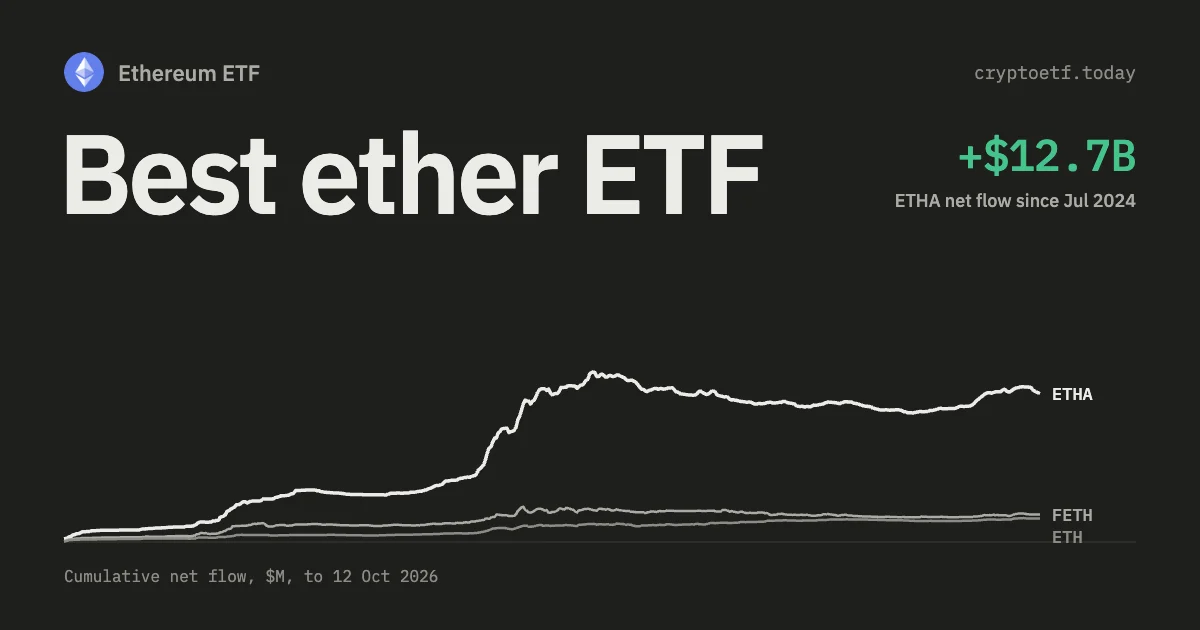
FETH's daily creations and redemptions are the Fidelity column on the Ethereum ETF flows page, updated every business day. Through 18 September 2026 the series runs to $2.26bn of net inflow since 23 July 2024, the second-largest cumulative figure in the category after ETHA's $12.95bn and ahead of Bitwise ETHW at $394m. The arc has three parts.
| Period | FETH net flow | What the filings show |
|---|---|---|
| 23 Jul to 31 Dec 2024 | +$1.58bn | 471,750 ETH and 47.2m shares at year-end; fee waived throughout (10-K) |
| 2025 | +$1.08bn | 126.1m shares created, 98.7m redeemed; 743,795 ETH and $2.21bn at 31 Dec 2025; July and August alone brought +$1.09bn |
| 1 Jan to 30 Jun 2026 | -$531m | 72.8m shares redeemed against 46.1m created; net assets fell to $758.6m as NAV per share went from $29.64 to $15.87 |
| 1 Jul to 18 Sep 2026 | +$134m | July flat (-$12m); August +$181m, the first positive month since December 2025, in the weeks the staking filings landed |
Flow figures are cryptoetf.today's series; share and ether counts are from the FY2025 10-K and the June 2026 10-Q. Two things stand out. The first-half 2026 exodus was real money leaving as well as price: shares outstanding dropped 36% in six months while ether lost roughly 46%, so the fund shrank on both axes. The second is the turn in August. FETH's biggest single day since launch was +$277m on 11 August 2025 and its worst -$272m four days later, so +$181m in a month is modest by its own history; but a positive month that opened with the 8-K and closed with an effective prospectus is at least consistent with staking bringing some money back. One month isn't a trend. Where the line goes from here is the thing to watch, and the ETH reading of the CEFI index puts the whole category's flow into one 0 to 100 score so a single fund's swing can't dominate the picture.
Liquidity and options
FETH ranks second by cumulative inflow but only fifth by assets at 30 June 2026, behind ETHA, the Grayscale mini, ETHE and ETHB, and every one of those has a different reason for its size (a spin-off, a legacy trust, a fee waiver). Neither the 10-Q nor the prospectus reports a bid-ask figure, and we don't publish spreads we can't source, so treat liquidity qualitatively: a $750m fund with an options chain trades fine for any retail order, and only block-sized trades will notice the gap to ETHA. What can be sourced is options. The SEC approved listed options on FETH on 9 April 2025 in the same order as ETHA, ETHW, ETHE and the mini, American-style and physically settled. The ETHA chain is deeper, but FETH's exists, which is more than ETHB, ETHV, QETH, EZET or TETH can say.
Trading notes are the same as for any spot crypto ETF: limit orders, and skip the first minutes after the US open while overnight ether moves get priced in.
FETH against the funds it competes with
| FETH | ETHA | ETHB | ETHW | ETH (Grayscale mini) | |
|---|---|---|---|---|---|
| Fee | 0.25% | 0.25% | 0.25%, waived to 0.12% to Mar 2027 | 0.20% | 0.15% |
| Stakes? | Yes, up to 100%, 85% paid out | No | Yes, 70-95% target, 82% paid out | No | Yes, ~83% staked, 94% paid out |
| Primary custodian | Fidelity Digital Assets, Anchorage, BitGo | Coinbase | Coinbase | Coinbase | Coinbase |
| Exchange | Cboe BZX | Nasdaq | Nasdaq | NYSE Arca | NYSE Arca |
| Options | Yes (Apr 2025) | Yes | Broker-dependent | Yes | Yes |
| Net assets | $758.6m (30 Jun 2026) | $8.57bn (16 Sep 2026) | $1.04bn (16 Sep 2026) | $262m (15 Sep 2026) | $1.35bn (30 Jun 2026) |
| Cost on $10,000, fee only | $25 | $25 | $12 | $20 | $15 |
| Net carry on $10,000 with staking (1.45% gross) | about +$98 if fully staked | -$25 | about +$91 | -$20 | about +$98 |
Sources: FETH 10-Q and prospectus; iShares and Bitwise product pages for the September figures; Grayscale's June 2026 10-Q for the mini. The carry line assumes each fund's reported staked share and the 1.45% rate iShares quoted on 16 September 2026.
The table says what the sections above say: FETH ties the mini on net carry only if it stakes essentially everything, costs $10 a year more on $10,000, and has a smaller options chain than ETHA. What it has that none of the other four has is a custodian roster without Coinbase and a home inside the largest US retail brokerage. That's the whole case.
Who FETH is for
- Fidelity account holders. Same login, same 1099, IRA-eligible, and the sponsor's own product on the sponsor's own platform. ETHA and the mini are also available at Fidelity, so nothing locks you in; the convenience is still real.
- Anyone who wants ether exposure without Coinbase in the chain. FETH and ETHV are the two choices. FETH stakes and has options; ETHV is 5 basis points cheaper, doesn't stake, and held $106.8m at 31 March 2026.
- Holders splitting a position across two issuers. The institutional pattern with Bitcoin ETFs, half IBIT and half FBTC, translates directly to ETHA plus FETH: same fee, different custodian, different sponsor.
- Holders who want staking income with cash payouts and would rather have a Fidelity name on the statement than a Grayscale one, and are willing to pay a 15% cut instead of 6% for it.
Who it isn't for: the fee minimiser (the mini), the options trader who needs depth (ETHA), and anyone in a taxable account who doesn't want five taxable distributions a year on top of the ether position. And, per the ETHE review, nobody should be in ETHE at all, so if you're comparing FETH to that, stop and buy FETH.
Pros and cons
| For | Against |
|---|---|
| No Coinbase in the custody chain; three OCC-supervised custodians | Custody is no longer purely in-house; the Fidelity share of the ether isn't disclosed |
| Stakes up to 100% with cash distributions, options chain, second-largest inflows in the category | 15% reward cut is mid-pack among the five staking ether funds; Grayscale's mini keeps 6% |
| 0.25% is the same as ETHA, with a Fidelity account fully integrated | Not the cheapest: 10 bp above the mini, 5 above ETHW and ETHV |
| Two and a half years of filings, no premium or discount episodes, no operational incidents in the 10-Qs | Sponsor, administrator, distributor, index provider and a custodian are all FMR subsidiaries |
| Fee was fully waived for the first five months of trading | Staked share and first distribution weren't public as of mid-September 2026; the "up to 100%" is a ceiling, not a promise |
Verdict
FETH is a good ether ETF that used to have one sharp differentiator and now has a blunter one. "The only self-custodied ether ETF" was a clean line; "Fidelity plus Anchorage plus BitGo, no Coinbase" is longer, but it still gives the custody-conscious investor what they came for, and now with staking income and an options chain attached. At 0.25% it's fairly priced against ETHA and a dollar a month on $10,000 dearer than the mini. If you bank at Fidelity, or already hold ETHA and want a second custodian, buy it and don't overthink it. Choosing one ether ETF from scratch on cost alone, take the mini; on liquidity, ETHA. Before you place the order, read the last month of the Fidelity column on the Ethereum ETF flows page; the funds that are taking in money are the ones whose spreads stay tight.
FAQ
Who is the custodian of the Fidelity Ethereum Fund?
Since listing in July 2024 the ether has been held by Fidelity Digital Assets, N.A. (formerly Fidelity Digital Asset Services, LLC), a Fidelity affiliate and OCC-supervised national trust bank. On 7 August 2026 the trust also signed custodial agreements with Anchorage Digital Bank N.A. and BitGo Bank & Trust, N.A. to support staking. The August 2026 prospectus lists all three as custodians, each holding a portion of the ether. None of them is Coinbase, which custodies eight of the ten US ether ETFs.
What is the FETH expense ratio?
A unified sponsor fee of 0.25% of ether holdings a year, the same as BlackRock ETHA. Fidelity waived the whole fee from launch until 31 December 2024 and has charged the full rate since 1 January 2025. The 15% staking fee is separate and comes out of staking rewards, not out of the ether position.
Does FETH stake its ether?
Yes, since the trust agreement was amended on 7 August 2026 and the registration statement became effective on 21 August 2026. Under normal circumstances the trust may stake up to 100% of its ether with no minimum. It keeps 85% of the rewards; 15% is shared by the sponsor, the custodians and the node operators Blockdaemon, Figment and Galaxy. Rewards are sold for cash and distributed, at least quarterly per the prospectus and five times a year per the fund page.
How big is FETH?
At 30 June 2026 the fund held 476,311 ETH worth $758.6m across 47.8 million shares, NAV $15.87, per its 10-Q. CoinDesk reported about $898m of net assets in mid-August 2026. It peaked at $2.21bn and 743,795 ETH at 31 December 2025; the first half of 2026 saw net redemptions of 26.75 million shares alongside a 46% fall in ether.
FETH or ETHA?
Same 0.25% fee. ETHA is more than ten times larger, has the deepest options chain and does not stake. FETH stakes with 85% of rewards paid out, has a smaller options chain, and keeps its ether away from Coinbase. Choose ETHA for liquidity, FETH for custody diversification or staking income under a Fidelity name, or hold both as an ether version of the IBIT-plus-FBTC split.
Are FETH staking distributions taxable?
In a taxable account, yes: staking rewards are income to the trust and flow through to shareholders, and each cash distribution is reported on your 1099. Inside an IRA or 401(k) the distributions are not currently taxed. The trust may also sell ether, not just rewards, to fund a payout. This is general information, not tax advice.
Sources and further reading
- Fidelity Ethereum Fund, Form 10-Q for the quarter ended 30 June 2026: net assets, ether held, shares, sponsor fee, custodian: sec.gov.
- Fidelity Ethereum Fund, Form 8-K dated 7 August 2026: Anchorage and BitGo custodial agreements, amended sponsor agreement, 85/15 staking split, third amended trust agreement: sec.gov.
- Fidelity Ethereum Fund, prospectus dated 21 August 2026 (424B3): staking program, node operators, custodians, distributions, liquidity risk: sec.gov.
- Fidelity Ethereum Fund, Form 10-K for 2025: fee waiver to 31 December 2024, 2024 and 2025 share activity, NAV history: sec.gov.
- Fidelity Institutional, FETH fund page (staking and "five distributions per year"): institutional.fidelity.com; CoinDesk, 12 August 2026, on the staking filing and $898m of net assets: coindesk.com.
For information only. Not investment advice.
 BTC
 SOL
 XRP
 HYPE
 LINK
 HBAR
 AVAX
 DOGE
 LTC
 SUI
 DOT
 BNB
 NEAR
 TRX
 ZEC