FBTC is the second-largest spot Bitcoin ETF — $10.30bn at 30 June 2026 — and the only large fund holding no bitcoin at Coinbase. What in-house custody buys and where FBTC fits.
TL;DR. Fidelity's Wise Origin Bitcoin Fund (FBTC) is the second-largest US spot Bitcoin ETF — $10.30 billion of net assets and 174,383 BTC at 30 June 2026 (Q2 2026 10-Q), 14.4% of the category, 0.25% expense ratio, the same headline fee as IBIT. The structural differentiator: FBTC's bitcoin is held by Fidelity Digital Assets, N.A., an affiliate of the sponsor, not at Coinbase. For investors who already use Fidelity and for those seeking custody diversification away from Coinbase, FBTC is the obvious choice. For pure liquidity, IBIT is deeper.
Contents · 11 sections

The basics
| Field | Value |
|---|---|
| Ticker | FBTC |
| Exchange | Cboe BZX |
| Inception | 11 Jan 2024 |
| Sponsor | FD Funds Management LLC (a subsidiary of FMR LLC) |
| Trustee | CSC Delaware Trust Company |
| Custodian | Fidelity Digital Assets, N.A. (affiliate of the sponsor) |
| Administrator | Fidelity Service Company, Inc. |
| Transfer agent and cash custodian | State Street Bank and Trust Company |
| Expense ratio | 0.25% (fully waived to 31 July 2024) |
| Net assets (30 Jun 2026) | $10.30 billion — 174,383 BTC |
| Average daily volume | ~8 million shares |
Why in-house custody matters
There are now thirteen listed US spot Bitcoin ETFs, and Coinbase Custody Trust appears in almost every one of them. Of the funds whose latest 10-Qs we read — IBIT, GBTC, the Grayscale Mini, BITB, ARKB, HODL and BRRR — every single one holds bitcoin at Coinbase, either as sole custodian or as one of several. VanEck HODL keeps Gemini Trust as its bitcoin custodian and added Coinbase as the additional custodian; CoinShares BRRR uses three (Coinbase Custody, BitGo Trust Company and Komainu (Jersey) Limited); ARKB uses four, Coinbase among them. FBTC is the genuine exception: its bitcoin sits entirely with Fidelity Digital Assets, N.A., an affiliate of the sponsor. In the fund's earlier filings the custodian was named Fidelity Digital Asset Services, LLC; by the Q2 2026 10-Q it is Fidelity Digital Assets, N.A. — a national association.
This is a meaningful structural diversifier. The Coinbase concentration risk is the single most-discussed systemic vulnerability of the spot Bitcoin ETF category — covered in how Bitcoin ETF custody actually works. FBTC's in-house custody removes that exposure entirely.
The custody architecture itself is similar in spirit to Coinbase's: segregated cold storage, keys controlled by the custodian. The difference is the operational and regulatory chain behind it. For investors who want a genuinely different custodian — not just a different name on the same desk — Fidelity is the clean answer.
Fees and tracking
FBTC charges 0.25% flat — identical to IBIT's post-waiver rate. There was a launch waiver, contrary to a claim that circulates widely: the fund's 10-K for 2024 states that "the Sponsor contractually waived the Sponsor Fee until July 31, 2024", and the fee began accruing at 0.25% on 1 August 2024. Total expense to a $100k holder: $250/year, compounding to roughly $2,471 over a decade if BTC is flat (see Bitcoin ETF expense ratios compared for the full math).
Tracking quality: Fidelity does not publish the numbers
This is the part of FBTC that gets written about most carelessly. Fidelity publishes no 30-day median bid-ask spread and no premium/discount history for FBTC. Neither the retail crypto-funds page nor the institutional product page carries those fields. FBTC is a 1933 Act commodity trust rather than a 1940 Act fund, so Rule 6c-11 does not require it — and unlike BlackRock, Bitwise and 21Shares, Fidelity has not volunteered the data.
So every precise spread figure quoted for FBTC, anywhere, is somebody's estimate. Here is what the issuers who do disclose were showing at 23 September 2026:
| Fund | 30-day median bid-ask spread | Net assets | Daily volume (shares) |
|---|---|---|---|
| IBIT (BlackRock) | 0.02% | $67.08bn | 46.9M |
| BITB (Bitwise) | 0.0234% | $3.24bn | 0.95M |
| ARKB (21Shares) | 0.04% | $2.88bn | 1.87M |
| FBTC (Fidelity) | not published | — | — |
Issuer fund pages, 23 September 2026.
Two things follow. First, spread tracks size only loosely: BITB at $3.24bn quoted the same 0.02% median as IBIT at $67.08bn, while ARKB — smaller than BITB but trading twice its share volume — quoted double that. Second, FBTC held $10.30bn at 30 June 2026 (Q2 2026 10-Q), second in the category and far larger than either disclosing mid-tier fund, so the reasonable expectation is a spread in the same 2 bp neighbourhood as IBIT. That is an inference from comparable funds, not a disclosure, and it should not be printed as one.
The Fidelity ecosystem advantage
If you already hold a Fidelity brokerage account, FBTC integrates cleanly with the rest of your investment infrastructure:
- Available in all account types — taxable, Roth IRA, traditional IRA, SEP-IRA, 401(k) through Fidelity's plan administration arm.
- Consolidated tax reporting on one 1099 with the rest of your Fidelity holdings.
- Same login, same statements, same customer service infrastructure.
- Eligible for Fidelity's automatic rebalancing and advisor-managed portfolios.
None of this is unique to FBTC vs other ETFs — IBIT and ARKB are also available at Fidelity. But the consolidated experience inside the Fidelity ecosystem is smoother for the issuer's own product.
Custody risk: the FBTC-specific concern
The flip side of in-house custody is concentration of legal entities. FD Funds Management LLC is the sponsor; Fidelity Digital Assets, N.A. is the custodian; Fidelity Service Company, Inc. is the administrator. All three sit under FMR LLC. (The transfer agent and cash custodian, State Street Bank and Trust Company, is an outside party, as is the trustee, CSC Delaware Trust Company.)
In a Coinbase-custodied ETF, the sponsor (BlackRock) and custodian (Coinbase) are independent companies, each subject to its own regulator. If one fails the other is unaffected at the entity level. With FBTC the chain is internally consistent — a benefit for operational integration but a single point of corporate-parent failure (improbable but worth noting).
The trust structure itself is still bankruptcy-remote: bitcoin held in trust belongs to shareholders, not to FMR creditors. The risk is more about coordinated regulatory action against an integrated group than about typical custody failure.
The case for FBTC
- Non-Coinbase custody. The single best reason. Hedge against the category's biggest concentration risk.
- Fidelity ecosystem. If you live there already, the experience is best-in-class.
- Reputational stability. Fidelity's long history and family ownership make it among the most operationally conservative US financial firms.
- Scale. $10.30bn at 30 June 2026 makes FBTC the second-largest fund in the category, well clear of the mid-tier — though Fidelity publishes no spread or premium data to confirm what that buys in execution.
The case against FBTC
- Not the cheapest. Same 0.25% as IBIT, but 6 bp more than Franklin EZBC (0.19%) and 11 bp more than the cheapest fund in the category, Morgan Stanley MSBT (0.14%).
- Smaller book. Less liquid than IBIT for institutional-size orders.
- FMR concentration. Sponsor and custodian under the same corporate parent.
FBTC vs IBIT — the headline question
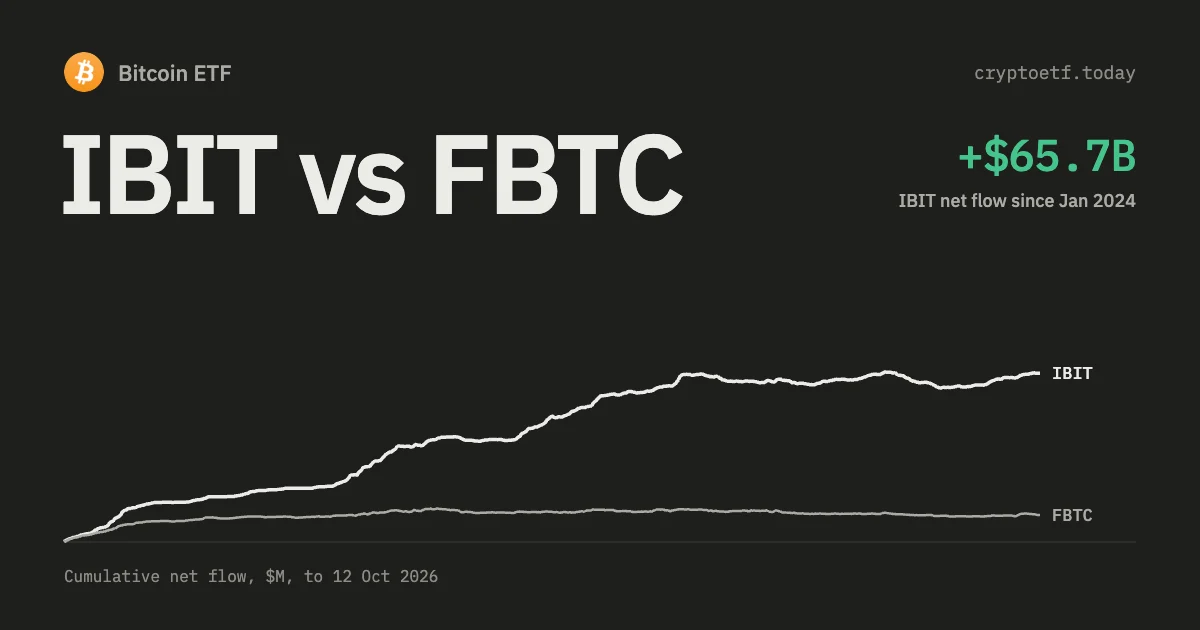
This deserves its own article — IBIT vs FBTC: which is better — and the short answer is: identical fee, identical tax treatment, identical access; choose IBIT for liquidity, FBTC for custody diversification. Who holds which, and in what size, is disclosed every quarter in 13F filings — see Bitcoin ETF 13F filings explained.
FAQ
Who custodies the bitcoin behind FBTC?
Fidelity Digital Assets, N.A., an affiliate of the sponsor (earlier filings name Fidelity Digital Asset Services, LLC). Of the large US spot Bitcoin ETFs whose latest 10-Qs we checked, FBTC is the only one holding no bitcoin at Coinbase: VanEck HODL uses Gemini plus Coinbase, CoinShares BRRR uses Coinbase, BitGo and Komainu, and ARKB uses four custodians including Coinbase.
What is the expense ratio of Fidelity FBTC?
0.25% per year, and there was a launch waiver: per the fund's 10-K for 2024 the sponsor waived the fee entirely until 31 July 2024, with the 0.25% accruing from 1 August 2024. Identical headline fee to BlackRock IBIT.
Is FBTC available in a Roth IRA?
Yes, in all standard tax-advantaged account types: Roth IRA, traditional IRA, SEP-IRA, and 401(k) plans where the menu allows. Fidelity supports FBTC across its full account suite.
What's the main difference between FBTC and IBIT?
Both have a 0.25% fee and similar access. The structural difference is custody: FBTC uses Fidelity Digital Assets, N.A. (an affiliate of its own sponsor); IBIT uses Coinbase Custody Trust, as do the funds holding just under 80% of category assets. IBIT is the larger and more heavily traded of the two, and it publishes a 30-day median spread (0.02% at 23 September 2026) where Fidelity publishes nothing. Choose IBIT for depth and disclosure, FBTC for custody diversification.
How big is FBTC compared to IBIT?
At 30 June 2026 FBTC held $10.30 billion of net assets and 174,383 BTC — 14.4% of the $71.4 billion category — versus IBIT at $43.39 billion (60.7%). FBTC is the clear #2 product and the only large fund whose bitcoin is not at Coinbase.
Sources and further reading
- Fidelity Wise Origin Bitcoin Fund prospectus — sec.gov/Archives/edgar.
- Fidelity Digital Asset Services NYDFS charter disclosure — dfs.ny.gov.
- Internal: BlackRock IBIT review, IBIT vs FBTC, How Bitcoin ETF custody works, Expense ratios compared.
Live data on this topic
For information only. Not investment advice.
 ETH
ETH SOL
SOL XRP
XRP HYPE
HYPE LINK
LINK HBAR
HBAR AVAX
AVAX DOGE
DOGE LTC
LTC SUI
SUI DOT
DOT BNB
BNB NEAR
NEAR TRX
TRX ZEC
ZEC