Counted session by session: $56.94bn of net flow across 676 trading days, IBIT above the entire category in all three years, and a 2026 that has gone almost exactly nowhere.
TL;DR. Summed from our own daily series, the twelve US spot Bitcoin ETFs in our series took in $56.94bn net across 676 trading sessions between 11 January 2024 and 22 September 2026. The record splits cleanly by year: +$35.25bn in 2024, +$21.35bn in 2025, and +$349m so far in 2026, which is a rounding error on a category this size. One fund explains all of it. BlackRock's IBIT has taken +$64.86bn, more than the entire category in each of the three calendar years, while the other eleven funds combined have shed $5.91bn since 1 January 2025. The dollar-weighted price the category paid for its bitcoin works out at about $80,021 against a $86,416 spot close on 22 September 2026, so the money is roughly 8% ahead. Gold, over the same window, is up 118% against bitcoin's 86%.
المحتويات · 11 قسمًا
- What two and a half years of flows add up to
- Year two was not a smaller year one
- 2026 has been a round trip to nowhere
- The category is one fund and a tail
- The Grayscale unwind is over, and it took two years
- What actually changed in year two
- What the flows paid for their bitcoin
- Gold won the period
- Four ways this record gets misread
- FAQ
- Sources and further reading

What two and a half years of flows add up to
Most retrospectives about this category quote assets under management, which is mostly a statement about the price of bitcoin. Flow is the harder number and the more honest one: it's money that arrived or left, and it doesn't rise when the coin rallies. Our Bitcoin ETF flows page carries one row per trading day per fund, and the arithmetic below is that series added up. None of it is modelled or taken from a static holdings table.
| Calendar year | Sessions | Net flow | Positive sessions | Best month | Worst month | BTC, first → last close |
|---|---|---|---|---|---|---|
| 2024 (from 11 Jan) | 245 | +$35.25bn | 166 (68%) | Nov, +$6.47bn | Apr, −$0.35bn | $46,563 → $92,782 |
| 2025 | 250 | +$21.35bn | 146 (58%) | Jul, +$6.01bn | Feb, −$3.56bn | $94,473 → $88,472 |
| 2026 (to 22 Sep) | 181 | +$0.35bn | 90 (50%) | Aug, +$3.54bn | Jun, −$4.51bn | $88,720 → $86,416 |
| All 676 sessions | 676 | +$56.94bn | 402 (59.5%) | — | — | $46,563 → $86,416 |
Source: our daily Bitcoin ETF flow series, read 22 September 2026. Two things in that table are worth pausing on. The share of up days barely moved, from 68% to 58% to 50%, but the money fell by two orders of magnitude, which means the change isn't in how often creations happen. It's in their size, and in how much comes back out. Gross creations across the whole period total $117.26bn; gross redemptions total $60.32bn. The net is the difference, and in 2026 those two lines have been running almost level.
Year two was not a smaller year one
If you slice on the listing anniversary rather than the calendar, year one (11 January 2024 to 10 January 2025) took +$36.22bn over 251 sessions and year two (to 9 January 2026) took +$20.16bn over 250. That looks like a healthy deceleration until you split it by fund. In year one, nine of the eleven original funds were net positive. In year two, only three were: IBIT, VanEck's HODL by $255m, and the Grayscale Mini Trust by $997m. Fidelity's FBTC, the second-largest fund in the category, finished year two at −$425m.
That's the real shape of the second year: the category kept growing in dollars while most of its members stopped growing in shares. The redemptions weren't panic, either, but rotation into the cheapest large wrappers. Why a redemption prints at all, and why a redemption day isn't automatically bearish, is in what Bitcoin ETF outflows mean.
The extremes, with dates
- Best session: +$1,373.8m on 7 November 2024, the day after the US election. IBIT was $1,119.9m of it, or 82%.
- Worst session: −$1,113.7m on 25 February 2025. Every one of the twelve columns was negative that day, which has happened rarely enough to be worth naming.
- Longest run of inflows: 19 sessions, 13 May to 7 June 2024.
- Longest run of outflows: 13 sessions, 15 May to 3 June 2026.
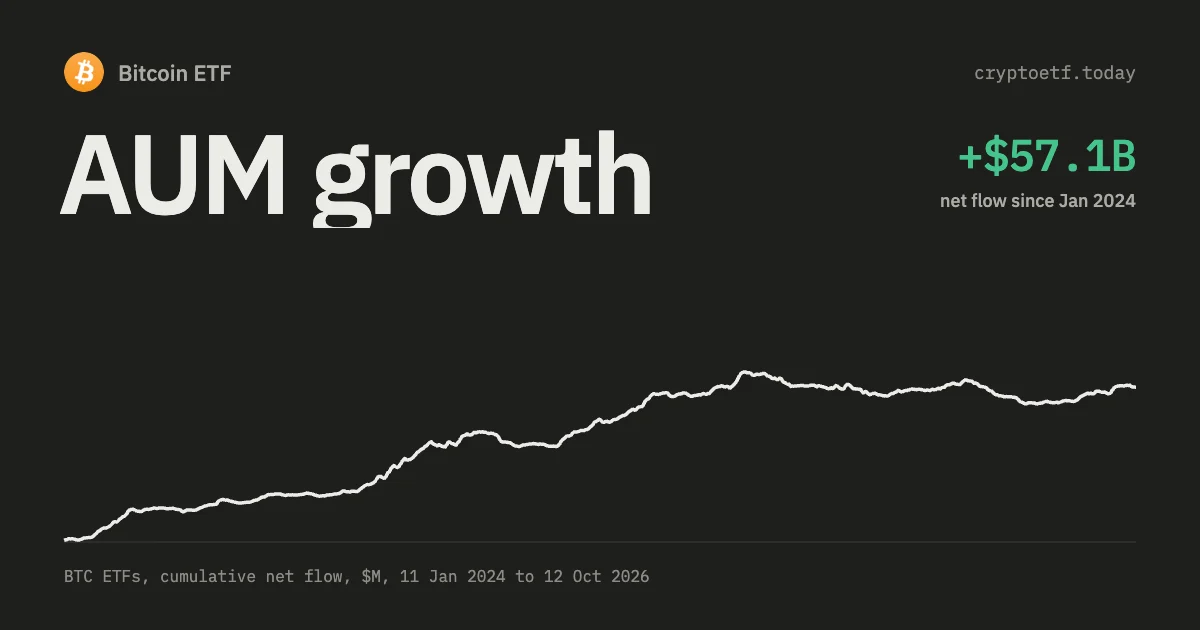
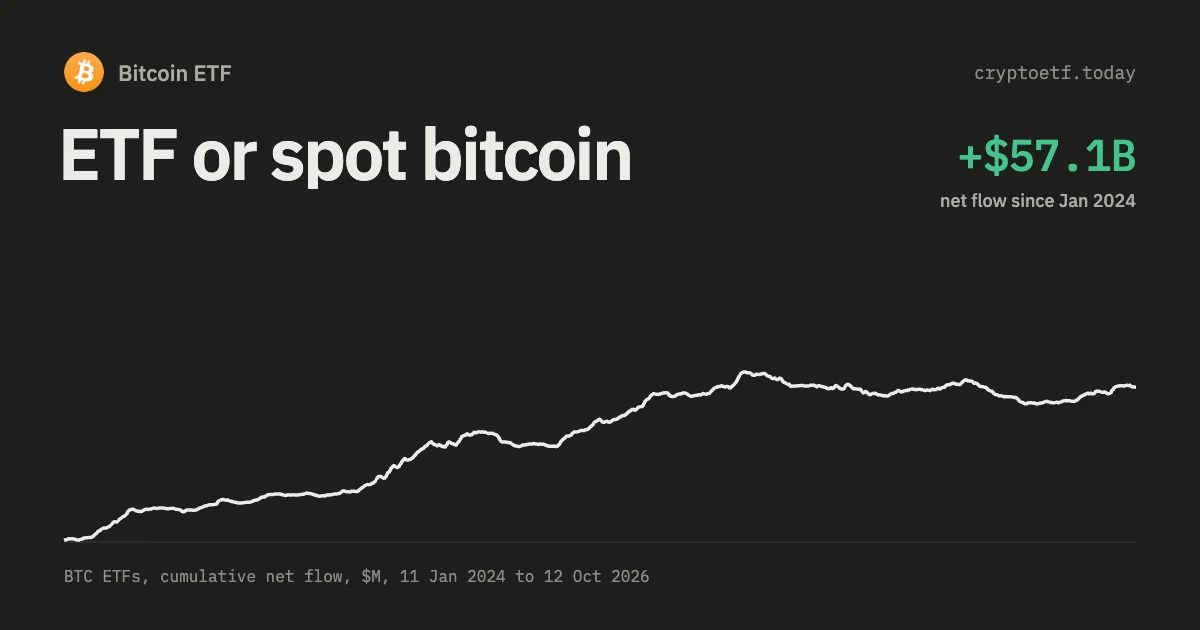
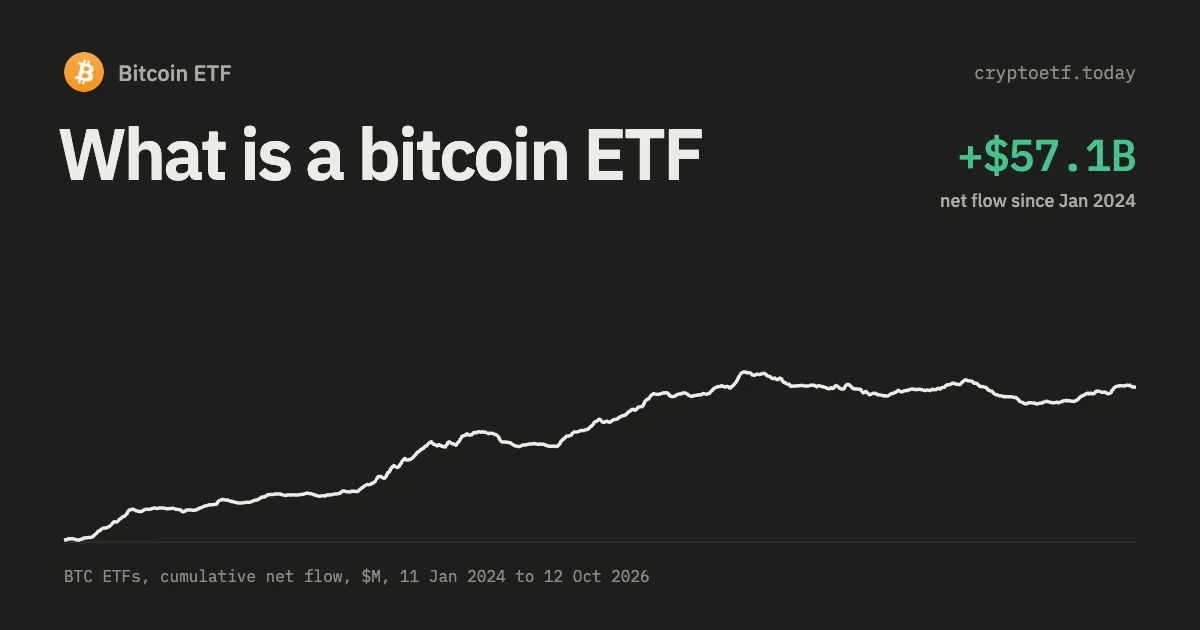
- Peak cumulative flow: $62.74bn on 9 October 2025, two days after bitcoin's $124,674 high in our series. The line has been lower ever since.
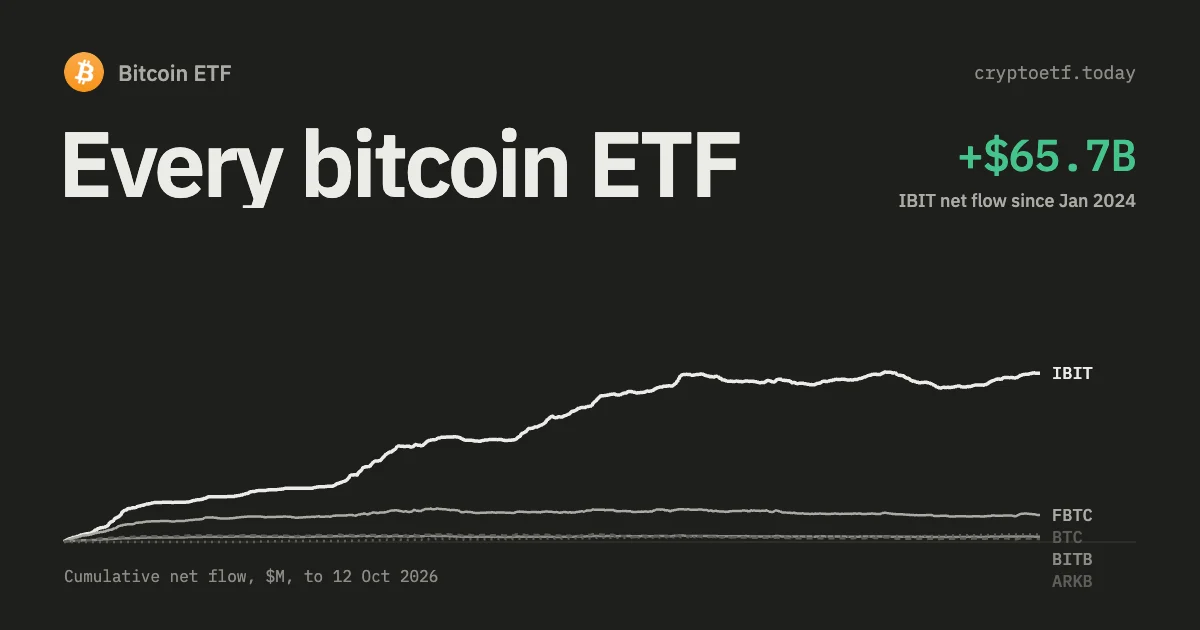
That last point is the one most summaries miss. The cumulative flow line has a top, and it's already behind us: since 9 October 2025 the twelve funds have given back $5.79bn net. Reading that line properly, and why its slope beats any single bar, is covered in how to analyze ETF flows.
2026 has been a round trip to nowhere
Through 181 sessions, 2026 stands at +$349.1m. By late September of its first year the category had taken $30.0bn. The path to that flat number is the interesting part.
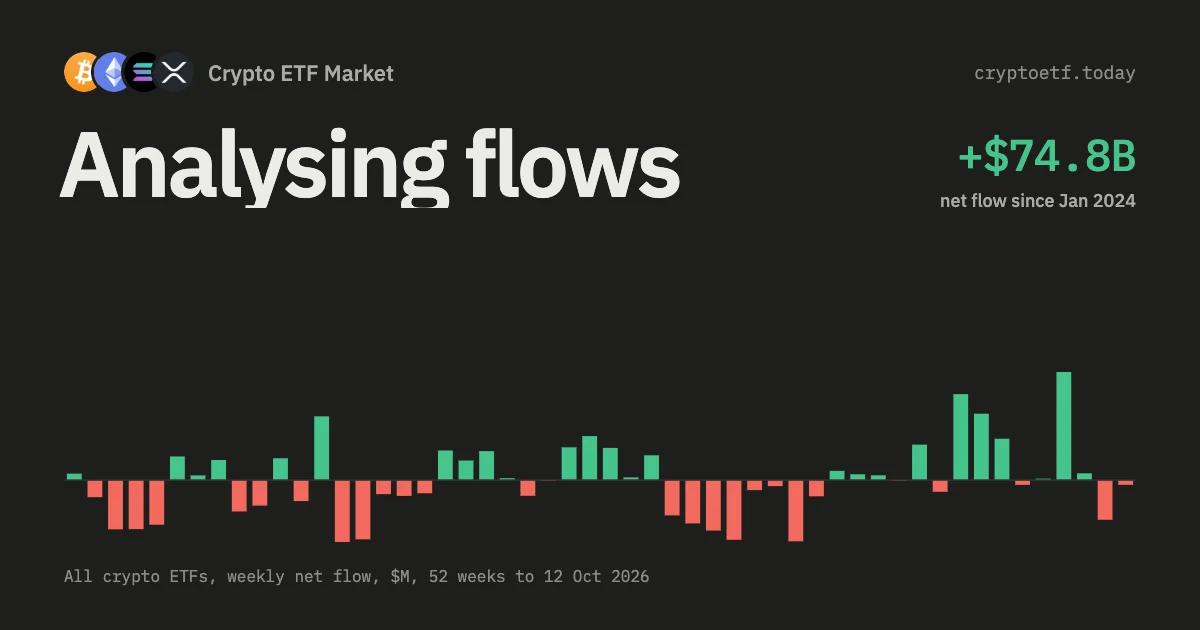
The first half of 2026 lost money steadily: −$1.60bn in January, then a slow bleed through February, a brief +$1.32bn in March and +$2.02bn in April, then −$2.41bn in May and −$4.51bn in June, the worst month the category has ever recorded. Bitcoin bottomed at $58,625 on 1 July 2026, down 53.0% from the October 2025 high. Then it turned: July came in flat at +$173m, August took +$3.54bn, and the first fifteen sessions of September added +$2.03bn. Q3 2026 alone is +$5.74bn, against a combined −$6.52bn across the previous three quarters.
So the honest read on 2026 isn't "demand died". It's that a $4.5bn month of redemptions and a $5.7bn quarter of creations happened inside nine months and cancelled out. Our CEFI sentiment index, which scales daily flow against market cap on a 0–100 band, closed at 87 for bitcoin on 22 September 2026. That's a hot reading, and it describes the last few weeks rather than the year.
The category is one fund and a tail
Here's the finding that survives every way I sliced the data. In all three calendar years, IBIT's net flow exceeded the entire category's net flow, which is only possible if everything else, in aggregate, was negative.
| Period | Category net | IBIT net | All other funds, combined |
|---|---|---|---|
| 2024 | +$35.25bn | +$37.25bn | −$2.00bn |
| 2025 | +$21.35bn | +$24.84bn | −$3.50bn |
| 2026 to 22 Sep | +$0.35bn | +$2.76bn | −$2.41bn |
The popular framing is a duopoly of IBIT and FBTC, and on assets it holds: at 30 June 2026 the twelve funds held 1,210,299 BTC worth $71.42bn, roughly 5.76% of bitcoin's 21 million cap, and IBIT was 60.7% of that with FBTC at 14.4%. BlackRock's own 10-Q for the quarter puts IBIT's net assets at $43,386,012,125 across 1,296,040,000 shares, an NAV of $33.48. Add the two and you're at three-quarters of the category.
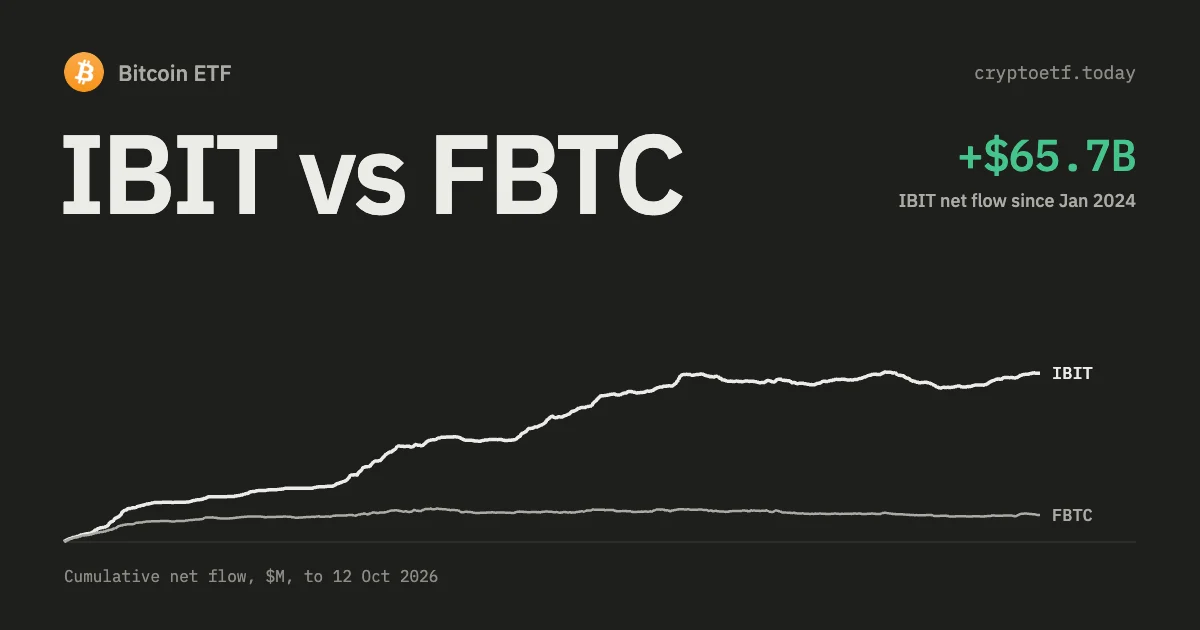
On flows the duopoly doesn't exist. FBTC's lifetime net is +$10.87bn, but $11.72bn of that arrived in 2024. Since 1 January 2025 it's −$854m, and in 2026 alone it's −$1.26bn. Fidelity's fund is holding a large stack it accumulated early, not adding to it. Here's the full roster.
| Fund | Issuer | Lifetime net flow | Share of all gross creations | Net since 1 Jan 2025 | Net in 2026 |
|---|---|---|---|---|---|
| IBIT | BlackRock | +$64.86bn | 58.3% | +$27.61bn | +$2.76bn |
| FBTC | Fidelity | +$10.87bn | 20.4% | −$854m | −$1.26bn |
| BTC (Mini Trust) | Grayscale | +$2.93bn | 2.9% | +$2.12bn | +$1.02bn |
| BITB | Bitwise | +$2.13bn | 4.7% | −$34m | +$17m |
| ARKB | ARK 21Shares | +$1.38bn | 9.0% | −$1.08bn | −$264m |
| HODL | VanEck | +$1.01bn | 1.4% | +$223m | −$73m |
| MSBT | Morgan Stanley | +$733m | 0.5% | +$733m | +$733m |
| BRRR | CoinShares | +$329m | 0.5% | −$210m | +$29m |
| EZBC | Franklin Templeton | +$319m | 0.6% | −$147m | −$8m |
| BTCO | Invesco | +$144m | 0.7% | −$173m | −$62m |
| BTCW | WisdomTree | +$82m | 0.2% | −$147m | +$38m |
| GBTC | Grayscale | −$27.84bn | 0.9% | −$6.35bn | −$2.59bn |
Source: our per-fund series, 11 January 2024 to 22 September 2026. Six of the twelve are net negative in 2026: FBTC, ARKB, BTCO, EZBC, HODL and GBTC. The seven mid-size and small funds taken together (BITB, ARKB, BTCO, EZBC, BRRR, HODL, BTCW) raised $5.40bn in the whole period, and $5.72bn of that came in 2024. Since then they're collectively down. Profiles of the individual wrappers are in the major Bitcoin ETF funds overview, and the two largest go head to head in IBIT vs FBTC.
The Grayscale unwind is over, and it took two years
GBTC is the only fund in the category with a negative lifetime number, and it's a big one: −$27.84bn. The shape of it is worth spelling out, because it distorted the headline flow figure for most of year one. Across 422 non-zero sessions, GBTC has printed just 66 creation days against 356 redemption days, $1.40bn in versus $29.24bn out.
The bleeding was front-loaded. GBTC lost $15.81bn in the first 60 trading sessions, through 8 April 2024, and $18.51bn in the first half of 2024 alone. By 2025 the annual figure was −$3.76bn, and 2026 to date is −$2.59bn. The 1.50% fee that drove the rotation is still there, and Grayscale's own answer to it, the 0.15% Mini Trust, has taken +$2.93bn lifetime with 215 up days against 49 down, including +$1.02bn in 2026 when almost nothing else was positive. The family is now roughly flat on net: −$24.91bn combined, with the Mini absorbing a slice of what GBTC lost. Background on the conversion and the discount that preceded it is in the GBTC analysis and premium and discount to NAV.
What actually changed in year two
Four structural things happened between early 2025 and September 2026, and only one of them shows up in the flow data the way you'd expect.
| Date | Change | What it meant | Visible in flows? |
|---|---|---|---|
| 29 Jul 2025 | SEC permitted in-kind creations and redemptions for crypto ETPs (press release 2025-101), with accelerated approvals to Nasdaq, NYSE Arca and Cboe BZX | Authorised participants can deliver or receive bitcoin itself instead of cash, cutting a trading leg and improving tax treatment | Barely. Mean absolute daily flow was $265.8m over the 386 sessions before and $258.5m over the 290 after |
| 8 Apr 2026 | Morgan Stanley listed MSBT on NYSE Arca at 0.14%, the first spot bitcoin ETF under a major US bank's own name and the cheapest in the category | Bank-channel distribution arrived, and the fee floor moved 5bp below the Grayscale Mini | Yes. +$733m in 116 sessions, positive on 68 of 69 non-zero days, with one redemption of $5.3m on 29 May 2026 |
| 31 Jul 2026 | VanEck's HODL fee waiver expired. The zero-fee period on the first $2.5bn ran from 25 Nov 2025 and ended with the fund at $1.076bn, 43% of the threshold. The fee is 0.20% now | The waiver era is closing. Free is no longer a way to buy share in this category | Partly. HODL is −$73m in 2026 after +$223m across 2025 |
| 3 Aug 2026 | Hashdex announced the closure of DEFI, about $14.7m of assets as of 30 July. Last trading day 17 August, liquidating distribution around 28 August | The first US spot bitcoin ETF to shut. The category can now lose members, not just gain them | Not in our series. DEFI was never one of the twelve columns we track |
The in-kind row deserves a second look, because the intuition is strong and the data doesn't support it. If settling in bitcoin rather than cash lowered friction for authorised participants, you'd expect bigger or more frequent baskets afterwards. Daily flow magnitude is essentially unchanged, and the share of positive sessions fell from 66% to 50% across that boundary, which is a bitcoin price story rather than a plumbing story. In-kind made the wrapper cheaper to run. It did not make anybody buy.
What the flows paid for their bitcoin
Because every row in the series carries both a dollar flow and that day's bitcoin close, you can compute something the AUM tables can't show: the dollar-weighted average price at which this money entered. Divide each day's net flow by that day's price, sum the implied coins, then divide total dollars by total coins.
| Cohort | Net dollars | Implied net coins | Dollar-weighted entry | Versus $86,416 on 22 Sep 2026 |
|---|---|---|---|---|
| All twelve funds | $56.94bn | 711,601 BTC | $80,021 | +8.0% |
| Excluding GBTC | $84.78bn | 1,164,401 BTC | $72,814 | +18.7% |
| IBIT alone | $64.86bn | 809,901 BTC | $80,079 | +7.9% |
It's an aggregate, not any real investor's return. The ex-GBTC line is the most useful of the three: it strips out legacy holders leaving a 1.50% fee and looks only at money that chose this wrapper. That cohort's average entry of $72,814 sits below every close since the start of 2026 except the June and July trough. The all-fund line is worse because GBTC's redemptions, at 2024 prices between $40k and $70k, net out coins that were bought cheaply.
The implied coin counts are flow-derived, not custody-derived. The funds held 1,210,299 BTC at 30 June 2026 while the ex-GBTC math implies 1.16 million, and the gap is the coins GBTC carried in from its trust days, which were never a flow at all. Assets and cumulative flow answer different questions, as explained in the AUM growth analysis.
Gold won the period
One comparison keeps getting left out of these retrospectives. Our series carries a gold price alongside bitcoin's. On 11 January 2024 gold was $2,001 and bitcoin $46,563. On 22 September 2026 gold was $4,364.66 and bitcoin $86,416. That's +118.1% for gold against +85.6% for bitcoin, over exactly the window in which the bitcoin ETF was supposed to be the structural bid that changed everything.
That doesn't make the wrapper a failure. $56.94bn of net creations and 1.2 million coins in custody changed how bitcoin is held, and neither depends on beating gold. It does argue against the story that ETF access alone drives price: the same window produced a 53% drawdown from October 2025 to July 2026 with every fund fully operational. More on that in Bitcoin ETF vs spot bitcoin and gold ETFs versus bitcoin ETFs.
Four ways this record gets misread
- Quoting AUM as growth. The category's assets fell from roughly $110bn at the October 2025 high toward $71.42bn at 30 June 2026 while net flow over the same stretch was mildly negative. Almost all of that move was price. If you want the demand signal, use flow.
- Treating 2026's flat number as no activity. +$349m net hides $4.51bn of June redemptions and $5.74bn of Q3 creations. A near-zero annual figure on this series usually means two large opposing moves, not a quiet market.
- Calling it a duopoly. On assets, yes. On flow since 2025, IBIT took +$27.61bn and the other eleven funds combined shed $5.91bn. Only four funds are net positive over that stretch, and one of them listed in April 2026.
- Expecting fee cuts to move flow. MSBT at 0.14% undercut everything and has taken $733m in five months, which is real but is 1.1% of IBIT's lifetime total. HODL waived its entire fee for eight months and reached 43% of the $2.5bn it was aiming at. Distribution has beaten price in this category every year so far.
If you want to check any of this yourself, the Bitcoin ETF flows page carries the daily net figure, the cumulative line and the per-fund table, and the funds directory lists every wrapper we track with its issuer and fee. The series updates each business day after issuers post, so it isn't real-time, and it covers the twelve funds named above. For the wrapper itself, start with what a Bitcoin ETF is.
FAQ
How much money have US spot Bitcoin ETFs taken in since launch?
Summing our daily series across 676 trading sessions from 11 January 2024 to 22 September 2026, the twelve funds have taken $56.94bn net. That is $117.26bn of gross creations against $60.32bn of gross redemptions, with 402 positive sessions and 274 negative. The cumulative line peaked at $62.74bn on 9 October 2025 and has been lower since.
How did year two compare with year one?
Measured on listing anniversaries, year one took +$36.22bn over 251 sessions and year two +$20.16bn over 250. The bigger change is composition: nine of eleven original funds were net positive in year one, and only three in year two. Fidelity FBTC finished year two at minus $425m despite being the second-largest fund.
Why is IBIT bigger than the whole Bitcoin ETF category?
Because the rest of the category is negative in aggregate. IBIT has taken +$64.86bn lifetime against a category total of $56.94bn, and it has beaten the category in each of the three calendar years: +$37.25bn in 2024 versus +$35.25bn, +$24.84bn in 2025 versus +$21.35bn, +$2.76bn in 2026 versus +$0.35bn. IBIT also accounts for 58.3% of all gross creations ever recorded in the series.
What happened to Bitcoin ETF flows in 2026?
They have gone almost nowhere. Through 181 sessions the net is +$349.1m, with exactly half the sessions positive. June 2026 was the worst month the category has recorded at minus $4.51bn, bitcoin bottomed at $58,625 on 1 July 2026, and Q3 then delivered +$5.74bn. The flat annual figure is two large opposing moves cancelling, not an absence of trading.
Are Bitcoin ETF investors in profit?
In aggregate, modestly. Dividing each day net flow by that day bitcoin close gives a dollar-weighted average entry of about $80,021 for all twelve funds, against a $86,416 close on 22 September 2026, so roughly 8% ahead. Excluding GBTC, whose redemptions net out coins bought at 2024 prices, the average entry is $72,814 and the cohort is about 19% ahead. Neither figure is any individual investor return.
Did the SEC in-kind approval change Bitcoin ETF flows?
Not measurably. The SEC permitted in-kind creations and redemptions on 29 July 2025 (press release 2025-101). Mean absolute daily flow was $265.8m across the 386 sessions before that date and $258.5m across the 290 after. In-kind lowered the cost of operating the wrapper and improved tax treatment for authorised participants. It did not change how much money arrived.
Has any US spot Bitcoin ETF closed?
Yes. Hashdex announced the closure of DEFI on 3 August 2026 with roughly $14.7m of assets as of 30 July; the last trading day was 17 August 2026 and the liquidating distribution was expected around 28 August. It is the first US spot bitcoin ETF to shut, and it was never part of the twelve-column series this article is built from.
Sources and further reading
- SEC press release 2025-101: Commission permits in-kind creations and redemptions for crypto ETPs, 29 July 2025.
- iShares Bitcoin Trust ETF, Form 10-Q for the quarter ended 30 June 2026 (net assets, shares outstanding, NAV).
- Hashdex announces closure of the Hashdex Bitcoin ETF (DEFI), 3 August 2026.
- VanEck Bitcoin ETF (HODL) fund page, sponsor fee and waiver terms through 31 July 2026.
- Internal: what is a Bitcoin ETF, major Bitcoin ETF funds overview, how to analyze ETF flows, AUM growth analysis, the halving and ETF flows.
لأغراض إعلامية فقط. ليست نصيحة استثمارية.
 ETH
 SOL
 XRP
 HYPE
 LINK
 HBAR
 AVAX
 DOGE
 LTC
 SUI
 DOT
 BNB
 NEAR
 TRX
 ZEC