Every US spot Bitcoin ETF with ticker, issuer, exchange, listing date, fee, basket size and custodian. IBIT and FBTC took 75% of the money; GBTC is $27.8bn in the red.
TL;DR. Twelve US spot Bitcoin ETFs trade today, plus an uplisted thirteenth, Osprey's OBTC, that this site doesn't track. Ten of them listed on the same morning, 11 January 2024; Grayscale's mini trust followed on 31 July 2024 and Morgan Stanley's MSBT on 8 April 2026. Together they held 1,210,299 bitcoin worth $71.4bn at the 30 June 2026 quarter end, close to 5.8% of the 21m coins that will ever exist. The market is a duopoly: BlackRock's IBIT and Fidelity's FBTC hold 75.1% of those coins, and IBIT alone has pulled in $64.9bn of net flow against the category’s $56.9bn, because GBTC has bled $27.8bn since the day it converted. Fees run from 0.14% (MSBT) to 1.50% (GBTC), a spread of more than ten to one on a product where every fund holds exactly the same asset. Our own daily flow series runs from 11 January 2024 through 22 September 2026.
المحتويات · 11 قسمًا
- The full list of US spot Bitcoin ETFs
- How big each fund really is
- The market settled into a duopoly, and it happened fast
- GBTC: the fund that has never had a good year
- The Grayscale mini trust is not a smaller GBTC
- What actually differs between these funds
- One fund has already left the list
- How to choose between them
- Where our numbers come from
- Frequently asked questions
- Sources and further reading

The full list of US spot Bitcoin ETFs
Here's the directory, sorted by the money each fund holds. Everything in it comes from the trusts' own Form 10-Q filings for the quarter ended 30 June 2026, which is the last audited-adjacent snapshot available in September 2026. If you're new to the wrapper itself, start with what a Bitcoin ETF is; this page is the map of who sells one.
| Ticker | Fund | Issuer | Exchange | First trading day | Fee | Basket | Bitcoin custodian |
|---|---|---|---|---|---|---|---|
| IBIT | iShares Bitcoin Trust ETF | BlackRock | Nasdaq | 11 Jan 2024 | 0.25% | 40,000 | Coinbase Custody (Anchorage Digital named as additional, unused) |
| FBTC | Fidelity Wise Origin Bitcoin Fund | Fidelity | Cboe BZX | 11 Jan 2024 | 0.25% | 25,000 | Fidelity Digital Assets, N.A. (in-house) |
| GBTC | Grayscale Bitcoin Trust ETF | Grayscale | NYSE Arca | 11 Jan 2024 (OTC since 2015) | 1.50% | 10,000 | Coinbase Custody (Anchorage as alternative) |
| BTC | Grayscale Bitcoin Mini Trust ETF | Grayscale | NYSE Arca | 31 Jul 2024 | 0.15% | 10,000 | Coinbase Custody (Anchorage as alternative) |
| BITB | Bitwise Bitcoin ETF | Bitwise | NYSE Arca | 11 Jan 2024 | 0.20% | 10,000 | Coinbase Custody; BNY Mellon holds the cash |
| ARKB | ARK 21Shares Bitcoin ETF | 21Shares (21co, owned by FalconX) | Cboe BZX | 11 Jan 2024 | 0.21% | 5,000 | Coinbase, BitGo Bank & Trust, BitGo New York, Anchorage |
| HODL | VanEck Bitcoin ETF | VanEck | Cboe BZX | 11 Jan 2024 | 0.20% (0% waiver ran to 31 Jul 2026) | 25,000 | Gemini Trust, with Coinbase Custody as additional |
| BRRR | CoinShares Bitcoin ETF | CoinShares (ex-Valkyrie) | Nasdaq | 11 Jan 2024 | 0.25% | 5,000 | Coinbase, BitGo Trust, Komainu (Jersey) |
| EZBC | Franklin Bitcoin ETF | Franklin Templeton | Cboe BZX | 11 Jan 2024 | 0.19% | 50,000 | Coinbase Custody |
| BTCO | Invesco Galaxy Bitcoin ETF | Invesco and Galaxy | Cboe BZX | 11 Jan 2024 | 0.25% | 5,000 | Coinbase Custody |
| MSBT | Morgan Stanley Bitcoin Trust | Morgan Stanley | NYSE Arca | 8 Apr 2026 | 0.14% | 10,000 | Coinbase Custody and BNY |
| BTCW | WisdomTree Bitcoin Fund | WisdomTree | Cboe BZX | 11 Jan 2024 | 0.25% | 5,000 | Coinbase Custody |
A few entries deserve a footnote. MSBT's trust commenced operations on 7 April 2026 when the seed investor bought 50,000 shares at $19.70, but the shares were listed for trading on NYSE Arca the next morning, and that's the date in the table. GBTC has existed since 2013 and traded on OTC Markets from 4 May 2015; 11 January 2024 is its uplisting date, not its birthday. And the "basket" column is the block size an authorised participant has to deal in, which matters more than it looks — see the section on what actually differs below.
How big each fund really is
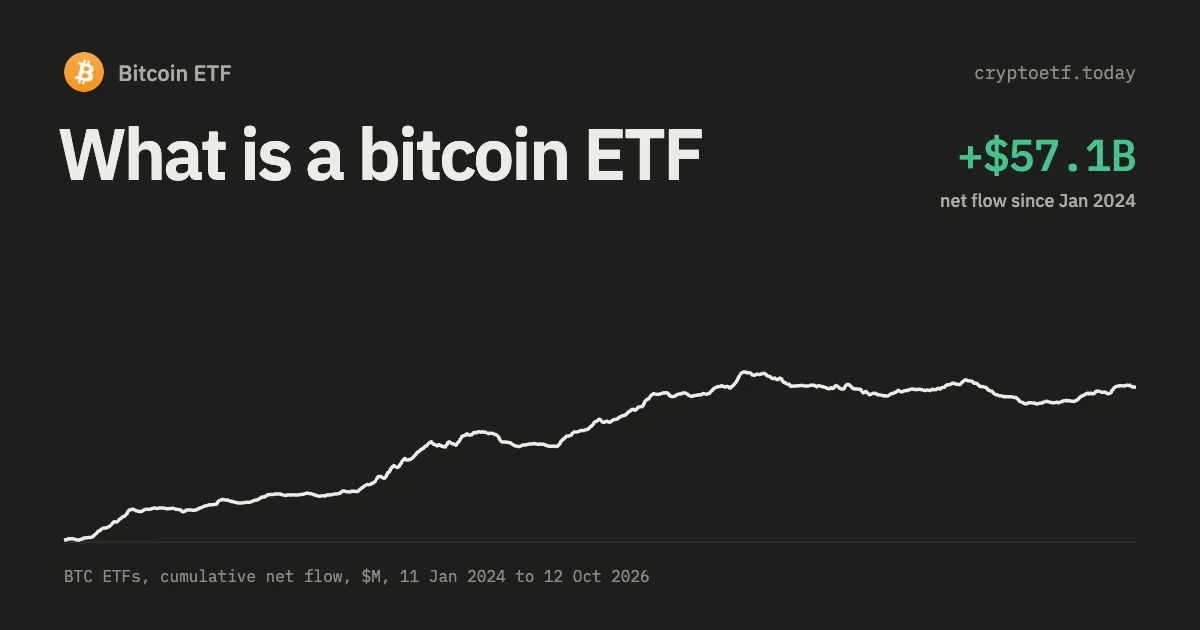
Size can mean two things, and they don't agree. Assets measure what a fund holds today, which moves with the bitcoin price. Cumulative net flow measures how much money investors have actually handed over, which is the honest scorecard for a fund's sales effort. Here they are side by side. Holdings come from the 30 June 2026 10-Qs, when bitcoin's principal-market price was $59,101.49; flows are the sum of our own daily series through 22 September 2026, when bitcoin traded at $86,416.
| Ticker | Bitcoin held (30 Jun 2026) | Net assets (30 Jun 2026) | Share of category | Cumulative net flow to 22 Sep 2026 | Share volume, 21 Sep 2026 session |
|---|---|---|---|---|---|
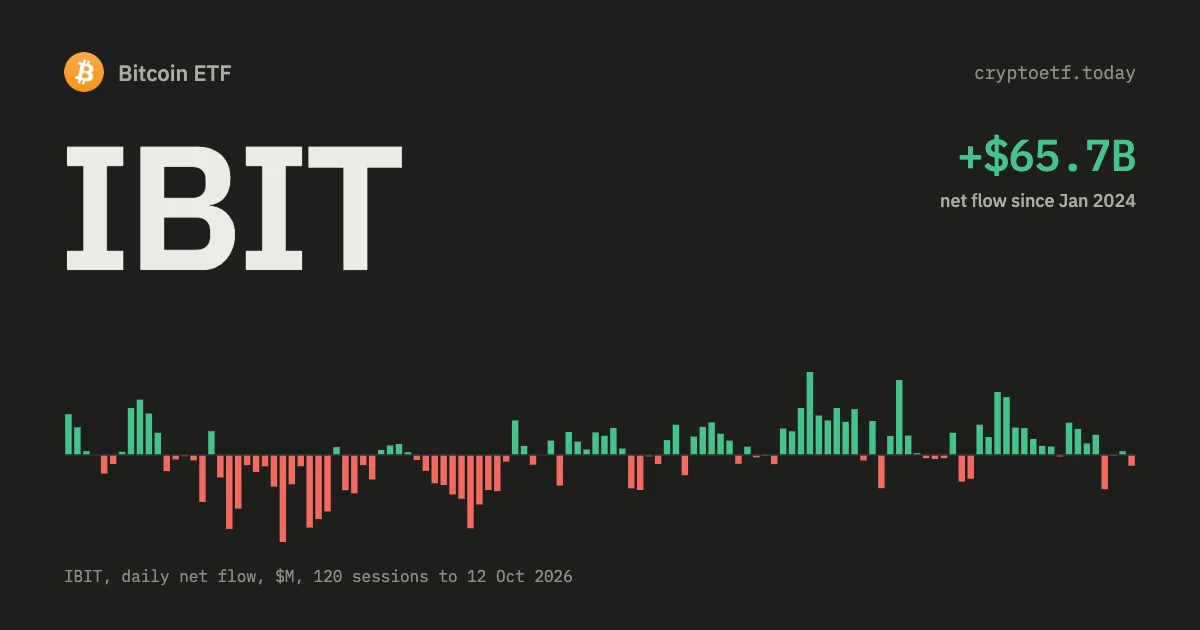
| IBIT | 734,261 | $43.39bn | 60.7% | +$64.86bn | 57.6m shares (~$2.83bn) |
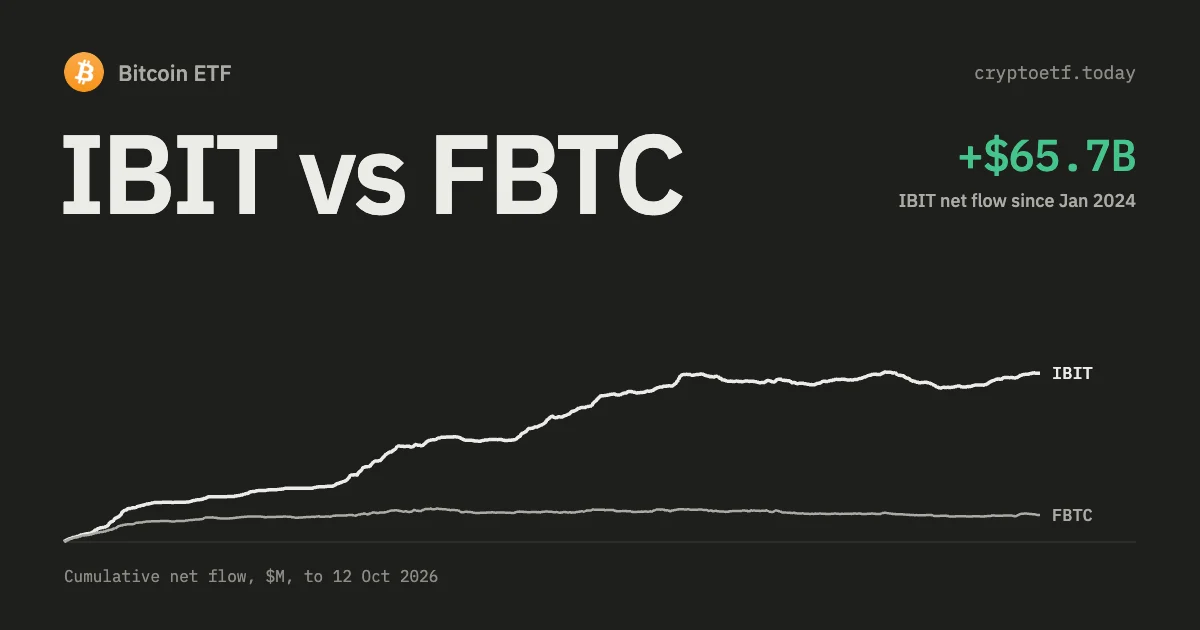
| FBTC | 174,383 | $10.30bn | 14.4% | +$10.87bn | 4.9m shares (~$371m) |
| GBTC | 138,506 | $8.14bn | 11.4% | −$27.84bn | 1.5m shares (~$103m) |
| BTC (mini) | 54,280 | $3.19bn | 4.5% | +$2.93bn | 2.5m shares (~$96m) |
| BITB | 36,208 | $2.13bn | 3.0% | +$2.13bn | 1.2m shares (~$56m) |
| ARKB | 32,178 | $1.89bn | 2.6% | +$1.38bn | 2.3m shares (~$65m) |
| HODL | 16,241 | $0.96bn | 1.3% | +$1.01bn | 0.8m shares (~$20m) |
| BRRR | 5,864 | $342m | 0.5% | +$329m | 41k shares (~$1.0m) |
| EZBC | 5,664 | $335m | 0.5% | +$319m | 170k shares (~$8.6m) |
| BTCO | 5,345 | $316m | 0.4% | +$144m | 45k shares (~$3.8m) |
| MSBT | 5,059 | $299m | 0.4% | +$733m | 1.1m shares (~$27m) |
| BTCW | 2,310 | $136m | 0.2% | +$82m | 8k shares (~$0.7m) |
| Total | 1,210,299 | $71.42bn | 100% | +$56.94bn | — |
Two numbers in that table don't line up with intuition. MSBT has taken in more money ($733m) than it holds in assets ($299m at the June quarter end), because half its intake arrived after June: $368m of the $733m came in during the 58 sessions from 1 July to 22 September. BTCO is the mirror image, holding $316m on $144m of lifetime flow, which is what happens when a fund stops growing and the coin price does the work instead. The bottom six funds together hold $2.4bn, about a twentieth of IBIT.
The volume column is share volume for a single recent session, which is a crude liquidity read but a useful one. IBIT turned over roughly $2.8bn of stock in one day. BTCW turned over about $700,000. Both funds track the same asset with the same custodian at the same 0.25% fee.
The market settled into a duopoly, and it happened fast
Eleven products were approved together, which looked like the start of a fee war between equals. It wasn't. Year by year, here's how concentrated the money became, using the sum of positive fund-level flows in each calendar year as the denominator.
| Year | Sessions | Category net flow | Sum of positive fund flows | IBIT's share of that | GBTC |
|---|---|---|---|---|---|
| 2024 (from 11 Jan) | 245 | +$35.25bn | $56.74bn | 66% | −$21.50bn |
| 2025 | 250 | +$21.35bn | $26.65bn | 93% | −$3.76bn |
| 2026 to 22 Sep | 181 | −$1.2m | $4.25bn | 57% | −$2.59bn |
Read the 2025 row twice. In a year when the category took in $21.3bn net, $24.8bn of it went to one fund, and the rest of the field was a rounding error or worse. FBTC, the clear number two by assets, gathered $403m that year against IBIT's $24.8bn. The IBIT versus FBTC comparison goes into why the gap widened even though the two funds charge the same fee.
2026 has been a wash. Across 181 sessions the twelve funds have netted minus $1.2m, which is as close to zero as a $71bn category gets. Under that flat surface the money moved: IBIT took +$2.41bn, the Grayscale mini +$1.02bn and MSBT +$733m, while GBTC gave up $2.59bn and FBTC $1.26bn. Fidelity's fund spent the year shrinking, going from 188,144 bitcoin at the end of March to 174,383 at the end of June. The most recent 30 sessions turned positive again, +$4.50bn net, of which IBIT alone took $3.38bn.
Concentration has a practical consequence. When one fund is three quarters of the flow, the category number you read in the press is mostly a BlackRock number, and treating it as a measure of "institutional demand for bitcoin" overstates how broad that demand is. Our Bitcoin ETF flows page breaks the daily print out by issuer for exactly that reason, and how to read Bitcoin ETF flows covers the traps in the headline figure.
GBTC: the fund that has never had a good year
Grayscale's flagship is the third largest US spot Bitcoin ETF and it has lost money on net every single calendar year of its ETF life: $21.5bn out in 2024, $3.8bn in 2025, $2.6bn so far in 2026. Cumulatively it's down $27.84bn, which is why the category’s net total ($56.9bn) is so much smaller than the sum of what the winners took in ($84.4bn across all funds with positive lifetime flow).
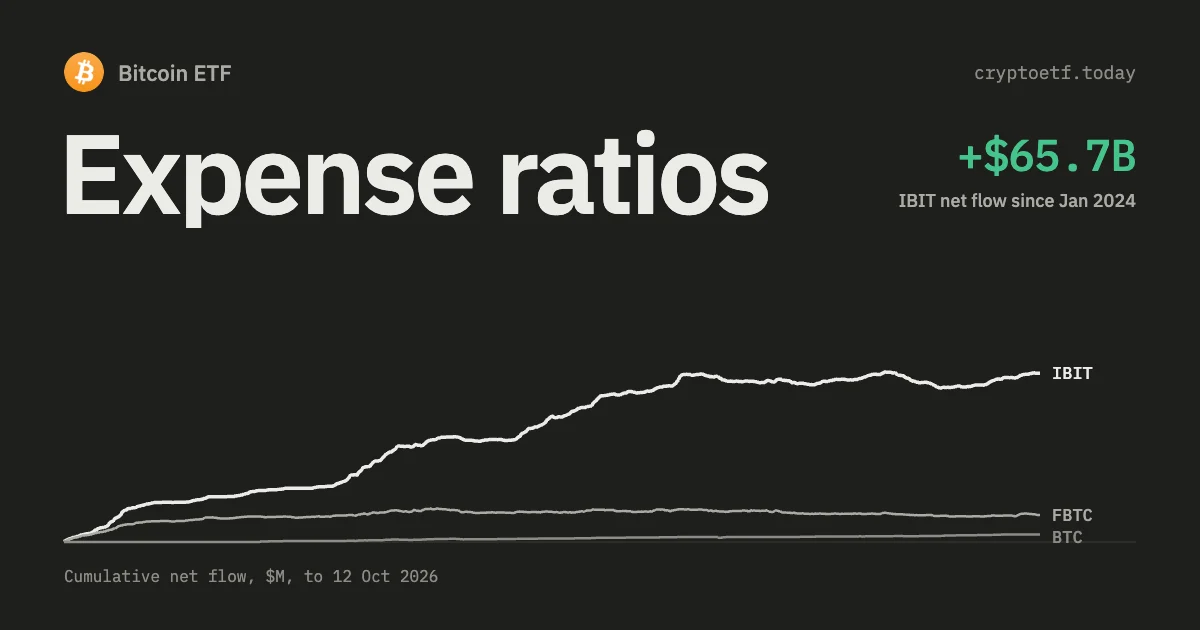
None of that is a mystery. GBTC spent nine years as a closed-end trust with no redemption mechanism, so shares traded at a premium and then at a discount of up to 49%. Conversion on 11 January 2024 opened the exit for the first time since 2015, and years of trapped arbitrage capital walked out. Its biggest single outflow day, 18 March 2024, was $642.5m. What kept the bleeding going after the arbitrage unwound is the fee: 1.50% against 0.25% at IBIT and 0.15% at Grayscale's own mini trust. Our GBTC analysis works through the discount history in detail, and the expense ratio comparison puts the 1.50% into ten-year money.
One structural detail is worth knowing if you hold it. GBTC's June 2026 10-Q states that its agreements with authorised participants still don't provide for in-kind creations and redemptions, so orders run as cash orders. Every other fund in this list can now do in-kind, because the SEC approved rule changes on 29 July 2025 that permit it for crypto ETPs. Cash orders mean the trust itself sells bitcoin to meet redemptions, which is both a tax and an execution difference from the funds that simply hand coins to the AP.
The Grayscale mini trust is not a smaller GBTC
Grayscale's second fund confuses people because its ticker is literally BTC. It didn't raise money the normal way. On 31 July 2024 GBTC contributed roughly 10% of its bitcoin to the new trust and distributed 303,690,100 mini shares to GBTC holders on a 1:1 basis, at no cost and, by Grayscale's own account, without a taxable event for shareholders. Every GBTC holder woke up owning both.
Since then the two have moved in opposite directions. The mini charges 0.15%, the second-cheapest fee in the category, and it has taken in $2.93bn net while its parent lost $27.84bn. It also ran a 1-for-5 reverse share split effective 19 November 2024, which is why its share count reads 122,749,963 today rather than something in the hundreds of millions. VanEck did the opposite with HODL, a 4-for-1 forward split on 14 February 2025. If you ever compare share counts across quarters and the numbers jump, check for a split before concluding that a fund gained or lost investors.
What actually differs between these funds
Every one of the twelve holds spot bitcoin, prices it off a 4pm benchmark, charges a unified fee that covers the administrator and the auditor, and passes the price through less that fee. There's no active management, no tracking skill and no security selection. The differences are narrow but real.
Custodian
Eight of the twelve use Coinbase Custody Trust Company as the sole or primary bitcoin custodian, which is a genuine concentration of counterparty risk across the category. The exceptions: FBTC holds its coins at Fidelity Digital Assets, N.A., an affiliate of the sponsor, and is the only fund whose bitcoin never leaves the issuer's own group. HODL's primary custodian is Gemini Trust, with Coinbase as the additional custodian. ARKB spreads coins across four custodians (Coinbase, BitGo Bank & Trust, BitGo New York, Anchorage), and BRRR across three (Coinbase, BitGo, Komainu). MSBT is the only fund where BNY serves as a bitcoin custodian alongside Coinbase, not just as cash custodian. IBIT and both Grayscale funds name Anchorage Digital as an additional custodian, though BlackRock's filing says plainly it has no current plans to move any coins there. The mechanics behind all of this are in how Bitcoin ETF custody works.
Basket size
Baskets range from 5,000 shares (ARKB, BRRR, BTCO, BTCW) to 50,000 (EZBC). This is the minimum block an AP can create or redeem, and it sets the granularity of every flow number you'll ever see for that fund. At EZBC's $34.15 NAV per share, one basket is about $1.7m, which is why EZBC prints zero on most days and then a large round number. IBIT's 40,000-share basket was about $1.3bn worth of creations and redemptions per quarter in mid-2026: 2,523 baskets created and 4,684 redeemed in the June quarter alone. How authorised participants work covers the arbitrage this enables.
In-kind versus cash
Since the SEC's July 2025 approval, in-kind creations are the norm rather than the exception. IBIT's June quarter included $3.29bn of bitcoin purchased in-kind for shares issued and $3.85bn paid in-kind for shares redeemed. Franklin's EZBC, by contrast, states that during the period covered by its report creation units were issued and redeemed in cash, although the fund has the ability to transact in kind. GBTC, as noted, is still cash-only by AP agreement. In-kind matters mostly at the margin: it avoids the fund crossing the spread on your behalf.
Liquidity and spread
This is the difference that costs retail investors real money and gets the least attention. A fund trading $700,000 a day has a wider quoted spread than one trading $2.8bn, and on a position you plan to trade, crossing a wide spread twice can cost more than a year of the fee gap you switched for. The rule of thumb: for a hold-forever position the fee dominates; for anything you'll trade, the spread does.
What doesn't differ
The bitcoin. A coin in IBIT's wallet is identical to one in BTCW's. There is no fund in this list that holds "better" bitcoin, earns yield on it, lends it, or stakes it — bitcoin has no staking, unlike the Ethereum and Solana products. Any marketing that implies otherwise is describing the wrapper, not the asset.
One fund has already left the list
The eleventh product approved in January 2024 was Hashdex's, which converted from a futures fund to spot and traded as DEFI on NYSE Arca. On 3 August 2026 Hashdex announced it was closing and liquidating the fund, with about $14.7m of assets as of 30 July 2026. Shareholders could sell through the close on 17 August 2026, the fund stopped accepting creation orders after that, and the cash liquidating distribution was expected on or about 28 August 2026. Hashdex filed to deregister the trust on 3 September 2026.
DEFI is the first US spot Bitcoin ETF to close, and the reason is the one the bottom half of the table should worry about: a $14.7m fund can't pay a custodian, an administrator, an auditor and a listing fee out of a fee that small. Closure isn't a catastrophe for holders — you get NAV in cash — but it's a taxable event you didn't choose, in a taxable account, at a time you didn't pick. That risk scales inversely with the size column above.
How to choose between them
Three variables decide it, and they're not equally weighted for everyone. We keep a longer decision tree in the Bitcoin ETF selection checklist; this is the short version for this list.
- Buying and holding for years in a tax-advantaged account? The fee is the only thing that compounds against you. MSBT at 0.14% and the Grayscale mini at 0.15% are the cheapest, EZBC at 0.19% next, and on $50,000 held for ten years the gap between 0.15% and 0.25% is roughly $500 before any price appreciation. Closure risk is the counterweight: the mini has $3.2bn behind it, MSBT $299m and a parent that isn't going anywhere.
- Trading, or writing options? Take IBIT and stop optimising. Its volume is an order of magnitude above the next fund and two above most of the field, and the spread you save on a round trip swamps the 10 basis points you'd pick up elsewhere.
- Want the coins somewhere other than Coinbase? The real choices are FBTC (Fidelity's own custody), HODL (Gemini first, Coinbase second), ARKB or BRRR (three to four custodians each). Everything else is Coinbase.
- Holding GBTC from before the conversion? The 1.50% fee is the strongest argument in the category for moving, and the capital gains tax on selling is the strongest argument against. Run that arithmetic on your own cost basis rather than on a rule of thumb.
What shouldn't drive the decision: the issuer's brand, the fund's marketing, or the "% since inception" number on a fact sheet. All twelve track the same coin within a few basis points a year of each other, and the differences that survive a decade are fee, spread and whether the fund still exists.
Where our numbers come from
Two sources feed this page. Fund-level facts (fee, exchange, basket, custodian, coins held, net assets) come from each trust's own Form 10-Q for the quarter ended 30 June 2026, filed with the SEC in August 2026. Flow figures come from cryptoetf.today's own daily series, which has covered the Bitcoin ETFs since their first session on 11 January 2024 and runs through 22 September 2026. We sum the daily series to get cumulative flow rather than reading a stored total, because the daily series is the part that gets updated every business day.
Two honest limits. The tracker is daily: a session's flows land in the evening, and weekends and US market holidays are empty. And a cumulative flow number is not an AUM number — it ignores every dollar of price change since the money arrived, which is why IBIT’s $64.9bn of lifetime inflow sat in $43.4bn of assets at the June quarter end after bitcoin fell from its highs.
Per-fund pages with current prices and the full flow history live on the funds directory, and the daily issuer-by-issuer table is on the Bitcoin ETF flows page. For a deeper look at any single fund, we've written one up individually: IBIT, FBTC, GBTC, BITB, ARKB, HODL, EZBC, BTCO and BTCW.
Frequently asked questions
How many spot Bitcoin ETFs are there in the United States?
Twelve trade as the category is usually counted, as of September 2026: IBIT, FBTC, GBTC, BTC (Grayscale mini), BITB, ARKB, HODL, BRRR, EZBC, BTCO, MSBT and BTCW. Osprey’s OBTC is a thirteenth listed fund holding spot bitcoin, uplisted to Nasdaq on 19 December 2025 at 0.49%; it sits outside this site’s flow series. A fourteenth, Hashdex’s DEFI, closed in August 2026 with about $14.7m of assets and was the first US spot Bitcoin ETF to liquidate.
Which is the biggest Bitcoin ETF?
BlackRock’s IBIT, by a wide margin. It held 734,261 bitcoin worth $43.4bn at the 30 June 2026 quarter end, 60.7% of all the bitcoin held by US spot ETFs, and it has taken in $64.9bn of net flow since launch. Fidelity’s FBTC is second at 174,383 coins and $10.3bn.
Which Bitcoin ETF has the lowest fee?
Morgan Stanley’s MSBT at 0.14% a year, followed by the Grayscale Bitcoin Mini Trust at 0.15% and Franklin’s EZBC at 0.19%. The most expensive by a distance is GBTC at 1.50%, ten times MSBT. VanEck’s HODL charged 0% until 31 July 2026 and has charged its headline 0.20% since.
Do different Bitcoin ETFs hold different bitcoin?
No. Every fund in this list holds ordinary spot bitcoin, and none of them lends, stakes or earns yield on it, because bitcoin has no staking. What differs is the fee, the custodian, the basket size, the exchange and how liquid the shares are, not the asset inside.
Why is GBTC still one of the largest funds if it keeps losing money?
Because it started enormous. GBTC ran as a closed-end trust from 2013 with no way out for shareholders, so it had accumulated a very large pile of bitcoin by the time it converted on 11 January 2024. It has lost $27.8bn on net since, and still held 138,506 bitcoin worth $8.1bn at the June 2026 quarter end.
Which Bitcoin ETFs do not use Coinbase as custodian?
FBTC keeps its bitcoin at Fidelity Digital Assets, N.A., an affiliate of the sponsor. HODL uses Gemini Trust as primary custodian with Coinbase as additional. ARKB splits coins across Coinbase, BitGo Bank & Trust, BitGo New York and Anchorage; BRRR across Coinbase, BitGo and Komainu; MSBT across Coinbase and BNY. The other funds use Coinbase Custody as sole or primary bitcoin custodian.
What happens if a Bitcoin ETF I own closes?
You can sell on the exchange until the last trading day, after which the fund sells its bitcoin and pays a cash liquidating distribution equal to NAV. That is what Hashdex did with DEFI: last trading day 17 August 2026, distribution on or about 28 August 2026. In a taxable account the distribution is a sale you did not choose, so closure risk is worth weighing for the smallest funds on this list.
Sources and further reading
- iShares Bitcoin Trust ETF, Form 10-Q for the quarter ended 30 June 2026: holdings, basket size, custodian and in-kind activity for IBIT.
- Grayscale Bitcoin Trust ETF, Form 10-Q for the quarter ended 30 June 2026: the 1.50% fee, uplisting history and the cash-order language.
- Morgan Stanley Bitcoin Trust, Form 10-Q for the quarter ended 30 June 2026: 0.14% fee, 8 April 2026 listing, Coinbase and BNY as bitcoin custodians.
- Hashdex press release, 3 August 2026: closure of the Hashdex Bitcoin ETF (DEFI): assets, last trading day and liquidation date.
- SEC press release, 29 July 2025: in-kind creations and redemptions permitted for crypto ETPs.
لأغراض إعلامية فقط. ليست نصيحة استثمارية.
 ETH
 SOL
 XRP
 HYPE
 LINK
 HBAR
 AVAX
 DOGE
 LTC
 SUI
 DOT
 BNB
 NEAR
 TRX
 ZEC