What to normalise on, how to subtract issuer rotation, why 31 sessions carry half of Bitcoin’s cumulative, and what the price correlation is really worth.
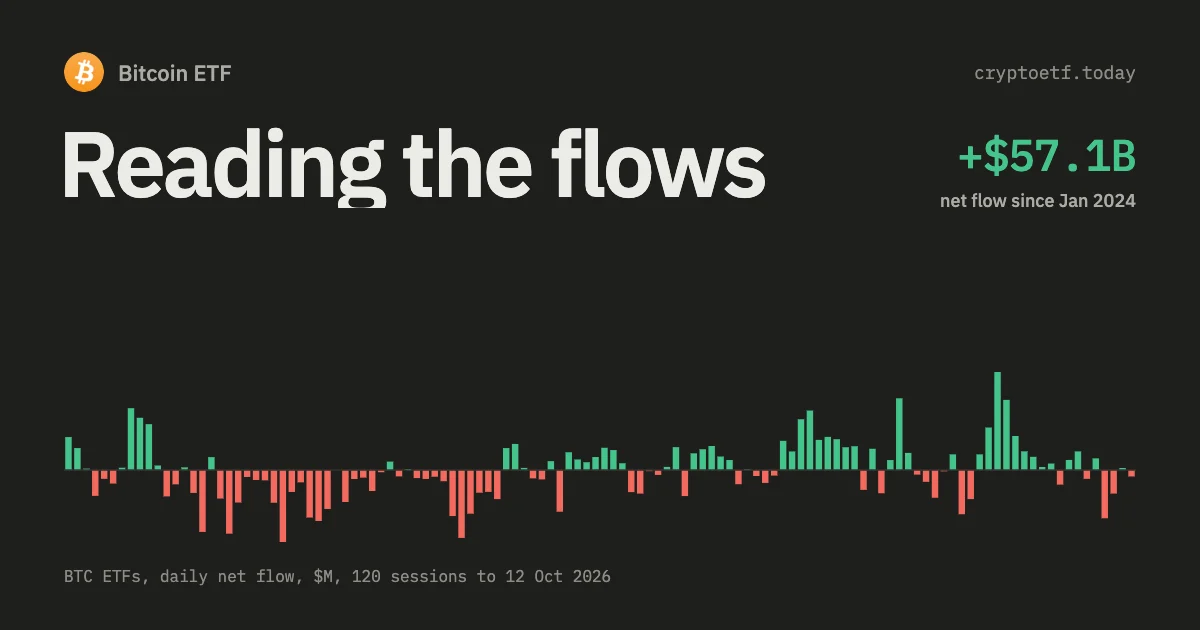
TL;DR. Four numbers settle most arguments about a flow series. Through 22 September 2026 the US Bitcoin ETF complex shows $56.9bn of net creations over 676 sessions, but 31 sessions carry half of it, and the GBTC column alone accounts for −$27.8bn of the arithmetic. Normalise and the table inverts: Bitcoin's last 30 sessions were 0.285% of its market cap against Ethereum's 0.670%. And the correlation between a day's flow and the first return you could act on (T+2, since the figure lands only on the evening of T+1) is +0.02 for BTC, measured on the fund's own closes. The +0.08 that number is usually quoted at belongs to T+1: the price column sitting beside our flow rows is a 07:00 UTC snapshot against a session that runs 13:30 to 20:00 UTC, which shifts every daily lag by exactly one session. Flow measures realised primary-market demand through one channel. It isn't a forecast.
Contents · 11 sections
- What the number is, and the three questions it answers
- Check one: never compare assets in dollars
- Check two: subtract the rotation
- Check three: the cumulative line is a handful of days in a trenchcoat
- Check four: zeros, gaps and the seed row are three different kinds of empty
- Check five: flow against price, and what the correlation is worth
- Check six: flow isn't volume, and cumulative flow isn't AUM
- Where our data stops, and why nobody else's starts
- A ten-minute weekly routine
- FAQ
- Sources and further reading
What the number is, and the three questions it answers
A daily ETF flow is the dollar value of shares an authorised participant created or redeemed with the trust that day. Nothing else is in it: two investors trading IBIT on Nasdaq generate no flow, because the fund isn't a party. Wrapper mechanics are in what a Bitcoin ETF is, and reading our Bitcoin page's columns is covered in how to read Bitcoin ETF flows. This is the layer between: getting from a column of numbers to a defensible sentence.
The series answers three questions honestly: how much of an asset moved into a regulated wrapper over a window, which issuer received it, and whether that pace is accelerating. Everything else is inference, and most bad inference skips one of the six checks below. All figures come from our own daily series, read 23 September 2026 and covering sessions through 22 September 2026; the same rows sit on the flows dashboard.
Check one: never compare assets in dollars
The most common mistake in flow commentary is the sentence "Bitcoin ETFs took in sixteen times more than Solana ETFs". It's arithmetically true and analytically empty: the two complexes sit on floats differing by a factor of twenty-four. Market capitalisation is the denominator that works, and the one our sentiment index uses. Here are the four majors over the same 30 sessions ending 22 September 2026, caps struck at that day's close against the index supply constants.
| Asset | First session | Sessions | Last 30 sessions | Market cap, 22 Sep 2026 | Last 30 as % of cap | Avg per session | Cumulative | Cum. as % of cap |
|---|---|---|---|---|---|---|---|---|
| BTC | 11 Jan 2024 | 676 | +$4,845.4m | $1,702bn | 0.285% | 0.95 bps | +$56,943.3m | 3.3% |
| ETH | 23 Jul 2024 | 531 | +$2,225.7m | $332bn | 0.670% | 2.23 bps | +$13,711.3m | 4.1% |
| SOL | 27 Oct 2025 | 178 | +$299.0m | $71bn | 0.419% | 1.40 bps | +$1,752.9m | 2.5% |
| XRP | 14 Nov 2025 | 167 | +$184.0m | $84bn | 0.218% | 0.73 bps | +$1,572.4m | 1.9% |
Source: our own flow series and the daily close in each row, read 23 September 2026. In dollars the order is BTC, ETH, SOL, XRP. Per unit of float it's ETH, SOL, BTC, XRP, and Solana's $299m outranks Bitcoin's $4.8bn. The full-year view is blunter: through 22 September 2026 Bitcoin is net +$349.1m across 181 sessions, Ethereum +$1,364.1m on a cap one fifth the size.
Two denominators that also matter
Two more corrections matter. Age of the complex: Bitcoin's series is 32 months old, Solana's eleven, so any cumulative total flatters whichever listed earlier. Compare rates, or equal-length windows from each fund's own listing day. And fund size: $50m into a $90bn fund is a rounding error, while the same $50m into a $200m fund is a quarter of its assets arriving at once. Per-fund figures are on the funds page.
Check two: subtract the rotation
The largest distortion in the Bitcoin series has nothing to do with demand for Bitcoin. When GBTC converted from a closed-end trust into an ETF on 11 January 2024, roughly $27bn of coins locked for two years in a vehicle trading at a discount became redeemable at NAV. Holders who had waited years took the exit, and every one of those redemptions prints as an outflow.
| Window | GBTC column | Grayscale mini | Headline complex total | Complex excluding both Grayscale vehicles |
|---|---|---|---|---|
| First 124 sessions (11 Jan – 10 Jul 2024) | −$18,623.3m | n/a | +$15,423.7m | +$34,047.0m |
| Calendar 2024 / calendar 2025 | −$21,496.1m / −$3,758.4m | mini listed 31 Jul 2024 | conversion dominates both years | |
| 2026 to 22 Sep (181 sessions) | −$2,586.9m | +$1,018.3m | +$349.1m | +$1,917.7m |
| Since inception (676 sessions) | −$27,841.4m | +$2,932.1m | +$56,943.3m | +$81,852.6m |
Source: our Bitcoin series, read 23 September 2026. The GBTC column has been negative on 356 of 676 sessions and positive on 66. Two things follow. The honest measure of new money entering the wrapper is $81.9bn, not $56.9bn, the difference being one shareholder base leaving a 1.50% fee for a 0.25% one, often without touching its Bitcoin exposure. And on 36 sessions the headline was negative while the rest of the complex was net positive, printing −$2,826.1m of "outflows" that were nothing of the sort. Background: the GBTC analysis and what Bitcoin ETF outflows actually mean.
Ethereum repeats the pattern with ETHE: −$5,416.9m since July 2024, of which −$3,639.6m landed in 2024 alone. Over its first 123 sessions ETHE bled −$3,761.8m while the eight non-Grayscale funds took in +$5,975.7m, so the +$2,798.5m headline understated new money by more than half. Across the series Ethereum is +$13,711.3m headline against +$17,105.7m excluding both Grayscale vehicles, with 45 sessions negative on the headline and positive everywhere else.
Rotation doesn't stop at Grayscale
Fee competition keeps moving money between issuers long after a conversion ends. Over the last 120 sessions the Bitcoin complex netted just +$844.9m, while BlackRock was +$1,652.1m, Morgan Stanley +$733.2m and GBTC −$1,831.3m, with Fidelity, VanEck, Invesco, 21Shares and Franklin all negative. The gross absolute sum of daily nets is $28,426.1m, so the net is 3.0% of the gross. Ethereum is cleaner at 29% and almost entirely one house: ETHA plus the staked ETHB is +$2,086.2m of +$2,153.5m. Before writing "investors bought", check whether they just changed tickers.
Check three: the cumulative line is a handful of days in a trenchcoat
Cumulative flow is the right chart for direction and the wrong one for intuition, because so few sessions carry it:
| Asset | Sessions | Cumulative | Top 10 days as % of cumulative | Sessions to reach 50% | Sessions to reach 80% | Median absolute day |
|---|---|---|---|---|---|---|
| BTC | 676 | +$56,943.3m | 19.3% | 31 (4.6%) | 59 (8.7%) | $199.4m |
| ETH | 531 | +$13,711.3m | 45.5% | 12 (2.3%) | 23 (4.3%) | $52.7m |
| SOL | 178 | +$1,752.9m | 47.3% (38.4% without the seed row) | 12 (6.7%) | 33 (18.5%) | $5.7m |
| XRP | 167 | +$1,572.4m | 53.0% (46.2% without the seed row) | 9 (5.4%) | 37 (22.2%) | $5.3m |
Source: our own series, read 23 September 2026. Twelve sessions out of 531 built half of everything Ethereum has raised, ten of them inside July and August 2025. That's an event, not a trend, and an average over such a series describes no day that happened. Quote a monthly total with the share from its largest two or three sessions, and test for lead-lag with medians and rank statistics: one $1,018.8m print (Ethereum, 11 August 2025) drives a least-squares fit on its own.
Check four: zeros, gaps and the seed row are three different kinds of empty
A blank or a zero is never self-explanatory, and the three causes read in opposite directions.
A zero row is not zero demand
Creations happen in baskets, typically 10,000 or 25,000 shares. If a small fund's net demand is worth six thousand shares, no basket is created, the row prints zero, and the buying is absorbed in the secondary market at a wider spread. Over the last 120 sessions the Bitcoin feed printed zero for Valkyrie on 116 days, WisdomTree on 114, Invesco on 105 and Franklin on 104, against 2 for BlackRock and 9 for Fidelity. Those aren't funds without investors, they're funds below the size where a day's demand reaches one basket. Litecoin's single fund moved on 29 of 226 sessions, once sitting still for 27 straight; the Polkadot fund moved on 6 of 137, with a 64-session run of zeros to 9 September 2026. A granularity floor, not capitulation.
A missing row is a closed exchange
Our Bitcoin series has 676 rows across 986 calendar days, so 31% of the calendar has no data. Funds don't strike a NAV on a Saturday, no basket can be created, nothing is published. Spot Bitcoin trades all weekend regardless, which is why Monday's print looks outsized: it's the first session in which three days of demand can reach the primary market, and holiday gaps behave the same way. Count sessions, never calendar days, and be suspicious of weekend-dated rows, including in ours: the XRP series carries four upstream artefacts. Treat the last one or two rows as provisional too, since issuer corrections arrive after publication.
The seed row belongs to the launch, not to demand
Every trust buys its first shares before it lists. Our Solana series opens on 27 October 2025 with +$325.6m, $222.9m Bitwise and $102.7m Grayscale at a $200.13 SOL price, while BSOL's first trading day was the 28th. That pre-listing row is 18.6% of everything the complex has raised in eleven months, and it explains most of the gap between our aggregate and series starting on the first trading day. Strip it and the cumulative is $1,427.3m, top-ten concentration falling from 47.3% to 38.4%. XRP is the same shape: its opening row of 14 November 2025 carries +$243.05m, all Canary, 15.5% of the complex. Drop the first row from run rates; keep it when quoting assets.
Check five: flow against price, and what the correlation is worth
This is where most flow analysis quietly stops being analysis. The honest test is a lag scan: correlate the flow dated session T against the return of session T+k, and see where the relationship sits.
One thing has to be settled before the scan can be read, because it moves every column in it. The price carried beside each flow row is a snapshot struck at 07:00 UTC, while the US session that flow belongs to runs 13:30 to 20:00 UTC on the same date — so that price was fixed roughly six and a half hours before the trading day it sits next to. A return built by differencing that column therefore describes the previous session, and every k below lands one step earlier than its label. This is measurable, not theoretical: over the 568 sessions our column shares with IBIT, its return correlates +0.840 with IBIT’s previous close-to-close, +0.132 with the same day’s and −0.029 with the next day’s. One of those is a match and the other two are nothing. The second header row below states what each column really measures; the full derivation is in Bitcoin ETF correlation with equities.
| Asset | k = −1 (prior session) | k = 0 (same session) | k = +1 | k = +2 | k = +3 | 20-session flow vs next 20 sessions |
|---|---|---|---|---|---|---|
| Actually measures | session T−2 | session T−1 | session T | session T+1 | session T+2 — tradeable | — |
| BTC (674 obs) | +0.178 | +0.405 | +0.394 | +0.081 | −0.016 | +0.032 |
| ETH (529 obs) | +0.179 | +0.340 | +0.232 | +0.068 | +0.003 | +0.054 |
| SOL (176 obs) | −0.021 | +0.163 | +0.082 | −0.086 | −0.032 | −0.289 |
| XRP (165 obs) | −0.058 | +0.069 | +0.185 | −0.024 | +0.045 | −0.120 |
Source: Pearson correlation of daily net flow against the change in the close carried in the same rows, over each asset's full history to 22 September 2026. Read down the second header row rather than the first. Bitcoin's +0.405 at k = 0 is not the same-session figure it looks like: it lands on session T−1, money arriving behind yesterday's move, and a lag-one autocorrelation of +0.54 in the flow series is enough on its own to produce it. The contemporaneous number is the +0.394 in the k = +1 column, and rerunning the test on IBIT's own closes, which carry no snapshot offset, puts it at +0.43. That is simultaneity: an AP creates shares because the fund is bid, and the fund is bid on days the asset is bid. Causation runs both ways inside the session and the data can't separate them.
The column that decides whether any of this is tradeable is the one that lands on session T+2 — and after the shift that is k = +3, not k = +2. A flow dated Monday isn't visible until Tuesday evening, so Tuesday's return is history by the time the number exists, and Tuesday is exactly what the k = +2 column holds: its +0.081 and +0.068 describe a move that finished before anyone could see the flow. Wednesday, the first session you could actually trade, is the k = +3 column: −0.016 for Bitcoin, +0.003 for Ethereum, −0.032 for Solana and +0.045 for XRP. Measured cleanly on IBIT's closes, Bitcoin's first tradeable lag is +0.02, against the +0.08 this figure is usually quoted at — including by us, before the alignment was checked. Every one of those numbers is under a twentieth of one percent of variance. The correction points the same way the rest of this section does, only harder: +0.08 at T+2 would be a thin edge worth testing, whereas +0.02 is noise. Lengthening the horizon doesn't help either: twenty sessions of cumulative flow against the next twenty gives +0.03 for Bitcoin and +0.05 for Ethereum, and turns negative for both younger complexes.
So "are ETF inflows bullish" resolves to: concurrent, not predictive. Flows measure a channel rather than signalling an asset, telling you whether a buyer who can only reach it through a listed wrapper showed up. That's a regime question, and the layer the CEFI sentiment index works on: it scales each asset's daily flow by market cap, smooths with an exponential moving average weighting today at 30%, z-scores against a window of at most 90 sessions and maps onto a 0–100 scale whose neutral base is 50. Background is in the CEFI explainer, though the transform to trust is the one on the index page. Rates and dollar liquidity drive flow regimes more than anything inside the series, as macro impact on Bitcoin ETF flows sets out.
Check six: flow isn't volume, and cumulative flow isn't AUM
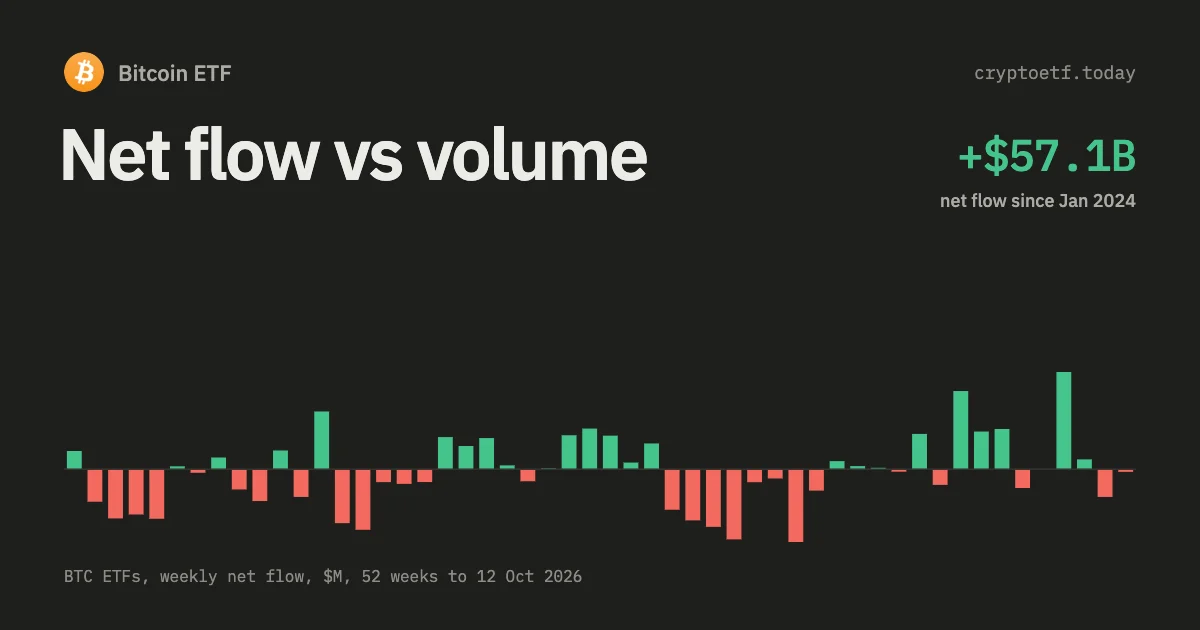
Two numbers get substituted for flow constantly. Volume measures secondary-market turnover, meaning liquidity; flow measures primary-market creation, meaning ownership change at the fund. On 22 September 2026:
| Ticker | Close | Session share volume | Dollar turnover | That issuer's flow, same session | Flow as % of turnover |
|---|---|---|---|---|---|
| IBIT | $48.83 | 37.24m | $1,818.4m | +$350.3m | 19.3% |
| FBTC | $74.98 | 3.95m | $296.3m | +$257.4m | 86.9% |
| GBTC | $66.67 | 1.26m | $84.1m | $0.0m | 0% |
| BTC (mini) | $38.14 | 1.35m | $51.7m | +$5.0m | 9.7% |
| BSOL | $16.35 | 2.69m | $43.9m | +$26.4m | 60.1% |
Source: our candle feed and flow series for the session of 22 September 2026, read on the 23rd, share volumes rounded. Those tickers turned over roughly $2.25bn of shares on a day the complex created $714.7m of new ones, about three dollars of trading per dollar of creation. GBTC is the instructive row: no flow at all, yet $84m traded, because its holders were trading with each other. A high flow-to-volume ratio, as at FBTC, means the buying had to be sourced new rather than found in the order book. Both are worked through in net flow vs volume.
The other substitution is treating cumulative flow as assets under management. Assets are cumulative flow marked to the current price, plus the seed, minus fees paid in kind, so the gap widens with time. Bitcoin's cumulative is $56.9bn against a price that went from $46,562.56 on 11 January 2024 to $86,416.02 on 22 September 2026, so most of the difference is the asset, not the investor. The decomposition is in the AUM growth analysis.
Where our data stops, and why nobody else's starts
A flow methodology is only as good as the disclosure beneath it. For the five majors our daily series comes from aggregated issuer reporting, reconciled against per-fund checks. For the eight newer assets, Dogecoin, Chainlink, Avalanche, Hedera, Litecoin, BNB, Polkadot and Sui, no aggregator publishes a flow series at all. We compute it from daily snapshots of each trust's shares outstanding and its NAV, as flow(T) = (shares(T+1) − shares(T)) × NAV(T). Hence the T+1 evening lag, and hence an empty column rather than a zero for a fund with no published share history.
| Asset | Funds tracked | Series starts | Sessions | Cumulative flow | Per-fund history complete |
|---|---|---|---|---|---|
| LINK | 2 | 2 Dec 2025 | 202 | +$158.6m | yes |
| HBAR | 1 | 28 Oct 2025 | 225 | +$109.5m | yes |
| AVAX | 3 | 26 Jan 2026 | 166 | +$34.6m | yes |
| SUI | 3 | 18 Feb 2026 | 150 | +$14.2m | no |
| DOGE | 3 | 24 Nov 2025 | 207 | +$13.9m | yes |
| LTC | 1 | 28 Oct 2025 | 226 | +$10.7m | yes |
| DOT | 1 | 6 Mar 2026 | 137 | +$2.7m | yes |
| BNB | 1 | 28 May 2026 | 81 | +$1.1m | yes |
Source: our issuer summary endpoint, read 23 September 2026. All eight together have raised $345.3m since late 2025, less than half of what the Bitcoin complex created in the single session of 22 September. Internalise that ratio before writing about altcoin ETF demand.
Three limits, because they change what a reader should conclude. Our Solana feed carries six issuer columns and excludes Canary's Marinade-staked fund, so its activity is missing from the Solana total. Two spot Solana ETFs, Invesco's QSOL and Morgan Stanley's MSOL, aren't tracked at all. And the Sui per-fund history is incomplete, which is why its asset total and the sum of its fund columns don't reconcile. Where a series has a hole, say so instead of publishing a zero: a dataset that never shows a gap usually fills them silently.
A ten-minute weekly routine
Everything above collapses into a weekly sequence.
- Count sessions, not days. A holiday turns a five-session week into four and makes the total look soft.
- Read the cumulative slope, not the last bar. The median session is $199.4m for Bitcoin and $5.3m for XRP.
- Split the week into its two largest sessions and the rest. Top two carrying it is an event; the rest carrying it is a trend.
- Check the Grayscale columns separately. A headline that turns positive once GBTC or ETHE is excluded is rotation, not selling.
- Normalise before comparing. Divide by market cap, or by the same week four weeks earlier. Never compare two assets' raw dollars.
- Note which columns printed zero, and why. Zero at a small fund is a basket artefact; zero at BlackRock, which moved on 118 of the last 120 sessions, is real.
- Look up the price move separately, then resist joining them. Disagreement is normal. Note the seed row you excluded and the lag you assumed.
The flows dashboard carries the daily series, cumulative line and per-issuer breakdown for all thirteen assets, and the sentiment index does the normalisation and smoothing. Both update daily after issuers report. Neither is real-time, and anything claiming to be promises what the disclosure regime can't deliver.
FAQ
Are ETF inflows bullish for the price?
Concurrently yes, predictively all but not at all. The price column beside our flow rows is a 07:00 UTC snapshot while the US session runs 13:30 to 20:00 UTC, so every daily lag measured on it sits one session early — the +0.405 that looks like the same session is really the one before it. Realigned on IBIT’s own closes, flow on day T correlates +0.43 with session T, +0.05 with T+1 and +0.02 with T+2. Since the figure isn’t published until the evening of T+1, T+2 is the first return anyone could trade, so the tradeable correlation is +0.02, not the +0.081 that scan appears to show. Inflows evidence wrapper demand, not direction.
What do ETF flows actually tell you, then?
Three things: how much of an asset moved into a regulated wrapper over a window, which issuer received it, and whether that pace is accelerating. They measure one distribution channel, and say nothing about coins on exchanges, in self-custody or in treasuries, which together dwarf ETF holdings.
Why do Grayscale outflows keep dragging the headline down?
Because GBTC converted from a closed-end trust rather than launching fresh, so holders locked in at a discount could finally redeem at NAV. Its column is −$27.8bn across 676 sessions, negative on 356. Excluding both Grayscale vehicles the complex has taken in $81.9bn, not $56.9bn. ETHE repeats it at −$5.4bn.
Should I compare Bitcoin ETF flows with Solana ETF flows in dollars?
No. Divide by market capitalisation first. Over the 30 sessions to 22 September 2026 Bitcoin took 0.285% of its cap, Ethereum 0.670%, Solana 0.419% and XRP 0.218%. In dollars Bitcoin leads by sixteen times; normalised it is third of four.
Does a zero flow day mean nobody bought the ETF?
No. Creations happen in baskets of 10,000 or 25,000 shares, so demand below one basket is absorbed in the secondary market and the row prints zero. Over the last 120 sessions the Bitcoin feed printed zero for Valkyrie on 116 days and BlackRock on 2: that difference is fund size, not investor interest.
Why is the first row of a new ETF series so large?
It is the seed purchase made before listing. Our Solana series opens on 27 October 2025 at +$325.6m, a day before the first fund traded, and that row alone is 18.6% of everything the complex has raised since. Exclude it from run rates; keep it when discussing assets.
How often are crypto ETF flows updated, and how fresh are they?
Once per trading day, after issuers report. For the eight assets we compute ourselves, session T depends on the share count published on T+1, so it appears that evening and no sooner. There are no weekend or holiday rows: funds do not strike a NAV when the exchange is closed, even though the assets keep trading.
Sources and further reading
- SEC Release 34-99306 (10 January 2024). The order approving spot Bitcoin ETPs, with the creation and redemption mechanics flow data measures.
- SEC Release 34-100224 (23 May 2024). The corresponding order for spot Ether ETPs.
- EDGAR full-text search. Each trust’s 10-K, 10-Q and 8-K filings: basket sizes, shares outstanding, fee waivers.
- Grayscale Bitcoin Trust annual filings (CIK 0001588489). The trust-to-ETF conversion and its redemption history.
- SEC investor.gov: mutual funds and ETFs. Primary versus secondary market basics.
For information only. Not investment advice.
 BTC
BTC ETH
ETH SOL
SOL XRP
XRP HYPE
HYPE LINK
LINK HBAR
HBAR AVAX
AVAX DOGE
DOGE LTC
LTC SUI
SUI DOT
DOT BNB
BNB NEAR
NEAR TRX
TRX ZEC
ZEC