IBIT and FBTC charge the same 0.25% and give the same access. The differences that survive scrutiny are size, liquidity and custody. Here is the side-by-side.
TL;DR. IBIT and FBTC are the two largest US spot Bitcoin ETFs and both charge 0.25%. IBIT is roughly four times larger and trades about ten times the dollar volume. The structural difference is custody: IBIT's bitcoin sits with Coinbase Custody Trust and Anchorage Digital Bank; FBTC's sits with Fidelity Digital Assets, the only mainstream fund custodied entirely outside the Coinbase orbit. Pick IBIT for size and liquidity, FBTC for custody diversification. Many allocators hold both.
Contents · 7 sections

The headline comparison
| Dimension | IBIT | FBTC |
|---|---|---|
| Issuer | BlackRock | Fidelity |
| Sponsor entity | iShares Delaware Trust Sponsor LLC | FD Funds Management LLC |
| Custodians | Coinbase Custody Trust + Anchorage Digital Bank | Fidelity Digital Assets, N.A. |
| Expense ratio | 0.25% | 0.25% |
| AUM (24 Sep 2026) | ~$67.9 billion | ~$15.3 billion |
| Share price (24 Sep 2026) | ~$47.81 | ~$73.41 |
| Average daily volume | ~37.9M shares (~$1.8B notional) | ~2.4M shares (~$0.18B notional) |
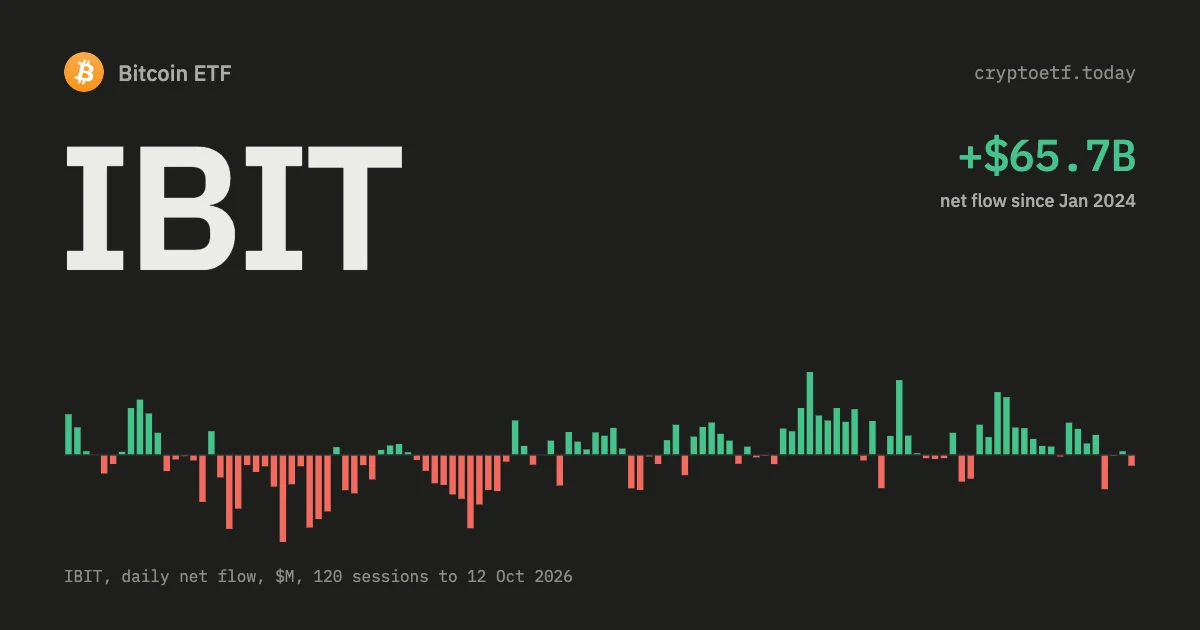
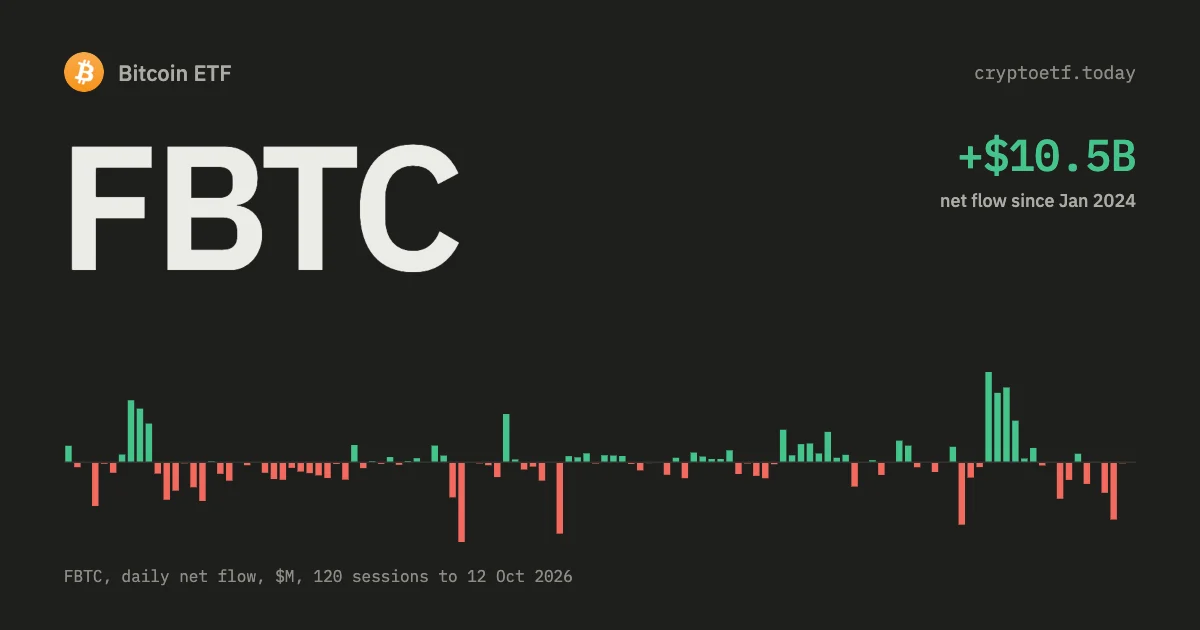
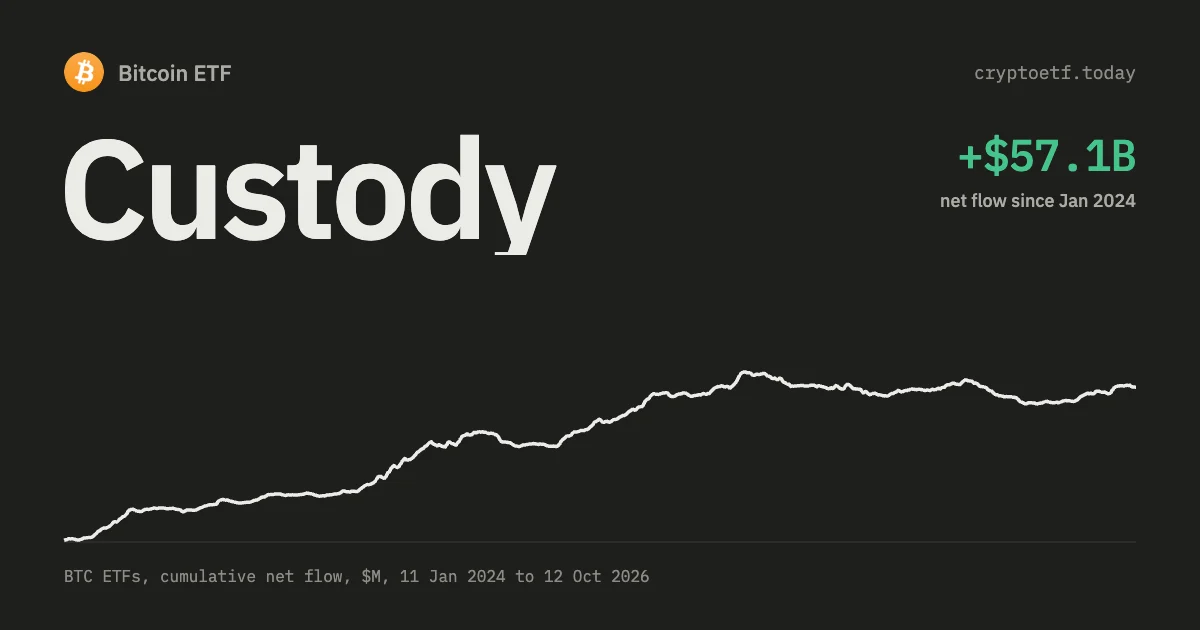
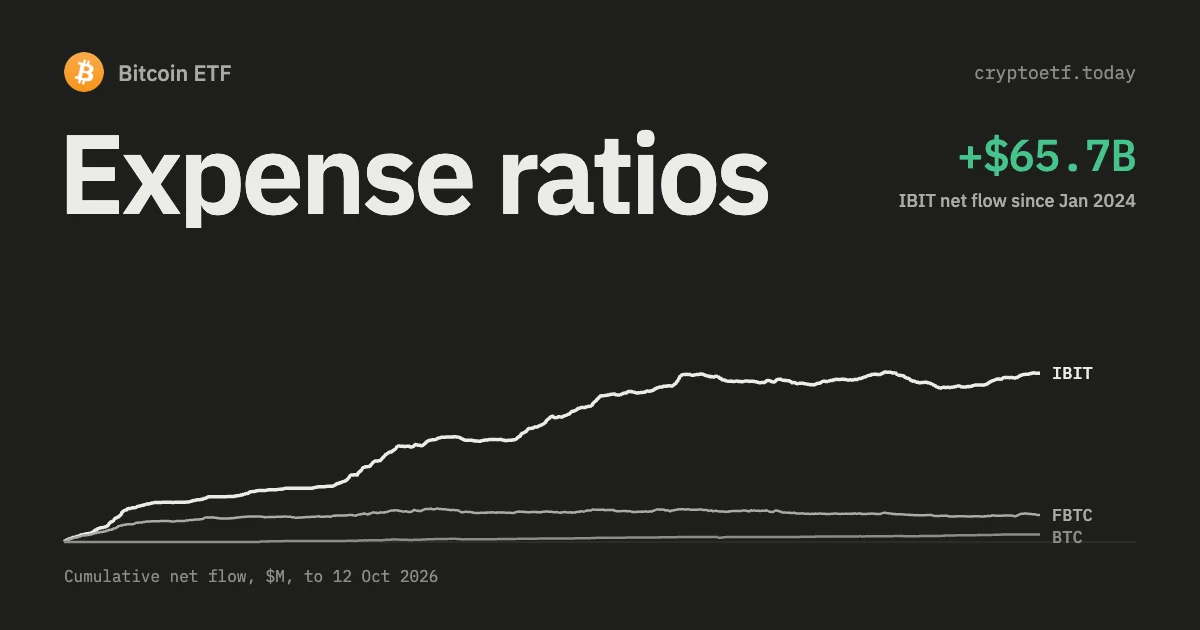
| Cumulative net flows since launch | +$64.9 billion | +$10.9 billion |
| First trading day | 11 Jan 2024 | 11 Jan 2024 |
Cumulative flow figures are our own tracker's daily series through 22 September 2026; AUM, price and volume are as of the close of 24 September 2026.
The custody question
This is the one difference that is genuinely structural rather than cosmetic. Coinbase Custody is the default choice across the category: IBIT, GBTC and the Grayscale Bitcoin Mini Trust alone — roughly three-quarters of all US spot Bitcoin ETF assets — all name it. FBTC is the only mainstream fund that does not use Coinbase at all; Fidelity custodies its own bitcoin through Fidelity Digital Assets, N.A.
Note that the category has moved away from single-custodian arrangements. IBIT, GBTC and the Mini Trust have added Anchorage Digital Bank alongside Coinbase; VanEck's HODL uses Gemini and Coinbase; Valkyrie's BRRR uses Coinbase, BitGo and Komainu; ARKB names four custodians. "One fund, one custodian" is no longer an accurate description of the market.
The counterargument to FBTC: the sponsor (FD Funds Management LLC) and the custodian (Fidelity Digital Assets) are both Fidelity entities. If what you want is sponsor-and-custodian independence rather than simply "not Coinbase", FBTC does not give it to you — see VanEck HODL review. Full background in how Bitcoin ETF custody actually works.
Size and liquidity
IBIT holds about 4.4× FBTC's assets and trades roughly 10× the dollar volume. For retail-sized orders the gap is invisible: both are among the most liquid ETFs in the US market and fill instantly. It starts to matter at institutional block size, which is the ordinary reason large allocators default to the bigger book.
We do not publish bid-ask or market-impact estimates for these funds, and we are not going to invent them. If execution quality at size is your binding constraint, get quotes from your own desk rather than from an article.
Fee waivers: both had one
A persistent myth is that Fidelity never discounted FBTC. It did. FBTC charged 0% from launch until 31 July 2024, after which the headline 0.25% applied. IBIT's waiver was structured differently: 0.12% on the first $5.0 billion of assets for the first twelve months from 11 January 2024. Both waivers are long expired, and today the two funds cost exactly the same.
Neither is the cheapest fund in the category. The Grayscale Bitcoin Mini Trust charges 0.15% and Morgan Stanley's MSBT charges 0.14% — see expense ratios compared.
The decision
Pick IBIT if you:
- Want the largest and most heavily traded fund in the category.
- Have an existing BlackRock / iShares relationship.
- Are trading at a size where depth of book matters.
Pick FBTC if you:
- Specifically want custody outside Coinbase.
- Are an existing Fidelity customer consolidating accounts.
Hold both if you:
- Have a position large enough that custodian concentration is a real line item in your risk register.
- Manage client money where single-issuer exposure needs a documented answer.
- Want two same-fee, same-exposure positions to move between — see tax-loss harvesting, and note that switching between them means matching dollar amounts, not share counts: FBTC shares cost roughly 1.5× IBIT shares.
FAQ
Which Bitcoin ETF is bigger, IBIT or FBTC?
IBIT. As of 24 September 2026 it held roughly $67.9 billion against FBTC’s $15.3 billion — about 4.4× larger. IBIT has also taken in far more money since launch: +$64.9 billion of cumulative net flows against +$10.9 billion for FBTC.
Is IBIT's fee lower than FBTC's?
No — both charge 0.25%. Both also ran launch waivers that have since expired: FBTC charged nothing at all until 31 July 2024, and IBIT charged 0.12% on its first $5.0 billion for twelve months from 11 January 2024.
Should I hold both IBIT and FBTC?
The only real reason to is custody diversification: IBIT uses Coinbase Custody and Anchorage, FBTC uses Fidelity Digital Assets. Fee, exposure and tax treatment are identical, so holding both costs nothing extra. Whether it is worth the extra line item depends on how large your position is.
Is FBTC safer than IBIT?
Different rather than safer. FBTC removes exposure to Coinbase Custody, which the rest of the category leans on heavily. IBIT sits behind the largest asset manager in the world and now spreads its bitcoin across two custodians. Neither fund has had a custody incident since launch.
What's the main difference between IBIT and FBTC for retail investors?
Almost nothing that shows up in your account: same fee, same tax treatment, same broker access. The differences are size, trading volume and who holds the bitcoin. For a retail position, custody preference is the only reason to choose one over the other.
Sources and further reading
- iShares Bitcoin Trust ETF and Fidelity Wise Origin Bitcoin Fund filings — sec.gov.
- Fund size, price and volume — stockanalysis.com, 24 September 2026.
- Cumulative flows — our own daily series, Bitcoin ETF flows.
- Internal: BlackRock IBIT review, Fidelity FBTC review, Custody mechanics.
For information only. Not investment advice.
 ETH
ETH SOL
SOL XRP
XRP HYPE
HYPE LINK
LINK HBAR
HBAR AVAX
AVAX DOGE
DOGE LTC
LTC SUI
SUI DOT
DOT BNB
BNB NEAR
NEAR TRX
TRX ZEC
ZEC