Spot XRP ETFs arrived in November 2025, not 2027. Five funds, $1.59bn of net inflow, no staking, no US options — and a Ripple case that ended a year later than most write-ups say.
TL;DR. The wait is over and it was much shorter than anyone forecast. Five US spot XRP ETFs listed between 13 November and 11 December 2025 — Canary XRPC, Bitwise XRP, Franklin XRPZ, Grayscale GXRP and 21Shares TOXR. Our XRP flow series begins on 14 November 2025 and shows +$1.59bn of cumulative net inflow through 24 September 2026, two thirds of it in the first seven weeks. None of them stakes, because the XRP Ledger has no staking. None has US-listed options. BlackRock and Fidelity still have no XRP fund. And the Ripple litigation that supposedly cleared in December 2024 actually ended on 7 August 2025.
Contents · 8 sections

The Ripple case, with the right dates
This is the single most mis-told part of the XRP story, so here it is from the Franklin XRP Trust's own prospectus:
- July 2023. Judge Analisa Torres ruled that XRP sold to buyers on the secondary market did not constitute an unregistered sale of securities, and nor did XRP granted to Ripple employees as compensation or to third parties to build on the ledger.
- 7 August 2024. The S.D.N.Y. entered final judgment, imposing a $125m civil penalty on the Ripple defendants.
- After that judgment, the SEC appealed to the Second Circuit and the Ripple defendants cross-appealed.
- 7 August 2025. The SEC announced a Joint Stipulation of Dismissal with the Ripple defendants. It dismissed the cross-appeals, left the $125m penalty standing, and resolved the complaint.
The appeals ran for a year, and the matter closed three months before the first XRP ETF listed. Any timeline that has both sides walking away in December 2024 has compressed that year out of existence.
One caveat the prospectuses all keep: dismissal is not a determination that XRP is not a security. If a court or regulator later finds otherwise, a fund holding it could face problems under the Investment Company Act. That risk is disclosed, not resolved.
What actually opened the door
Not the litigation by itself, and not a bespoke SEC order for each fund. Two things:
CME XRP futures. "In May of 2025, the CME, a designated contract market registered with the CFTC, launched new contracts for XRP futures products," as Franklin's prospectus puts it. That gave exchanges a regulated surveillance reference — the CME CF XRP-Dollar Reference Rate is what these funds price against.
Generic listing standards. The SEC approved generic listing standards for commodity-based trust shares holding digital assets, replacing the case-by-case Rule 19b-4 route. Once a fund met the standard, its exchange could list it. Five XRP funds came to market inside four weeks. The same mechanism produced nine Solana funds a fortnight earlier — the pattern is in Solana ETF approval status.
The five funds
| Fund | Ticker | Exchange | First traded | Fee | Net flow to 24 Sep 2026 |
|---|---|---|---|---|---|
| Canary XRP ETF | XRPC | Nasdaq | 13 Nov 2025 | 0.50% | +$458.9m |
| Bitwise XRP ETF | XRP | NYSE Arca | 20 Nov 2025 | 0.34% | +$567.2m |
| Franklin XRP ETF | XRPZ | NYSE Arca | 24 Nov 2025 | 0.19% | +$442.8m |
| Grayscale XRP Trust ETF | GXRP | NYSE Arca | 24 Nov 2025 | 0.35% | +$131.9m |
| 21Shares XRP ETF | TOXR | Cboe BZX | 11 Dec 2025 | 0.30% | −$12.4m |
Bitwise got the ticker XRP itself, which is a permanent source of confusion on quote screens and, judging by the flows, a permanent advantage. Franklin is the cheapest at 0.19% and Canary the dearest at 0.50%, with no waiver. Assets, spreads, custodians and the case for each one are in best XRP ETF.
What the flows have done
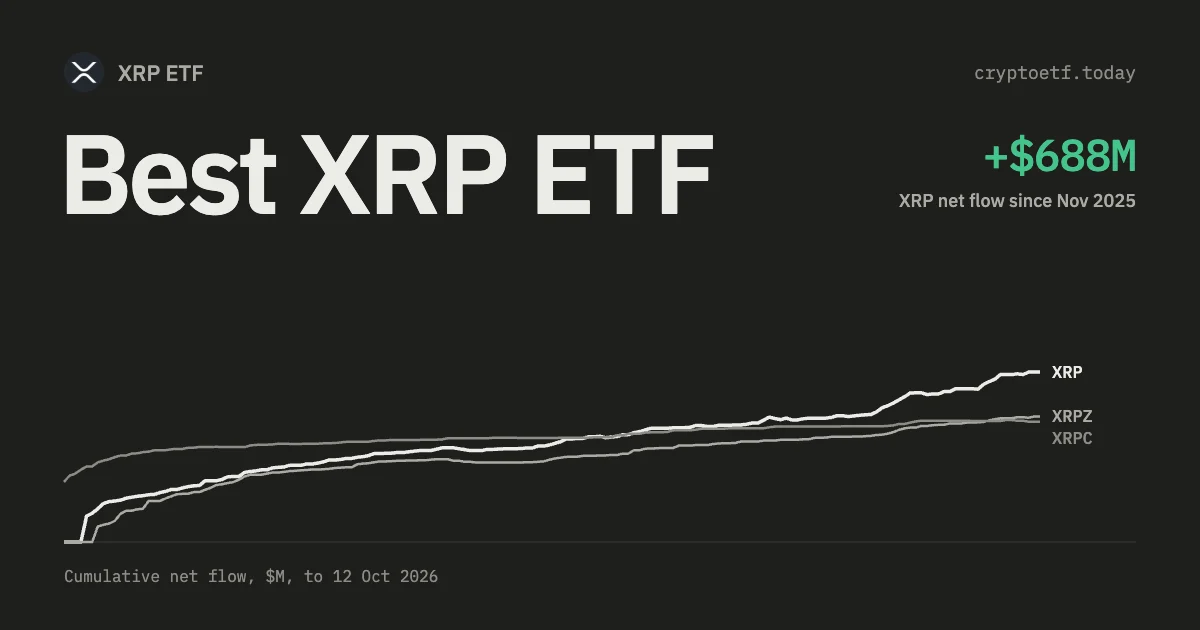
Cumulative net flow across the five is +$1.59bn over 169 sessions. The shape matters more than the total: $1,048m of it — two thirds — arrived in the seven weeks before the end of 2025, and every month since has landed between −$23m and +$118m. That is a normal maturity curve for a new asset class, not a warning sign, but it does mean the launch numbers were never the run rate.
One line needs explaining. 21Shares' TOXR shows a negative cumulative flow since listing. It is not that nobody wanted it — the trust existed as a private placement before it was an ETF and came to market with a quarter of a billion dollars already inside. What the tracker records is early holders taking the exit that the uplisting gave them. Grayscale's GXRP has a milder version of the same history. Both cases are a reminder that for an uplisted trust, "flow since listing" and "demand" are different things. The daily series is on the XRP ETF flows page, and the reading mechanics are in how to read XRP ETF flows.
What XRP ETFs do not have
- No staking. The XRP Ledger uses a federated consensus mechanism with no staking rewards, so unlike the Solana or Ether funds there is nothing to offset the sponsor fee. The fee is paid by selling a sliver of the trust's XRP, so XRP per share drifts down over time. That makes the fee the whole decision.
- No US-listed options. As of September 2026 no US exchange had listed options on any of the five. Covered-call and protective-put strategies are simply not available here.
- No BlackRock, no Fidelity. The two largest ETF issuers in the world have looked at this market and passed, which they did not do with Bitcoin, Ether or Solana.
Against that, the wrapper gives regulated US exposure inside an IRA, a 401(k) or an ordinary brokerage account, with no self-custody. Whether that beats buying the coin is in XRP ETF vs buying XRP.
What the forecast got wrong
The consensus in mid-2025 — including on this site — was that XRP's enforcement history would make it politically harder to approve than Solana, pushing the first fund into 2027. Two assumptions failed. The SEC's posture on the case reversed in August 2025 rather than hardening. And the approval bottleneck turned out to be procedural: once generic listing standards existed, the enforcement history had no remaining mechanism through which to slow anything down. The funds listed a fortnight behind Solana, not a year.
The lesson is the one from Solana: when a queue is gated by process rather than by law, it clears all at once, and "more politically difficult" buys weeks, not years.
FAQ
Is there a spot XRP ETF in the US?
Yes, five. Canary XRPC listed on Nasdaq on 13 November 2025, followed by Bitwise's XRP on 20 November, Franklin XRPZ and Grayscale GXRP on 24 November, and 21Shares TOXR on Cboe BZX on 11 December 2025.
When did the Ripple v. SEC case actually end?
On 7 August 2025, when the SEC announced a Joint Stipulation of Dismissal with the Ripple defendants that dismissed the cross-appeals and left the $125m civil penalty standing. The S.D.N.Y. final judgment imposing that penalty was entered on 7 August 2024, and the SEC appealed it. The widely repeated claim that both sides dropped their appeals in December 2024 is wrong by roughly eight months.
How much money has gone into XRP ETFs?
Our tracker shows +$1.59bn of cumulative net inflow across the five funds over 169 sessions, from 14 November 2025 to 24 September 2026. Bitwise leads at +$567m, then Canary +$459m and Franklin +$443m. 21Shares' TOXR is negative at −$12m, because it listed with money already inside from a pre-ETF private placement.
Do XRP ETFs pay staking rewards?
No. The XRP Ledger uses federated consensus and pays no staking rewards, so there is nothing for a fund to earn or pass on. That is different from the Solana and Ether ETFs, where staking offsets part of the fee. In an XRP ETF the sponsor fee is the entire ongoing cost, paid by selling a small amount of the trust's XRP.
Which XRP ETF is cheapest?
Franklin's XRPZ at 0.19%. 21Shares TOXR is 0.30% per its SEC filings, Bitwise 0.34%, Grayscale 0.35% and Canary XRPC 0.50% with no waiver. Every launch waiver in the group has expired, so these are the rates you actually pay.
Can I trade options on an XRP ETF?
Not in the US. As of September 2026 no US exchange had listed options on any of the five spot XRP ETFs. CME offers XRP futures and options on futures, which is a different product requiring a futures-enabled account.
Sources and further reading
- SEC EDGAR, Franklin XRP Trust prospectus (424B3, 24 November 2025) — Torres ruling, 7 August 2024 final judgment and $125m penalty, the 7 August 2025 Joint Stipulation of Dismissal, CME XRP futures launched May 2025, generic listing standards.
- SEC EDGAR, 10-K and 10-Q filings of the five XRP trusts — fees, share counts, custodians.
- cryptoetf.today, daily XRP ETF flow series, 14 November 2025 to 24 September 2026.
- Internal: Best XRP ETF, XRP ETF fees compared, How to read XRP ETF flows.
Live data on this topic
ETFs still waiting for approval: Injective, SEI, Cronos, PEPE, Worldcoin, Canton, Aave, TRUMP, Ondo, Uniswap, Aptos, PENGU
For information only. Not investment advice.
 BTC
BTC ETH
ETH SOL
SOL HYPE
HYPE LINK
LINK HBAR
HBAR AVAX
AVAX DOGE
DOGE LTC
LTC SUI
SUI DOT
DOT BNB
BNB NEAR
NEAR TRX
TRX ZEC
ZEC