
All seven US Solana ETFs stake. Gross rewards ran 5.7% in September 2026, sponsors keep 6% to 15%, and on $10,000 the gap between the best and worst fund is about $155 a year.
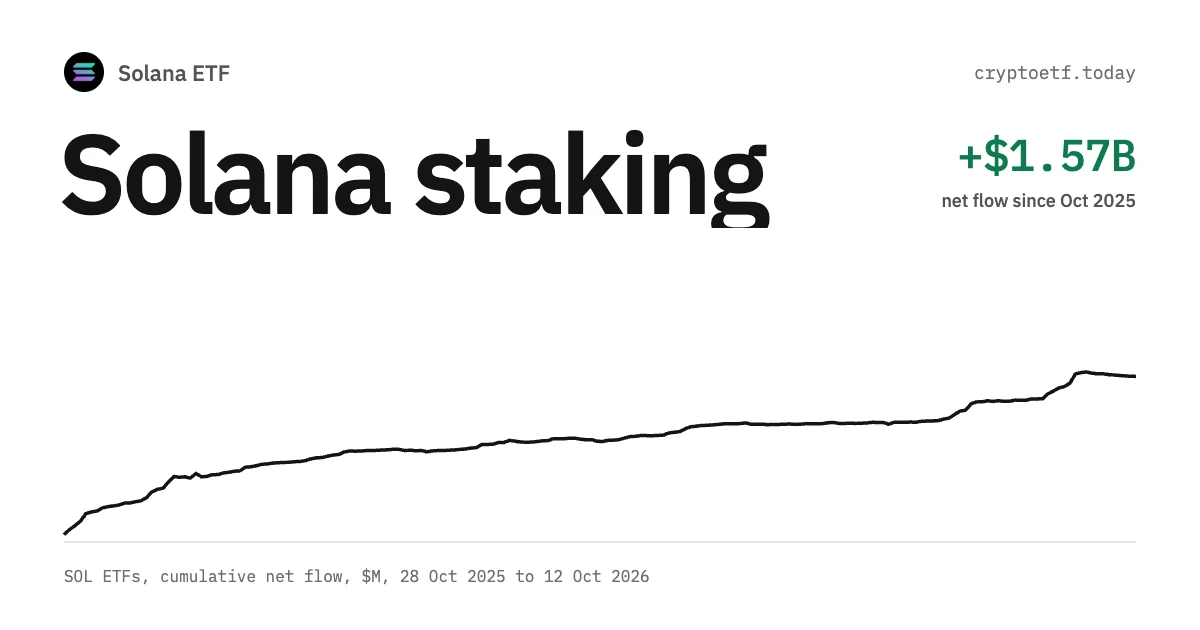
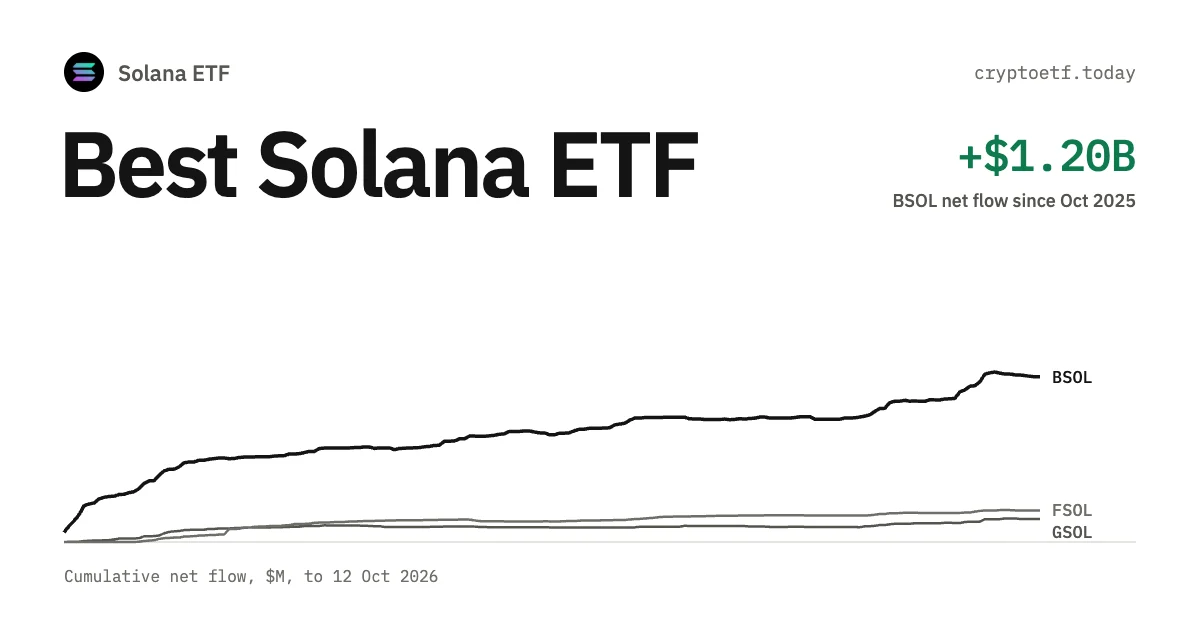
TL;DR. All seven US spot Solana ETFs stake, and most stake nearly everything: Bitwise's BSOL was 99.996% staked on 18 September 2026, Grayscale's GSOL 99.9% at 30 June. The gross reward rate was 5.69% on Bitwise's reading, against on-chain inflation of 3.64%. The sponsor's cut runs from 6% (BSOL) and 7% (GSOL, since 25 June 2026) to 15% (FSOL). Four funds pay rewards in cash and three let them accrue into the share price, a split that decides your tax bill in a taxable account. On $10,000 at a 6% gross rate, the best fund nets about $544 a year after fees and the weakest about $389.

Solana ETF flows, live
as of Fri 20 Nov · updated every trading dayContents · 12 sections
- What staking on Solana actually is
- Where the 5.7% comes from
- How a trust stakes without handing anything over
- Two ways the reward reaches you
- The tax difference, and the IRS rule that shaped it
- Staking terms, fund by fund
- Worked example: $10,000 at 6% gross
- Unbonding risk versus redemption liquidity
- How staking got into the wrapper: the timeline
- What staking does to the flow numbers
- FAQ
- Sources and further reading
What staking on Solana actually is
Solana is a proof-of-stake network: validators produce and vote on blocks, weighted by how much SOL is delegated to them. A holder who wants the rewards doesn't run a validator; they delegate from a stake account they control, and the validator never takes possession. The account has two keys, a stake authority that delegates and undelegates and a withdraw authority that moves coins out once undelegated. For a fund, both sit with the custodian.
Time runs in epochs of 432,000 slots, about two days at the network's roughly 400-millisecond slot time; mainnet was in epoch 1038 on 19 September 2026. Rewards are credited at each epoch boundary straight into the stake account, where they compound. The validator keeps a public commission, so a fund's provider can be judged on it. Delegating and undelegating both take effect at epoch boundaries, and the network caps how much stake can move in one epoch, which is why fund filings talk about unstaking in days rather than hours.
One more thing matters for a fund: as of September 2026, Solana has no slashing. The documentation says losing tokens that way "is not implemented in the Solana protocol today". A proposal to record slashable events (SIMD-0204) has been prototyped and the penalty mechanism (SIMD-0212) was still under discussion. Every prospectus lists slashing as a risk anyway, because the protocol could add it and a fund's delegated SOL is exactly the stake that would be cut.
Where the 5.7% comes from
The reward is paid out of new issuance. Solana's inflation schedule, readable from the network's inflation governor, starts at 8% a year, decays by 15% of itself each year and stops at a 1.5% floor; on 19 September 2026 the live rate was 3.64%. Nearly all of it goes to stakers, so the reward per staked SOL is roughly inflation divided by the share of supply staked, plus a slice of fees. Bitwise's 5.69% gross rate against 3.64% inflation implies a bit under two-thirds of supply is staked, which is our arithmetic, not a published figure.
Two things push the number down. The schedule decays on its own: 3.64% becomes about 3.1% next year and hits the floor around 2032. And in late August 2026 validators passed SGP-0002 (implemented as SIMD-0550) to double the decay to 30% a year, scraping through at 67.0% against a two-thirds threshold. That's a mandate, not a live change; on 19 September the on-chain governor still showed a 15% taper. If it activates, the floor arrives around 2029 and today's 5.7% is nearer 3% within two years. The reward rate on a fund page is a snapshot; nothing about it is locked in.
Grayscale's June-quarter 10-Q is a useful cross-check: GSOL earned 19,953 SOL in the three months to 30 June 2026 on a holding that ended at 1,373,774 SOL, about 1.45% for the quarter, or a little under 6% annualised. That matches the 5.7% to 6.1% the issuers were quoting.
How a trust stakes without handing anything over
The fund does what any large holder does, with a custodian and a contract in the middle. Coinbase Custody holds GSOL's SOL and delegates it through third-party staking providers under written arrangements; the 10-Q states the trust "retains control of its SOL throughout the staking process" and that delegating is not a transfer. Bitwise runs the other model: BSOL's SOL is bonded through Bitwise Onchain Solutions, an affiliate, with Helius Blockchain Technologies as the validator. Canary's SOLC delegates through Marinade, hence the name Canary Marinade Solana ETF. The Bitcoin ETF custody model applies unchanged, with one addition: the coins are delegated from the cold wallet's stake accounts rather than sitting idle.
What a fund can't do is stake everything. Listing rules require written liquidity policies, and staked SOL isn't available within a business day, so every fund keeps a reserve, and its size is where the funds differ most. BSOL, GSOL, SOEZ, FSOL and SOLC run at 99.6% to 100% staked and rely on the two-day unstaking window plus cash creations. TSOL targets 70% to 90% (90.8% at 30 June 2026) and VSOL was 73.3% staked, which is why its yield lags: a quarter of its SOL earns nothing.
Two ways the reward reaches you
The reward arrives at the fund as SOL. What happens next splits the seven funds down the middle.
Cash distributions. The fund sells the reward SOL and pays the proceeds to shareholders, like a dividend. FSOL pays at least quarterly ($0.21 a share in the first half of 2026), TSOL at least quarterly, SOEZ monthly. GSOL joined this camp on 6 August 2026, when Grayscale amended the trust agreement to require converting rewards to cash at least quarterly, with monthly payments intended.
Accrual. The fund keeps the reward SOL, so the SOL behind each share rises and the share price carries it. BSOL, VSOL and SOLC do this and paid nothing in the June quarter. BSOL's holdings show it: 10,091,677 SOL across 73,320,000 shares on 18 September 2026 is 0.1376 SOL a share, drifting up about 5% a year as long as rewards outrun the 0.20% fee.
Neither is better in the abstract. Cash gives you a visible income line; accrual compounds on its own. Which you want depends almost entirely on the account you hold it in.
The tax difference, and the IRS rule that shaped it
All seven are grantor trusts, the same structure as the Bitcoin funds in our US tax guide: each shareholder is treated as owning a slice of the trust's SOL directly, and a pro-rata share of its income flows through. Staking rewards are income to the trust when earned, so in a taxable account you can owe tax on them whether they're paid in cash or retained; a distribution just makes the amount obvious and hands you the money to pay it. Inside an IRA or 401(k) the question vanishes, which is the strongest argument for holding these funds there.
Until late 2025 there was real doubt whether a staking trust could be a grantor trust at all, because a trust that runs a business or has the "power to vary" its investments gets taxed as a corporation. On 10 November 2025 the IRS closed that with Revenue Procedure 2025-31, a safe harbor for exchange-listed single-asset trusts that stake. Its fourteen conditions read like a spec sheet for these funds: the custodian alone holds the keys, "including while those assets are staked"; the staking provider must be unrelated to the sponsor and paid an arm's-length share of rewards; all coins must be staked except a liquidity reserve; the trust's coins must be indemnified against slashing; and rewards, net of expenses, must be distributed in kind or sold for cash and paid out "no less frequently than quarterly". Existing trusts got nine months to amend.
That last clause explains the summer of 2026. Grayscale's mandatory cash conversion for GSOL was signed on 6 August, four days before the window closed, and the same amendment went into its Sui and Avalanche trusts; the 10-Q doesn't cite the procedure, but the language tracks it. Bitwise's BSOL 10-Q doesn't mention it either, and its arrangement (an affiliated staking agent, rewards retained, no distributions) isn't the one the safe harbor describes. That doesn't make BSOL's position wrong; it means it rests on something other than this safe harbor, and the prospectus tax section is where to read it. The IRS was explicit that the procedure draws no inference outside its scope, including how staking income is characterised.
Staking terms, fund by fund
Fees and staked shares are from the June-quarter 10-Qs unless dated otherwise; BSOL's are from its fund page on 18 September 2026. "Cut" is what sponsor, custodian and provider keep between them, as a share of gross rewards.
| Fund | Sponsor fee | Staked | Cut of rewards | Provider | Payout |
|---|---|---|---|---|---|
| BSOL (Bitwise) | 0.20% | 99.996% | 6% | Bitwise Onchain Solutions / Helius | Accrual |
| GSOL (Grayscale) | 0.19% since 25 Jun 2026 | 99.9% | 7% since 25 Jun 2026 (was 23%) | Third-party providers via Coinbase Custody | Cash, monthly intended, since Aug 2026 |
| SOEZ (Franklin) | 0.19% | 99.88% | 8% | Coinbase Crypto Services | Cash, monthly |
| FSOL (Fidelity) | 0.25% | 99.64% | 15% | Unnamed node operators via its custodians (Anchorage, BitGo, Coinbase Custody) | Cash, at least quarterly |
| TSOL (21Shares) | 0.21%, waived to 27 Jul 2027 | 90.8% | ~13% (10% of net after providers) | Coinbase Crypto Services, Figment | Cash, at least quarterly |
| VSOL (VanEck) | 0.30% | 73.3% | 0.28% a year of staked assets (~5% at a 6% rate) | Not named; Gemini custody | Accrual |
| SOLC (Canary) | 0.50% | 99.98% | Marinade's fee, not itemised | Marinade | Accrual |
GSOL's history shows what competition did. At its October 2025 uplisting it charged 0.35% and kept 23% of rewards; in the first half of 2026 it earned 40,850 SOL and paid 7,119 SOL, about 17%, in sponsor staking fees, mostly at the old rate. From 25 June the fee went to 0.19% and the cut to 7%, level with BSOL on the only two numbers that matter. Our cross-asset staking comparison runs the same grid for Ether, Hyperliquid, Sui, Avalanche and Polkadot.
Worked example: $10,000 at 6% gross
The formula is the same for every fund: gross rate × share staked × (1 − cut) − sponsor fee. Bitwise's page confirms it, quoting 5.69% gross and 5.35% net, exactly 94% of gross at 100% staked. The table uses a round 6%, close to the September 2026 readings, so every difference is structure.
| × staked | × kept | Staking reward | − fee | Net carry | |
|---|---|---|---|---|---|
| BSOL | 100% | 94% | $564 | $20 | +$544 |
| GSOL | 99.9% | 93% | $557 | $19 | +$538 |
| SOEZ | 99.9% | 92% | $551 | $19 | +$532 |
| FSOL | 99.6% | 85% | $508 | $25 | +$483 |
| TSOL | 90.8% | ~87% | $474 | $0 to Jul 2027, then $21 | +$474, then +$453 |
| VSOL | 73.3% | 0.28% of staked assets | $419 | $30 | +$389 |
| SOLC | ~100% | Marinade fee unknown | Under $600 | $50 | Under +$550, can't be pinned |
| Staking it yourself | 100% | Validator commission, typically 0–10% | $540–600 | $0 | +$540 to +$600 |
Three readings. The fee is nearly irrelevant: 0.19% versus 0.30% is $11 a year, while staking 100% versus 73% is $130. The top three funds sit within $12 of each other and within a few dollars of self-staking through a low-commission validator, without a wallet. And the cheapest headline fee (TSOL, free until July 2027) doesn't win, because a 90% staking target costs more than a 0.21% fee saves. The Solana ETF comparison weighs the rest: size, spreads and options.
Unbonding risk versus redemption liquidity
Staked SOL can't be sold the moment a redemption arrives. Bitwise's 10-Q describes a cooldown "that generally lasts between 2 and 8 days" plus a further two-day lock-up; Fidelity's says "approximately 2 days". The range comes from the per-epoch cap: one fund deactivating in a quiet week clears at the next boundary, but if much of the network leaves at once, deactivation is rationed across several epochs.
None of that touches your shares. You can sell BSOL at 10:31am and settle T+1; the fund manages the plumbing. The mismatch bites only if redemptions outrun the unstaked reserve and cash creations, at which point the sponsor waits out the cooldown or, under the liquidity policies the listing rules require, bridges it with a contingent arrangement. That hasn't happened to any of the seven as far as their filings show, and it's a milder problem here than elsewhere: a Hyperliquid fund waits seven days, as the HYPE staking explainer sets out, and an Avalanche fund is locked into fixed terms. Two days is about as forgiving as proof-of-stake gets.
Two risks the fee table doesn't show: provider concentration and protocol change. Coinbase Custody or Coinbase Crypto Services sits behind GSOL, SOEZ and TSOL, so a problem there hits three funds in the same week; Bitwise's own staking agent moves that risk from a vendor to the sponsor. And slashing, absent today, is on Solana's roadmap. The safe harbor's indemnification clause exists because the IRS expects it to arrive.
How staking got into the wrapper: the timeline
The spot Ether ETFs approved in July 2024 had staking stripped from every filing. The reversal took five steps.
| Date | Event | Why it mattered |
|---|---|---|
| 29 May 2025 | SEC Division of Corporation Finance statement on protocol staking | Staff view that delegated staking is administrative, not a securities offering |
| 17 Sep 2025 | SEC approves generic listing standards for commodity-based ETPs | Each altcoin ETF needs only a filing instead of its own rule change; liquidity policies required |
| 6 Oct 2025 | Grayscale's Solana trust begins staking | First US Solana vehicle to stake, three weeks before its 29 October uplisting |
| 28 Oct 2025 | BSOL lists on NYSE Arca during the government shutdown | Built to stake from day one; $1.15bn of net assets by 18 September 2026 |
| 10 Nov 2025 | IRS Revenue Procedure 2025-31 | A staking trust can stay a grantor trust; pushes payouts to quarterly or better |
The run-up, including the CME futures test Solana passed in March 2025, is in our Solana ETF approval history; every fund that followed is in the 2026 altcoin ETF list.
What staking does to the flow numbers
Flows count creations and redemptions: shares in, shares out. Staking rewards create no shares. In an accrual fund like BSOL the SOL balance rises about 5% a year with zero recorded inflow; in a cash fund like GSOL the reward SOL is sold and leaves as a distribution, again with no flow. So cumulative flow understates what an accrual fund holds and says nothing about what a cash fund has paid out.
The daily figures on our Solana ETF flows page, built from the issuers' share counts and NAV and updated every business day, answer one question: is new money arriving or leaving. Whether the coins already inside are earning is the separate question this article was about. A holding that's 99.9% staked at 6% on a 0.19% fee is a different asset from the same coins in a Bitcoin-style trust, even when the flow chart looks identical.
FAQ
Do Solana ETFs pay staking rewards to shareholders?
All seven stake, but only four pay out. GSOL (monthly intended since August 2026), SOEZ (monthly), FSOL and TSOL (at least quarterly) distribute cash. BSOL, VSOL and SOLC retain rewards, so the SOL behind each share rises instead. Either way the sponsor takes its cut first.
What is the staking yield inside a Solana ETF?
Bitwise quoted 5.69% gross and 5.35% net for BSOL on 18 September 2026; Grayscale quoted 6.10% gross in July. After cut and fee, the fully staked funds net roughly 5.3% to 5.6% a year at that rate, and the rate is falling as Solana's inflation decays.
Which Solana ETF keeps the smallest share of rewards?
Bitwise BSOL takes 6% of gross rewards and Grayscale GSOL 7% since 25 June 2026, followed by Franklin SOEZ at 8%. Fidelity FSOL takes 15%. 21Shares TSOL takes 10% of net rewards after its providers, about 13% of gross. VanEck VSOL charges 0.28% a year on staked assets instead, about 5% of rewards at a 6% rate.
Can a Solana ETF be slashed?
Not today. Solana's documentation states that slashing is not implemented in the protocol as of 2026, though proposals to add it (SIMD-0204 and SIMD-0212) are in progress. Fund prospectuses disclose slashing as a risk anyway, and the IRS safe harbor requires a staking trust's coins to be indemnified against it.
How long does it take a Solana ETF to unstake?
Deactivation takes effect at an epoch boundary, and epochs last about two days. Bitwise's BSOL filing describes a cooldown of 2 to 8 days plus a two-day lock-up, because the network limits how much stake can leave in one epoch. Your shares are unaffected: they trade during market hours and settle T+1.
How are Solana ETF staking rewards taxed in the US?
The funds are grantor trusts, so a shareholder in a taxable account is treated as earning a pro-rata share of the rewards as income, whether the fund pays cash or retains them. Revenue Procedure 2025-31 (10 November 2025) confirmed a staking trust can keep grantor status, but said nothing about how the income is characterised. Inside an IRA the question doesn't arise.
Sources and further reading
- Solana mainnet RPC (getInflationRate, getInflationGovernor, getEpochInfo), queried 19 September 2026: 3.64% inflation, 15% taper, 1.5% floor, epoch 1038, 432,000 slots per epoch; and Solana documentation on staking and stake accounts, solana.com.
- IRS, Revenue Procedure 2025-31, safe harbor for trusts staking digital assets, 10 November 2025, irs.gov.
- SEC EDGAR, Form 10-Q for the quarter ended 30 June 2026: Grayscale Solana Staking ETF (GSOL) and Bitwise Solana Staking ETF (BSOL).
- Bitwise, BSOL fund page: gross and net staking reward rate, share staked, holdings and net assets as of 18 September 2026, bsoletf.com.
- P2P.org, SGP-0002 vote results on doubling Solana's disinflation rate, August 2026, p2p.org.
Live data on this topic
ETFs still waiting for approval: Injective, SEI, Cronos, PEPE, Worldcoin, Canton, Aave, TRUMP, Ondo, Uniswap, Aptos, PENGU
For information only. Not investment advice.
 BTC
 ETH
 XRP
 HYPE
 LINK
 HBAR
 AVAX
 DOGE
 LTC
 SUI
 DOT
 BNB
 NEAR
 TRX
 ZEC