
Nine US spot Solana ETFs compared: Bitwise BSOL holds $1.15bn, Morgan Stanley MSOL charges 0.14%, TSOL is free until July 2027. Fees, staking cuts from 3% to 15%, who each suits.
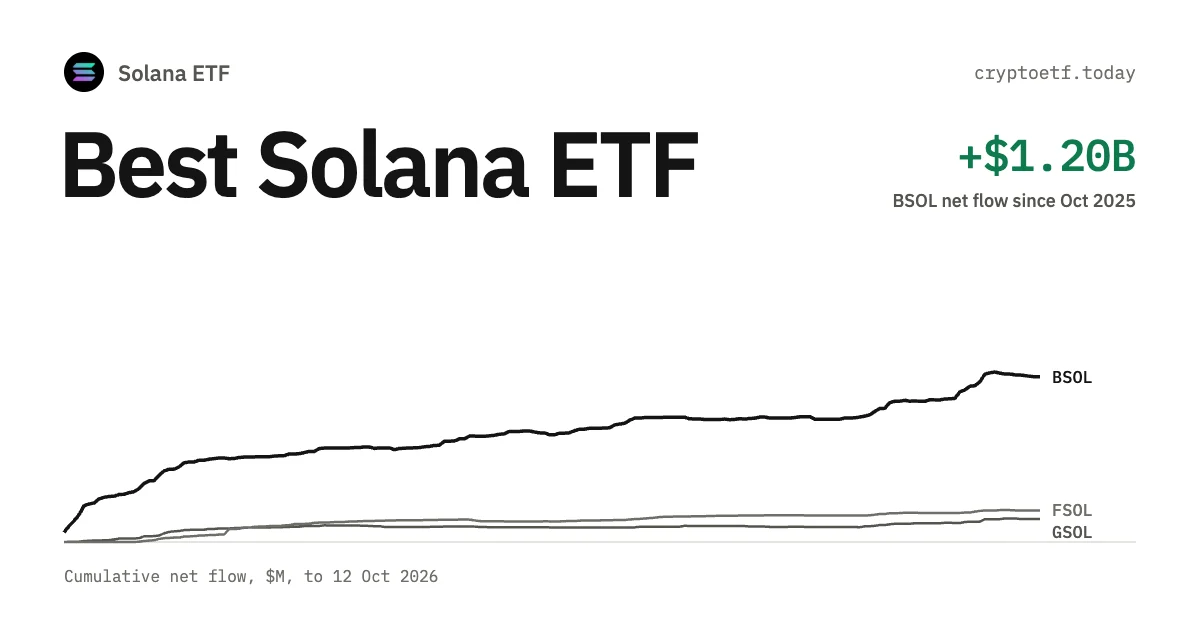
TL;DR. Nine spot Solana ETFs trade in the US, listed between 28 October 2025 and 28 July 2026. Bitwise's BSOL is the largest by a wide margin at $1.15bn on 17 September 2026 and the only one with a verified options chain. The cheapest headline fee is Morgan Stanley's MSOL at 0.14%; among the funds our flows page tracks, Grayscale's GSOL and Franklin's SOEZ tie at 0.19%, and 21Shares' TSOL is free until 27 July 2027. Every fund stakes, so the number that matters is net carry, and there GSOL, BSOL and SOEZ lead at roughly 5.0% to 5.5% a year on a 5.7% network rate. Four of the nine held under $10m at their last reading, which is the real risk in this list.

Solana ETF flows, live
as of Fri 20 Nov · updated every trading dayContents · 12 sections
- Nine funds, one table
- The fee is the small number; staking is the big one
- Best overall for size and liquidity: Bitwise BSOL
- Best net carry among tracked funds: Grayscale GSOL
- Cheapest fee: Morgan Stanley MSOL, with a caveat
- Cheap but small: 21Shares TSOL and Franklin SOEZ
- Best for cash income with a big brand: Fidelity FSOL
- The ones to think twice about: SOLC, VSOL and QSOL
- Custody, staking operators and what the flows show
- Which Solana ETF for which investor
- FAQ
- Sources and further reading
Nine funds, one table
Fees, custodians and staking cuts come from each fund's June-quarter 10-Q or prospectus on EDGAR; assets come from the issuer's own page where it publishes one, otherwise from the 10-Q at 30 June 2026. Listing dates are the first day of trading as an ETF. For GSOL, which was an OTC trust before it moved to NYSE Arca, that's the uplisting date. Our Solana ETF flows page tracks the first seven; QSOL and MSOL are here for completeness and are not in our flow data.
| Fund | Issuer | Exchange | First traded | Fee | Net assets (date) | SOL custodian |
|---|---|---|---|---|---|---|
| BSOL | Bitwise | NYSE Arca | 28 Oct 2025 | 0.20% | $1,145m (17 Sep 2026) | Coinbase Custody |
| GSOL | Grayscale | NYSE Arca | 29 Oct 2025 | 0.19% since 25 Jun 2026 | $181m (18 Sep 2026) | Coinbase Custody; Anchorage as alternate |
| VSOL | VanEck | Nasdaq | 17 Nov 2025 | 0.30% | $23m (17 Sep 2026) | Gemini (staked SOL) and Coinbase Custody |
| SOLC | Canary | Nasdaq | 17 Nov 2025 | 0.50% | $2.3m (18 Sep 2026) | BitGo |
| FSOL | Fidelity | NYSE Arca | 18 Nov 2025 | 0.25% | $127m (30 Jun 2026) | Anchorage, BitGo, Coinbase Custody |
| TSOL | 21Shares | Cboe BZX | 19 Nov 2025 | 0.21%, waived to 27 Jul 2027 | $9.4m (18 Sep 2026) | Anchorage, BitGo, Coinbase Custody |
| SOEZ | Franklin Templeton | NYSE Arca | 3 Dec 2025 | 0.19% | $8.5m (30 Jun 2026) | Coinbase Custody |
| QSOL | Invesco Galaxy | Cboe BZX | 15 Dec 2025 | 0.25% | $5.1m (30 Jun 2026) | Coinbase Custody |
| MSOL | Morgan Stanley | NYSE Arca | 28 Jul 2026 | 0.14% | Not published at time of writing | BNY Mellon and Coinbase Custody |
A tenth product, REX-Osprey's SSK, holds SOL and staking yield but as a 1940-Act fund: it charged 0.75% and held $89.3m on 17 September 2026, and about 43% of that sat in a CoinShares European ETP rather than in SOL directly. It's a different structure and stays out of the comparison below.
How this field came to exist, from CME futures to the SEC's generic listing standards, is in our Solana ETF approval status piece, and the full altcoin roster is in every new crypto ETF of 2026.
The fee is the small number; staking is the big one
Every Solana fund on this list stakes, which changes the arithmetic that works for Bitcoin. Solana's network paid a gross rate of about 5.7% in mid-September 2026 (Bitwise quoted 5.69% on 17 September; Canary quoted 7.08% through Marinade). Against that, a 0.20% fee is a rounding error, and the difference between funds comes down to two structural terms: how much of the SOL is actually staked, and what share of the reward the sponsor and its providers keep.
| Fund | Share staked (date) | Cut of rewards | How rewards reach you | Net carry on $10,000 a year |
|---|---|---|---|---|
| BSOL | 100% (17 Sep 2026) | 6% of gross | Retained in the fund; no cash paid | About +$519 |
| GSOL | 99.9% (30 Jun 2026) | 7% of gross since 25 Jun 2026 (was 23%) | Cash, monthly intended, since Aug 2026 | About +$548 |
| SOEZ | 99.88% (30 Jun 2026) | 8% of gross | Cash, monthly | About +$505 |
| FSOL | 99.64% (30 Jun 2026) | 15% of gross | Cash, at least quarterly; $0.21 a share paid in H1 2026 | About +$458 |
| TSOL | 90.8% (30 Jun 2026) | 10% of net, after providers take a low single-digit share | Cash, at least quarterly | About +$450 while the fee is waived |
| VSOL | 73.3% (30 Jun 2026) | 0.28% a year of staked assets | Retained in the fund | About +$367 |
| SOLC | 99.99% (18 Sep 2026) | Marinade's share; page shows 7.08% gross vs 6.38% net | Retained in the fund | Under +$520; not disclosed precisely |
| QSOL | About 54% ($2.76m of $5.1m, 30 Jun 2026) | 3% of gross | Per prospectus | Roughly +$275 at that staked share |
| MSOL | Up to 100% by design; no actual figure yet | 5% of gross | Cash, monthly, at least quarterly | Up to about +$525 if fully staked |
The carry column uses one formula for every row: gross rate × share staked × (1 − cut) − sponsor fee, on a 5.7% network rate. The first seven rows reuse the worked numbers from our staking ETF comparison; QSOL and MSOL are our own application of the formula to their filings. Treat the MSOL row with care. Its prospectus allows staking up to 100% and gives away only 5% of rewards, which on paper beats everything, but the fund is young enough that no 10-Q has reported how much it has actually staked.
Two things the table makes obvious. Staked share swings the answer more than fee or cut: VSOL's 73% is why it trails GSOL by about 180 basis points even though their fees differ by 11. And the 21Shares waiver is a fixed-term saving on a term that's already small. TSOL at 0% for a year still earns less than GSOL at 0.19%, because GSOL stakes more and takes less.
Best overall for size and liquidity: Bitwise BSOL
BSOL was first to list, on 28 October 2025, and has stayed the default. Bitwise's page showed $1,145m of net assets, 73.3m shares and 0.137639 SOL a share on 17 September 2026, after the fund crossed $1bn on 26 August. Staking runs through Bitwise Onchain Solutions, powered by Helius, with 100% of the SOL staked and a 6% cut, the smallest in the group. The 10-Q shows 8.05m SOL held at 30 June.
BSOL is also the only fund here with a verified options chain: options began trading in November 2025, about two weeks after the ETF itself, and Yahoo Finance lists the chain. Brokers show a GSOL chain too, but we couldn't confirm the listing exchange or start date, so we don't count it.
The catch is the payout policy. Bitwise retains rewards inside the fund rather than paying cash, so BSOL's SOL per share rises over time and the return shows up only when you sell. In an IRA that's neutral; in a taxable account it's a deferral, which some investors prefer and others don't. And because rewards land as extra SOL rather than as new shares, BSOL can show zero flow on a day its holdings grew.
Best net carry among tracked funds: Grayscale GSOL
GSOL is the fund that changed the most in 2026. It uplisted from an OTC trust to NYSE Arca on 29 October 2025 at 0.35%, cut the fee to 0.19% on 25 June 2026, and on the same day cut its staking take from 23% of gross rewards to 7%. Its 10-Q shows 99.9% of holdings staked at 30 June, and an August amendment to the trust agreement made cash distributions mandatory at least quarterly, with monthly intended. Grayscale's daily file showed $181.2m of assets and 20.9m shares on 18 September 2026, up from $101.2m at the end of June.
Put those terms into the formula and GSOL nets about 5.5% a year, the best of the seven we track. The custodian is Coinbase Custody, with Anchorage Digital Bank as the named alternate. If you want the highest reward pass-through from a fund with a record of actually paying it out, this is it.
Cheapest fee: Morgan Stanley MSOL, with a caveat
MSOL listed on NYSE Arca on 28 July 2026 with a 0.14% delegated sponsor fee, the lowest in the group and five basis points under GSOL and SOEZ. The prospectus is aggressive on staking too: up to 100% of the SOL, with Figment, Galaxy and Coinbase as staking providers keeping an aggregate 5% of rewards, and net rewards paid in cash monthly. Custody is split between BNY Mellon and Coinbase Custody, the only fund here with BNY Mellon among its SOL custodians.
What we can't tell you is how big it is or how much it has staked. Morgan Stanley's product page doesn't publish daily assets in a form we can read, and the first 10-Q covering the fund's operations hadn't been filed when we wrote this; its EDGAR record since listing consists of one 8-K about a director's resignation. On terms, MSOL should be the cheapest fund to hold. On evidence, it's the least documented. Nor is it on our flows page, so its daily creations and redemptions aren't in our Solana total.
Cheap but small: 21Shares TSOL and Franklin SOEZ
TSOL's headline fee is 0.21%, but 21Shares is waiving all of it from 28 July 2026 to 27 July 2027. It listed on Cboe BZX on 19 November 2025, stakes 90.8% of its SOL at last count and pays rewards in cash at least quarterly, after providers take a low single-digit share and the sponsor 10% of what's left. Custody is spread across Anchorage, BitGo and Coinbase. 21Shares' page showed $9.4m of net assets on 18 September 2026, up from $2.85m at 30 June but still one of the smallest funds in the group.
SOEZ charges 0.19%, waived entirely on the first $5bn through 31 May 2026, and listed on NYSE Arca on 3 December 2025. Its 10-Q reports 99.88% of the SOL staked through Coinbase Crypto Services, an 8% aggregate cut, and cash distributions monthly. On terms it sits right beside GSOL. The money hasn't followed: net assets were $8.5m at 30 June 2026.
The arithmetic on both is the same. A free year on TSOL is worth $21 on $10,000; SOEZ's 0.19% is $19. A fund that closes is a forced sale on the sponsor's timetable, and the bid-ask spread on a fund under $10m is a real cost that no fee table captures. Franklin has the balance sheet to keep a small fund open indefinitely, and 21Shares has run small products for years, so neither is a closure candidate today. Weigh that against the saving before the waiver decides it for you.
Best for cash income with a big brand: Fidelity FSOL
FSOL began trading on NYSE Arca on 18 November 2025 with a six-month fee holiday and now charges 0.25%. It's the second-largest tracked fund after BSOL, at $127.1m at 30 June 2026, and the one with the clearest payout record: $0.06 a share on 17 February, $0.11 on 15 May and $0.04 on 24 June 2026, $0.21 in total for the half year. Staking stood at 99.64% and Fidelity keeps 15% of rewards, the largest cut in the group, which is why its net carry lands about 90 basis points under GSOL's.
You're paying for the name and for a custodian mix that doesn't depend on any single firm: Anchorage, BitGo and Coinbase Custody all hold SOL for the trust. For an investor whose brokerage account is already at Fidelity, that convenience can be worth more than the carry gap.
The ones to think twice about: SOLC, VSOL and QSOL
Canary SOLC charges 0.50%, two and a half times BSOL, and held $2.29m across exactly 100,000 shares on 18 September 2026, a seed-sized fund ten months after listing. Staking through Marinade is nearly total (99.99%) and Canary's page quotes 7.08% gross against 6.38% net, so the reward is real; but you're paying the highest fee in the group for the smallest fund, with BitGo as sole custodian. The Marinade validator set is the one genuine differentiator, and it isn't worth 30 basis points to most buyers.
VanEck VSOL listed on Nasdaq on 17 November 2025 and is the lowest-carry tracked fund for two reasons. It staked only 73.3% of its SOL at 30 June 2026, and it charges a staking fee of 0.28% a year on staked assets, a fixed cost that doesn't shrink if the network rate does. Staked SOL sits with Gemini, the rest with Coinbase. Assets were $23.4m on 17 September 2026 per VanEck's holdings file, so it isn't tiny, but the terms cost roughly 180 basis points a year against the leaders.
Invesco Galaxy QSOL has the second-smallest cut in the group at 3%, and Coinbase custody, but held $5.1m at 30 June 2026 with only about 54% of its SOL staked. Listing on 15 December 2025, a month after the crowd, it never caught up, and it isn't in our flow data.
Custody, staking operators and what the flows show
Coinbase Custody Trust Company holds SOL for every fund except SOLC, alone or alongside Anchorage, BitGo, Gemini or BNY Mellon. That's the same concentration the Bitcoin funds have, and the same argument applies: the model is segregated cold storage under a regulated trust company, as we set out in how Bitcoin ETF custody works, but a problem at one custodian would touch most of this list in the same week. Investors who want to spread that exposure have three routes: SOLC (BitGo only), VSOL (Gemini for the staked portion) or MSOL (BNY Mellon alongside Coinbase).
Staking adds a second layer. Coinbase Crypto Services stakes for SOEZ and is among MSOL's providers; Bitwise runs its own operation; Canary uses Marinade; VanEck named SOL Strategies at launch. Solana doesn't currently slash stake, so the operational risk is validator downtime rather than lost principal, and unstaking takes about two days at the epoch boundary. None of that reaches your shares, which settle T+1 regardless of what the fund's SOL is doing.
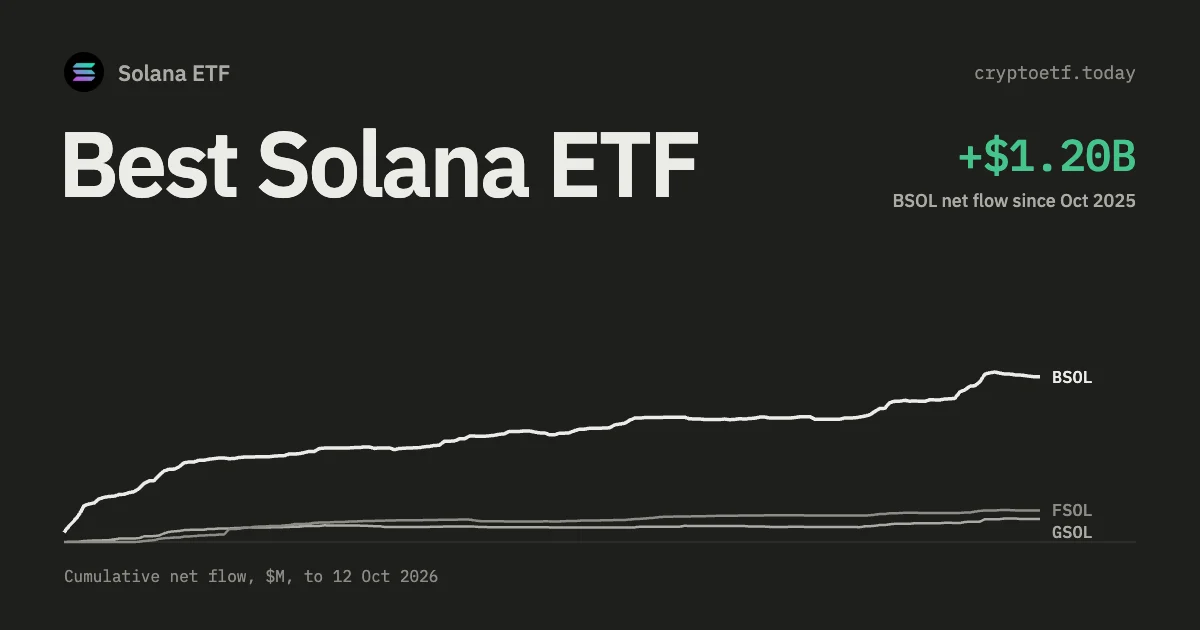
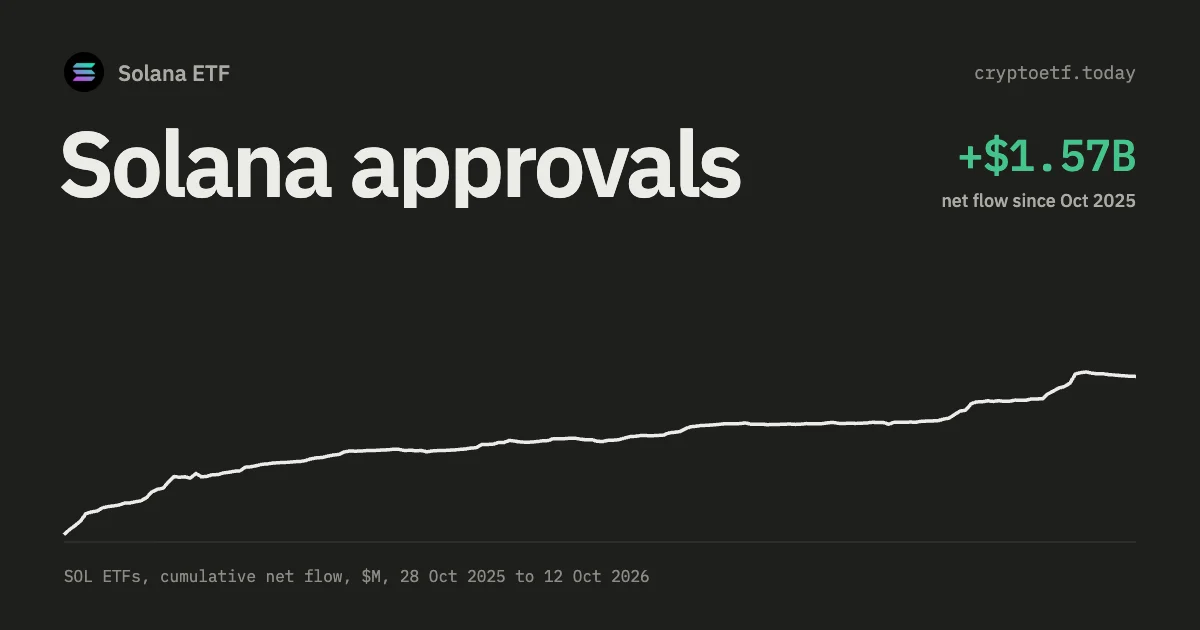
On flows: Bitwise reported that BSOL crossed $1bn in assets on 26 August 2026, ten months after listing, and on the mid-September readings above it held more than three times the other six tracked funds combined. The category has had inflow weeks and outflow weeks like every other crypto ETF group, and we don't quote a running total here because it changes every business day. The daily series for all seven tracked funds is on the Solana ETF flows page, and the Crypto ETF Flow Index folds Solana's flows into a single 0–100 reading alongside the other assets. One reading habit matters more here than for Bitcoin: flows count shares created and redeemed, not SOL earned. A fund that retains rewards (BSOL, VSOL, SOLC) grows its SOL without a creation, so its balance can rise on a zero-flow day. Compare SOL per share across dates to see it.
Which Solana ETF for which investor
| If you want... | Choose | Because |
|---|---|---|
| The largest, most liquid fund | BSOL | $1.15bn, listed options, 6% cut, 100% staked |
| Highest net carry with cash payouts | GSOL | 0.19% fee, 7% cut, 99.9% staked, monthly cash intended |
| Lowest headline fee | MSOL | 0.14%, 5% cut; but no reported staked share or assets yet |
| Zero fee for a year | TSOL | Waived to 27 Jul 2027; $9.4m fund |
| Fidelity account and quarterly cash | FSOL | $127m, three distributions in H1 2026, three custodians |
| A non-Coinbase custodian | SOLC, VSOL or MSOL | BitGo, Gemini, BNY Mellon respectively |
| To avoid | SOLC on fee and size; VSOL on carry | 0.50% on $2.3m; 73% staked plus 0.28% staking fee |
For most buyers the decision is BSOL or GSOL: the first for size and options, the second for carry and cash. MSOL is the one to re-check once its first 10-Q lands. Everything below $10m needs a specific reason. And whichever you pick, the numbers above are September 2026 readings of terms that change with a filing; the fee table for this group has moved several times this year already.
FAQ
How many Solana ETFs are there in the US?
Nine spot Solana ETFs structured as grantor trusts were trading as of September 2026: BSOL, GSOL, VSOL, SOLC, FSOL, TSOL, SOEZ, QSOL and MSOL, listed between 28 October 2025 and 28 July 2026. REX-Osprey's SSK is a tenth product but a 1940-Act fund with a different structure. Leveraged and futures-based Solana ETFs are separate.
Which Solana ETF is the cheapest?
Morgan Stanley's MSOL has the lowest sponsor fee at 0.14%. Among the seven funds on our flows page, Grayscale GSOL and Franklin SOEZ charge 0.19%, and 21Shares TSOL waives its entire 0.21% fee until 27 July 2027. Canary SOLC is the most expensive at 0.50%.
Which Solana ETF has the highest staking yield?
On a 5.7% network rate, GSOL nets about 5.5% a year after its 7% cut and 0.19% fee, followed by BSOL near 5.2% and SOEZ near 5.1%. VSOL is lowest among the tracked funds at roughly 3.7%, because it stakes only 73% of its SOL and charges a 0.28% staking fee on top.
Which Solana ETF is the largest?
Bitwise BSOL, at $1,145m of net assets on 17 September 2026 per Bitwise's page. Grayscale GSOL was second at $181m on 18 September and Fidelity FSOL third at $127m at 30 June 2026. The other five tracked funds each held under $25m at their last reading; Morgan Stanley had not published a figure for MSOL.
Do Solana ETFs pay staking rewards in cash?
Most do. GSOL, FSOL, TSOL, SOEZ and MSOL convert rewards to cash and distribute monthly to quarterly; FSOL paid $0.21 a share in the first half of 2026. BSOL, VSOL and SOLC retain rewards inside the fund, so the SOL behind each share rises instead.
Can I trade options on a Solana ETF?
BSOL options have traded since November 2025 and are listed on major quote sites. Brokers also show a GSOL chain, but we could not confirm its listing details. We found no options on the other seven funds as of September 2026.
Sources and further reading
- SEC EDGAR, Form 10-Q for the quarter ended 30 June 2026: Grayscale GSOL, Bitwise BSOL, Fidelity FSOL, VanEck VSOL, Franklin SOEZ, Invesco Galaxy QSOL.
- SEC EDGAR, Morgan Stanley Solana Trust prospectus (424B3, 23 July 2026): fee, staking providers, 5% reward cut, custodians — sec.gov.
- Issuer pages, 17–18 September 2026: Bitwise BSOL (assets, staking rate, custodian), 21Shares TSOL (fee waiver dates, assets), Canary SOLC (assets, staking yields), REX-Osprey SSK.
- Bitwise newsroom, BSOL launch announcement of 28 October 2025 (fee, waiver, Helius) — bitwiseinvestments.com.
- 21Shares TSOL launch release, 19 November 2025 — globenewswire.com.
Live data on this topic
ETFs still waiting for approval: Injective, SEI, Cronos, PEPE, Worldcoin, Canton, Aave, TRUMP, Ondo, Uniswap, Aptos, PENGU
For information only. Not investment advice.
 BTC
 ETH
 XRP
 HYPE
 LINK
 HBAR
 AVAX
 DOGE
 LTC
 SUI
 DOT
 BNB
 NEAR
 TRX
 ZEC