IBIT is the largest spot Bitcoin ETF in the world — 734,261 BTC and $43.4bn of net assets at 30 June 2026. A close look at fees, custody, liquidity and the risks of dominance.
TL;DR. BlackRock's iShares Bitcoin Trust (IBIT) is the dominant US spot Bitcoin ETF — $43.39 billion of net assets and 734,261 BTC at 30 June 2026 (Q2 2026 10-Q), 0.25% expense ratio, bitcoin held at Coinbase Custody Trust. That is 60.7% of the $71.4bn US spot Bitcoin ETF category. For the average investor accumulating bitcoin exposure inside a brokerage or IRA, it is the most liquid and lowest-friction choice. The trade-offs: not the cheapest (Morgan Stanley's MSBT at 0.14% and the Grayscale Mini at 0.15% are lower), and you sit at the same custodian as most of the category.
Contents · 11 sections

The basics
| Field | Value |
|---|---|
| Ticker | IBIT |
| Exchange | NASDAQ |
| Inception | 11 Jan 2024 |
| Sponsor | iShares Delaware Trust Sponsor LLC |
| Trustee | BlackRock Fund Advisors |
| Delaware Trustee | Wilmington Trust, N.A. |
| Bitcoin custodian | Coinbase Custody Trust Company (Anchorage Digital Bank N.A. named as additional custodian) |
| Trust administrator | The Bank of New York Mellon |
| Expense ratio | 0.25% |
| Net assets (30 Jun 2026) | $43.39 billion — 734,261 BTC |
| Average daily volume | ~30 million shares |
What you actually own
One IBIT share represents a fractional beneficial interest in the Trust's bitcoin holdings. The Trust holds physical bitcoin — not futures, not derivatives — in segregated cold-storage addresses on the Bitcoin blockchain. The custodian, Coinbase Custody Trust Company, controls the private keys; Anchorage Digital Bank N.A. is named in the filings as an additional bitcoin custodian, though as of the Q2 2026 10-Q the sponsor had no plans to move any of the trust's bitcoin there.
Creation and redemption mechanics are the same for IBIT as for the rest of the category, with one change worth knowing: on 29 July 2025 the SEC issued the 19b-4 orders permitting in-kind creations and redemptions, and the Q2 2026 10-Q shows both sides running in kind ($3.29bn of bitcoin purchased in-kind for shares issued in the quarter, $3.85bn paid in-kind for shares redeemed). See Authorized Participants explained and how Bitcoin ETF custody works.
Fees: the launch waiver and what you pay today
At launch IBIT offered a fee discount: 0.12% on the first $5B of AUM for the first 12 months. The waiver expired in January 2025 and IBIT now charges the headline 0.25%. On a $100k position that is $250/year — compounding to roughly $2,471 over a decade if BTC price is flat (and more in dollar terms if BTC appreciates). Full fee comparison in Bitcoin ETF expense ratios compared.
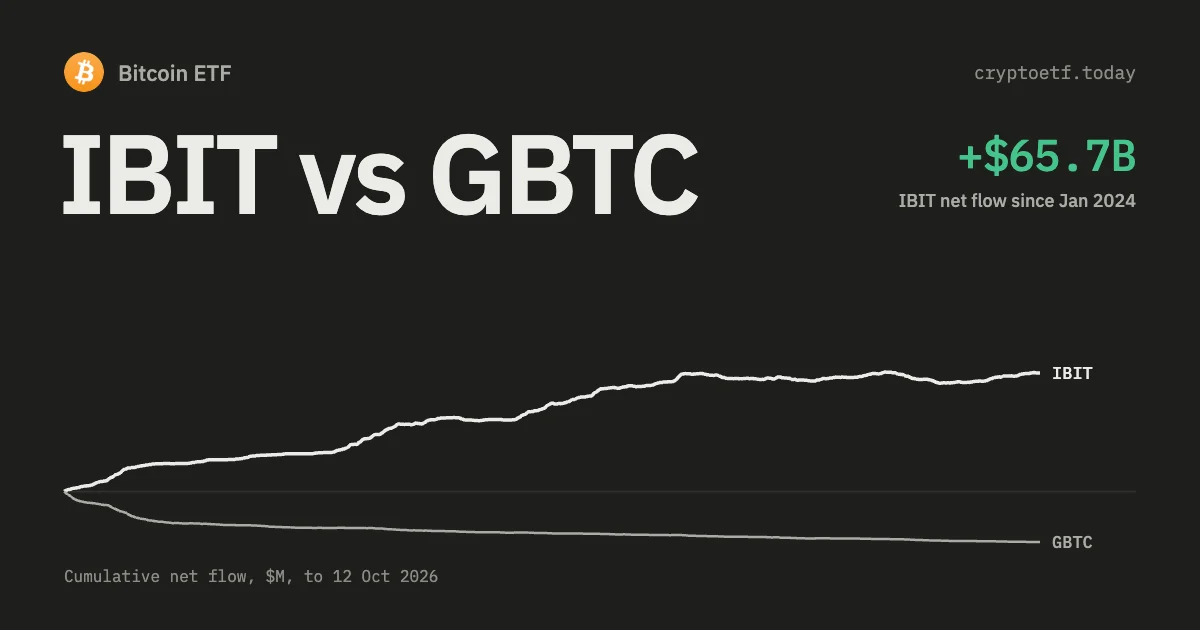
At 0.25%, IBIT is mid-pack: far cheaper than the 1.50% Grayscale GBTC, more expensive than Franklin EZBC (0.19%), the Grayscale Mini Trust (0.15%) and the cheapest fund in the category, Morgan Stanley's MSBT (0.14%, listed April 2026). The 6–11 bp gap to those is real but, given IBIT's liquidity, most investors absorb it.
Tracking quality — what BlackRock actually discloses
IBIT is the most-traded spot Bitcoin ETF in the world, and BlackRock publishes the figures rather than leaving them to be guessed at. At 23 September 2026 the fund page showed a 30-day median bid-ask spread of 0.02%, 30-day average volume of 53.3 million shares and net assets of $67.08 billion.
Note what that disclosure is. IBIT is not registered under the Investment Company Act of 1940, so Rule 6c-11 — which obliges conventional ETFs to publish median spread and premium/discount history — does not reach it. BlackRock, Bitwise and 21Shares publish anyway. Fidelity does not, so any table putting a precise spread on FBTC is quoting an estimate.
| Fund | 30-day median bid-ask spread | Net assets | Daily volume (shares) |
|---|---|---|---|
| IBIT (BlackRock) | 0.02% | $67.08bn | 46.9M |
| BITB (Bitwise) | 0.0234% | $3.24bn | 0.95M |
| ARKB (21Shares) | 0.04% | $2.88bn | 1.87M |
| FBTC (Fidelity) | not published | — | — |
Issuer fund pages, 23 September 2026.
The gap is narrower than size suggests. BITB holds one-twentieth of IBIT's assets and trades about 2% of its shares, yet its median spread — 0.0234% on the same date — rounds to the same 0.02%. Tightness in this category comes from authorised participants arbitraging against a deep 24-hour spot market, not from the fund's own order book, so a small fund can still quote well. What size actually buys is depth: a pension fund deploying $200M can fill in one order without moving the print. That is a block-trading advantage, and most retail buyers never touch it.
Premium and discount behave the same way. On 23 September 2026 IBIT closed at $47.88 against a NAV of $47.78 — a premium of 0.20% — and BITB closed at a 0.20% premium the same day. Both reflect bitcoin moving between the NAV strike and the 4pm close, not fund quality.
Custody architecture
IBIT uses Coinbase Custody Trust Company, LLC, a New York trust company capitalised separately from Coinbase Inc. The trust holds bitcoin in segregated cold-storage addresses.
Concentration risk is the thing to weigh. IBIT, GBTC, the Grayscale Bitcoin Mini Trust and Bitwise BITB all name Coinbase Custody as their bitcoin custodian, and those four alone are $56.8bn of the $71.4bn category at 30 June 2026 — just under 80%. ARK 21Shares ARKB adds Coinbase to a list of four custodians, and VanEck HODL keeps Gemini as primary custodian with Coinbase as the additional one. Of the funds whose latest 10-Qs we checked, Fidelity FBTC is the only one with no Coinbase exposure at all: its bitcoin sits with Fidelity Digital Assets, N.A., an affiliate of the sponsor.
Holders: what the 13F filings actually say
The State of Wisconsin Investment Board (SWIB) is the case everyone quotes, and it is usually quoted wrong. Its 13F for the quarter ended 31 March 2024 lists two separate positions: 2,450,400 shares of iShares Bitcoin Trust worth $99.17 million, and 1,013,000 shares of Grayscale Bitcoin Trust worth $63.69 million. The widely repeated "$160M of IBIT" is those two lines added together — most of the gap between the two numbers is a GBTC position, not an IBIT one.
Why institutions pick IBIT when they do come in? Three factors:
- Existing iShares relationship — institutional buyers already have BlackRock paper across many ETFs and prefer consolidating.
- Operational deepest book — large block orders execute with less impact.
- Brand assurance — for legal/compliance committees, "BlackRock spot Bitcoin ETF" is easier to approve than smaller-issuer alternatives.
The dynamic is a self-reinforcing loop: bigger AUM attracts more institutional buyers, which grows AUM further. Covered in detail in Bitcoin ETF 13F filings explained.
The case for IBIT
- Liquidity. Best-in-class for any order size from $1k to $100M+.
- Brand and platform fit. Available on every US brokerage. Trusted by compliance teams.
- Tax wrapper. Eligible for Roth IRA, traditional IRA, 401(k), SEP-IRA, taxable brokerage. Same as competitors but with the best execution.
- Depth, not just a tight spread. At 0.02% median spread IBIT is level with Bitwise BITB, not ahead of it — but it trades roughly fifty times the daily share volume, which is what a large order needs.
- Predictable counterparty. BlackRock has more institutional weight behind operational risk management than smaller issuers.
The case against IBIT
- Fee not the cheapest. At 0.25% you pay 6 bp more than Franklin EZBC (0.19%) and 11 bp more than the cheapest fund in the category, Morgan Stanley MSBT (0.14%). On a $500k position held ten years that is roughly $3,000 and $5,500 of foregone return respectively.
- Coinbase custody concentration. Same custodian as most of the category. The clean alternative is FBTC; HODL splits between Gemini and Coinbase, and ARKB includes Coinbase among four custodians.
- Index-fund-style dominance. 60.7% of the category sits in one product — meaningful systemic risk concentration.
- BlackRock political exposure. Some investors specifically avoid BlackRock products on principle. Niche but real.
Who should pick IBIT
Default choice for:
- Investors with existing BlackRock / iShares relationships.
- Anyone allocating inside a wealth manager or large RIA.
- Holders prioritising liquidity over the absolute lowest fee.
- Institutional and pension fund allocators.
Consider alternatives if:
- You specifically want bitcoin held away from Coinbase — FBTC is the only large fund that does that.
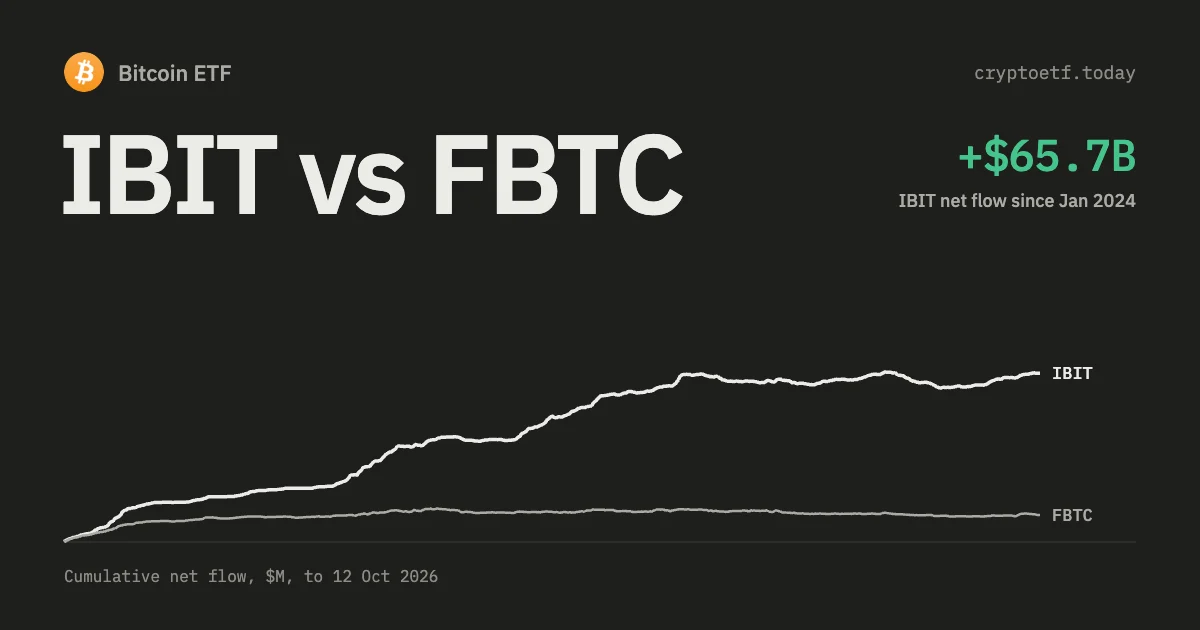
- You hold a very large position over very long horizon and fee compounds materially — see IBIT vs FBTC for the exact comparison.
- You are committed to spreading exposure across two or more issuers for systemic risk diversification.
FAQ
What is the expense ratio of BlackRock IBIT?
0.25% per year, after the launch fee waiver expired in January 2025. The original waiver charged 0.12% on the first $5 billion of AUM for the first 12 months.
Who custodies the bitcoin held by IBIT?
Coinbase Custody Trust Company, LLC, a New York trust company capitalised separately from Coinbase Inc. Anchorage Digital Bank N.A. is named as an additional bitcoin custodian, but as of the Q2 2026 10-Q no bitcoin had been moved there. The Bank of New York Mellon is the trust administrator. Bitcoin is held in segregated cold-storage addresses on the Bitcoin blockchain.
How big is IBIT compared to other Bitcoin ETFs?
IBIT held $43.39 billion of net assets and 734,261 BTC at 30 June 2026 — 60.7% of the $71.4 billion US spot Bitcoin ETF category. Fidelity FBTC is second at $10.30 billion, Grayscale GBTC third at $8.14 billion. IBIT is the largest spot Bitcoin ETF in the world.
Can I hold IBIT in a Roth IRA?
Yes. All major US brokerages support IBIT in Roth IRAs, traditional IRAs, SEP-IRAs and 401(k) accounts where the plan menu allows. This is the primary structural advantage of the ETF wrapper for retirement savers.
What's the difference between IBIT and Bitcoin held directly?
IBIT holds physical bitcoin in regulated custody on your behalf; you own ETF shares in a brokerage account. Direct bitcoin gives you full sovereignty over the asset, no annual fee, and 24/7 trading — but requires you to manage keys and forgo tax-advantaged account access. We compare both in detail in our Bitcoin ETF vs spot Bitcoin guide.
Sources and further reading
- iShares Bitcoin Trust prospectus and SAI — sec.gov/Archives/edgar (CIK 0001980994).
- BlackRock iShares product page — ishares.com/us/products/333011/IBIT.
- 13F filings disclosure — sec.gov.
- Internal: Fidelity FBTC review, IBIT vs FBTC, Bitcoin ETF vs spot Bitcoin, Expense ratios compared.
Live data on this topic
ETFs still waiting for approval: Injective, SEI, Cronos, PEPE, Worldcoin, Canton, Aave, TRUMP, Ondo, Uniswap, Aptos, PENGU
For information only. Not investment advice.
 ETH
ETH SOL
SOL XRP
XRP HYPE
HYPE LINK
LINK HBAR
HBAR AVAX
AVAX DOGE
DOGE LTC
LTC SUI
SUI DOT
DOT BNB
BNB NEAR
NEAR TRX
TRX ZEC
ZEC