For investors who want both BTC and ETH exposure, the question is the split. Market-cap weighting says about 84/16 — and the old argument against ETH ETFs no longer holds.
TL;DR. Market-cap weighting currently puts the bitcoin/ether split at roughly 84/16, and most institutional frameworks land somewhere between that and 70/30. Pure bitcoin remains the conservative default for a first crypto allocation. The argument that used to settle this question — that US Ethereum ETFs cannot stake and therefore give up yield — is out of date: most of them have staked since late 2025. The notable exception is BlackRock's ETHA, whose prospectus still rules staking out.
Contents · 8 sections
 Ethereum ETFsNet flow Fri 16 Oct−$69.7M
Market-cap weighting as the default
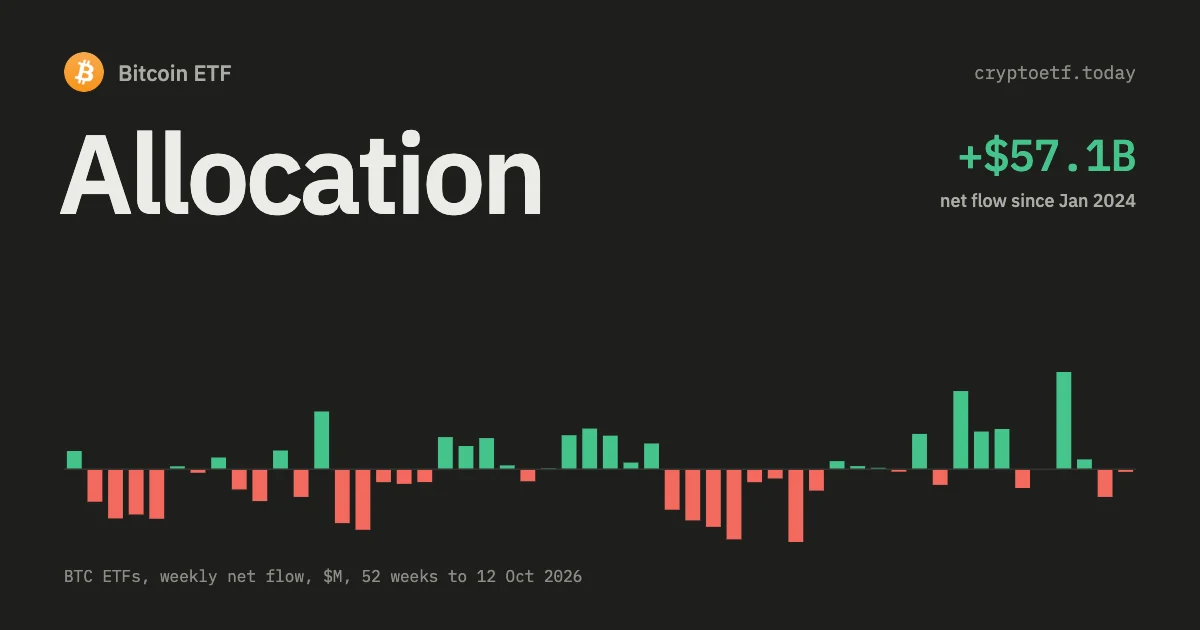
At 24 September 2026 prices, with 20.09 million bitcoin and 122.07 million ether in circulation, bitcoin's market capitalisation is about $1.70 trillion and ether's about $0.33 trillion — a ratio near 5.2 : 1. A market-cap-weighted crypto sleeve is therefore roughly 84% BTC / 16% ETH. That is the neutral starting point, in the same sense a total-market equity index is neutral: it takes no view beyond what the market already prices. Anything else is an active bet worth naming as one.
The case for over-weighting bitcoin (90/10 or 100/0)
- The monetary thesis is simpler and has been running unchanged since 2009.
- Ethereum has been through significant protocol changes — proof-of-work to proof-of-stake, repeated fee-market revisions — and more are planned. A feature for some investors, an ongoing risk for others.
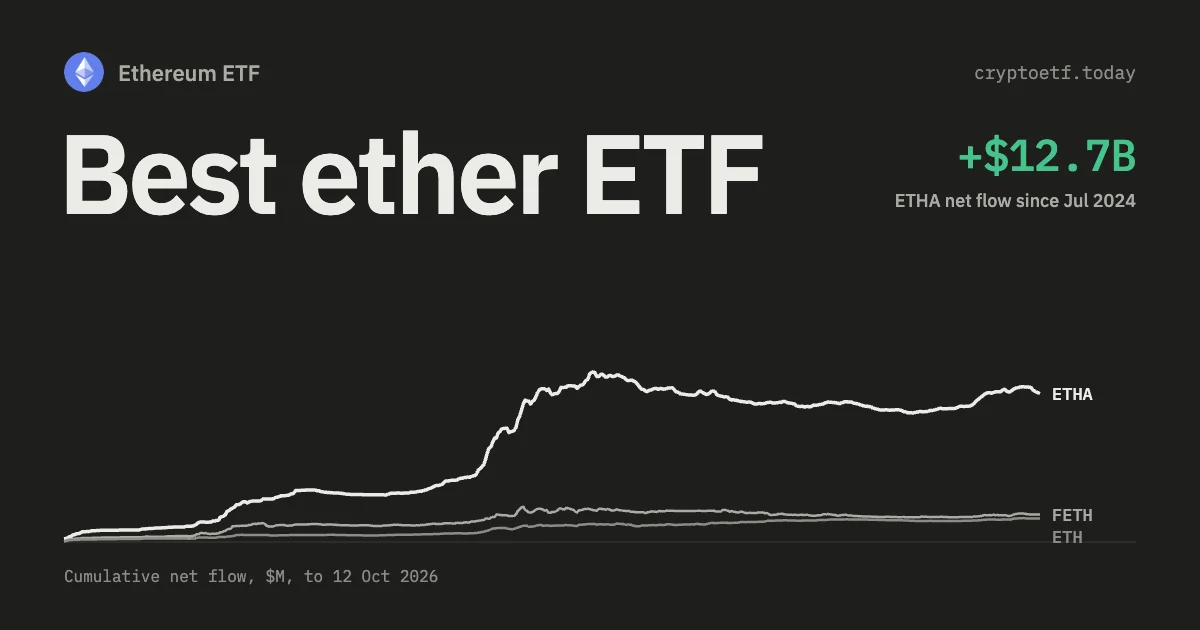
- Bitcoin ETFs are far larger: IBIT alone held about $67.9 billion in September 2026, against $9.8 billion for ETHA, the largest ether fund.
The case for adding ether (70/30 or 50/50)
- Ether's exposure to smart contracts, DeFi and tokenisation is a different bet from bitcoin's monetary one.
- Ether now carries a native income stream inside the ETF wrapper, which bitcoin does not have and cannot have.
- If you think the ratio between the two narrows, market-cap weighting is the wrong way to express it.
The staking gap has mostly closed
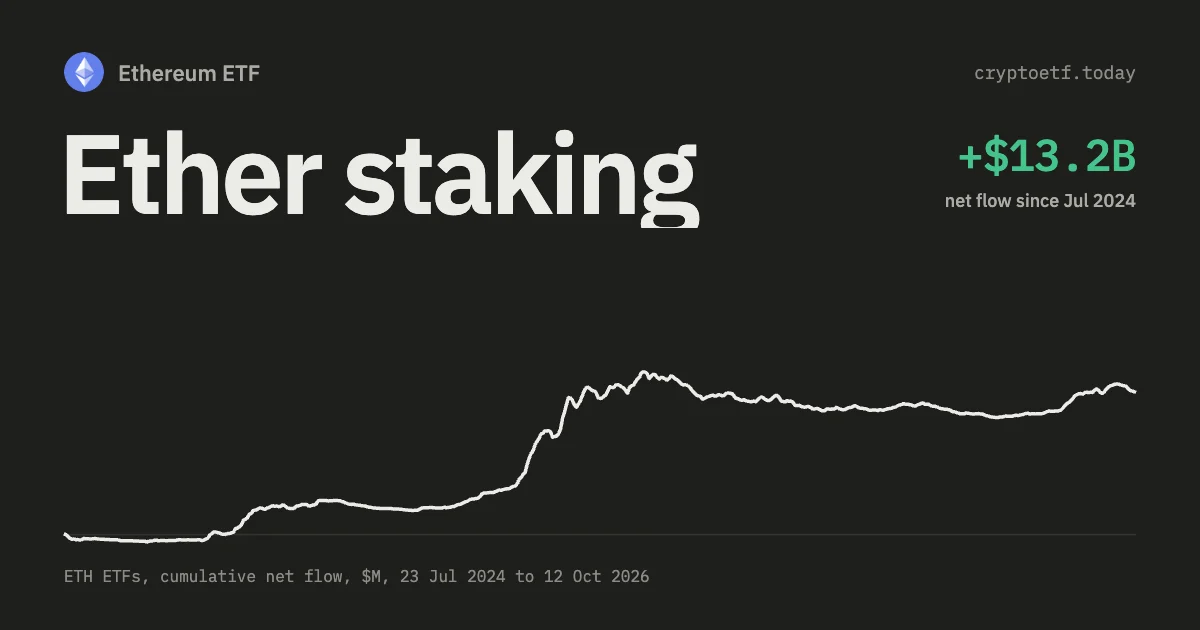
Until late 2025 the standard objection to Ethereum ETFs was that they held ether but could not stake it, forfeiting the network's validation income. That is no longer true of the category, and several funds have been renamed to say so: the SEC's registrant list now carries the Grayscale Ethereum Staking ETF (ETHE), the Grayscale Ethereum Staking Mini ETF (ETH), the 21Shares Ethereum Staking ETF (TETH) and BlackRock's separate iShares Staked Ethereum Trust ETF (ETHB).
Fidelity moved later. In an 8-K filed on 10 August 2026 the Fidelity Ethereum Fund (FETH) amended its trust agreement to permit staking and disclosed the economics plainly: the trust retains 85% of all staking rewards, with the remaining 15% shared among the sponsor, the custodians and the node operators, and net staking income paid out as quarterly cash distributions.
The exception matters, because it is the biggest fund. BlackRock's ETHA does not stake, and says so in its prospectus: neither the trust, the sponsor nor the custodian "will, directly or indirectly, employ the Trust's ether in Staking Activities", so it "will not earn any form of staking rewards, or income of any kind" from them. BlackRock's answer for investors who want the yield is ETHB. So the question is no longer "ETF or direct ETH" but which ether ETF — detail in Ethereum ETF staking explained.
Three model allocations
- Conservative, 90/10. A deliberate under-weight to ether. The exposure is on the record; bitcoin stays the conviction.
- Neutral, 85/15. Roughly market-cap weighted as of September 2026. Takes no view and drifts with the market.
- Aggressive, 70/30 or 50/50. An explicit bet that ether closes ground. At 50/50 you hold about three times ether's market weight — a strong opinion, and worth holding as one.
Rebalancing
Crypto weights drift far faster than equity weights, so the rebalancing rule matters more than the starting split. Threshold-based beats calendar-based: rebalance when a position drifts a set number of percentage points from target. Inside an IRA or 401(k) that is frictionless; in a taxable account, steer new contributions into the under-weight side before selling anything. Cash distributions from a staking ether ETF are a natural rebalancing tool — and a taxable event outside a retirement account.
FAQ
How should I split allocation between Bitcoin and Ethereum ETFs?
Market-cap weighting in September 2026 gives roughly 84% bitcoin / 16% ether, based on a $1.70 trillion bitcoin market cap against $0.33 trillion for ether. Most institutional frameworks sit between that and 70/30. Anything more aggressive than market weight is an active view on ether, and worth treating as one.
Can US Ethereum ETFs stake their ether?
Most of them now do. Grayscale’s two funds, 21Shares’ TETH and BlackRock’s separate ETHB all carry "staking" in their registered names, and Fidelity’s FETH began staking in August 2026, keeping 85% of the rewards for the trust and paying out net staking income quarterly. The big exception is ETHA, whose prospectus states it will not stake.
Should I hold direct ETH instead of an Ethereum ETF?
The old reason to — that the ETF forfeited staking income entirely — has largely gone. A staking ETF now passes most of the reward through, minus the fee and the share taken by sponsor, custodians and node operators. Direct holding still nets more, and still means managing keys yourself.
Which Ethereum ETF should I use in a retirement account?
Any of them can be held in an IRA or 401(k). The choice is between a staking fund, where distributions and rewards compound inside the wrapper with no tax drag, and a non-staking one such as ETHA. In a tax-advantaged account the staking versions have the clearer case.
Does the Bitcoin ETF have an equivalent to staking?
No, and it cannot. Bitcoin has no native staking mechanism, so a spot Bitcoin ETF’s return is the bitcoin price less the fee. That is a genuine structural difference between the two wrappers, and it now runs in ether’s favour rather than against it.
Sources and further reading
- iShares Ethereum Trust ETF prospectus (424B3, 6 August 2026) — staking prohibition, sec.gov CIK 2000638.
- Fidelity Ethereum Fund Form 8-K, 10 August 2026 — staking programme and 85/15 reward split, CIK 2000046.
- SEC registered company and ticker list — fund names for ETHE, ETH, TETH, ETHB.
- Circulating supply: blockchain.info (bitcoin) and ultrasound.money (ether); prices from our own feed, 24 September 2026.
- Internal: Ethereum ETF staking explained, Bitcoin ETF portfolio allocation, Bitcoin ETF vs spot Bitcoin.
For information only. Not investment advice.
 BTC
BTC SOL
SOL XRP
XRP HYPE
HYPE LINK
LINK HBAR
HBAR AVAX
AVAX DOGE
DOGE LTC
LTC SUI
SUI DOT
DOT BNB
BNB NEAR
NEAR TRX
TRX ZEC
ZEC