The cheapest US spot crypto ETFs charge 0.14% (MSBT, MSSE, MSOL); the biggest is IBIT at $66.4bn. Picks by asset, plus GDLC (0.59%) vs BITW (0.75%) for a basket.
TL;DR. There's no single best crypto ETF; there's a best fund for each job. For bitcoin, Morgan Stanley's MSBT is the cheapest at 0.14% and BlackRock's IBIT is the biggest and most traded at $66.4bn. For ether, Grayscale's mini (ticker ETH) charges 0.15% and passes 94% of staking rewards through. For Solana, Bitwise's BSOL ($1.19bn) leads; for XRP, Franklin's XRPZ is cheapest at 0.19% and Bitwise's fund is largest at $572m. If you want one fund for several coins, Grayscale's GDLC holds five assets for 0.59% and Bitwise's BITW holds ten for 0.75%. The two funds to avoid are the expensive Grayscale originals: GBTC at 1.50% and ETHE at 2.50%. Net assets in this article are for 12 October 2026; fees are the headline rates on that date.
Contents · 11 sections

How we picked
Every US spot crypto ETF holds the same coin as its rivals, so the differences are narrow and measurable. We ranked on four things, in this order:
- Fee. The sponsor fee is the one cost you pay every year, whatever the market does. On $10,000, each 0.10% is $10 a year.
- Size and trading. A big fund trades tight spreads, has options listed in some cases and is unlikely to close. Size here is net assets from this site's issuer data on 12 October 2026.
- Structure. For ether and Solana, whether the fund stakes and how much of the reward reaches shareholders.
- Track record. How long it has traded and whether money keeps arriving. Cumulative net flow is the simplest test.
We didn't rank on past returns. Two funds holding the same coin return the same thing before fees; a different return between them is the fee, the staking and the tracking error, which we already count.
The picks at a glance
This is a comparison of fund costs and structure, not investment advice; crypto ETFs can lose most of their value.
| If you want | Pick | Fee | Net assets (12 Oct 2026) | Why |
|---|---|---|---|---|
| Bitcoin, lowest cost | MSBT (Morgan Stanley) | 0.14% | $0.88bn | Cheapest Bitcoin ETF, no waiver to expire |
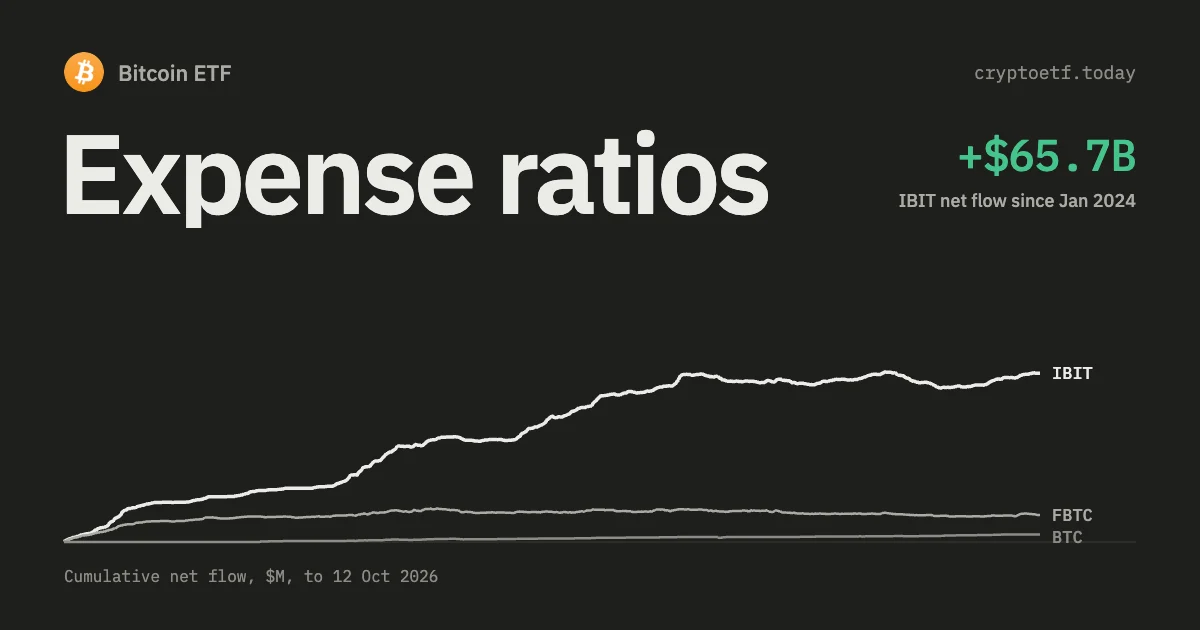
| Bitcoin, most liquid | IBIT (BlackRock) | 0.25% | $66.43bn | Largest by far, $65.7bn of net inflows |
| Bitcoin, cheap and large | BTC (Grayscale Mini) | 0.15% | $5.22bn | Near-lowest fee at real scale |
| Ether with staking | ETH (Grayscale Mini) | 0.15% | $2.34bn | Stakes, 94% of rewards paid out |
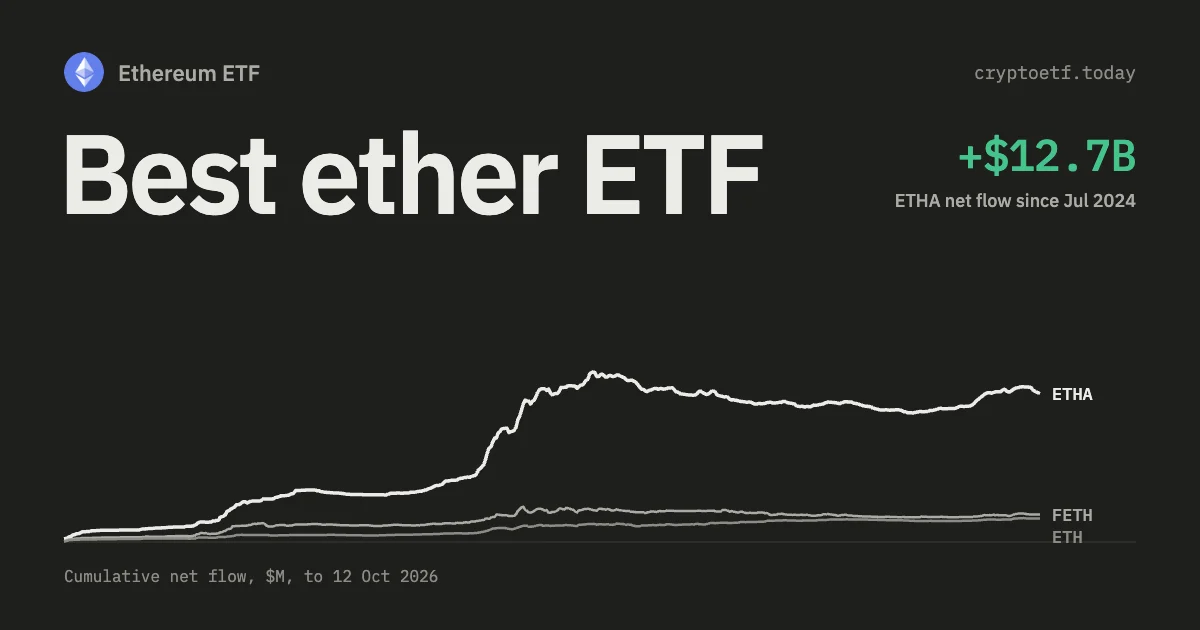
| Ether, most liquid | ETHA (BlackRock) | 0.25% | $8.76bn | Largest ETH fund; doesn't stake |
| Solana | BSOL (Bitwise) | 0.20% | $1.19bn | Largest SOL fund, stakes, listed options |
| XRP, lowest cost | XRPZ (Franklin) | 0.19% | $0.41bn | Cheapest XRP fund |
| Hyperliquid | HYPG (Grayscale) | 0.29% | $0.20bn | Cheapest of three HYPE funds |
| Several coins in one fund | GDLC (Grayscale) | 0.59% | $0.43bn | Five largest coins, quarterly rebalance |
Best Bitcoin ETF
Thirteen spot Bitcoin ETFs trade in the US, and the fee spread is wide for funds holding an identical asset: 0.14% to 1.50%. Since VanEck's HODL waiver ended on 31 July 2026, every fund charges its headline rate.
| Fee | Funds | Net assets, 12 Oct 2026 |
|---|---|---|
| 0.14% | MSBT | $0.88bn |
| 0.15% | BTC (Grayscale Mini) | $5.22bn |
| 0.19% | EZBC | $0.47bn |
| 0.20% | BITB, HODL | $3.08bn, $1.21bn |
| 0.21% | ARKB | $2.64bn |
| 0.25% | IBIT, FBTC, BTCO, BRRR, BTCW | $66.43bn, $14.79bn, $0.42bn, $0.47bn, $0.17bn |
| 0.49% | OBTC (Osprey) | $55.4m (30 Jun 2026; not in our flow data) |
| 1.50% | GBTC | $10.43bn |
For a buy-and-hold position, the fee decides most of it. MSBT at 0.14% costs $14 a year on $10,000; IBIT at 0.25% costs $25. Over ten years on $100,000 that's roughly $1,390 against $2,470, assuming the coin's price doesn't move and the fee is taken from the shrinking balance.
IBIT earns its 0.25% if you trade. It's more than four times the size of the next fund, FBTC, and the most traded; in our fee comparison it averaged about $1.82bn of volume a day over the ten sessions to 22 September 2026, while WisdomTree's BTCW averaged $477,000. For anyone moving in and out, a wide spread on a small fund can cost more than a year of fee difference.
Grayscale's Mini Trust is the middle path: 0.15% and $5.2bn. FBTC is the other large option at 0.25% and the only one with its own custodian, Fidelity Digital Assets. If you're weighing the two giants directly, see IBIT vs FBTC. To see how much bitcoin each of these funds actually holds, our holdings breakdown has the fund-by-fund count.
Best Ethereum ETF
Eleven spot ether funds trade in the US, and since 2026 the main split is staking. Six stake and five don't, which matters more than the fee: a fund that stakes earns a network yield and passes some of it back.
- Grayscale Ethereum Staking Mini (ETH), 0.15%, $2.34bn. Stakes and pays out 94% of rewards. Low fee and real size together.
- BlackRock ETHA, 0.25%, $8.76bn. The largest and most liquid ether fund, but it doesn't stake. BlackRock's staking version, ETHB, was charging a waived 0.12% in September 2026 and had $1.11bn on 12 October.
- Morgan Stanley MSSE, 0.14%. Cheapest headline fee and stakes from launch, but it listed on 28 July 2026 and held $52m on 12 October.
Avoid ETHE: it charges 2.50% for the same ether its Grayscale sibling holds for 0.15%. The full eleven-fund comparison, including how much of the staking reward each fund keeps, is in our best Ethereum ETF guide, and crypto ETF staking compared covers the staking terms across assets.
Best Solana, XRP and Hyperliquid ETFs
Solana
Nine spot Solana ETFs trade in the US and all of them stake, so the comparison is fee plus how much yield reaches you. Bitwise's BSOL is the default at 0.20% and $1.19bn, the largest by a wide margin and the one with a verified options chain. Grayscale's GSOL charges 0.19% and held $198m. Morgan Stanley's MSOL has the lowest fee at 0.14% and held $54m. Three of the nine, SOLC, QSOL and TSOL, held under $10m on 12 October, which is a closure risk worth more than a few basis points.
XRP
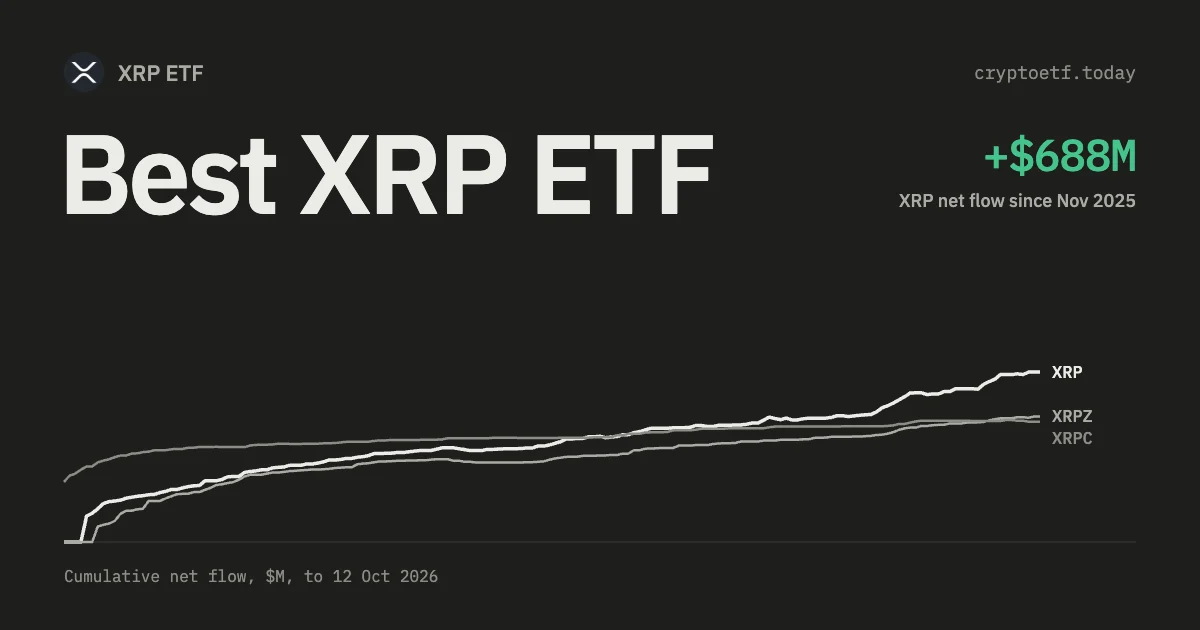
Five XRP funds, none of which stakes. Franklin's XRPZ is cheapest at 0.19% with $407m. Bitwise's fund, ticker XRP, is the largest at $572m and the most traded, at 0.34%. Canary's XRPC charges 0.50%. Our best XRP ETF guide goes through all five.
Hyperliquid
Three HYPE funds, all staking part of their holdings. Grayscale's HYPG is cheapest at 0.29% ($195m), 21Shares' THYP charges 0.30% ($73m) and is the only one with listed options, and Bitwise's BHYP charges 0.34% ($180m) and runs its own validator. On a five-figure position the fee gap is a few dollars a year; BHYP vs THYP vs HYPG covers the staking terms that matter more.
The long tail: one or two funds per coin
For the newer assets, "best" is often "only". Fees are mostly higher and most funds are small (Zcash's ZCSH, at $698m, is the exception), so check the fund's size before its fee. Fees below are the sponsor fees issuers report, as collected by this site on 12 October 2026.
| Asset | Funds (fee) | Largest by net assets |
|---|---|---|
| Chainlink | GLNK (0.35%), CLNK (0.34%) | GLNK, $167m |
| Avalanche | VAVX (0.20%), BAVA (0.34%), GAVA (0.35%) | BAVA, $28m |
| Sui | TSUI (0.30%), GSUI (0.35%), SUIS (0.75%) | GSUI, $43m |
| Dogecoin | BWOW (0.34%), GDOG (0.35%), TDOG (0.50%) | GDOG, $12m |
| BNB | VBNB (0.39%) | $97m (9 Oct) |
| NEAR | NRR (0.75%) | $82m |
| Hedera | HBR (0.95%) | $72m (9 Oct) |
| Litecoin | LTCC (0.95%) | $14m (9 Oct) |
| Polkadot | TDOT (0.30%) | $12m |
| Tron | TRXS (1.10%) | $50m (9 Oct) |
| Zcash | ZCSH (2.50%) | $698m |
Two observations. First, the cheapest fund isn't always the one investors chose: in Avalanche, VanEck's 0.20% VAVX is smaller than Bitwise's 0.34% BAVA. Second, a fund with a few million dollars in it may not survive. Bitwise's BWOW held $0.7m on 12 October; if a fund that size closes, you get cash back and a taxable event you didn't plan. The full list of 2026 crypto ETFs has launch dates and custodians for each.
Best crypto index ETF: GDLC vs BITW
If the goal is "some crypto" rather than a view on one coin, two US-listed funds hold a basket.
| GDLC | BITW | |
|---|---|---|
| Sponsor | Grayscale | Bitwise |
| Fee | 0.59% | 0.75% |
| Holdings | 5 (CoinDesk 5 Index) | 10 |
| Bitcoin / ether weight | 75.06% / 13.74% (12 Oct) | 75.91% / 14.07% (11 Oct) |
| Other holdings | BNB 4.49%, XRP 3.86%, SOL 2.85% | XRP 3.95% and seven smaller positions |
| Size | $426.3m (12 Oct) | $722.5m (11 Oct) |
| ETP listing on NYSE Arca | 19 Sep 2025 | 9 Dec 2025 |
Notice the weights. Both funds are about 75% bitcoin and 14% ether, so everything else is roughly a tenth of the fund. You pay 0.59% or 0.75% on all of it, against 0.14% to 0.25% for single-coin funds. Holding MSBT and the ETH mini in an 85/15 split would cost about 0.14%, with no exposure to the smaller coins. The index fund makes sense if you want the rebalancing done for you and want those smaller coins without picking them; it doesn't make sense as a cheaper way to own bitcoin.
Which funds to avoid
- GBTC (1.50%) and ETHE (2.50%). Both are Grayscale's original trusts, and Grayscale offers the same exposure in its own mini funds for 0.15%. GBTC has lost $27.9bn to net outflows since January 2024, mostly to cheaper funds.
- Tiny funds when a large one costs about the same. A fund under $10m can close, and its spread is usually wider than the fee saving.
- A temporary waiver as the reason to buy. Waivers end. TETH's 0% ran to 8 October 2026; ETHB's 0.12% is a waiver on a 0.25% fee. Compare the headline rate.
Use flows as a second opinion
Fees and size tell you what a fund costs. Flows tell you what other investors are doing with it, day by day. A cheap fund that keeps losing money to a dearer rival usually has a reason, often liquidity or a platform that doesn't offer it. You can check any fund's daily flows on our pages for Bitcoin, Ethereum, Solana and XRP, and compare issuers side by side on the funds directory.
FAQ
What is the best crypto ETF to buy in 2026?
It depends on the coin. For bitcoin, MSBT is cheapest at 0.14% and IBIT is the largest at $66.4bn. For ether, the Grayscale Ethereum Staking Mini (ticker ETH) charges 0.15% and stakes. For several coins in one fund, GDLC charges 0.59% and BITW 0.75%.
What is the cheapest crypto ETF?
Morgan Stanley’s three funds share the lowest headline fee in the US spot market, 0.14%: MSBT (bitcoin), MSSE (ether) and MSOL (Solana). Some funds charge less temporarily through fee waivers, but those expire.
Which crypto ETF is the largest?
BlackRock’s iShares Bitcoin Trust (IBIT), with $66.43bn of net assets on 12 October 2026. The largest ether fund is BlackRock’s ETHA at $8.76bn.
Is there an ETF that holds several cryptocurrencies?
Yes. Grayscale’s GDLC tracks the CoinDesk 5 Index (bitcoin, ether, BNB, XRP and Solana on 12 October 2026) for 0.59% a year, and Bitwise’s BITW holds ten coins for 0.75%. Both are about 75% bitcoin.
Are crypto ETFs with staking better?
For ether and Solana, a staking fund earns network rewards and passes part of them to shareholders, so it can outperform a non-staking fund with the same fee. Check what share of rewards the fund keeps; among the ether funds it ranged from about 5% to 23% of the reward in September 2026.
Should I avoid GBTC?
For a new position, there’s little reason to pay GBTC’s 1.50% when Grayscale’s own Bitcoin Mini Trust holds the same asset for 0.15%. Existing holders with large unrealised gains should weigh the tax cost of switching before selling.
Sources and further reading
- Grayscale CoinDesk Crypto 5 ETF (GDLC) fund page: fee, AUM and holdings as of 12 Oct 2026 — etfs.grayscale.com.
- Bitwise 10 Crypto Index ETF (BITW) fund page: fee, net assets and weights as of 11 Oct 2026 — bitwetp.com.
- Morgan Stanley Bitcoin Trust registration statement and fee disclosure — sec.gov EDGAR.
- Fee, waiver, staking and options details for the Bitcoin, Ether, Solana, XRP and Hyperliquid funds come from issuer prospectuses and fund pages as compiled in our September 2026 fund guides; issuer sites: grayscale.com, bitwiseinvestments.com, franklintempleton.com, 21shares.com, vaneck.com, fidelity.com.
- iShares Bitcoin Trust ETF fund page — ishares.com.
For information only. Not investment advice.
 ETH
 SOL
 XRP
 HYPE
 LINK
 HBAR
 AVAX
 DOGE
 LTC
 SUI
 DOT
 BNB
 NEAR
 TRX
 ZEC