
A stablecoin is a token built to hold $1.00. USDT and USDC are backed by cash and Treasury bills, DAI by crypto, USDe by a hedge, and the algorithmic TerraUSD failed in May 2022. Issuers earn the interest on the reserves.
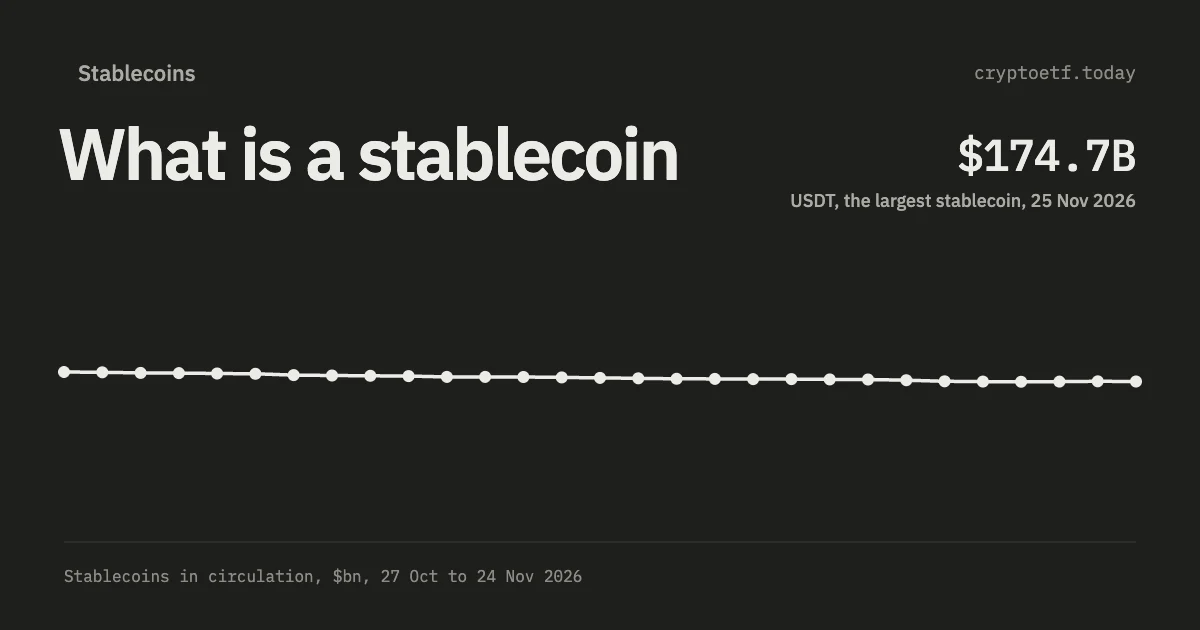
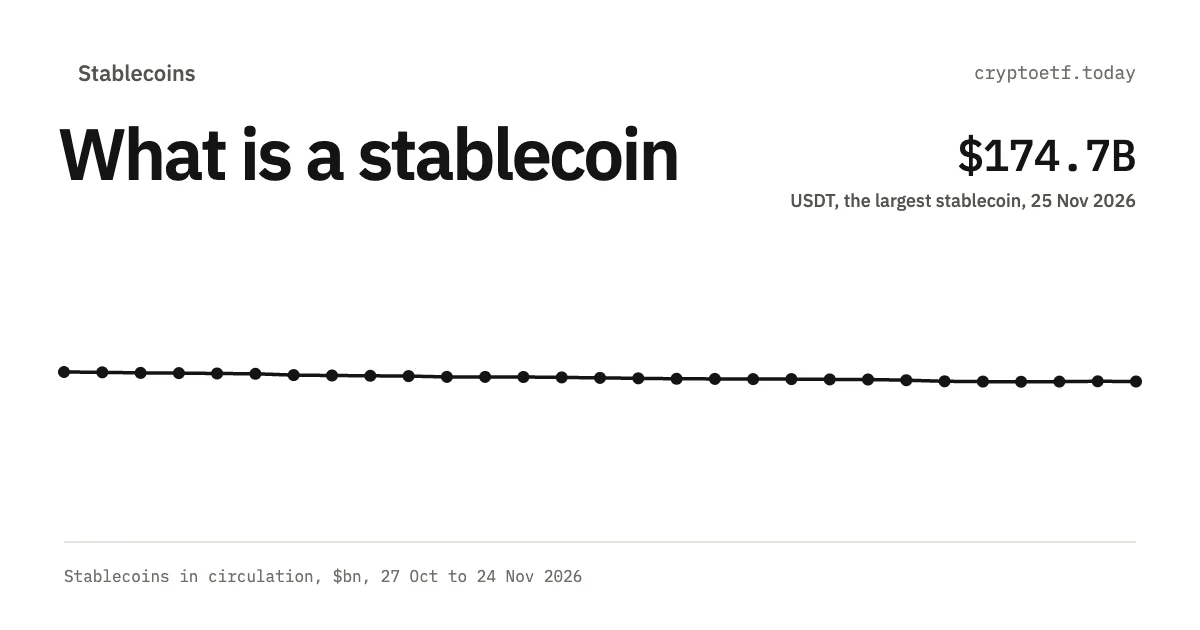
TL;DR. A stablecoin is a crypto token designed to keep a fixed price, almost always $1.00. On 25 November 2026 stablecoins worth $281.8bn were in circulation, and most of that sat in coins backed one for one by cash and short-term US Treasuries: USDT held $174.7bn and USDC $69.0bn. The next largest coin, Ethena’s USDe, had $4.6bn. The price holds because large customers can create new coins by sending dollars to the issuer and destroy coins to get dollars back. Other designs back the coin with crypto (DAI) or with a hedged position (USDe). The purely algorithmic kind failed when TerraUSD lost its peg in May 2022. Issuers earn most of their money from the interest on the reserves.
Contents · 10 sections
- What is a stablecoin?
- How do stablecoins work? Minting and redemption
- The four types of stablecoins
- How do stablecoins make money?
- Four corporate dollars beyond USDT and USDC
- Stablecoin vs CBDC vs tokenized fund
- Reading stablecoin supply as a money flow
- What can go wrong with a stablecoin
- FAQ
- Sources and further reading
What is a stablecoin?
A stablecoin is a token on a blockchain that tries to be worth a fixed amount of something else. In practice that something is the US dollar. One USDC is meant to be worth one dollar at any time, while living on Ethereum, Solana, Tron or a dozen other networks where it can move between wallets in seconds, at any hour.
Traders park money in stablecoins between positions, exchanges quote prices against them, and businesses use them to send dollars across borders without a correspondent bank. When their supply grows, more money has come in through the dollar rails. When it shrinks, money has gone back out.
Whether a coin actually holds $1.00 depends on what stands behind it: a bank account, a pile of locked crypto, a futures hedge or nothing at all. That backing is how the types are told apart.
How do stablecoins work? Minting and redemption
For the big dollar-backed coins, a customer who has passed the issuer’s checks wires $10m to the issuer. The issuer creates (mints) 10 million tokens and sends them to the customer’s wallet. Later, an approved customer sends tokens back, the issuer destroys (burns) them and wires out dollars.
Arbitrage holds the price. If USDC trades at $0.99 on an exchange, a large holder can buy it there and redeem it with Circle for $1.00. If it trades at $1.01, the same holder can mint at $1.00 and sell. Those trades pull the market price back toward the peg, as long as people believe the reserve is really there.
For ordinary holders, direct minting and redemption are usually out of reach. They are open only to verified customers, mostly institutions, and Tether’s fee page sets a minimum redemption of $100,000, so most people exit through an exchange instead. The supply figure you see on a dashboard is the record of this process: every mint adds to it, every burn takes away. Our stablecoin dashboard tracks that daily, coin by coin, and the chains page shows where the coins live.
The four types of stablecoins
Stablecoins are usually sorted by what backs them, and the backing decides what can break: a bank, a collateral auction or a futures exchange. Many guides list three types. We add a fourth, synthetic, because USDe works differently from both fiat-backed and crypto-backed coins.
| Type | What backs it | Examples | Main risk |
|---|---|---|---|
| Fiat-backed | Cash, Treasury bills and repo held by the issuer | USDT, USDC, PYUSD, RLUSD | The issuer: reserves, banks, redemptions |
| Crypto-collateralized | More crypto than the coins issued, locked in smart contracts | DAI, USDS | A fast crash in the collateral |
| Synthetic (delta-neutral) | Crypto hedged with an equal short, plus stablecoins and other assets | USDe | Negative funding, exchange failure |
| Algorithmic | A second token and a minting rule, no outside reserve | TerraUSD (failed 2022) | Loss of confidence, then collapse |
Tokens backed by gold, such as PAXG and XAUT, are sometimes counted as a fifth type. They track the price of an ounce of gold rather than a dollar, so we cover them separately in PAXG vs XAUT.
Fiat-backed: USDT and USDC
These are the two coins that matter most by size. Circle says the majority of the USDC reserve is held in the Circle Reserve Fund, an SEC-registered government money market fund managed by BlackRock and open only to Circle, with the remainder in cash at large banks. Tether publishes quarterly reserve attestations prepared by the accounting firm BDO. The report as of 30 September 2026 shows mostly US Treasury bills, along with precious metals and bitcoin, and KPMG issued an unqualified audit opinion on Tether’s 2025 financial statements in August 2026. The risk sits with the issuer: whether the reserves are what it says and whether redemptions keep working under stress.
Crypto-collateralized: DAI
DAI, now being upgraded to USDS by the Sky protocol (formerly MakerDAO), is created when someone locks crypto in a vault and borrows DAI against it. The vault must hold more value than it lends, and each collateral type has a collateralization ratio among the parameters set by governance. If a vault falls below it, its collateral is taken and auctioned off to repay the debt. No bank holds dollars here. The cushion is the extra collateral, and the danger is a crash so fast the auctions can’t keep up.
Synthetic: USDe
Ethena’s USDe holds crypto such as ether and opens a short perpetual futures position of the same size, so a fall in the price of ether is offset by a gain on the short. The short earns funding payments from traders who are long when funding is positive. Ethena says USDe’s revenue now also comes from lending, tokenized Treasuries and stablecoin rewards, and that it moves backing into stablecoins when funding turns low or negative. It depends on the derivatives exchanges staying solvent. More in yield-bearing stablecoins and USDe.
Algorithmic: the TerraUSD lesson
An algorithmic stablecoin has no outside reserve. TerraUSD (UST) relied on a sister token, LUNA, and a rule that let anyone swap one UST for a dollar’s worth of newly minted LUNA. When UST holders rushed for the exit in May 2022, LUNA was printed faster than buyers could absorb it, and both collapsed. The SEC later charged Terraform Labs and its founder Do Kwon with fraud, alleging they misled investors about UST’s stability. After a jury found them liable, they agreed to pay more than $4.5bn.
How do stablecoins make money?
Issuers keep the interest on the reserves. Customers hand over dollars, the issuer puts them in Treasury bills and money market funds, and the yield is the business.
Circle, the only one of the two large issuers that reports as a listed company, shows how dependent the model is on it. In its full-year 2025 results, reserve income was $2.637bn out of $2.747bn of total revenue and reserve income, about 96%. A large part of that is passed on to the partners who distribute USDC: the same filing shows $1.662bn of distribution and transaction costs. Issuer income also follows the Federal Reserve’s rates. When short-term rates fall, so does the business, even if the supply of coins doesn’t change.
The issuer pays holders nothing. In the US the GENIUS Act bars stablecoin issuers from paying interest or yield to holders just for holding the coin (details in our GENIUS Act guide). Platforms that distribute stablecoins can still pay their own rewards: PayPal, for example, pays rewards on PYUSD held in eligible US PayPal and Venmo wallets, at a rate it sets and can change. Products that pass reserve income to holders directly sit on the other side of the line, as tokenized funds or staked versions of synthetic dollars such as sUSDe.
Four corporate dollars beyond USDT and USDC
The fiat-backed group is wider than the two leaders. PayPal, Ripple, World Liberty Financial and Paxos each have a dollar coin, and the brand on the token is often not the company that issues it: PayPal’s PYUSD is minted by Paxos, USD1 by BitGo. Together the four had $10.51bn in circulation on 25 November 2026. Issuers, supervisors, reserves and the PayPal rewards are compared in PYUSD vs RLUSD vs USD1.
Stablecoin vs CBDC vs tokenized fund
All three get called “digital dollars”.
- A stablecoin is a private company’s liability. You’re trusting Tether, Circle or a protocol to honor redemptions.
- A CBDC, in the Federal Reserve’s definition, would be a digital liability of the central bank widely available to the public, the way paper cash is today. In that 2022 paper the Fed said it would not issue one without clear support from the executive branch and Congress, ideally in a specific authorizing law. A January 2025 executive order (EO 14178) bars federal agencies from establishing, issuing or promoting a CBDC, and the United States has none.
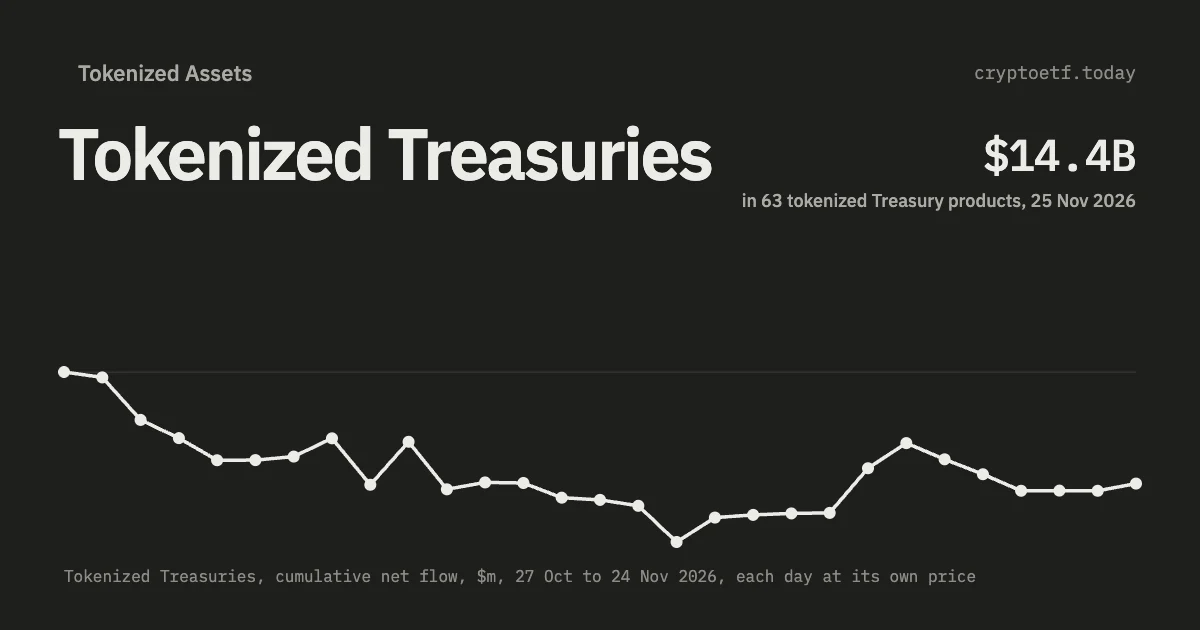
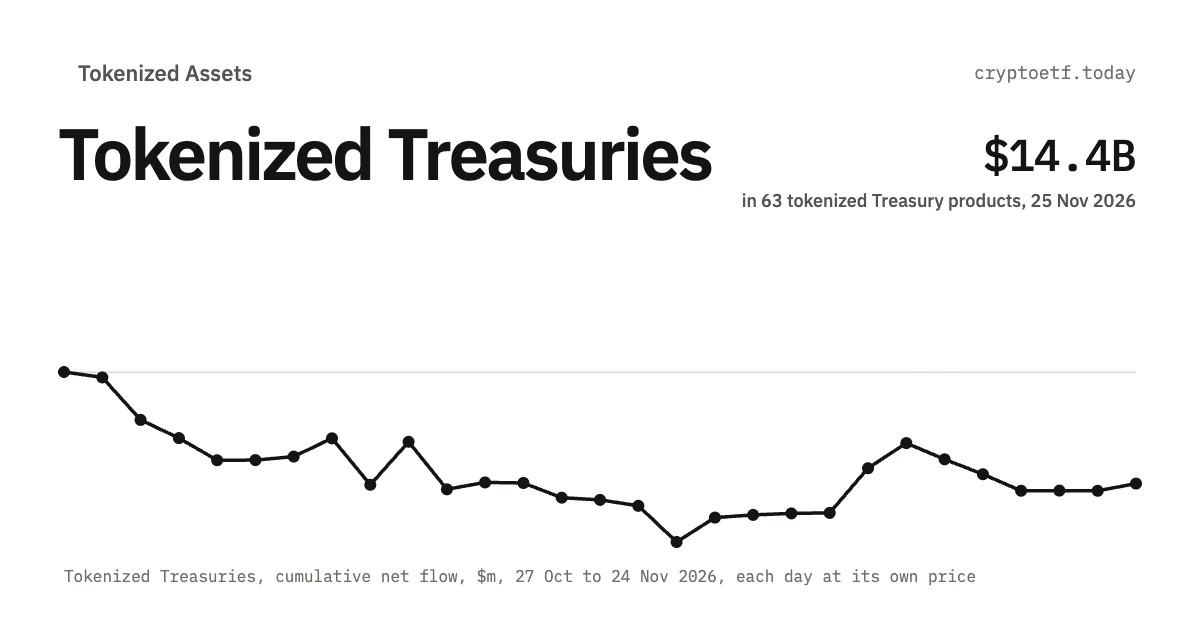
- A tokenized fund, such as BlackRock’s BUIDL, is a share in a money market or Treasury fund recorded on a blockchain. Unlike a stablecoin, it passes the interest to the holder, and for that reason it’s a security sold only to approved investors. See tokenized Treasuries explained.
Reading stablecoin supply as a money flow
Because every mint and burn changes the count, supply works as a running record of dollars arriving on blockchains or leaving them: in the 30 days to 25 November 2026, USDT circulation fell by $8.1bn and USDC by $2.8bn. That stablecoin flow is one of three inputs to our Wall Street Money Index, next to spot crypto ETF flows and tokenized assets. For how the market total is counted and why sources disagree, see stablecoin market cap.
What can go wrong with a stablecoin
- Issuer risk. For fiat-backed coins, the peg is only as good as the reserve and the issuer’s willingness to redeem.
- Freezes. Circle’s USDC terms reserve the right to block addresses it links to illegal activity, and Tether’s terms of service let it freeze tokens. Blocked coins stay at the address but can’t be moved. Our frozen stablecoins page tracks those balances.
- Depegs. Even well-backed coins can trade below $1.00 for a while in a panic.
- Chain and contract risk. A bug in a bridge or a smart contract can make a token worthless on one network while the issuer’s coin is fine elsewhere.
- Rules. Stablecoin regulation is changing country by country. For the US framework, see the GENIUS Act and stablecoins.
FAQ
What is a stablecoin in simple terms?
It’s a crypto token built to stay worth a fixed amount, usually one US dollar. Most are backed by cash and short-term US government debt held by the issuer, so one token can be exchanged for one dollar through the issuer or an exchange.
How do stablecoins keep their price at $1?
Through minting and redemption. Verified customers can create new coins by sending dollars to the issuer and destroy coins to get dollars back. If the market price drifts from $1.00, that arbitrage pulls it back, as long as the reserves are trusted.
What are the main types of stablecoins?
Fiat-backed coins like USDT and USDC, crypto-collateralized coins like DAI, synthetic or delta-neutral coins like Ethena’s USDe, and algorithmic coins. The algorithmic model failed most visibly when TerraUSD collapsed in May 2022. Gold-backed tokens such as PAXG are sometimes listed as a fifth type.
What is an algorithmic stablecoin?
A coin that tries to hold its peg with a minting rule and a second token instead of an outside reserve. TerraUSD used LUNA this way. When holders rushed to redeem in May 2022, the mechanism broke and both tokens collapsed.
How do stablecoin issuers make money?
From the interest on their reserves. Customers’ dollars are invested in Treasury bills and money market funds, and the issuer keeps the yield. Circle’s 2025 results show reserve income was about 96% of its total revenue and reserve income.
Do stablecoins pay interest?
Not from the issuer. The US GENIUS Act bars stablecoin issuers from paying holders interest or yield for holding the coin. Some platforms pay their own rewards on balances, as PayPal does on PYUSD, at rates they set and can change.
What happens to my stablecoins if the issuer goes bust?
You become a creditor of the issuer. Under the GENIUS Act, holders of a permitted US issuer’s coins rank ahead of its other creditors for the required reserves. The law also says payment stablecoins are not covered by FDIC insurance.
What is the difference between a stablecoin and a CBDC?
A stablecoin is a liability of a private issuer. A central bank digital currency would be a liability of the central bank itself. The United States has none: a January 2025 executive order bars federal agencies from establishing one.
Sources and further reading
- Circle, USDC transparency, circle.com; “Deepening our partnership with BlackRock” (Circle Reserve Fund), circle.com; USDC terms, circle.com.
- Circle, fourth quarter and full fiscal year 2025 financial results, circle.com; Form 8-K, exhibit 99.1, sec.gov.
- Tether, Q3 2026 attestation release (30 October 2026), tether.io; BDO opinion and reserves report as of 30 September 2026, PDF; KPMG audit of 2025 financial statements (13 August 2026), tether.io; fees, tether.to; terms of service, tether.to.
- Sky, “Collateral Liquidation”, developers.skyeco.com.
- Ethena, “Delta-neutral stability”, docs.ethena.fi; Ethena overview, docs.ethena.fi.
- SEC, charges against Terraform Labs and Do Kwon (16 February 2023), sec.gov; settlement after jury verdict (2024), sec.gov.
- Federal Reserve, “Money and Payments: The U.S. Dollar in the Age of Digital Transformation” (January 2022), federalreserve.gov; Executive Order 14178, “Strengthening American Leadership in Digital Financial Technology” (23 January 2025), whitehouse.gov.
- PayPal, “PayPal Unlocks Rewards for Holding PayPal USD” (23 April 2025), newsroom.paypal-corp.com.
- On cryptoetf.today: stablecoins, stablecoins by chain, frozen stablecoins, Wall Street Money Index. Figures are as of 25 November 2026.
For information only. Not investment advice.
 BTC
 ETH
 SOL
 XRP
 HYPE
 LINK
 HBAR
 AVAX
 DOGE
 LTC
 SUI
 DOT
 BNB
 NEAR
 TRX
 ZEC