
PAXG and XAUT each stand for one troy ounce of gold, but one sits in London under a US federal regulator and the other in Switzerland under El Salvador’s. Fees, minimums and redemption rules compared.
TL;DR. PAX Gold (PAXG) and Tether Gold (XAUT) are the two tokens that dominate tokenized gold. Each token stands for one fine troy ounce of London Good Delivery gold. PAXG is issued by Paxos Trust Company, N.A. under the US Office of the Comptroller of the Currency, and its gold sits in London. XAUT is issued by TG Commodities, a Tether company licensed in El Salvador, and its gold sits in a Swiss vault. Both need about 430 tokens to take a physical bar. Paxos charges no storage fee, has waived its creation fee until 1 January 2027 and charges 0.125% to 0.5% to redeem for dollars. Tether charges 25 basis points to buy and 25 to redeem, plus a one-off $150 verification fee, and delivers bars only inside Switzerland. As of 25 November 2026 the two held $4.34bn between them, 85% of the segment we track.
Contents · 9 sections
What tokenized gold is
A gold token is a claim on vaulted metal, recorded on a blockchain so it can move between wallets. The issuer buys gold, has a custodian hold it, and mints one token per ounce. When a holder gives tokens back, the issuer burns them and either hands over gold or pays out the cash value.
People also call it a gold token, gold-backed crypto or a gold stablecoin. The last name misleads: a dollar stablecoin aims to hold $1.00, while a gold token is meant to move with the gold price. What stays fixed is the weight.
The design isn’t new: Paxos published the PAXG white paper in September 2019. What’s new is where the tokens can be used. Both trade on exchanges and sit in ordinary crypto wallets, and in November 2026 Paxos announced that PAXG on Base would become the first non-crypto collateral in Coinbase Borrow; Morpho, the lending protocol behind the product, says the loans are now live. A bar in a vault can’t be pledged that quickly.
PAXG and XAUT, row by row
Every row below comes from the issuers’ own documents: the PAX Gold terms and conditions, Paxos’s PAXG overview and fee schedule, its transparency page, Tether Gold’s Relevant Information Document (dated 27 January 2025) and its fee schedule. Fees change, so check the current schedule first.
| PAXG (Paxos) | XAUT (Tether Gold) | |
|---|---|---|
| Issuer | Paxos Trust Company, N.A. | TG Commodities, S.A. de C.V. (El Salvador), owned by the Tether group |
| Supervisor | US Office of the Comptroller of the Currency (OCC) | El Salvador’s National Commission of Digital Assets (CNAD) |
| One token equals | 1 fine troy ounce of London Good Delivery gold | 1 fine troy ounce of London Good Delivery gold |
| Where the gold is | LBMA-approved vaults in London, segregated for holders | A vault in Switzerland, held by a Swiss custodian related to Tether |
| Smallest unit | 18 decimal places | 6 decimal places (0.000001 oz) |
| Buying from the issuer | Minimum purchase 0.03 PAXG on paxos.com; creation fees waived until 1 January 2027, then from a flat 0.02 PAXG down to 0.125% on large orders | From 50 XAUT, after KYC and a non-refundable $150 verification fee; market price plus 25 bps |
| Redeeming for cash | USD: 0.125%, rising in marginal bands to 0.5% on net redemptions above $20m over 30 days. Into unallocated Loco London gold: 0.05% | Tether tries to sell your bar in the Swiss market and pays USD, minus 25 bps |
| Redeeming for a bar | Minimum 430 PAXG per bar, plus a 0.05% conversion fee; you arrange and pay for delivery | Full bars only, deposit about 430 XAUT; 25 bps plus delivery, inside Switzerland only |
| Storage fee | None “at this time”; the terms allow one later with 30 days’ notice | Tether’s fee schedule lists no storage fee |
| Proof of reserves | Monthly attestation by KPMG; bar lookup by address | Quarterly reserve reports; bar lookup by address |
Who stands behind each token
PAXG: a US trust bank and London vaults
Paxos describes PAXG as issued by Paxos Trust Company, N.A., with the gold held in LBMA-accredited London vaults “on a segregated basis for the benefit of PAXG holders.” The terms say PAXG is issued under specific approval from the OCC, the federal regulator of national banks. Attestation reports posted since 28 February 2025 are issued by KPMG LLP; earlier ones came from Withum. Purchases on paxos.com run during London gold market hours; exchanges trade PAXG around the clock.
XAUT: an El Salvador issuer and a Swiss vault
Tether moved issuance to a Salvadoran entity, TG Commodities, which took over from TG Commodities Limited. The Relevant Information Document says TG Commodities is authorized by the CNAD as a stablecoin issuer and as a digital asset service provider, and that it is wholly owned by Tether Holdings and Tether Operations. The gold sits with a Swiss custodian that the document calls “a related party to Tether Gold.” The custodian is in the same family as the issuer, so the outside check on the metal comes from the quarterly reserve reports.
How redemption actually works
Where does 430 come from? Gold doesn’t come in neat 400-ounce bars. Tether’s document says London Good Delivery bars usually weigh about 385 to 415 fine ounces, and you can only take a whole bar. Both issuers ask for 430 tokens so any bar will be covered, then return what’s left over.
Delivery is the bigger difference. Paxos’s terms make shipping your job: once the bar is in the hands of the delivery service you choose, Paxos has met its obligation. Tether delivers to an address you choose in Switzerland and nowhere else; moving the bar abroad is your problem. With PAXG you can cash out in dollars without a whole bar, and with XAUT you can ask Tether to sell the bar for you and wire the dollars. Holders without an issuer account sell on an exchange.
A worked example, using the fee schedules above. Redeeming 430 PAXG into dollars at Paxos’s base rate of 0.125%, which covers the first $2m of an account’s net redemptions over 30 days, costs about half an ounce. Redeeming 430 XAUT through Tether costs 25 bps, a little over one ounce, before any sale spread. On the way in Tether also charges 25 bps. Paxos charges nothing to create PAXG until 1 January 2027; after that its fee falls to 0.125% only above 800 ounces, and orders of 2 to 25 ounces pay 1%.
Tokenized gold vs a gold ETF
The obvious comparison is a gold ETF such as SPDR Gold Shares (GLD). GLD also holds allocated bars; its fact sheet names HSBC Bank plc and JPMorgan Chase Bank, N.A. as custodians and lists a 0.40% annual expense ratio. The differences are in the wrapper:
- Ongoing cost. GLD takes 0.40% a year, every year. Paxos takes nothing for storage today and charges on the way in and out. A buyer of 2 to 25 ounces paying 1% to create and 0.125% to redeem spends what GLD charges in about two years and ten months; while creation is free, the exit alone equals about four months of GLD. XAUT’s 25 bps in and 25 out equal about 15 months, before the $150 verification fee. The sums ignore spreads and commissions and assume Paxos keeps its optional storage fee off.
- Trading hours. GLD trades on NYSE Arca on market days. The tokens move at any hour, including weekends, when gold itself isn’t trading and token prices can drift from spot.
- Getting metal. An ETF shareholder can’t ask for a bar; only large authorized participants deal with the trust. A token holder with 430 ounces and a verified account can.
- Where it lives. GLD sits in a brokerage account with the investor protections that come with it. A token sits in a wallet: lose the keys and the issuer’s recovery process is all you have.
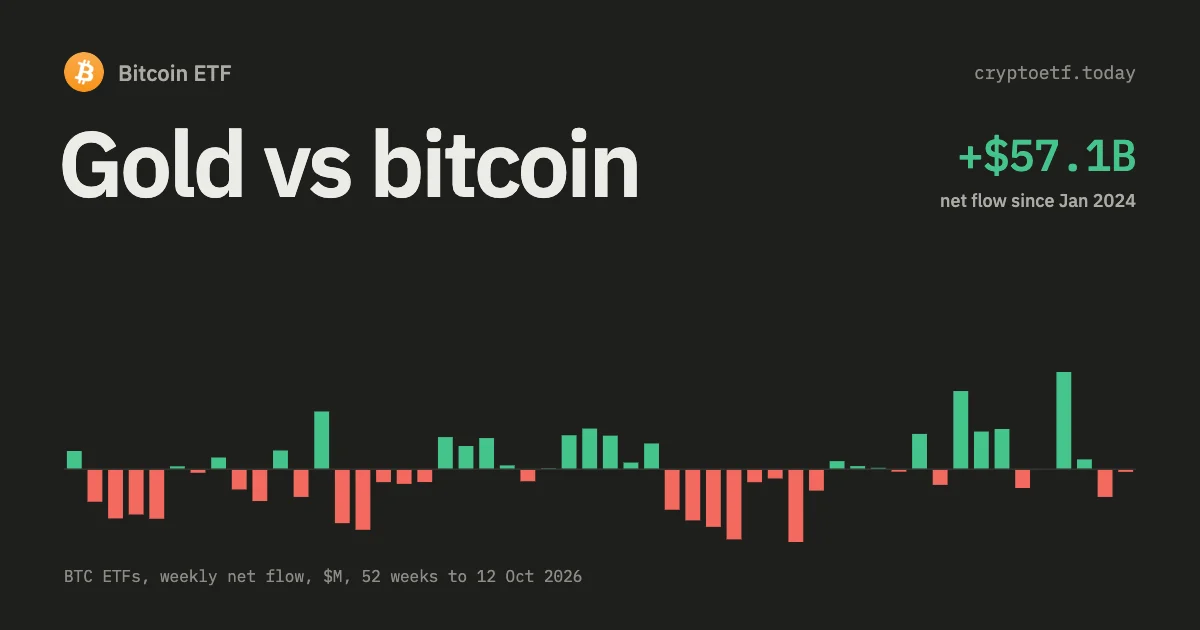
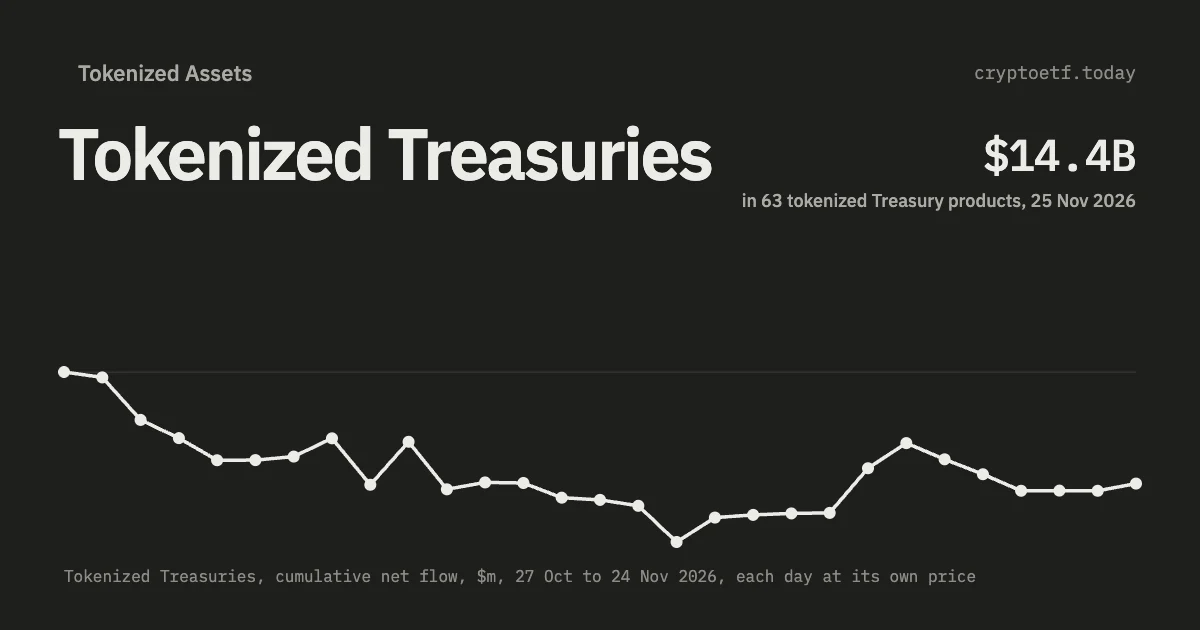
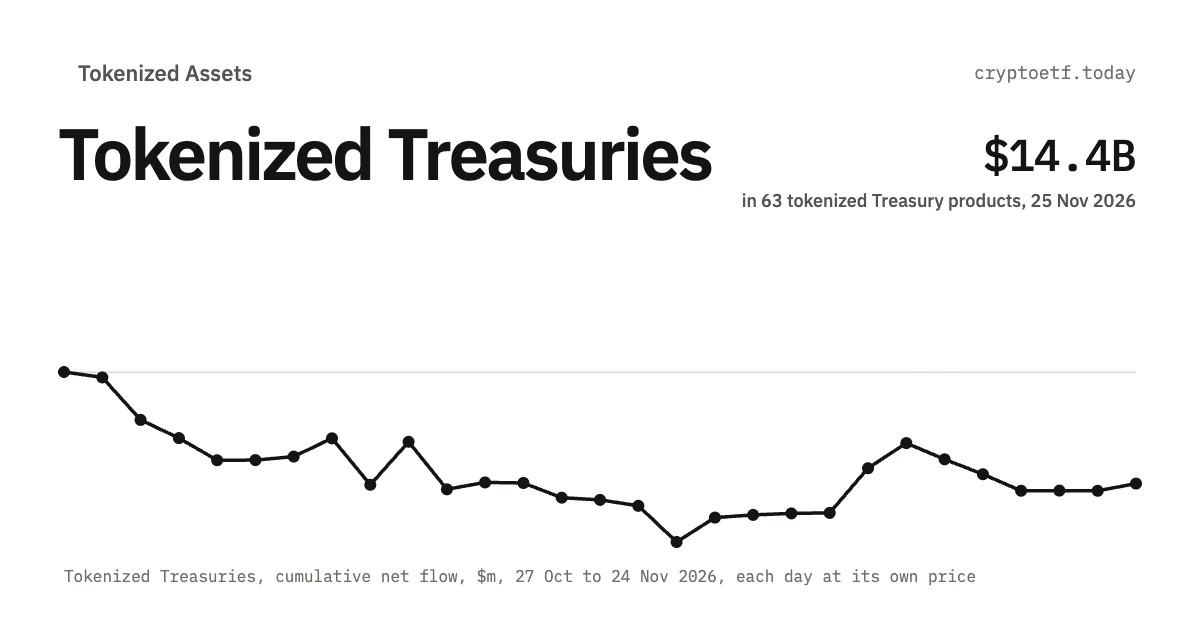
We compared gold and bitcoin funds as hedges in Gold ETF vs Bitcoin ETF; tokenized gold is still small next to the Treasury funds in Tokenized Treasuries Explained.
What the on-chain numbers say
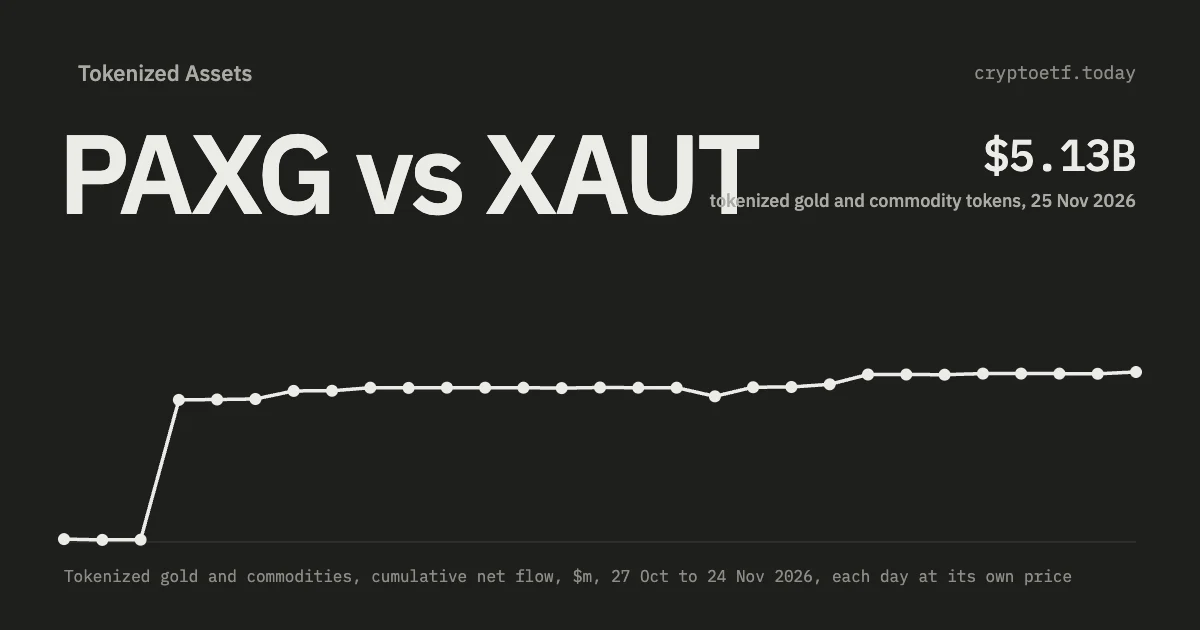
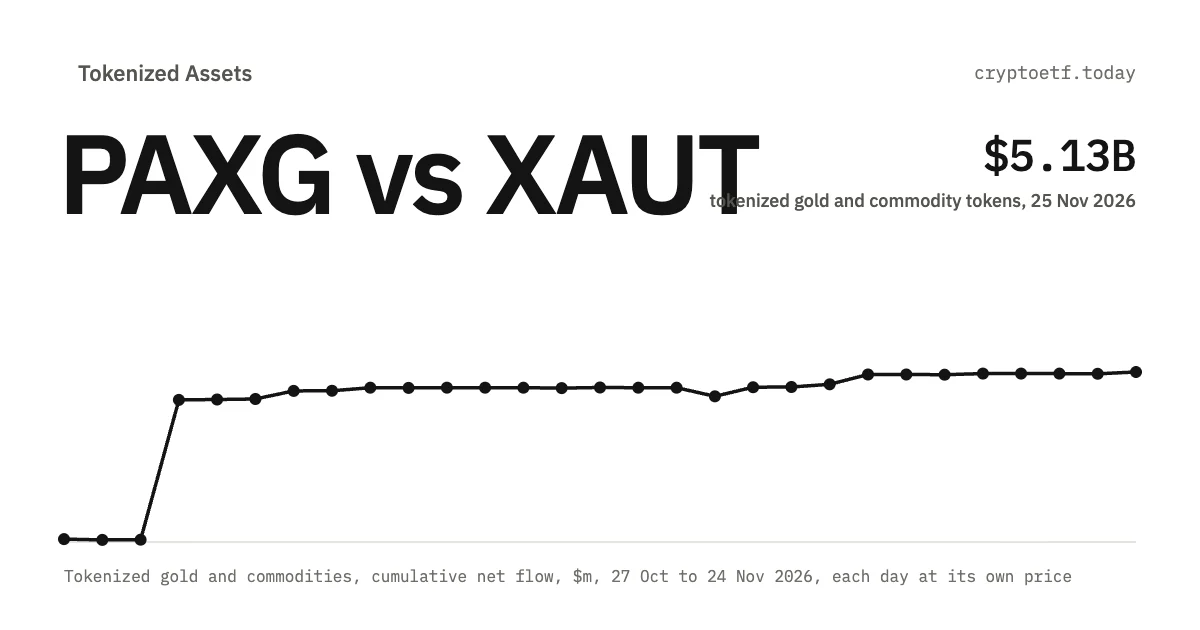
As of 25 November 2026, gold and other commodity tokens in our data (mostly gold, plus some silver and oil) were worth $5.13bn. XAUT held $2.71bn on Ethereum and PAXG $1.63bn across Ethereum, Solana and Base. Tether also issues XAUt0, which carries Tether Gold to other blockchains; it held another $101m. The next largest, Kinesis’s KAU, was $317m.
PAXG had 89,504 holder addresses, about $18,200 per address. XAUT on Ethereum had 63,910, about $42,400 each, while XAUt0 had nearly 240,000 addresses holding about $420 each. Bigger positions sit in the original token, small ones on cheaper chains, and one exchange wallet can hold for thousands of customers.
Over the 30 days to 25 November, XAUT added a net $64m of newly minted tokens and PAXG $1.4m. Value also moves with the gold price, so a rising total isn’t by itself new money. The current figures, by token and issuer, are on the tokenized gold page, and the Wall Street Money Index counts gold mints and redemptions among the tokenized-asset flows it tracks.
What can go wrong
- Issuer and custodian. You rely on the issuer to keep one ounce per token and on monthly (Paxos) or quarterly (Tether) reports to show it.
- Issuer failure. PAXG’s terms say a buyer becomes the beneficial owner of the underlying allocated gold, and Tether’s document describes each XAUT as an interest in gold on a specific bar. Neither document sets out what an insolvency process would look like. The outcome would depend on the law where the issuer and the vault sit: the US and the UK for PAXG, El Salvador and Switzerland for XAUT.
- Freezes. PAXG’s terms let Paxos freeze tokens and, under a binding legal order, seize them. Large dollar stablecoin issuers have similar powers (see frozen stablecoins). Read the XAUT terms for Tether’s position.
- Exchange price vs spot. On exchanges the tokens trade on their own order books. Paxos notes that PAXG prices “can vary across venues”, especially when the gold market is closed.
Matching the token to the need
PAXG has a US federal supervisor, London custody, cash redemption without a whole bar and, until 1 January 2027, no creation fee. XAUT has Swiss custody under an El Salvador licence, a 50-ounce minimum and a $150 verification fee for buying from the issuer, and delivery only inside Switzerland. Exchange buyers skip both issuers’ minimums, and a gold ETF gives the same exposure with no wallet at all.
FAQ
What is the difference between PAXG and XAUT?
Both represent one fine troy ounce of London Good Delivery gold. PAXG is issued by Paxos Trust Company, N.A. under the US OCC, with gold in London vaults. XAUT is issued by TG Commodities in El Salvador, licensed by the CNAD, with gold in a Swiss vault held by a Tether-related custodian. Their fees, minimums and delivery rules differ.
Is PAXG or XAUT backed by real gold?
Both issuers say each token is backed by one ounce of allocated gold and let you look up the bars tied to an address. Paxos publishes monthly attestations by KPMG; Tether says it publishes quarterly reports on its gold reserves.
Can I redeem PAXG or XAUT for physical gold?
Yes, in whole bars only, which in practice means about 430 tokens and a verified account. Paxos requires a minimum of 430 PAXG per bar plus a 0.05% conversion fee, and you arrange delivery. Tether delivers bars only to addresses in Switzerland and charges 25 bps plus delivery costs.
What are the fees for buying PAXG and XAUT from the issuer?
Paxos has waived its PAXG creation fee until 1 January 2027; after that it runs from a flat 0.02 PAXG on small orders to 0.125% above 800 ounces. Tether charges 25 bps on purchases of at least 50 XAUT and a one-off $150 verification fee, paid in USDT and not refundable.
What happens to PAXG or XAUT if the issuer goes bust?
PAXG’s terms say holders are beneficial owners of segregated allocated gold, and Tether’s document describes XAUT as an interest in gold on a specific bar. Neither spells out an insolvency process, so the outcome would depend on the law where the issuer and the vault sit: the US and the UK for PAXG, El Salvador and Switzerland for XAUT.
Is tokenized gold a stablecoin?
Not in the usual sense. Its dollar value moves with the gold price. Tether’s El Salvador filing does register XAUT as a stablecoin under local law, which defines the term broadly as a token backed by an asset.
How big is the tokenized gold market?
As of 25 November 2026, gold and other commodity tokens in our data were worth $5.13bn, with XAUT at $2.71bn and PAXG at $1.63bn. The live total is on the tokenized gold page.
Sources and further reading
- Paxos, PAX Gold terms and conditions, paxos.com; PAXG transparency and attestation reports, paxos.com.
- Paxos, PAX Gold (PAXG) overview and fee schedules, support.paxos.com; PAXG documentation, docs.paxos.com; white paper (September 2019), paxos.com.
- Paxos, “PAXG launches on Base” (November 2026), paxos.com; Morpho, “Coinbase and Morpho bring gold-backed loans to millions of users”, morpho.org.
- TG Commodities, Relevant Information Document for Tether Gold (27 January 2025), gold.tether.to; Tether Gold fee schedule, gold.tether.to; Tether, “Tether Gold: Digital Gold for the Modern Era”, tether.io.
- State Street, SPDR Gold Shares (GLD) fact sheet, ssga.com.
- On cryptoetf.today: tokenized gold, tokenized assets, Wall Street Money Index. Market figures in this article are as of 25 November 2026.
For information only. Not investment advice.
 BTC
 ETH
 SOL
 XRP
 HYPE
 LINK
 HBAR
 AVAX
 DOGE
 LTC
 SUI
 DOT
 BNB
 NEAR
 TRX
 ZEC