
PayPal, Ripple, World Liberty Financial and Paxos each have a dollar stablecoin. Only one company on that list issues its own. Issuers, regulators, reserves, rewards and chains compared, with supply as of 25 November 2026.
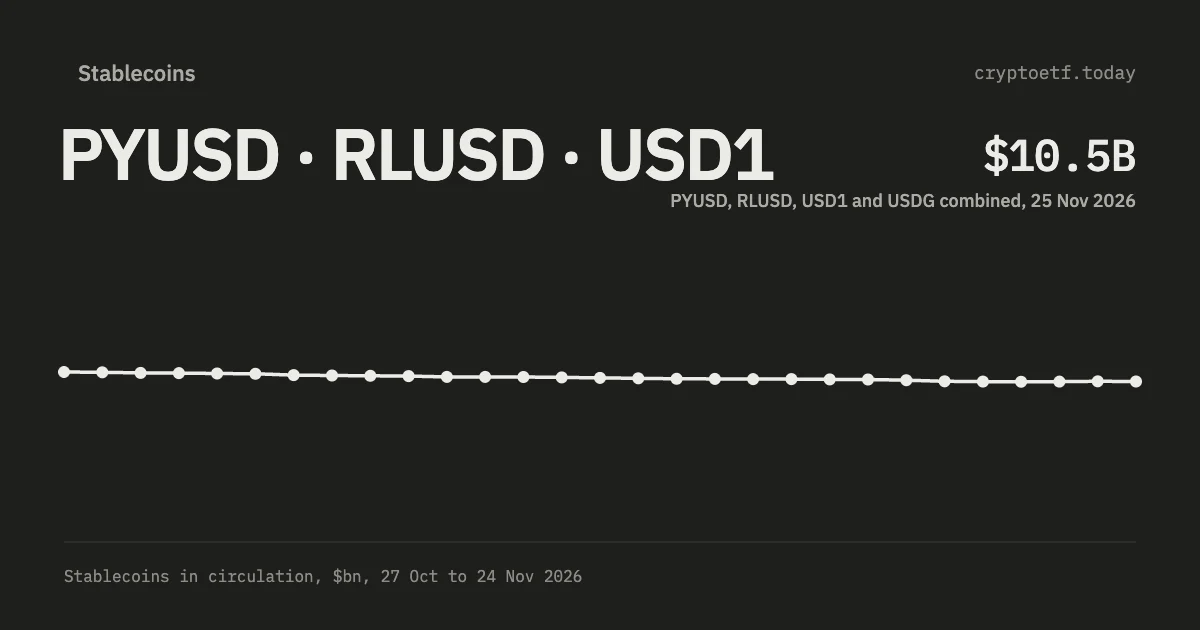
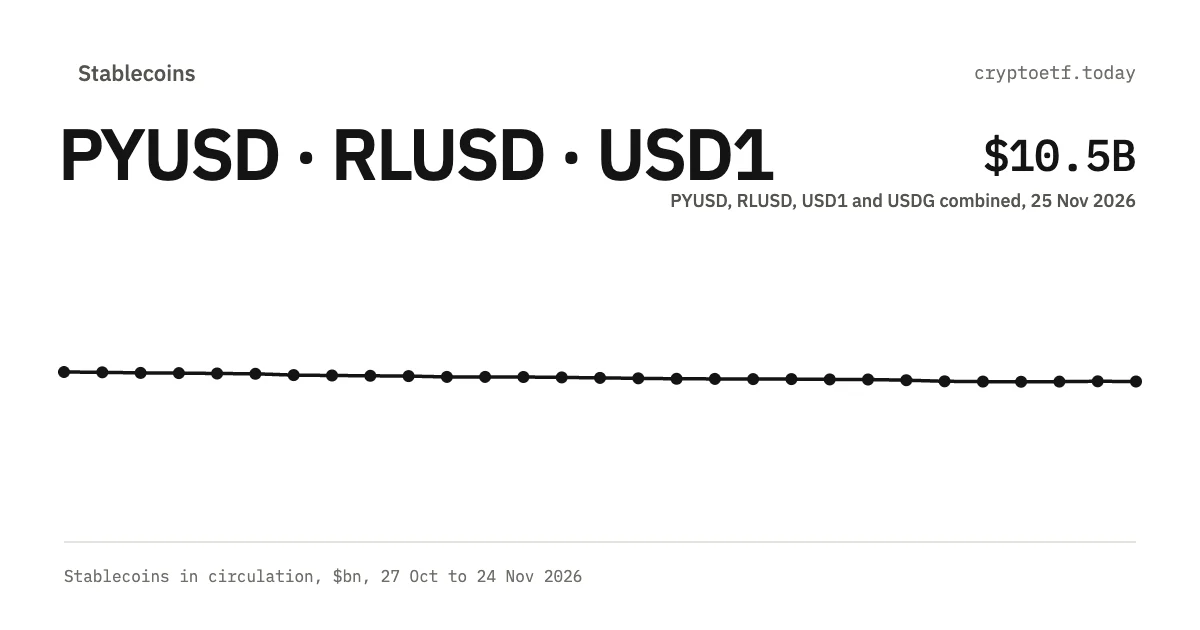
TL;DR. PYUSD, RLUSD, USD1 and USDG are dollar stablecoins launched by companies that aren’t Tether or Circle. The brand on the token and the company that issues it are often different: the PayPal stablecoin PYUSD is issued by Paxos, World Liberty Financial’s USD1 by BitGo, and the Ripple stablecoin RLUSD by a New York trust company Ripple owns. On 25 November 2026 the four together had $10.51bn in circulation, 3.7% of the $281.8bn stablecoin market, against 86% for USDT and USDC. Over the previous 30 days only RLUSD grew, +$448m. PYUSD shrank the most, −$685m. PYUSD also comes with a rewards program for holders, paid by PayPal rather than by the issuer.
Contents · 11 sections
- Brand versus issuer: the question to ask first
- PYUSD, RLUSD, USD1 and USDG compared
- Rewards: the issuer can’t pay, a platform can
- PYUSD: the PayPal stablecoin, minted by Paxos
- USDG: the dollar Paxos issues under its own name
- RLUSD: the Ripple stablecoin, mostly on Ethereum
- USD1: World Liberty Financial’s brand, BitGo’s balance sheet
- What the supply data says
- Which one fits which job
- FAQ
- Sources and further reading
Brand versus issuer: the question to ask first
Every dollar stablecoin has two roles behind it. One company puts its name on the token and finds people to use it. Another company actually mints the tokens, holds the reserves and owes holders a dollar for each token. With USDT and USDC the two roles sit in the same group. With the newer corporate dollars they often don’t.
Your claim is against the issuer. If you want to know who supervises the money, whose accounts hold the reserves and who signs the monthly attestation, you need the issuer’s name. The table below lines up all four.
PYUSD, RLUSD, USD1 and USDG compared
| PYUSD | RLUSD | USD1 | USDG | |
|---|---|---|---|---|
| Brand | PayPal | Ripple | World Liberty Financial | Paxos |
| Issuer | Paxos | Standard Custody & Trust Company (owned by Ripple) | BitGo | Paxos Digital Singapore |
| Supervisor | OCC, since Paxos became a national trust bank in December 2025 | New York DFS | OCC, since BitGo became a national trust bank in December 2025 | Monetary Authority of Singapore (issuer is a Major Payments Institution) |
| Reserves held by | Paxos (USD deposits, short-term Treasuries, cash equivalents) | BNY as primary custodian; Ripple National Trust Bank as collateral trustee | BitGo, in segregated accounts | DBS Bank named as reserve bank at launch |
| Reserve reports | Monthly reports and third-party attestations | Monthly attestations by Deloitte | Examinations by KPMG LLP (Crowe LLP until the May 2026 report) | Monthly reserve reports (Paxos) |
| Rewards for holders | Paid by PayPal on balances in eligible US PayPal and Venmo wallets | None in the Ripple documents we cite | None in the WLF and BitGo documents we cite | Paid to partner platforms through the Global Dollar Network |
| Chains in our data | 7 | 2 (Ethereum, XRP Ledger) | 8 | 7 |
| Supply, 25 Nov 2026 | $2.29bn | $2.77bn | $2.85bn | $2.61bn |
| 30-day change | −$685m | +$448m | −$541m | −$342m |
Supply is circulating tokens: on-chain supply minus anything the issuer still holds itself. The 30-day change is tokens created minus tokens redeemed. The current figures for all 58 coins we track are on the stablecoin dashboard.
Rewards: the issuer can’t pay, a platform can
The US GENIUS Act bars stablecoin issuers from paying holders interest or yield just for holding the coin. The ban is written for the issuer. A platform that distributes a coin can pay its own rewards, and for an ordinary user that is where the four differ most. PayPal runs a rewards program on PYUSD. For USDG, Paxos says its Global Dollar Network returns virtually all rewards to the participating platforms. We found no holder rewards in the RLUSD and USD1 documents cited here. How the yield ban works is covered in our GENIUS Act guide.
PYUSD: the PayPal stablecoin, minted by Paxos
PYUSD (PayPal USD) is a dollar stablecoin that carries PayPal’s brand and is issued by Paxos. PayPal launched it on 7 August 2023. Its launch release named the issuer as Paxos Trust Company, then a New York limited-purpose trust company supervised by the state’s Department of Financial Services. The same release said the coin is fully backed by US dollar deposits, short-term US Treasuries and similar cash equivalents, and that Paxos would publish monthly reserve reports and third-party attestations.
The supervisor has since changed. On 12 December 2025 Paxos converted its New York charter into a national trust charter and now operates as Paxos Trust Company, N.A. Paxos says all of its US activity is now supervised by the Office of the Comptroller of the Currency.
PayPal, not Paxos, pays the rewards. When it announced the program in April 2025, PayPal said US users would earn 3.7% a year on PYUSD held in their PayPal or Venmo wallets, paid monthly in PYUSD. The release called that the anticipated launch rate, said the rate is set at PayPal’s sole discretion and can change at any time, and said rewards might not be available to New York residents at launch. The current rate is shown in PayPal’s rewards terms and in the app, so check it there before relying on the 2025 figure.
You get PYUSD by buying it inside the PayPal or Venmo app, where it can be held, sent and moved to outside wallets. On chain it lives on seven networks in our data, Ethereum and Solana among them. Its supply also moves the most of the four: in the 30 days to 25 November it fell from about $2.97bn to $2.29bn, a drop of 23%.
USDG: the dollar Paxos issues under its own name
USDG (Global Dollar) is the dollar stablecoin Paxos issues under its own brand. Its announcement on 31 October 2024 named Paxos Digital Singapore as the issuer, regulated by the Monetary Authority of Singapore, described the coin as substantively compliant with MAS’s upcoming stablecoin framework, and named DBS Bank as the primary banking partner for its reserves. The coin’s current page describes the issuer as a Major Payments Institution supervised by MAS and says Paxos publishes monthly reserve reports.
Paxos distributes USDG through partner platforms rather than selling it directly to the public. Days after the launch, on 5 November 2024, Paxos started the Global Dollar Network with Anchorage Digital, Bullish, Galaxy Digital, Kraken, Nuvei and Robinhood as initial partners, and said the network would return virtually all rewards to participants. On chain, USDG sits on seven networks in our data, including Robinhood’s chain and OKX’s X Layer. Paxos says every token is redeemable 1:1 for US dollars from Paxos.
RLUSD: the Ripple stablecoin, mostly on Ethereum
RLUSD (Ripple USD) is Ripple’s dollar stablecoin, but Ripple doesn’t issue it directly. The issuer is Standard Custody & Trust Company, a New York limited-purpose trust company that Ripple owns, regulated by the state’s DFS. Ripple’s whitepaper names it, and Ripple’s 26 October 2026 release confirms that issuance stays there.
That release added a second layer. Ripple National Trust Bank received final OCC approval that day, after conditional approval in December 2025. Its approved activities include managing the segregated reserves behind RLUSD and acting as collateral trustee for holders. BNY is the primary custodian of the reserves. Ripple’s documentation says an independent accounting firm, Deloitte, prepares monthly reserve reports.
Most RLUSD isn’t on the XRP Ledger. On 25 November we counted $747m on XRPL and about $2.02bn on Ethereum, so roughly 73% of the supply sits on Ethereum.
USD1: World Liberty Financial’s brand, BitGo’s balance sheet
USD1 is a dollar stablecoin sold under the World Liberty Financial name and issued by BitGo. WLF’s own documentation describes it as a dollar-pegged token, and its risk disclosures say BitGo holds one dollar in segregated accounts for every token issued.
BitGo’s legal form changed during the coin’s life. The December 2025 reserve report notes that BitGo Trust Company converted into BitGo Bank & Trust, N.A. on 12 December 2025, after OCC approval. The reports are examined by an independent accountant: KPMG LLP since the June 2026 report, Crowe LLP before that. The September 2026 report also states that a holder’s right to redeem is contractual and doesn’t give a direct property interest in any specific reserve asset.
On chain, USD1 is the most spread out of the four, with eight networks in our data, including BNB Chain, Solana, Ethereum and Tron. Its supply fell by $541m in the 30 days to 25 November, about 16%.
What the supply data says
Put the four next to the leaders and the scale is clear. USDT had $174.7bn in circulation on 25 November and USDC $69.0bn. The four corporate dollars together had $10.51bn, less than a sixth of USDC alone.
| Coin | Supply, 25 Nov 2026 | Share of tracked stablecoins | 30-day change |
|---|---|---|---|
| USDT | $174.65bn | 62.0% | −$8.07bn |
| USDC | $69.01bn | 24.5% | −$2.83bn |
| USD1 | $2.85bn | 1.0% | −$541m |
| RLUSD | $2.77bn | 1.0% | +$448m |
| USDG | $2.61bn | 0.9% | −$342m |
| PYUSD | $2.29bn | 0.8% | −$685m |
These coins are small enough that one exchange or one partner moving its treasury can change the 30-day number by hundreds of millions, so a month of outflows says little about long-term demand. A falling total also doesn’t always mean people are leaving. Over the same 30 days USDT and USDC lost $10.9bn between them: the whole market was shrinking, and three of the four corporate dollars moved with it.
Which one fits which job
Each coin was built for a specific network of users:
- PYUSD fits people already in PayPal or Venmo who want a dollar they can also send to a crypto wallet and earn PayPal’s rewards on it.
- USDG is for platforms. You’ll meet it inside an exchange or broker that joined the Global Dollar Network, often without choosing it yourself.
- RLUSD is marketed by Ripple to institutions. The OCC-approved trust bank that manages its reserves is part of that pitch.
- USD1 is the most multi-chain of the four, with BNB Chain and Tron alongside Ethereum and Solana.
For any of them, the checks are the same: who issues it, who supervises the issuer, who holds the reserves, and when the last attestation was published. The answers above are as of November 2026. Charters, custodians and auditors do change, as Paxos and BitGo showed in December 2025 and USD1’s switch to KPMG showed in 2026, so check the issuer’s own pages before relying on them. The basics are in what is a stablecoin.
Each mint or redemption of these coins moves dollars onto or off a blockchain, the same kind of movement as a creation or redemption in a spot Bitcoin ETF, which is why stablecoin supply sits beside ETF flows in our Wall Street Money Index; daily supply by coin is on the stablecoin page and by network on stablecoins by chain.
FAQ
Who issues PayPal’s stablecoin PYUSD?
Paxos. PayPal’s launch release in August 2023 named Paxos Trust Company as the issuer. Since 12 December 2025 Paxos has operated as Paxos Trust Company, N.A., a national trust bank supervised by the OCC.
Does PYUSD pay interest?
Paxos, the issuer, pays none: the GENIUS Act bars issuers from paying holders interest or yield. PayPal runs its own rewards program on PYUSD held in eligible US PayPal and Venmo wallets. It announced 3.7% a year at the 2025 launch, at a rate it sets and can change.
Is RLUSD regulated?
Yes. RLUSD is issued by Standard Custody & Trust Company, a Ripple-owned limited-purpose trust company regulated by New York’s Department of Financial Services. Its reserves are managed by Ripple National Trust Bank, which received final OCC approval on 26 October 2026, with BNY as primary custodian and monthly reserve reports by Deloitte.
What is USD1?
A dollar stablecoin sold under the World Liberty Financial brand. BitGo issues the tokens and holds the reserves in segregated accounts, and KPMG LLP examines the reserve reports. BitGo has operated as BitGo Bank & Trust, N.A., an OCC-supervised national trust bank, since December 2025.
What happens if the issuer of one of these coins fails?
Holders have a claim on the issuer, not on the brand. USD1’s reserve report says a holder’s redemption right is contractual and gives no direct property interest in specific reserve assets. Under the GENIUS Act, holders of a permitted US issuer rank ahead of other creditors for the required reserves.
What is the difference between USDG and PYUSD?
Both come from Paxos. PYUSD is issued for PayPal and carries PayPal’s brand. USDG is Paxos’s own coin, issued by Paxos Digital Singapore under MAS supervision and distributed through partner platforms in the Global Dollar Network, which passes rewards to those partners.
Which is bigger, RLUSD or PYUSD?
On 25 November 2026 RLUSD had $2.77bn in circulation and PYUSD $2.29bn. USD1 was the largest of the corporate dollars at $2.85bn. All four together were 3.7% of the stablecoin market.
Is RLUSD on the XRP Ledger or Ethereum?
Both, but mostly Ethereum. On 25 November 2026 we counted $747m of RLUSD on the XRP Ledger and about $2.02bn on Ethereum.
Sources and further reading
- PayPal, “PayPal Launches U.S. Dollar Stablecoin” (7 August 2023), newsroom.paypal-corp.com; “PayPal Unlocks Rewards for Holding PayPal USD” (23 April 2025), newsroom.paypal-corp.com.
- Paxos, OCC approval of its conversion to a national trust charter (December 2025), paxos.com.
- Paxos, “Paxos Introduces Global Dollar (USDG)” (31 October 2024), paxos.com; Global Dollar Network announcement (5 November 2024), paxos.com; “About USDG”, globaldollar.com.
- Ripple, OCC final approval for Ripple National Trust Bank (26 October 2026), ripple.com; RLUSD whitepaper, ripple.com; “What is RLUSD?”, docs.ripple.com.
- World Liberty Financial, “What is USD1?”, docs.worldlibertyfinancial.com; USD1 risk disclosures, docs.worldlibertyfinancial.com.
- BitGo, USD1 reserve attestation reports for December 2025, June 2026 and September 2026.
- On cryptoetf.today: stablecoins, stablecoins by chain, Wall Street Money Index. Supply figures in this article are as of 25 November 2026.
For information only. Not investment advice.
 BTC
 ETH
 SOL
 XRP
 HYPE
 LINK
 HBAR
 AVAX
 DOGE
 LTC
 SUI
 DOT
 BNB
 NEAR
 TRX
 ZEC