GLD, IAU, GLDM and SGOL against IBIT and FBTC on fee, size, custody and tax. Since the Bitcoin ETFs opened in January 2024, gold is up 118% and bitcoin 86%.
TL;DR. The four big US gold trusts held $224.2bn and 1,732 tonnes at 30 June 2026, against $53.7bn in the two largest Bitcoin ETFs, every figure from the funds' own 10-Q filings. Bitcoin's wrapper gathered money far faster: $36.22bn net in twelve months against the $2.91bn at cost SPDR Gold Shares took in its first ten and a half months of 2004 and 2005. Returns went the other way. From 11 January 2024 to 22 September 2026 gold rose 118.1% and bitcoin 85.6%, at 23.3% annualised volatility against 47.7% and a worst drawdown of 27.8% against 53.0%. Their 90-session correlation ran between −0.08 and +0.28 through 2025 and reached 0.57 by 22 September 2026. The biggest unpriced gap is tax: gold trust shares are collectibles, taxed at up to 28%, and bitcoin trust shares are not.
المحتويات · 10 أقسام
- Two launches, twenty years apart
- What the first two years actually raised
- The products today, side by side
- Since the Bitcoin ETFs launched, gold has won
- The "digital gold" test: correlation
- Tax: the difference nobody prices
- Holding both: what the blend actually did
- What to take from this
- FAQ
- Sources and further reading

Two launches, twenty years apart
Both products are the same legal animal. A grantor trust holds one asset, an authorised participant delivers that asset for a block of shares, the trust sells a sliver of its holdings to pay the sponsor, and the shareholder is treated as owning a slice of the metal or coin directly. What changed between 2004 and 2024 is speed.
The gold trust that started the category was formed on 12 November 2004 with 30,000 ounces, worth $13,081,500. Trading began six days later on the New York Stock Exchange. Four weeks after that it filed a prospectus amendment stating that 29,300,000 shares were outstanding as of 16 December 2004 at an estimated NAV of $43.94. That's about $1.29bn in 28 calendar days.
The US spot Bitcoin ETFs opened on 11 January 2024, a batch of new funds listing alongside Grayscale's converted trust. Our daily flow series shows the category crossing $1bn of cumulative net creations on its fourth session, and BlackRock's IBIT doing it alone on the same day.
| Milestone | SPDR Gold Shares (GLD), from 18 Nov 2004 | US spot Bitcoin ETFs, from 11 Jan 2024 |
|---|---|---|
| First trading day | 23 baskets issued, roughly $100m | Category net +$655m; IBIT +$112m |
| $1bn gathered | Within 28 calendar days (16 Dec 2004) | Session 4, 17 January 2024 |
| First 28 calendar days | $1.29bn (29.3m shares at $43.94) | Category +$2.23bn net; IBIT +$3.50bn |
| Holdings after about a year | 6,669,251 oz (207.4 t) at 30 Sep 2005 | Category +$36.22bn net over 251 sessions |
| Share of the asset's world stock | 0.14% of the 150,500 t then above ground | IBIT alone now holds 3.50% of the 21m cap |
Gold figures come from the trust's 10-K filings for fiscal 2005 and 2006 and its December 2004 prospectus amendment on SEC EDGAR; the 150,500 tonne estimate is the one the trust itself quoted at the time, from the GFMS Gold Survey 2004. Bitcoin figures are our own daily series summed by hand.
What the first two years actually raised
The fair comparison isn't assets under management, which moves with the price of the thing being held. It's money in. For a gold trust the closest published proxy is the cost basis of the bullion, struck at each creation; for the Bitcoin ETFs we have the daily creation and redemption record itself.
| Period | GLD, at cost | US spot Bitcoin ETFs, net flow | Ratio |
|---|---|---|---|
| First year (GLD: 10.5 months to 30 Sep 2005) | $2.91bn, +6,654,825 oz net | $36.22bn over 251 sessions | 12.4x |
| Cumulative to about two years | $6.20bn, +5,791,655 oz in year two | $56.38bn over 501 sessions | 9.1x |
| Year three so far | Still growing; 1,005 t at 30 Jun 2026 | +$0.56bn over 175 sessions | — |
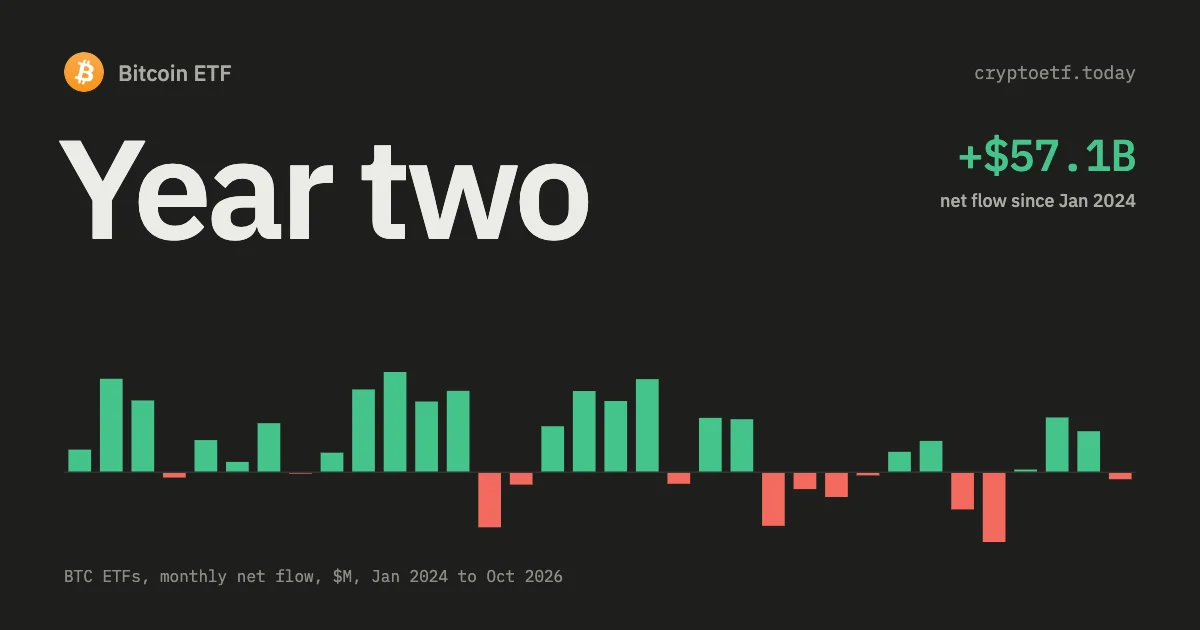
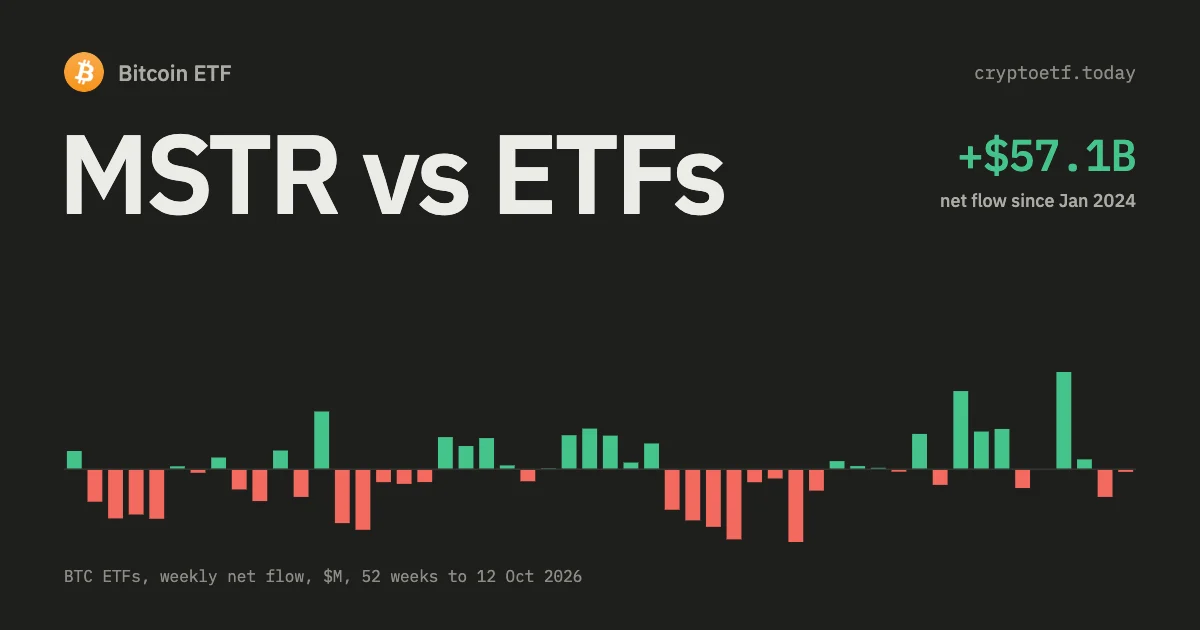
Two things fall out of that. Bitcoin's wrapper raised roughly twelve times as much in its opening year, in nominal dollars, as the product that invented the category. Then it stopped: the complex stands at +$56.94bn across 676 sessions through 22 September 2026, of which only $0.35bn arrived in 2026. Gold's trust kept compounding, reaching 32,314,227.7 ounces worth $130.05bn by 30 June 2026. That's twenty-two years of accumulation against a two-year sprint and a stall. Session by session, the bitcoin side is in two years of Bitcoin ETF flows.
One line from IBIT's 10-Q is worth pausing on. At 30 June 2026 its 734,261 bitcoin carried a cost basis of $61.0bn against a fair value of $43.4bn, so the average price the money paid was about $83,081 a coin. Nothing like that happened to GLD, carried at $2.91bn cost against $3.16bn market value after its first year.
The products today, side by side
Every number below comes from the relevant trust's Form 10-Q for the quarter ended 30 June 2026, so all six funds are measured on the same day under the same accounting. All six are grantor trusts; the gold sits in allocated vaults in London and New York, the bitcoin in cold storage. The supply share compares each gold fund with the 222,600 tonnes above ground and each bitcoin fund with the 21 million cap.
| GLD | IAU | GLDM | SGOL | IBIT | FBTC | |
|---|---|---|---|---|---|---|
| Asset | Gold | Gold | Gold | Gold | Bitcoin | Bitcoin |
| Sponsor fee | 0.40% | 0.25% | 0.10% | 0.17% | 0.25% | 0.25% |
| Net assets | $130.05bn | $60.11bn | $27.30bn | $6.74bn | $43.39bn | $10.30bn |
| Holding | 32,314,228 oz | 14,929,282 oz | 6,781,700 oz | 1,675,197 oz | 734,261 BTC | 174,383 BTC |
| Share of total supply | 0.45% | 0.21% | 0.09% | 0.02% | 3.50% | 0.83% |
| NAV per share | $369.47 | $75.72 | $79.65 | $38.34 | $33.48 | $51.44 |
| Custodian | HSBC Bank plc and JPMorgan Chase | JPMorgan Chase, London branch | JPMorgan Chase | ICBC Standard Bank | Coinbase Custody Trust and Anchorage Digital Bank | Fidelity Digital Assets, N.A. |
| Listed | 18 Nov 2004, NYSE | Trust organised 21 Jan 2005; NYSE Arca | 26 Jun 2018, NYSE Arca | Trust formed 1 Sep 2009; NYSE Arca | 11 Jan 2024, Nasdaq | 11 Jan 2024, Cboe BZX |
| Taxed as | Collectible, up to 28% | Collectible | Collectible | Collectible | Property, up to 20% | Property |
Same wrapper, different metal
Nothing about the legal plumbing separates these families. Neither gold nor bitcoin produces income, so no fund pays a dividend: the fee is met by selling a little of the asset each day, and the ounces or coins behind each share fall slowly forever. Both accept in-kind creations; IBIT's 10-Q records that being authorised for it from 31 July 2025. For the mechanics, start with what a Bitcoin ETF actually is and the fund directory.
The fee picture is less lopsided than the marketing suggests. GLDM at 0.10% is the cheapest of the six and SGOL at 0.17% undercuts both Bitcoin ETFs. GLD's 0.40% is a historical artefact: at launch the trust charged 0.15% to the sponsor, 0.02% to the trustee and a sliding custody fee, capped at 0.40% in total. The cap became the price.
Since the Bitcoin ETFs launched, gold has won
Measured from the first session of the Bitcoin ETFs to 22 September 2026, using the price series that sits alongside our flow data, gold beat bitcoin outright and did it with half the risk.
| 11 Jan 2024 to 22 Sep 2026 | Gold | Bitcoin |
|---|---|---|
| Price, first and last | $2,001 to $4,364.66 | $46,563 to $86,416 |
| Total return | +118.1% | +85.6% |
| Annualised | +33.8% | +26.0% |
| Annualised volatility | 23.3% | 47.7% |
| Worst drawdown | −27.8% (29 Jan to 17 Jul 2026) | −53.0% (7 Oct 2025 to 1 Jul 2026) |
| 2024, from 11 Jan | +31.1% | +99.3% |
| 2025 | +66.3% | −4.6% |
| 2026 to 22 Sep | +0.1% | −2.3% |
Be honest about what this window is. It starts where the Bitcoin ETFs start, which is unkind to bitcoin: it cuts out the 2020 to 2023 run when bitcoin beat gold by an order of magnitude, and it contains the strongest gold market in a generation. Over 2.7 years neither result settles the argument. What it does settle is that "bitcoin is digital gold, so it should behave like gold" failed its first live test as an investable pair.
One note on the gold price. Our series prices gold from PAXG, a token redeemable for one fine troy ounce of London Good Delivery bullion, because it trades on the same venues and clock as bitcoin. It tracks the official fix closely: at 30 June 2026 it printed $4,012.68 against the LBMA Gold Price PM of $4,026.05 that GLD used to strike its own NAV, a gap of 0.33%. On 31 March 2026 the gap was 1.8%, and both series peak on 29 January 2026. A dedicated bullion series would move the second decimal.
The "digital gold" test: correlation
If bitcoin were gold with better plumbing, the two would move together. They mostly haven't, and then in 2026 they started to.
| Quarter end | 90-session correlation, bitcoin vs gold | Quarter end | 90-session correlation |
|---|---|---|---|
| Q2 2024 | 0.28 | Q3 2025 | −0.08 |
| Q3 2024 | 0.26 | Q4 2025 | 0.09 |
| Q4 2024 | 0.03 | Q1 2026 | 0.44 |
| Q1 2025 | 0.08 | Q2 2026 | 0.33 |
| Q2 2025 | −0.05 | Q3 2026, to 22 Sep | 0.57 |
Across all 675 daily observations the correlation is 0.24, which sounds like a useful diversifier. The quarterly path says that average hides a regime change. Through 2025 the two were genuinely independent; since January 2026 they've moved together more than at any point in the sample. That's the direction of travel we found against equities in Bitcoin ETF correlation with equities, and the likeliest cause is the same: the marginal buyer of both is now an allocator with a risk budget rather than a true believer.
What gold did on bitcoin's worst days
Averages aren't the point of a hedge. The question is what the other asset does when the first one breaks. Bitcoin fell more than 5% on 24 sessions here: gold rose on 12 of them, fell on 12, and averaged −0.93%. Widen it to the 77 sessions where bitcoin fell more than 3% and gold rose on 39, averaging −0.23%. That's a coin flip, not a hedge.
The reverse test is lopsided. Gold fell more than 3% on 14 sessions and bitcoin rose on only two, averaging −3.37%. When gold breaks, bitcoin breaks harder. When bitcoin breaks, gold does nothing in particular.
The week the hedge failed for both
Early February 2026 is the case study. Gold closed at $5,474 on Friday 30 January and $4,795 the following Monday, a 12.4% fall across a weekend, while bitcoin fell 9.1%. Four sessions later bitcoin dropped 14.74% and gold a further 7.12% on the same day. Gold's own 27.8% peak-to-trough decline dates from that turn. Anyone holding both as insurance against each other held neither.
Tax: the difference nobody prices
Fees get compared to two decimal places and this gets ignored, which is backwards. Under US federal law physical gold is a collectible. IRS Topic 409 puts it plainly: "Net capital gains from selling collectibles (such as coins or art) are taxed at a maximum 28% rate." The Schedule D instructions define collectibles to include "metals (such as gold, silver, and platinum bullion)" and tell you to include any gain "attributable to unrealized appreciation of collectibles" held through a partnership, S corporation or trust.
A gold ETF is exactly that trust, and GLD's annual report spells it out under the heading "Maximum 28% Long-Term Capital Gains Tax Rate". Bitcoin doesn't fall in that bucket. The IRS treats digital assets as property, and while Notice 2023-27 opened collectible treatment to certain NFTs through a look-through test, it has never been applied to bitcoin. A Bitcoin ETF held over a year produces an ordinary long-term capital gain.
| $50,000 long-term gain, held over 1 year | Gold ETF | Bitcoin ETF | Extra tax on gold |
|---|---|---|---|
| Top bracket: 28% collectible + 3.8% NIIT vs 20% + 3.8% | $15,900 | $11,900 | $4,000 |
| 24% ordinary bracket, no NIIT | $12,000 | $7,500 | $4,500 |
| 22% ordinary bracket, no NIIT | $11,000 | $7,500 | $3,500 |
| Below the 0% capital gains threshold | $6,000 at a 12% ordinary rate | $0 | $6,000 |
The collectibles rate is capped at your ordinary marginal rate, so it never exceeds 28% and can be lower. That's why the 24% bracket is the worst case of the four: the gold holder pays a full 24% while the bitcoin holder still pays 15%. Thresholds are those the IRS publishes on Topic 409 as of September 2026. None of this is advice; the US picture in full is in Bitcoin ETF tax in the USA.
What that's worth as an annual fee
Convert the gap into the only unit that makes fees and taxes comparable. Hold for ten years at 7% a year and sell in the top bracket, and the collectibles rate costs the gold holder about 0.46% a year against an otherwise identical bitcoin position. At 12% a year it rises to 0.67%. Either figure exceeds GLD's entire 0.40% sponsor fee. Two caveats: it only bites in a taxable account, since inside an IRA or a 401(k) the distinction vanishes, and it only bites when you sell.
Holding both: what the blend actually did
The standard advice is that gold and bitcoin complement each other. Our window agrees, though not quite in the way the advice implies. Here's a daily-rebalanced blend over the same 675 sessions.
| Mix | Total return | Annualised | Volatility | Worst drawdown | Return per unit of risk |
|---|---|---|---|---|---|
| 100% gold | +118.1% | 33.8% | 23.2% | −27.8% | 1.46 |
| 10% bitcoin, 90% gold | +120.6% | 34.4% | 22.4% | −27.9% | 1.53 |
| 15% bitcoin, 85% gold | +121.4% | 34.5% | 22.5% | −28.1% | 1.54 |
| 20% bitcoin, 80% gold | +121.8% | 34.6% | 22.7% | −28.4% | 1.52 |
| 100% bitcoin | +85.6% | 26.0% | 47.7% | −53.0% | 0.54 |
A small bitcoin sleeve genuinely lowered the volatility of a gold position while raising its return, the textbook signature of a diversifier. The effect peaks around 10% to 20% and decays fast; past 30% you're buying bitcoin risk with extra steps. Notice that the drawdown barely improves at any weight, because the worst one came from a joint event. For allocation across a whole portfolio, see how much bitcoin is reasonable.
What to take from this
- Scale. The four gold trusts held 1,732 tonnes at 30 June 2026, 0.78% of the 222,600 tonnes the World Gold Council counts above ground. IBIT and FBTC together held 908,644 bitcoin, 4.33% of every coin that will exist. Gold ETFs are a rounding error in gold; Bitcoin ETFs are a structural holder of bitcoin.
- Price. Gold's above-ground stock was worth $29.0tn in Q2 2026; all 21 million bitcoin, at the 23 September 2026 price of $85,617, come to roughly $1.8tn. Gold is sixteen times larger on that generous basis.
- Fees. GLDM at 0.10% beats every Bitcoin ETF; GLD at 0.40% loses to all of them, as the expense ratio comparison shows for the other side.
- Tax. In a taxable US account the collectibles rate outweighs any fee difference here. In a retirement account it's worth nothing.
- Hedging. Neither asset reliably saved the other, and the correlation between them is rising.
To check the flow side, the Bitcoin ETF flows page carries the daily net figure, the cumulative line and the per-fund breakdown every bitcoin number above is summed from, and the dashboard puts that series next to the other twelve assets we track. It updates each business day after issuers publish, so it isn't real-time. We don't track gold ETFs, so the gold figures come from SEC filings.
FAQ
Has gold or bitcoin performed better since the Bitcoin ETFs launched?
Gold. From 11 January 2024, the first session of the US spot Bitcoin ETFs, to 22 September 2026, gold rose 118.1% and bitcoin 85.6%, at 23.3% annualised volatility against 47.7% and a worst drawdown of 27.8% against 53.0%. The window is short and excludes 2020 to 2023, when bitcoin beat gold by a very wide margin, so it settles nothing about the long run.
Are gold ETFs really taxed at 28% in the US?
Up to 28%, for an individual selling at a long-term gain in a taxable account. Gold is a collectible under the Schedule D rules, and the IRS treats a gain on an interest in a trust holding collectibles as a collectibles gain; GLD's own 10-K states this. The rate is capped at your ordinary marginal rate, so a filer in the 22% bracket pays 22%. Bitcoin ETFs are not collectibles and top out at 20% plus the 3.8% net investment income tax.
Which is cheaper to hold, a gold ETF or a Bitcoin ETF?
It depends which funds you compare. At 30 June 2026 GLDM charged 0.10% and SGOL 0.17%, both cheaper than IBIT and FBTC at 0.25%, while GLD charges 0.40%. Add the US collectibles tax and a taxable gold position in a top bracket carries roughly an extra 0.46% a year over ten years at 7% growth, which flips the ranking again.
Is bitcoin actually digital gold?
Partly. It shares a fixed supply and the absence of a sovereign issuer, but not gold's market behaviour. Across 675 sessions to 22 September 2026 the daily correlation was 0.24, and on the 24 days bitcoin fell more than 5% gold rose only half the time and averaged a small loss. Gold also carries a stock of metal worth $29.0tn against roughly $1.8tn for bitcoin's entire eventual supply.
How fast did the Bitcoin ETFs raise money compared with the first gold ETF?
About twelve times faster in nominal dollars. SPDR Gold Shares took in $2.91bn at cost in the ten and a half months from its 18 November 2004 launch to 30 September 2005, per its first 10-K; the US spot Bitcoin ETFs took $36.22bn net in twelve months, per our daily flow series. Gold reached $1bn in about four weeks, the Bitcoin ETFs on their fourth session.
Do gold ETFs and Bitcoin ETFs have the same structure?
Yes. All six are grantor trusts holding a single asset, with authorised participants creating and redeeming baskets and the fee paid by selling a sliver of the holdings. None pays income. The differences are the custodian, the vault or cold-storage arrangement, and the tax bucket the underlying asset falls into.
How much should I hold of each?
That is a question for your own plan rather than a data article. Our window shows a small bitcoin sleeve added to gold raising return and lowering volatility, peaking between roughly 10% and 20% bitcoin and decaying quickly above 30%. It did not reduce the worst drawdown, because the deepest fall hit both assets at once in February 2026.
Sources and further reading
- SPDR Gold Trust filings on SEC EDGAR (CIK 1222333): the fiscal 2006 10-K for the 2005 and 2006 creation and holdings detail, the June 2026 10-Q for current net assets, ounces and the LBMA Gold Price PM.
- iShares Bitcoin Trust ETF 10-Q, June 2026: 734,261 bitcoin, $43.39bn net assets, the 0.25% fee and the custodians.
- IRS Topic 409 and the Schedule D instructions: the 28% collectibles rate and the look-through rule for trust interests.
- IRS, Digital Assets: digital assets are property, and Notice 2023-27 limits collectible treatment to certain NFTs.
- World Gold Council, How much gold has been mined: 222,600 tonnes above ground, worth $29.0tn, as of Q2 2026.
لأغراض إعلامية فقط. ليست نصيحة استثمارية.

 ETH
 SOL
 XRP
 HYPE
 LINK
 HBAR
 AVAX
 DOGE
 LTC
 SUI
 DOT
 BNB
 NEAR
 TRX
 ZEC