Franklin EZBC charges 0.19% — the cheapest of the eleven funds that launched in January 2024 — and held $334.7m of net assets at 30 June 2026. A small fund from a very large manager.
TL;DR. Franklin Templeton's Franklin Bitcoin ETF (EZBC) charges 0.19% a year — 1 basis point below Bitwise BITB, 2 below ARK 21Shares ARKB, 6 below BlackRock IBIT and Fidelity FBTC, and 131 below Grayscale GBTC. It is the cheapest of the eleven US spot Bitcoin ETFs that launched on 11 January 2024, though two later funds undercut it: the Grayscale Bitcoin Mini Trust at 0.15% and Morgan Stanley's MSBT at 0.14%. The fund is sponsored by Franklin Holdings, LLC, custodies its bitcoin at Coinbase Custody Trust, and trades on Cboe BZX. At 30 June 2026 it held $334.7 million of net assets and 5,664.0163 BTC — roughly one-130th of IBIT. The differentiator is price, and nothing else.
Mục lục · 9 mục

The basics
| Field | Value |
|---|---|
| Ticker | EZBC |
| Exchange | Cboe BZX Exchange |
| Inception | 11 January 2024 |
| Sponsor | Franklin Holdings, LLC |
| Trustee | CSC Delaware Trust Company |
| Bitcoin custodian | Coinbase Custody Trust Company, LLC |
| Administrator, transfer agent, cash custodian | The Bank of New York Mellon |
| Benchmark | CME CF Bitcoin Reference Rate — New York Variant |
| Expense ratio | 0.19% |
| Net assets (30 Jun 2026) | $334,694,929 — 5,664.0163 BTC |
| Shares outstanding (30 Jun 2026) | 9,800,000 (NAV $34.15/share) |
All figures above come from the fund's Form 10-Q for the quarter ended 30 June 2026 (CIK 0001992870). One structural quirk worth knowing: the trust's fiscal year ends on 31 March, not 31 December, so its Form 10-K covers April-to-March and its quarterly filings are offset from those of every other fund in the category.
Franklin Templeton as an issuer
Franklin Templeton is one of the largest asset managers in the United States. Its parent, Franklin Resources, Inc. (NYSE: BEN), reported $1,791.6 billion of assets under management at 30 June 2026 across equity, fixed income, alternative, multi-asset and cash-management strategies. The ETF sponsor of record, Franklin Holdings, LLC, is a Delaware limited liability company formed on 21 July 2021 and a subsidiary of Franklin Resources; Franklin Distributors, LLC is the fund's marketing agent.
That scale is the substance of the "institutional backing" argument for EZBC. A sponsor with $1.79 trillion of assets is not going to be forced out of the ETF business by a crypto drawdown, and the fee it collects on EZBC is a rounding error in its revenue. The fund recognised sponsor fees of $1,028,947 for the fiscal year ended 31 March 2026 and $205,215 for the June 2026 quarter.
What Franklin does not have in this category is distribution momentum. EZBC gathered a small fraction of what BlackRock and Fidelity gathered from the same 11 January 2024 start, and the gap has not closed.
The fee — 0.19% and what it means in practice
EZBC launched with the sponsor fee waived entirely on the first $10.0 billion of fund assets. Per the fiscal-2026 Form 10-K, that waiver ran through 2 August 2024; the fund never came close to $10 billion, and the full 0.19% has accrued since. For the year ended 31 March 2025 the fund accrued $720,559 of sponsor fee offset by a $245,121 waiver — the last of the waived amount.
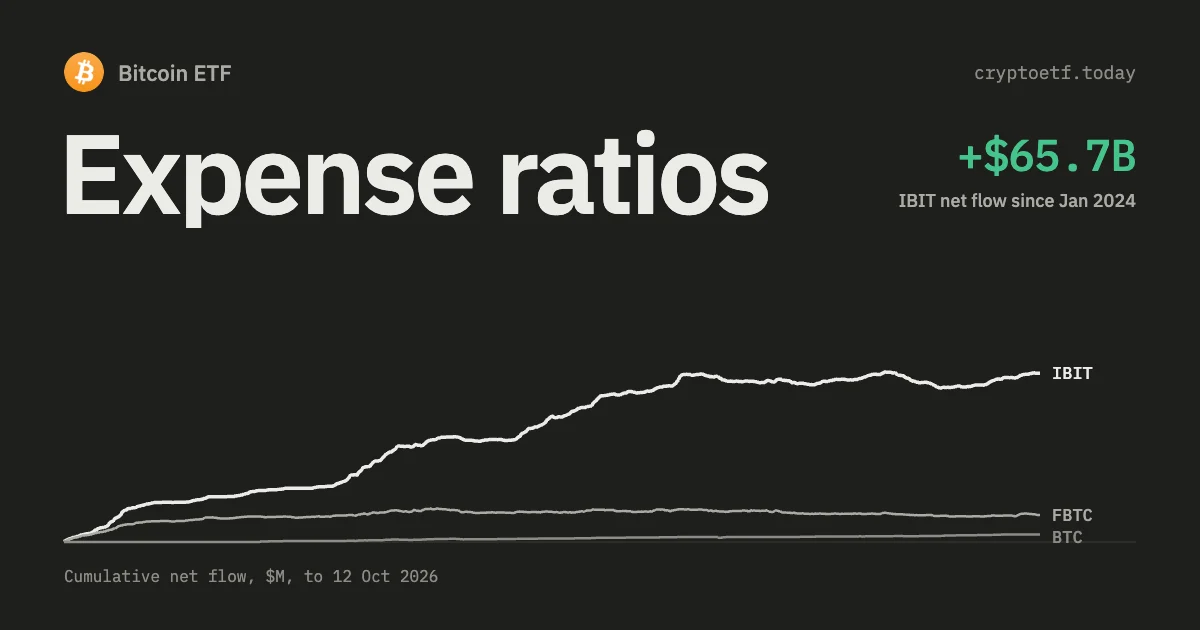
Where 0.19% sits across the category:
| ETF | Expense ratio | Annual cost on $100k |
|---|---|---|
| MSBT (Morgan Stanley) | 0.14% | $140 |
| BTC (Grayscale Bitcoin Mini Trust) | 0.15% | $150 |
| EZBC (Franklin) | 0.19% | $190 |
| BITB (Bitwise) | 0.20% | $200 |
| HODL (VanEck) | 0.20% | $200 |
| ARKB (ARK 21Shares) | 0.21% | $210 |
| IBIT (BlackRock) | 0.25% | $250 |
| FBTC (Fidelity) | 0.25% | $250 |
| GBTC (Grayscale) | 1.50% | $1,500 |
Among the January 2024 cohort, EZBC is the cheapest. Against the whole category it is third, behind MSBT and the Grayscale Mini. For full fee context, see Bitcoin ETF expense ratios compared.
The arithmetic is small. On a flat $100,000 position the 6 bp gap between EZBC and IBIT is $60 a year, $600 over ten years. The 1 bp gap to BITB is $10 a year. These are real dollars but trivial against the volatility of the underlying asset, and they only start to matter on a large, long-duration position — the kind an endowment or family office holds for decades, where fee drag compounds against the bitcoin itself, because the trust sells bitcoin to pay the fee and each share therefore represents slightly less BTC over time.
Custody and structure
EZBC's bitcoin sits at Coinbase Custody Trust Company, LLC — a New York-chartered limited purpose trust company regulated by the New York State Department of Financial Services, and the same custodian named by IBIT, GBTC, the Grayscale Mini, BITB, BTCO and BTCW. Coinbase Inc. is the fund's prime broker. Cash, administration, NAV calculation and transfer agency sit with BNY Mellon; CSC Delaware Trust Company is the trustee.
EZBC offers no custody differentiation. Across the category only a handful of funds name anything other than Coinbase: FBTC uses Fidelity Digital Assets, HODL adds Gemini Trust Company as its primary bitcoin custodian, ARKB spreads its holdings across four custodians, and IBIT, GBTC and the Grayscale Mini have added Anchorage Digital Bank alongside Coinbase. For the mechanics, see how Bitcoin ETF custody works.
Structurally EZBC is a plain grantor trust holding bitcoin directly — no derivatives, no lending, no leverage. The 10-Q states that creation units are issued and redeemed "in exchange for an amount of bitcoin and/or cash", so both cash and in-kind orders are contemplated; in-kind creation and redemption became available to US spot Bitcoin ETFs generally after the SEC's order of 29 July 2025.
Size and liquidity
$334.7 million of net assets puts EZBC near the bottom of the category. For comparison, at the same date IBIT held $43.39bn, FBTC $10.30bn, GBTC $8.14bn, the Grayscale Mini $3.19bn, BITB $2.13bn and ARKB $1.89bn. EZBC is not "comparable to ARKB and BITB in scale" — it is roughly one-sixth of either, and about one-130th of IBIT.
Small assets mean a thin order book. For a one-off purchase held for years this barely registers; for large or frequent orders the execution cost can exceed the 6 bp a year saved against IBIT. EZBC is a buy-and-hold instrument, not a trading vehicle.
Why so small? Distribution, not product quality. The January 2024 launch was a land grab, and the advisers and platforms that put IBIT or FBTC on their approved lists in the first quarter had no reason to revisit the decision for one basis point. Franklin's retail and adviser reach is large in mutual funds and much narrower in this specific channel.
Pros and cons
Pros
- Cheapest of the January 2024 cohort. 0.19% beats every fund that launched alongside it.
- Very large sponsor. Franklin Resources managed $1.79 trillion at 30 June 2026. Sponsor solvency is not a live risk here.
- Plain structure. Grantor trust, direct bitcoin ownership, one custodian, one benchmark, no complexity.
Cons
- Small fund. $334.7m of net assets and a correspondingly thin book. Larger orders pay for it in execution.
- No custody diversification. Coinbase Custody, like most of the category.
- Price is the only differentiator — and two funds outside the launch cohort are cheaper still.
- Off-cycle reporting. A 31 March fiscal year makes EZBC's annual report awkward to line up against every other fund's calendar-year 10-K.
Who should consider EZBC
- Cost-driven buyers who want a legacy-brand sponsor. If the mandate requires a traditional manager and the screen ranks on fee, EZBC is the answer among the original cohort.
- Existing Franklin clients on platforms where Franklin products are already approved and reported.
- Long-term, infrequent traders for whom a thin order book is a one-time cost.
It is the wrong choice for active traders, for large block orders, and for anyone optimising purely on fee without a brand constraint — MSBT and the Grayscale Mini are cheaper.
FAQ
What is the expense ratio of Franklin EZBC?
0.19% per year, accrued daily on net asset value. The sponsor initially waived the fee entirely on the first $10.0 billion of fund assets; per the fund's Form 10-K for the fiscal year ended 31 March 2026, that waiver ran through 2 August 2024 and the full 0.19% has accrued since. It is the lowest fee among the eleven US spot Bitcoin ETFs that launched in January 2024.
How big is Franklin EZBC?
$334,694,929 of net assets and 5,664.0163 BTC at 30 June 2026, across 9,800,000 shares (NAV $34.15 per share), per the fund's Form 10-Q. That is about one-130th of BlackRock IBIT ($43.39bn) and roughly one-sixth of Bitwise BITB ($2.13bn) or ARK 21Shares ARKB ($1.89bn).
How does EZBC's fee compare to other Bitcoin ETFs?
EZBC at 0.19% is 1 bp below Bitwise BITB and VanEck HODL (0.20%), 2 bp below ARKB (0.21%), 6 bp below IBIT and FBTC (0.25%) and 131 bp below Grayscale GBTC (1.50%). Two funds are cheaper: Morgan Stanley MSBT at 0.14% and the Grayscale Bitcoin Mini Trust at 0.15%.
Who custodies the bitcoin held by EZBC?
Coinbase Custody Trust Company, LLC, a New York-chartered limited purpose trust company regulated by the NYDFS. Coinbase Inc. acts as the fund's prime broker, and BNY Mellon is the administrator, transfer agent and cash custodian. EZBC offers no custody diversification away from Coinbase.
Is EZBC available in an IRA or 401(k)?
Yes. EZBC trades on Cboe BZX like any US-listed ETF and can be held in Roth IRAs, traditional IRAs and 401(k) plans whose menu permits ETF trading.
Why does EZBC report on a March fiscal year?
Franklin Templeton Digital Holdings Trust closes its books on 31 March. Its Form 10-K covers April to March, and its quarterly filings are offset by one quarter from the rest of the category, which reports on the calendar year. It changes nothing about the fund's economics but does make period-by-period comparisons with other issuers fiddly.
Sources and further reading
- Franklin Templeton Digital Holdings Trust, Form 10-Q for the quarter ended 30 June 2026 and Form 10-K for the fiscal year ended 31 March 2026 — sec.gov/Archives/edgar (CIK 0001992870).
- Franklin Resources, Inc., Form 10-Q for the quarter ended 30 June 2026 — sec.gov (CIK 0000038777).
- Internal: Bitwise BITB review, Bitcoin ETF expense ratios compared, how Bitcoin ETF custody works, Bitcoin ETF vs spot Bitcoin.
Chỉ nhằm mục đích thông tin. Không phải lời khuyên đầu tư.
 ETH
 SOL
 XRP
 HYPE
 LINK
 HBAR
 AVAX
 DOGE
 LTC
 SUI
 DOT
 BNB
 NEAR
 TRX
 ZEC