Three spot Hyperliquid ETFs listed in 2026: 21Shares THYP (12 May, 0.30%), Bitwise BHYP (15 May, 0.34%) and Grayscale HYPG (3 June, 0.29%). What they hold, why staking makes them different from a Bitcoin ETF, and how much money has actually arrived.
TL;DR. Three spot Hyperliquid ETFs trade in the US: 21Shares THYP (Nasdaq, 12 May 2026, 0.30% fee), Bitwise BHYP (NYSE, 15 May 2026, 0.34%) and Grayscale HYPG (Nasdaq, 3 June 2026, 0.29%). Each holds HYPE tokens directly and stakes part of them, which is the structural difference from a spot Bitcoin ETF. Together they had pulled in $288.0m of net flows through 20 August 2026, with HYPG the largest single contributor at $128.1m. They exist because the SEC approved generic listing standards in September 2025, which removed the 19b-4 bottleneck that had made every previous crypto ETF a multi-year fight.
المحتويات · 10 أقسام

What a spot Hyperliquid ETF actually is
A spot Hyperliquid ETF is a US-listed fund that holds HYPE, the native token of the Hyperliquid blockchain, and issues shares against that holding. Buy a share and you own a claim on the tokens in the trust. You don't hold a private key, you don't manage a wallet, and the position sits in the same brokerage account as your equities.
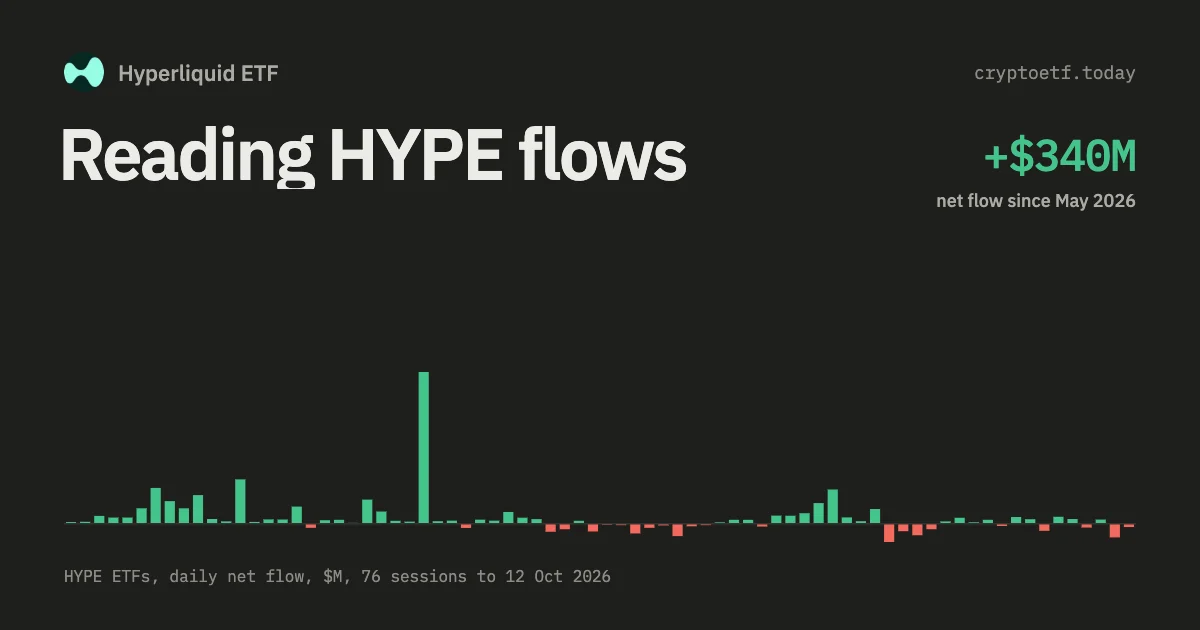
The mechanics are the same ones every spot crypto ETF uses. When demand pushes the share price above the value of the underlying tokens, authorised participants create new shares and the fund buys more HYPE. When shares trade below that value, they redeem and the fund sells. Those creations and redemptions are what the daily Hyperliquid ETF flow numbers measure. Ordinary trading between two investors on the exchange doesn't move the flow figure at all.
What's unusual here isn't the wrapper. It's the asset inside it, and the exchange behind it is worth understanding before the fund is: see what Hyperliquid and HYPE actually do.
The three US tickers
All three listed within four weeks of each other in 2026:
| Ticker | Issuer | Exchange | Listed | Sponsor fee | Staking |
|---|---|---|---|---|---|
| THYP | 21Shares | Nasdaq | 12 May 2026 | 0.30% | Via Figment, 30–70% of holdings |
| BHYP | Bitwise | NYSE | 15 May 2026 | 0.34% | In-house, 25% fee on rewards |
| HYPG | Grayscale | Nasdaq | 3 June 2026 | 0.29% | Yes, 25% fee on rewards |
21Shares got there first, listing THYP on 12 May alongside TXXH, a leveraged 40-Act product that is a different animal entirely. THYP took in $1.2m on its opening day against $1.8m of volume, which was read at the time as a solid rather than spectacular debut.
Bitwise followed three days later with BHYP and waived the sponsor fee entirely for the first month on the fund's first $500m. Grayscale came last on 3 June and undercut both on price at 0.29%, the lowest gross fee of any US Hyperliquid product.
If you're searching for a ticker and getting nowhere: THYP, BHYP and HYPG are the three. There is no BlackRock or Fidelity Hyperliquid fund.
Why these funds exist at all
Two years ago a Hyperliquid ETF would have been unthinkable. Every spot crypto ETF before 2025 required its exchange to file a Rule 19b-4 petition asking the SEC to change its own listing standards, one product at a time. That process took Bitcoin more than a decade and Ethereum most of a year.
On 17 September 2025 the SEC approved generic listing standards for commodity-based trust shares on Nasdaq, NYSE Arca and Cboe. An asset that meets the criteria — chiefly, trading on an ISG-member market with surveillance sharing, or underlying a CFTC-regulated futures contract with at least six months of history — can now be wrapped and listed without a bespoke rule change. Actively managed, leveraged and genuinely novel structures still need the old route.
HYPE qualified, and the queue moved from years to weeks. That single rule change is the reason a token that didn't exist before late 2024 had three US ETFs by June 2026.
What Hyperliquid is, in one section
Hyperliquid is a layer-1 blockchain built around an on-chain perpetual futures exchange. Perpetuals are leveraged derivatives with no expiry date, and until Hyperliquid they were almost entirely the business of centralised offshore exchanges. Hyperliquid put the order book on-chain and took roughly 70% of decentralised perpetuals volume, though that's still a single-digit share of the global perp market including centralised venues.
The token matters because of where fees go. Roughly 97% of protocol trading fees flow to the Assistance Fund, which buys HYPE on the open market. The protocol crossed $1bn in cumulative revenue on 30 June 2026, under two years after launch. Whatever you think of the valuation, the cash flow is real and it's observable on-chain, which is more than most tokens can say.
HYPE can also be staked to secure the network, and that's the part that reshapes the ETF.
The staking difference
A spot Bitcoin ETF holds an asset that produces nothing. Custody costs money, the sponsor charges a fee, and the fund's holdings per share drift slowly downward. That's the whole model.
HYPE pays a staking reward — historically around 2.2% annually, measured as a daily average from 1 May 2025 to 21 April 2026. All three funds capture some of it, and they do it differently:
- BHYP stakes through Bitwise Onchain Solutions, the sponsor's own validator operation, and keeps 25% of rewards.
- THYP stakes between 30% and 70% of holdings through Figment, with rewards split roughly 70/30 in the trust's favour.
- HYPG stakes and keeps 25% of rewards. Grayscale reported 94.31% of the fund's assets staked as of 3 August 2026.
Net of fees, staking can offset a meaningful part of the sponsor charge, enough that the headline expense ratio alone is a poor way to rank these three. It also introduces risks a Bitcoin fund doesn't have: validator slashing, an unstaking queue that can delay redemptions, and open questions about how staking rewards are taxed at the fund level. See our Ethereum ETF staking explainer for how differently the SEC treated this question just two years earlier.
How much money has actually arrived
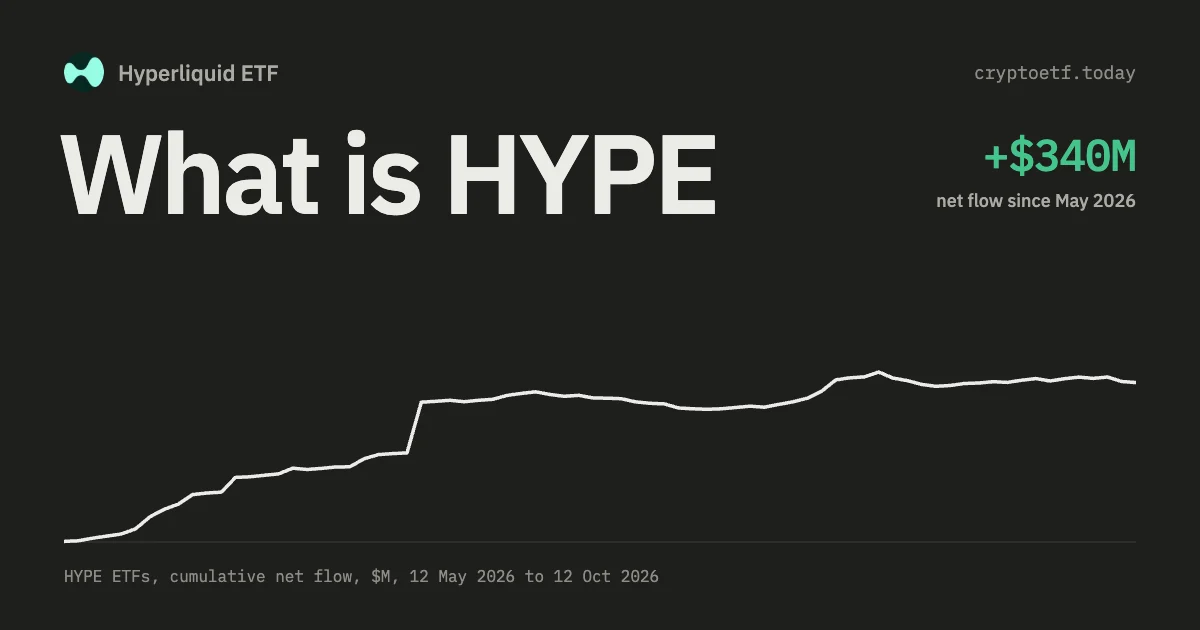
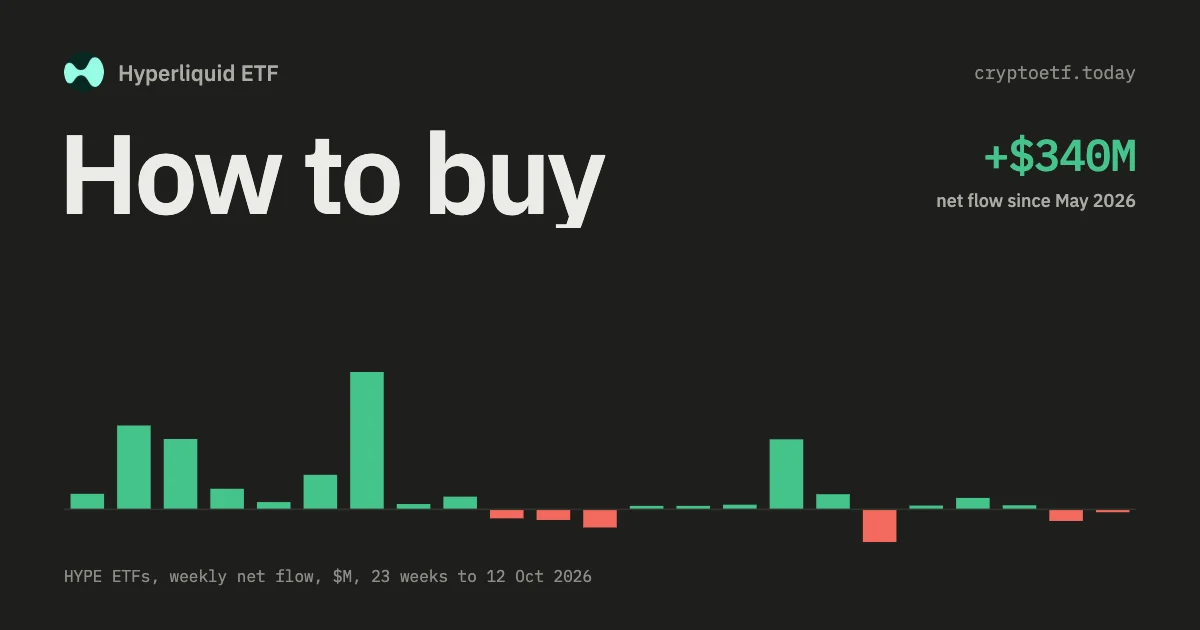
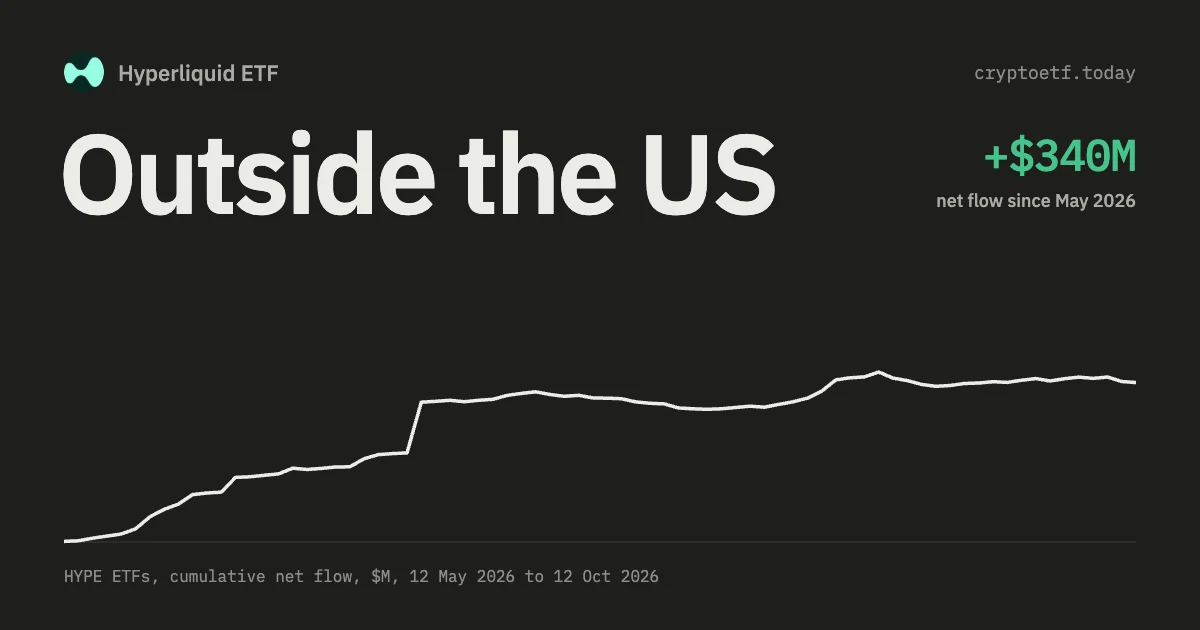
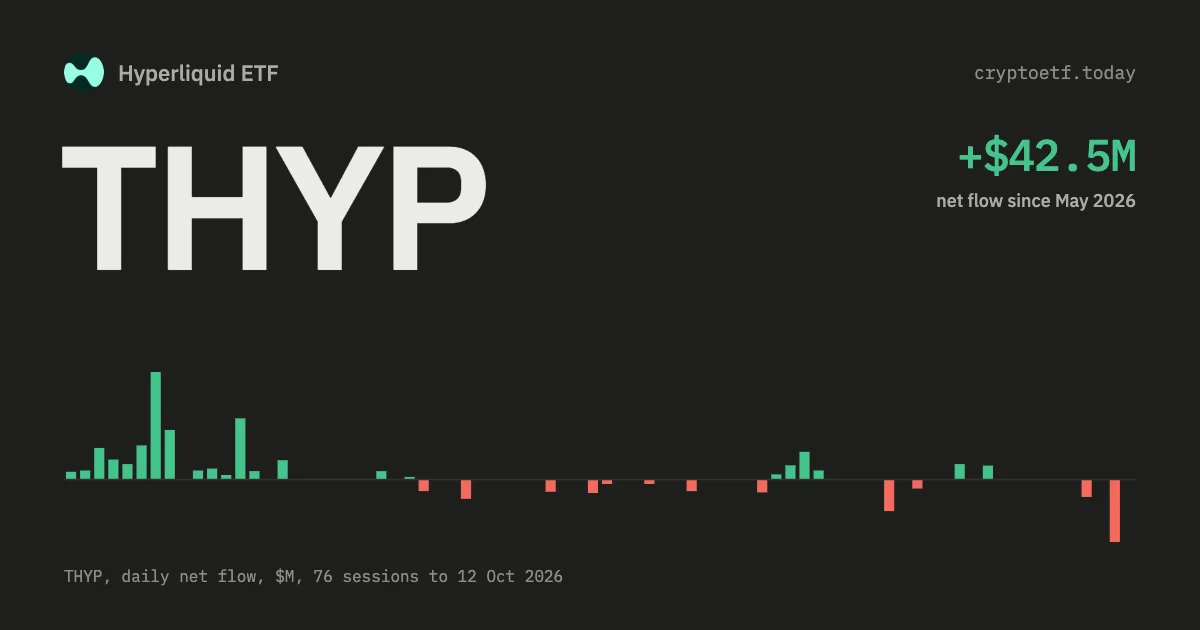
Through 20 August 2026, cumulative net flows across the three funds reached $288.0m. The split:
| Fund | Cumulative net flow | Share |
|---|---|---|
| Grayscale HYPG | $128.1m | 44% |
| Bitwise BHYP | $111.7m | 39% |
| 21Shares THYP | $48.0m | 17% |
Grayscale listed last and leads. The cheapest fund won, which is exactly what happened in the Bitcoin ETF fee war, only compressed into ten weeks instead of two years.
Put that $288m next to the Bitcoin complex and it disappears, spot Bitcoin ETFs move that much on an ordinary Tuesday. But scale isn't the point for a fund family this young. The useful question is whether demand shows up on quiet days, and there the record is mixed: after a strong May the flows cooled sharply, and a 12-session stretch from mid-July into early August produced $29.8m of net outflows with no inflow days at all. JPMorgan analysts tied the slowdown partly to newly regulated US perpetual futures venues competing for the same trade.
Who these funds are for
The wrapper solves three specific problems, and if none of them is yours, it's an expensive way to own a token:
- Tax-advantaged accounts. An IRA or 401(k) can hold an ETF. It generally can't hold HYPE directly.
- Mandates. Plenty of institutions may buy listed securities and may not touch a self-custodied token.
- Custody you don't want to run. No seed phrase, no bridge, no exchange counterparty.
Against that, you're paying 29 to 34 basis points a year, you're giving up a quarter to a third of the staking reward, you can only trade during US market hours, and you can't use the tokens on Hyperliquid itself, no staking to launch a market under HIP-3, no governance, no fee discounts. A trader active on the protocol has little reason to own the ETF instead.
The risks worth naming
HYPE is a young, volatile asset whose value is tied to one protocol's fee revenue. Between 12 May and 20 August 2026 the price moved from $42 to $69.73 with several double-digit drawdowns along the way. Three specific risks sit on top of that:
- Concentration. Hyperliquid's revenue is dominated by perpetuals trading. A sustained drop in speculative volume hits the buyback directly.
- Competition. The JPMorgan point stands: regulated US perp venues are now chasing the same flow.
- Liquidity in the wrapper. Funds this small can show wider spreads and larger premiums or discounts to NAV than the Bitcoin giants. Check the spread before placing a market order.
FAQ
Is there a Hyperliquid ETF?
Yes, three of them, all US-listed and all holding HYPE directly: 21Shares THYP (Nasdaq, 12 May 2026), Bitwise BHYP (NYSE, 15 May 2026) and Grayscale HYPG (Nasdaq, 3 June 2026).
What is the Hyperliquid ETF ticker symbol?
There are three tickers, not one: THYP, BHYP and HYPG. A fourth, TXXH from 21Shares, is a leveraged 40-Act product rather than a spot fund and behaves very differently over time.
Which Hyperliquid ETF has the lowest fee?
Grayscale HYPG at 0.29%, ahead of 21Shares THYP at 0.30% and Bitwise BHYP at 0.34%. All three also keep a share of staking rewards, so the headline sponsor fee is only part of the real cost.
Do Hyperliquid ETFs pay staking rewards to shareholders?
The rewards accrue to the fund and are reflected in its holdings rather than paid out as a dividend. Each sponsor keeps a cut first: Bitwise and Grayscale take 25% of rewards, and 21Shares splits roughly 70/30 with Figment on the portion it stakes.
How large are Hyperliquid ETFs compared with Bitcoin ETFs?
Tiny. Cumulative net flows across all three reached $288.0m through 20 August 2026, against tens of billions for the spot Bitcoin complex. HYPE ETFs are a frontier product, not a core holding.
Can I buy a Hyperliquid ETF in Canada or Europe?
The three funds discussed here are US-listed. Availability through a non-US broker depends on your jurisdiction and, in the EU, on PRIIPs documentation. Check with your broker rather than assuming access.
Sources and further reading
- Bitwise, BHYP launch announcement, bitwiseinvestments.com.
- SEC, generic listing standards for commodity-based trust shares (September 2025), sec.gov.
- Grayscale, HYPG fund page and fee schedule, grayscale.com.
- Daily flow data: Hyperliquid ETF flows tracker. Internal: BHYP vs THYP vs HYPG, staking inside a Hyperliquid ETF.
بيانات مباشرة حول هذا الموضوع
صناديق ETF لا تزال تنتظر الموافقة: Injective, SEI, Cronos, PEPE, Worldcoin, Canton, Aave, TRUMP, Ondo, Uniswap, Aptos, PENGU
لأغراض إعلامية فقط. ليست نصيحة استثمارية.
 BTC
 ETH
 SOL
 XRP
 LINK
 HBAR
 AVAX
 DOGE
 LTC
 SUI
 DOT
 BNB
 NEAR
 TRX
 ZEC