A spot Ethereum ETF is a listed trust that owns ether. Eleven trade in the US at 0.14% to 2.50%, six of them now stake, and the issuer keeps 6% to 25% of the reward.
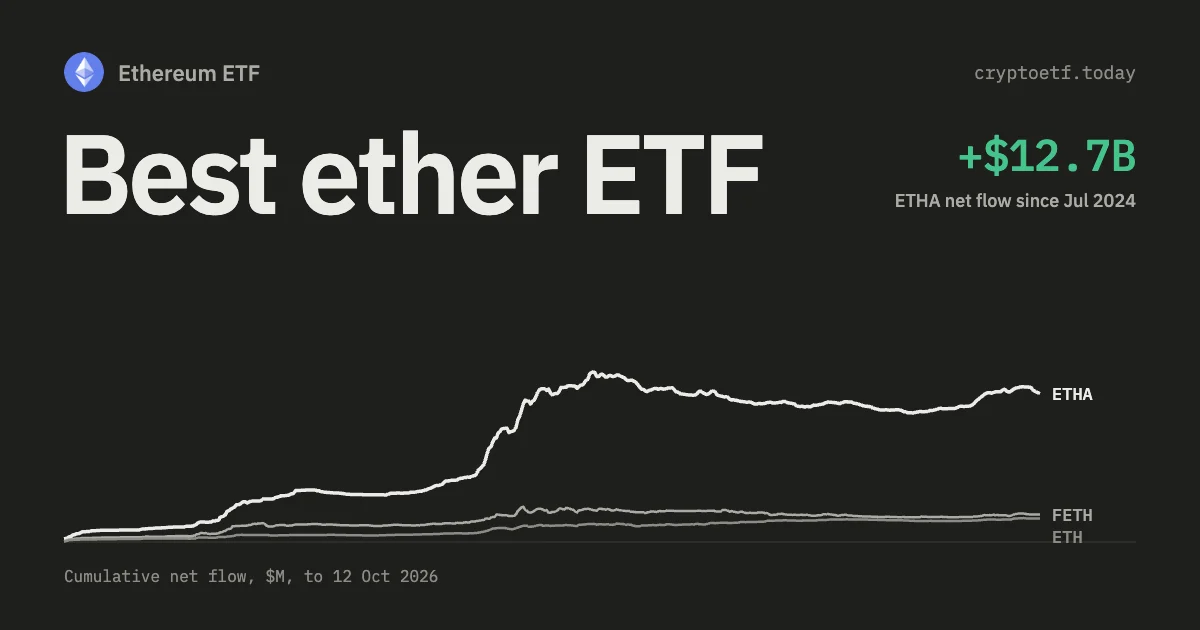
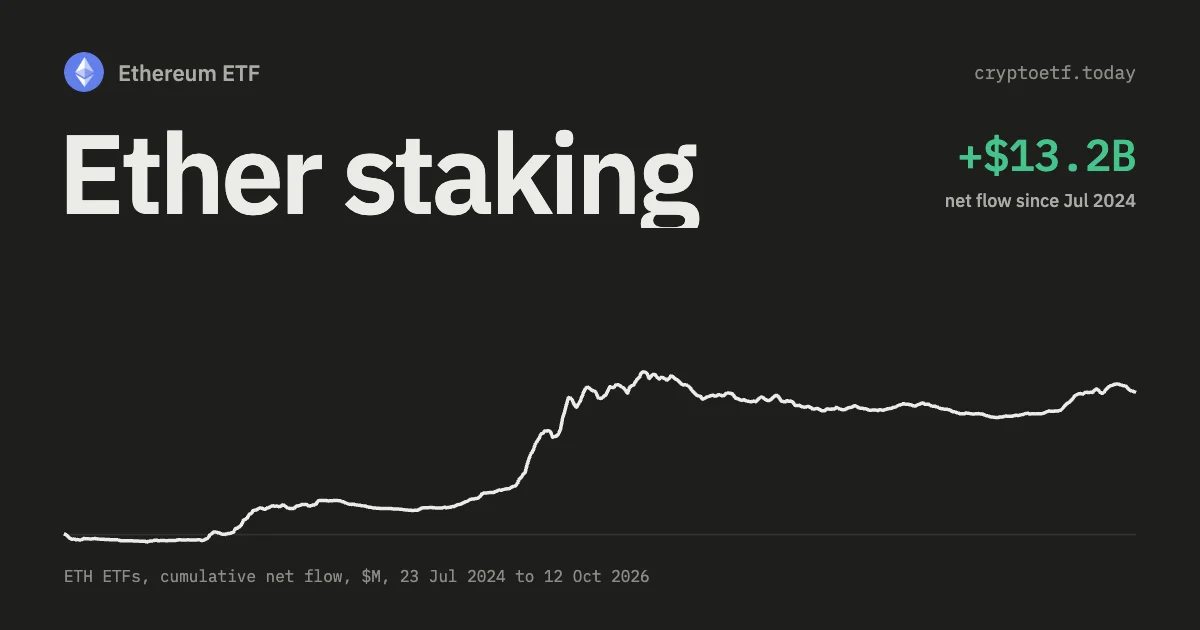
TL;DR. A spot Ethereum ETF is a listed trust whose only asset is ether, and whose shares are a proportional claim on that pile. Eleven trade in the United States at sponsor fees from 0.14% (Morgan Stanley's MSSE) to 2.50% (Grayscale's ETHE). The largest, BlackRock's ETHA, held $9.90bn across 476,400,000 shares on 22 September 2026, about 0.0075 ETH a share, and it does a 1-for-3 reverse split on 6 October 2026. The structural difference from a Bitcoin fund is staking: six of the eleven now stake, starting with ETHE and the Grayscale mini on 6 October 2025, and the issuer keeps between 6% and 25% of the gross reward before anything reaches you. BlackRock's flagship isn't one of them, because ETHA's own annual report forbids it, which is why a second BlackRock fund, ETHB, started trading on 12 March 2026. Our daily flow series counts $13.71bn of net money into the group across 531 sessions since 23 July 2024, of which ETHA took $13.15bn while ETHE gave back $5.42bn.
Sommaire · 12 sections
- The short answer
- What one share actually holds
- The eleven US spot Ethereum ETFs
- Staking: the difference that matters
- Why BlackRock needed a second fund
- Creation and redemption
- Grantor trusts and the tax shape of a staking fund
- What the flow record shows
- How an ether fund sits differently in a portfolio
- Risks worth writing down before you buy
- Frequently asked questions
- Sources and further reading

Figures are current as of September 2026, sourced to issuer pages, SEC filings and our own flow data, and updated as funds list, change fees or switch staking on.
The short answer
An exchange-traded fund is a pooled vehicle whose shares trade on a stock exchange through the session, like a share of any listed company. A spot Ethereum ETF is one where the pool holds real ether, bought and kept by a custodian, rather than futures contracts referencing the price. You buy a share in an ordinary brokerage account and you own a slice of the coins.
US spot ether funds began trading on 23 July 2024, eighteen months after the equivalent Bitcoin products, and for the first fourteen months the two groups were the same machine with a different coin inside. That stopped on 6 October 2025, when the first two funds turned on staking. Since then an ether fund has had something a Bitcoin fund structurally cannot have: an income stream from the asset itself, and a set of decisions about who keeps it.
If you already know how the Bitcoin side works, the fastest way in is to read what a Bitcoin ETF is and then treat this page as the list of differences. If you're choosing between specific tickers rather than understanding the wrapper, go to the best Ethereum ETF comparison instead.
What one share actually holds
Take ETHA, the biggest of the eleven. BlackRock's fund page showed $9,902,202,397 of net assets, 476,400,000 shares outstanding and a NAV of $20.7952 on 22 September 2026. Ether closed that session at $2,770.30 in our own price series, so the trust stood behind roughly 3.57 million ETH, and each share represented about 0.0075 ETH. No leverage, no cash sleeve worth mentioning, no second asset. Net assets are coins times price, less accrued fees.
That ether-per-share number responds to nothing except the fee. The trust pays its sponsor in ether, selling a sliver each month, so the coins behind each share decline on a fixed schedule. Hold a non-staking ether fund for a decade and your return is the ether return minus that erosion, compounded.
One warning about ETHA's per-share figures. BlackRock is running a 1-for-3 reverse split, effective after the close on 5 October 2026, with split-adjusted trading from 6 October. Every per-share number published before that date, the $20.7952 NAV above included, is a pre-split number: afterwards the fund shows roughly a third of the shares at three times the NAV, about 0.0225 ETH each. Nothing changes about what you own, but older screenshots stop matching.
The eleven US spot Ethereum ETFs
Nine of the eleven listed on the same morning in July 2024. Two arrived later: BlackRock's staking vehicle in March 2026 and Morgan Stanley's in July 2026. Fees below are the rates in force in September 2026, taken from issuer pages and prospectuses, with active waivers noted.
| Ticker | Issuer | Exchange | First trade | Sponsor fee | Stakes? |
|---|---|---|---|---|---|
| MSSE | Morgan Stanley | NYSE Arca | 28 Jul 2026 | 0.14% | Yes, from launch |
| ETH (mini) | Grayscale | NYSE Arca | 23 Jul 2024 | 0.15% | Yes, 6 Oct 2025 |
| EZET | Franklin Templeton | Cboe BZX | 23 Jul 2024 | 0.19% | No |
| ETHW | Bitwise | NYSE Arca | 23 Jul 2024 | 0.20% | No (S-1/A filed) |
| ETHV | VanEck | Cboe BZX | 23 Jul 2024 | 0.20% | No |
| TETH | 21Shares | Cboe BZX | 23 Jul 2024 | 0.21%, fully waived 9 Oct 2025 to 8 Oct 2026 | Yes, days after 6 Oct 2025 |
| ETHA | BlackRock | Nasdaq | 23 Jul 2024 | 0.25% | No, and not permitted |
| ETHB | BlackRock | Nasdaq | 12 Mar 2026 | 0.25%, cut to 0.12% on the first $2.5bn for 12 months from 12 Mar 2026 | Yes, from launch |
| FETH | Fidelity | Cboe BZX | 23 Jul 2024 | 0.25% | Yes, 21 Aug 2026 |
| QETH | Invesco | Cboe BZX | 23 Jul 2024 | 0.25% | No |
| ETHE | Grayscale | NYSE Arca | 23 Jul 2024 | 2.50% | Yes, 6 Oct 2025 |
Two footnotes. ETHA once carried a waiver of its own, 0.12% on the first $2.5bn, but it ran only from 23 July 2024 to 23 July 2025 and the fund has charged the full 0.25% since. And ETHB's inception date is 18 February 2026, three weeks before trading started on 12 March; vendors that read the registration rather than the listing show the February date. Fees and listing details for every fund we track sit on the funds page.
Staking: the difference that matters
Ethereum settles transactions by proof of stake. Ether locked into a validator earns new ether for doing that work. Bitcoin has no equivalent, which is why a Bitcoin ETF's only possible return is price, minus fee, forever. An ether fund can hold a productive asset, and since October 2025 most of the large ones do.
The timeline, which is messier than it looks
The funds didn't switch on together, and the common shorthand that "five funds started staking in October 2025" is wrong. Grayscale went first, turning on staking for both ETHE and the mini fund on 6 October 2025. 21Shares followed within days for TETH. Then nothing for five months, until BlackRock listed ETHB as a staking fund on 12 March 2026. Fidelity was last of the incumbents: it filed an amended registration on 11 August 2026 and began staking FETH on 21 August. Morgan Stanley's MSSE has staked since its first session on 28 July 2026, targeting 50% to 80% of holdings staked with Figment, Galaxy and Coinbase Canada as operators, capped at 80% so redemptions don't run into the validator exit queue.
Our older explainer at Ethereum ETF staking explained predates all of this and still says US ether funds don't stake. Treat the table above as the current state; that page is useful for the mechanics of validator queues and slashing, not for who stakes today.
Where the reward goes, and who takes a cut first
Two routes exist in principle. A fund can let the reward accumulate in the trust, raising ether per share and therefore NAV, so your gain shows up as price. Or it can sell the reward and pay cash to shareholders. US issuers have gone almost entirely down the second road, and the reason is structural: these trusts aren't 1940 Act funds, and a distribution is cleaner to report than a quietly compounding balance.
Before anything reaches you, the issuer and its staking providers take a share off the top. The size of that cut varies more than the sponsor fee does, and on a fund with a low headline fee it can be the larger of the two costs.
| Fund | Staking since | Issuer and providers keep | How the holder gets the rest |
|---|---|---|---|
| Grayscale ETHE | 6 Oct 2025 | 23% of gross reward | Cash distribution; first one $0.083178 a share, record date 5 Jan 2026 |
| Grayscale ETH (mini) | 6 Oct 2025 | 6% of gross reward | Cash distribution, same schedule |
| 21Shares TETH | Days after 6 Oct 2025 | 25% of gross reward | Passed through to shareholders net of that cut |
| BlackRock ETHB | 12 Mar 2026 | 18% of gross reward | Cash, intended monthly and no less often than quarterly |
| Fidelity FETH | 21 Aug 2026 | 15% of gross reward | Quarterly cash distributions |
| Morgan Stanley MSSE | 28 Jul 2026 | Not broken out in the launch release | Staking rewards included in the product from day one |
Read the middle column next to the fee column in the previous table, because the two together are the real cost. Grayscale's mini fund charges 0.15% and keeps 6% of the reward. ETHE charges 2.50% and keeps 23%, which is why we treat it as a legacy holding rather than a purchase in the ETHE review. TETH's sponsor fee is waived to zero until 8 October 2026, but 21Shares still keeps a quarter of every staking reward, so "free" describes only half the arrangement.
Two more things that don't fit in a table. No fund stakes everything: each keeps an unstaked buffer so redemptions can settle without waiting in Ethereum's exit queue, and a fund that stakes 60% of its ether earns 60% of the network rate before the issuer's cut. And rewards aren't contractual. Validator performance, the network's participation rate and penalties all move the number, and every prospectus says distributions aren't guaranteed.
Why BlackRock needed a second fund
ETHA is the largest ether fund in the world and it doesn't stake. That isn't a business decision that can be reversed by a press release. The trust's annual report on Form 10-K for 2025 states flatly that neither the trust nor its affiliates may stake the ether it holds, and that restriction runs through the documents the fund was approved under. Changing it would mean amending the registration, not flipping a switch.
BlackRock's answer was to build a separate vehicle. The iShares Staked Ethereum Trust ETF was incepted on 18 February 2026 and started trading on Nasdaq on 12 March 2026 with staking live from the first session, an 18% cut of the gross reward going to the sponsor and its execution agents, and a launch fee waiver to 0.12% on the first $2.5bn for twelve months. It pulled $853.3m of net inflows in its first 133 sessions on our series, through 22 September 2026.
For a buyer, the practical consequence is that "BlackRock's ether ETF" is now an ambiguous phrase. ETHA is the liquid one, with roughly twelve times the assets and the tighter book. ETHB is the one that pays you for the asset's own work. They hold the same coin under the same custodian and charge the same headline fee once the waiver expires.
Creation and redemption
You can't take shares to the trust and ask for ether. Only authorised participants, a short list of broker-dealers that have signed an agreement with the sponsor, deal with the fund directly, and only in baskets of tens of thousands of shares. An AP that wants new shares delivers ether or cash; an AP with surplus shares hands them back and receives ether or cash out. Orders price at that day's benchmark rate rather than at whatever the shares last traded for.
That process is the whole reason a share tracks NAV. If the shares trade above the value of the coins behind them, an AP creates new ones and sells them until the gap closes; below, it buys shares cheap and redeems them. The arbitrage is mechanical and it's also the only supply mechanism, which is why the daily change in shares outstanding is a clean measure of demand. That's precisely what our Ethereum ETF flows tracker publishes each evening: the change in shares multiplied by NAV, fund by fund, one row per trading day.
Your claim, then, is on the trust's assets, enforced through the market, not a right to redeem. In a dislocation the price can drift from NAV, which is how ETHE traded at a deep discount for years before it converted. And the shares sit still when US markets are shut, while ether keeps trading through the weekend.
Grantor trusts and the tax shape of a staking fund
None of these funds is registered under the Investment Company Act of 1940. Each is a Delaware statutory trust treated as a grantor trust for US federal income tax, which means the IRS looks through the wrapper and treats you as owning your slice of the ether directly. Three consequences follow.
- The fee is a taxable event you didn't choose. When the trust sells ether to pay the sponsor, that sale flows through pro rata to shareholders. Each trust publishes an annual tax information statement showing the per-share gross proceeds and cost basis so you can adjust yours.
- Staking income is ordinary income. A grantor trust has no corporate earnings to convert into a qualified dividend, so the staking distribution lands as ordinary income for the year it's received, at your marginal rate. The trust's tax statement and the Form 1099 your broker issues are where it appears; the exact box differs by broker and by how the trust characterises the payment, so check both rather than assuming it's a dividend.
- Your basis moves. Fee sales reduce it, distributions can too. This is the part people miss when they compare a staking ether fund with a bond fund: the cash flow looks similar and the paperwork doesn't.
Inside an IRA or a 401(k) most of that disappears, which is the strongest practical argument for the wrapper. A retirement account can hold a Nasdaq-listed share; it generally can't hold ether. None of this is tax advice, and the treatment of staking distributions is new enough that it's worth an hour of a professional's time before the first tax year in which you hold one.
What the flow record shows
The table below is our own series, computed daily from share counts and NAV since the first session on 23 July 2024 and running through 22 September 2026, 531 trading days. It's the closest thing there is to a demand history for the group.
| Fund | Net flow since 23 Jul 2024 | Net flow since staking began, 6 Oct 2025 |
|---|---|---|
| BlackRock ETHA | +$13,153.1m | −$696.5m |
| Fidelity FETH | +$2,370.0m | −$460.8m |
| Grayscale ETH (mini) | +$2,022.5m | +$499.6m |
| BlackRock ETHB | +$853.3m | +$853.3m (from 12 Mar 2026) |
| Bitwise ETHW | +$398.5m | −$44.7m |
| VanEck ETHV | +$161.0m | −$48.2m |
| Franklin EZET | +$67.8m | −$3.7m |
| Morgan Stanley MSSE | +$39.3m | +$39.3m (from 28 Jul 2026) |
| 21Shares TETH | +$37.1m | +$8.5m |
| Invesco QETH | +$25.6m | +$0.2m |
| Grayscale ETHE | −$5,416.9m | −$874.2m |
| Group total | +$13,711.3m | −$727.2m |
Three readings. First, concentration: ETHA alone accounts for more than the whole group's net total, because ETHE's outflows cancel most of the rest. Second, the group has been net negative since staking arrived, which is a useful corrective to the idea that yield pulls money in by itself. The money that did move went to the funds that stake, ETHB and the Grayscale mini between them taking $1.35bn while ETHA and FETH gave back $1.16bn. Third, the recent picture is different again: the 21 sessions from 24 August to 22 September 2026 brought $1,531.0m in, so the year-to-date figure of +$1,364.1m is almost entirely a late-summer story.
One caveat about reading any of this. Only 278 of 531 sessions were positive, so single days tell you close to nothing. The best day on record is +$1,018.8m on 11 August 2025 and the worst is −$465.1m a week earlier, on 4 August 2025. Our numbers are end-of-day, not live, and they're derived from published share counts rather than reported by the issuers.
How an ether fund sits differently in a portfolio
Four differences matter once you're past the mechanics.
- There's a yield, and it's taxed like income. A staking fund produces cash you didn't ask for, in a year you may not want it. In a taxable account that's a drag; in an IRA it's free compounding. The wrapper choice depends on the account more than it does on the fund.
- Fee alone no longer ranks the funds. On a Bitcoin ETF the cheapest fund is the cheapest fund. On the ether side a 0.15% fund that keeps 6% of rewards beats a 0.14% fund on an undisclosed split, depending on what fraction each one stakes.
- Liquidity is far more concentrated. ETHA is roughly ten times the size of the next US ether fund. Four of the eleven have taken under $200m net since launch. That matters for spreads and for the risk that a small fund closes, which has already happened elsewhere in the crypto ETF market.
- Ether isn't a smaller bitcoin. The correlation is high but the drivers differ, and sizing a sleeve of each is its own question, taken apart in ETH ETF versus BTC ETF allocation.
Risks worth writing down before you buy
Price risk dominates everything else: ether fell from over $3,400 on the first trading session to $2,770.30 on 22 September 2026, and every structural advantage above is a rounding error next to that. Beyond it, five specific risks belong to the wrapper rather than the coin.
- Fee erosion is certain. Ether per share only falls in a non-staking fund. At 2.50%, ETHE loses a quarter of its coins per share per decade.
- Staking risk is real, if small. Validators can be penalised for downtime and slashed for misbehaviour, and the exit queue can delay unstaking when a lot of ether leaves at once. That's the reason funds cap how much they stake.
- Distributions aren't promised. Every prospectus says so. Rates move with the network.
- No 1940 Act protections. No independent board, no diversification rules, no leverage limits. You have a trustee, a custodian, an administrator and an auditor.
- Custody is concentrated. Most of these trusts use the same small set of qualified custodians, so a failure at one would touch several funds at once.
The honest summary is that the wrapper buys you a brokerage account, a retirement-account home and someone else's key management, and charges you between 0.14% and 2.50% a year plus a slice of the staking reward for it. Whether that trade is worth making against simply owning the coin is a separate argument, and a good one.
Frequently asked questions
What is an Ethereum ETF in plain terms?
A trust that holds ether and nothing else, whose shares trade on a stock exchange. Buying a share gives you a proportional claim on the trust’s coins through an ordinary brokerage account, without keys, wallets or an exchange login. Eleven of them trade in the US, the first nine having listed on 23 July 2024.
Do Ethereum ETFs stake, and which ones?
Six of the eleven do. Grayscale’s ETHE and its mini fund started on 6 October 2025, 21Shares’ TETH within days, BlackRock’s ETHB from its first session on 12 March 2026, Morgan Stanley’s MSSE from its launch on 28 July 2026, and Fidelity’s FETH from 21 August 2026. ETHA, ETHW, ETHV, QETH and EZET don’t stake as of September 2026.
Why doesn’t BlackRock’s ETHA stake?
Because it isn’t allowed to. ETHA’s Form 10-K for 2025 states that neither the trust nor its affiliates may stake the ether it holds, a restriction built into the documents the fund was registered under. Rather than amend it, BlackRock launched a separate staking fund, ETHB, which was incepted on 18 February 2026 and began trading on 12 March 2026.
Do I receive the staking rewards, or do they just lift the NAV?
US issuers have chosen cash distributions rather than accruing rewards into NAV. Grayscale paid the first one in January 2026, $0.083178 a share on ETHE covering rewards earned from 6 October to the end of 2025. ETHB intends to distribute monthly and no less often than quarterly; FETH pays quarterly. The issuer takes its cut first: 6% at the Grayscale mini, 15% at FETH, 18% at ETHB, 23% at ETHE and 25% at TETH.
Which Ethereum ETF is cheapest?
On headline fee, Morgan Stanley’s MSSE at 0.14%, followed by Grayscale’s mini fund at 0.15% and Franklin’s EZET at 0.19%. On total cost the ranking changes, because a staking fund’s share of the reward can outweigh a one-basis-point fee difference, and because 21Shares has waived TETH’s 0.21% entirely until 8 October 2026 while still keeping a quarter of staking rewards.
Can I redeem my shares for actual ether?
No. Only authorised participants deal with the trust, in baskets of tens of thousands of shares, delivering or receiving ether or cash. Retail holders sell shares on the exchange. That creation and redemption process is what keeps the share price close to NAV, and the daily change in shares outstanding is what our flow tracker measures.
How is an Ethereum ETF taxed in the US?
Each fund is a grantor trust, so you’re treated as owning your slice of the ether directly. Selling shares is a capital gain or loss; the trust’s monthly fee sales pass through as small taxable events reported on an annual tax information statement; and staking distributions are ordinary income rather than qualified dividends. Holding the fund inside an IRA or 401(k) removes most of that friction. Confirm the details with a tax professional, since staking distributions from these trusts are recent.
Sources and further reading
- iShares Ethereum Trust ETF (ETHA) fund page — net assets, NAV, shares outstanding as of 22 September 2026, and the reverse split notice.
- iShares Staked Ethereum Trust ETF (ETHB) fund page — fee waiver terms and distribution policy.
- ETHB Form 424B3, 11 March 2026, SEC EDGAR — the 18% aggregate staking fee and the sponsor fee schedule.
- Grayscale press release, 5 January 2026 — the first US staking distribution and its per-share amount.
- Morgan Stanley Investment Management launches Ethereum and Solana ETPs — MSSE listing, 0.14% fee and staking from launch.
Flow figures throughout are from our own daily series for US spot ether funds, computed from published share counts and NAV and current through 22 September 2026. The up-to-date version is on the Ethereum ETF flows page, and the fee and listing detail for every fund we track is on the funds page.
Données en direct sur ce sujet
ETF encore en attente d’approbation: Injective, SEI, Cronos, PEPE, Worldcoin, Canton, Aave, TRUMP, Ondo, Uniswap, Aptos, PENGU
À titre informatif uniquement. Ceci n’est pas un conseil en investissement.
 BTC
 SOL
 XRP
 HYPE
 LINK
 HBAR
 AVAX
 DOGE
 LTC
 SUI
 DOT
 BNB
 NEAR
 TRX
 ZEC