HODL is the only US spot Bitcoin ETF that names Gemini Trust Company as its bitcoin custodian — with Coinbase as a second. Its investors also paid no sponsor fee at all from 25 November 2024 to 31 July 2026.
TL;DR. VanEck Bitcoin Trust (HODL) has a 0.20% headline fee, but shareholders have effectively paid nothing: the sponsor waived the entire fee on the first $2.5 billion of assets from 25 November 2024 through 31 July 2026, and the trust's 10-Q for the June 2026 quarter shows net expenses of exactly zero. The fund never reached the $2.5bn threshold — net assets were $958,827,545 and 16,241.00 BTC at 30 June 2026. HODL is also the only US spot Bitcoin ETF to name Gemini Trust Company as its bitcoin custodian. It is not, however, a way to avoid Coinbase: the filings name Coinbase Custody Trust Company as an additional bitcoin custodian, so the fund runs with two.
Sommaire · 10 sections

The basics
| Field | Value |
|---|---|
| Ticker | HODL |
| Exchange | Cboe BZX |
| Inception | 11 January 2024 |
| Sponsor | VanEck Digital Assets, LLC (subsidiary of Van Eck Associates Corporation) |
| Bitcoin custodian | Gemini Trust Company, LLC |
| Additional bitcoin custodian | Coinbase Custody Trust Company, LLC |
| Expense ratio | 0.20% — fully waived on the first $2.5bn through 31 July 2026 |
| Net assets (30 Jun 2026) | $958,827,545 — 16,241.00 BTC |
| Shares outstanding (30 Jun 2026) | 57,425,000 (NAV $16.70/share) |
Figures from the trust's Form 10-Q for the quarter ended 30 June 2026 (CIK 0001838028).
The fee: a full waiver that ran for twenty months
This is the part of HODL most reviews get wrong, and it is the most consequential fact about the fund. The 10-Q states the arrangement precisely: the trust pays a unified sponsor fee of 0.20% of average daily net assets, but "effective for the period from November 25, 2024 through July 31, 2026, the Sponsor will waive the entire Sponsor Fee for the first $2.5 billion of the Trust's assets." Assets above $2.5bn would have been charged at 0.20%.
The trust never got there. At $958.8 million on 30 June 2026 it was well under the threshold, which means the waiver covered everything. The income statement makes that concrete: sponsor fee of $596,118 for the June 2026 quarter and $1,215,892 for the first half, each offset by a waiver of exactly the same amount, leaving net expenses of $0.
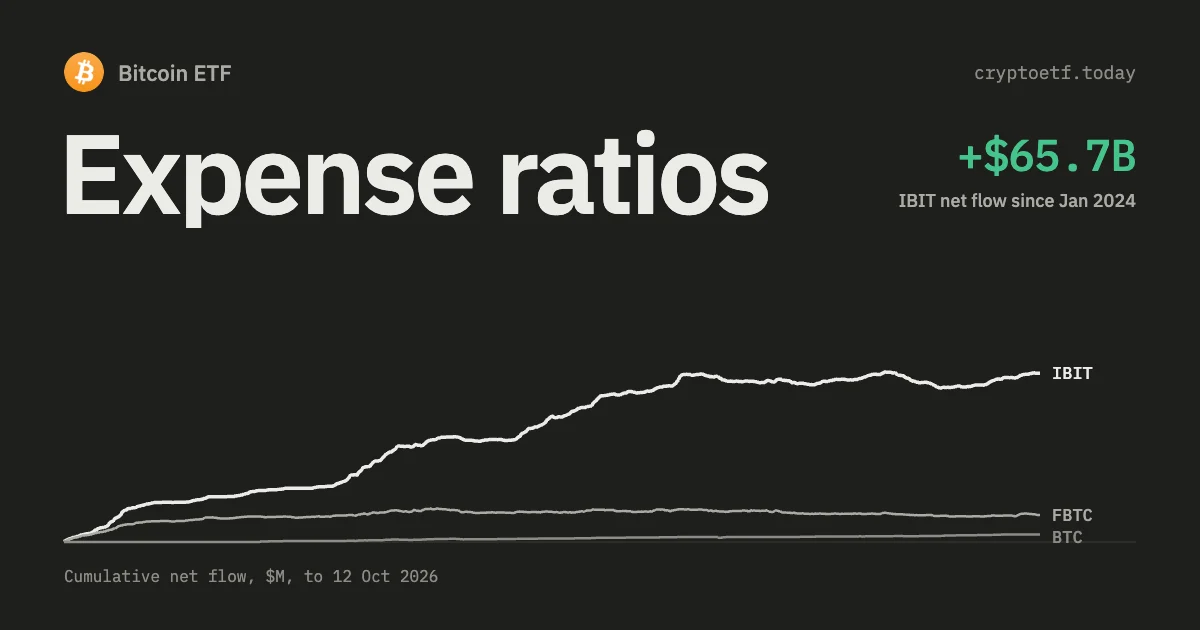
After 31 July 2026 the sponsor fee reverts to 0.20% of average daily net assets. At that rate HODL sits 5 bp below IBIT and FBTC (0.25%), level with Bitwise BITB, 1 bp above Franklin EZBC (0.19%), and above the two cheapest funds in the category — the Grayscale Bitcoin Mini Trust (0.15%) and Morgan Stanley MSBT (0.14%). Full comparison: Bitcoin ETF expense ratios compared.
One more structural detail: the sponsor fee accrues in dollars but is paid in bitcoin, withdrawn monthly from the trust's bitcoin account. Creations and redemptions are in-kind — the 10-Q states that the proceeds received by the trust from the issuance of baskets consist of bitcoin.
Custody: Gemini first, Coinbase second
HODL is the only fund in the category that names Gemini Trust Company, LLC as its bitcoin custodian. Gemini is a New York State-chartered limited purpose trust company licensed by the New York State Department of Financial Services — the same regulatory framework Coinbase Custody Trust operates under.
But the popular framing of HODL as "the non-Coinbase Bitcoin ETF" is wrong. The trust's filings name two custodians: Gemini as the Bitcoin Custodian and Coinbase Custody Trust Company, LLC as the Additional Bitcoin Custodian, referred to collectively as the Bitcoin Custodians, with the trust's NAV reconciled to both accounts. HODL therefore spreads custody rather than replacing Coinbase, and the filings do not break down how much bitcoin sits at each.
That still means something. Funds that name Coinbase Custody as a bitcoin custodian accounted for roughly 85% of the category's $71.4 billion at 30 June 2026, and most of the largest funds use it as the sole or primary holder. A second, independently chartered custodian is genuine diversification at the fund level, even if it is not a clean escape from the dominant one. The category-wide picture is in how Bitcoin ETF custody works.
One episode deserves honest mention. In 2022–2023 Gemini's retail lending product, Gemini Earn, became entangled in the collapse of the lender Genesis Global, and Earn customers faced frozen withdrawals. That was a retail lending programme, not the regulated trust company's institutional custody business, and it did not involve assets held in custody under the trust charter. It did damage the Gemini brand with some allocators, and any honest review of HODL has to say so.
VanEck's long run at a bitcoin ETF
VanEck has been trying to bring a US bitcoin fund to market for a decade. The VanEck SolidX Bitcoin Trust filed a confidential draft registration statement with the SEC in March 2016 and its first public Form S-1 in July 2016, amending it repeatedly through June 2018 before the effort was abandoned in the face of the SEC's position on spot products. While waiting, VanEck launched a futures-based fund, the VanEck Bitcoin Strategy ETF (XBTF), which completed its exchange listing certification in November 2021.
HODL itself began trading on Cboe BZX on 11 January 2024, in the same cohort as IBIT, FBTC, BITB, ARKB and the rest. The eight-year run-up is relevant to issuer risk: VanEck did not assemble this product after approval, it maintained the legal and operational work across multiple regulatory cycles.
Bitcoin developer funding
VanEck is publicly listed as a supporter of Brink, the non-profit that funds full-time Bitcoin Core developers through fellowships and grants. Brink's own sponsors page names VanEck as a program partner with cumulative contributions of $110,000 (retrieved 25 September 2026); Bitwise appears on the same list at $127,166.
VanEck has also described this in marketing terms as a share of the fund's profits. That specific commitment does not appear anywhere in the trust's SEC filings, and we have not been able to verify a percentage from a primary source — so treat the donation as documented and the formula as not. Either way, the money comes from VanEck's own revenue, not from the trust's NAV, and it has no effect on what shareholders pay.
Pros
- Nobody paid a fee. From 25 November 2024 through 31 July 2026, the entire sponsor fee was waived and net expenses were zero.
- Two custodians. Gemini as bitcoin custodian and Coinbase Custody as an additional custodian — the only US spot Bitcoin ETF with Gemini in the structure.
- Competitive fee going forward. 0.20% is 5 bp below IBIT and FBTC.
- Long-standing issuer commitment. Registration attempts running back to 2016 and a futures fund in the interim.
- Documented developer funding. Named on Brink's sponsor list.
Cons
- Small fund. $958.8m against IBIT's $43.39bn — about one-forty-fifth the size, with a correspondingly thinner order book.
- Not a Coinbase hedge. Coinbase Custody is named as an additional custodian, and the split is not disclosed.
- The fee arrives in August 2026. The waiver was a real benefit; it has now expired, and the comparison with cheaper funds changes accordingly.
- Gemini brand risk. Some allocators will not hold a Gemini-custodied product regardless of the legal segregation.
- Limited distribution. VanEck has solid adviser relationships but not the retail reach of BlackRock or Fidelity.
Who should consider HODL
- Investors who want custody spread across more than one name. HODL is the only route to Gemini inside a US spot Bitcoin ETF, and it runs two custodians rather than one.
- Long-term buy-and-hold investors. A thinner book matters less over a multi-year hold, and 0.20% is competitive.
- Investors who care about Bitcoin protocol funding. VanEck is on Brink's donor list; most issuers are not.
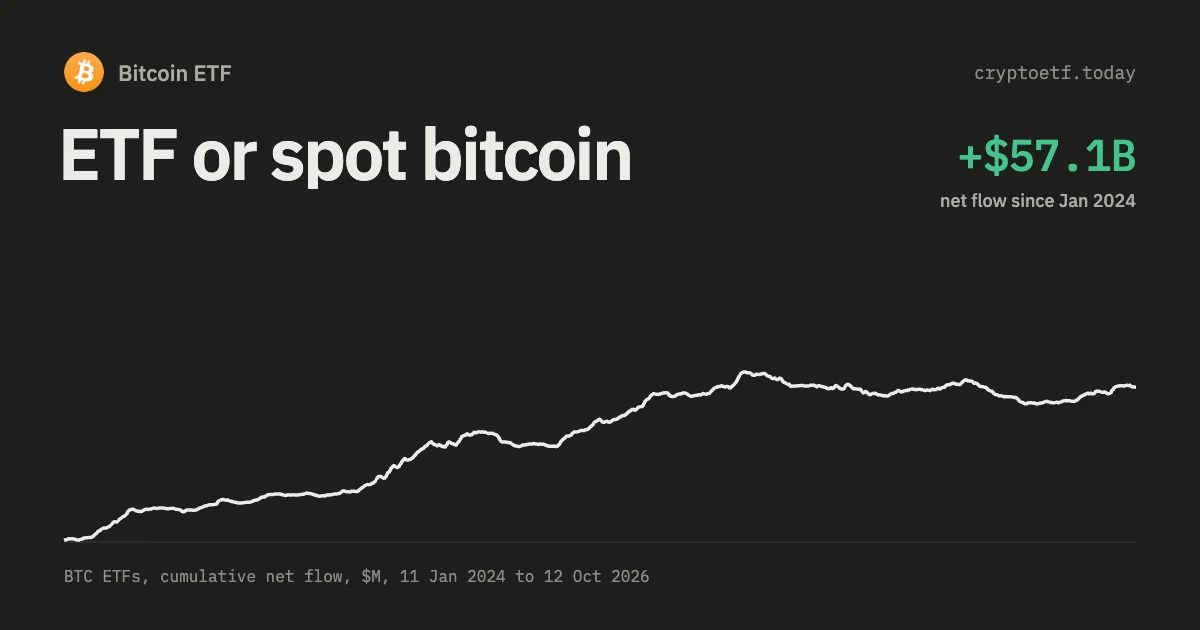
For the ETF-versus-coin question, see Bitcoin ETF vs spot bitcoin. For the nearest peer, see the Invesco BTCO review.
FAQ
Who custodies the bitcoin behind VanEck HODL?
Two custodians. Gemini Trust Company, LLC — a New York State-chartered limited purpose trust company regulated by the NYDFS — is the Bitcoin Custodian, and Coinbase Custody Trust Company, LLC is named as the Additional Bitcoin Custodian. HODL is the only US spot Bitcoin ETF that uses Gemini, but it is not a way to avoid Coinbase entirely, and the filings do not disclose how the holdings are split.
What is the expense ratio of HODL?
0.20% per year of average daily net assets. From 25 November 2024 through 31 July 2026 the sponsor waived the entire fee on the first $2.5 billion of trust assets; the fund never reached that level, so the waiver covered everything and the trust reported net expenses of zero for the first half of 2026. The full 0.20% applies after 31 July 2026.
How big is VanEck HODL?
$958,827,545 of net assets and 16,241.00 BTC at 30 June 2026, across 57,425,000 shares at a NAV of $16.70, per the trust's Form 10-Q. That is roughly one-forty-fifth of BlackRock IBIT ($43.39bn) and a little under half of Bitwise BITB ($2.13bn).
Did the Gemini Earn collapse affect HODL?
No. The Gemini Earn episode of 2022–2023 involved a retail lending programme and the insolvency of the lender Genesis Global. It was separate from Gemini Trust Company's regulated institutional custody business, which holds client assets under its New York trust charter rather than lending them out. HODL launched in January 2024, after the event.
Does VanEck donate profits from HODL to Bitcoin developers?
VanEck is named on Brink's sponsors page as a program partner with cumulative contributions of $110,000. VanEck has described this publicly as a share of the fund's profits, but no percentage appears in the trust's SEC filings and we could not verify the formula from a primary source. Whatever the mechanism, the money comes from VanEck's own revenue and does not affect the fee shareholders pay.
When did VanEck first try to launch a bitcoin ETF?
The VanEck SolidX Bitcoin Trust filed a confidential draft registration statement in March 2016 and its first public Form S-1 in July 2016, amending it through June 2018 before abandoning the attempt. VanEck ran a futures-based fund, the VanEck Bitcoin Strategy ETF (XBTF), from November 2021, and finally launched HODL as a spot fund on 11 January 2024.
How does HODL compare to Bitwise BITB?
Both charge 0.20%, and both issuers appear on Brink's donor list. BITB held $2.126bn of net assets at 30 June 2026 against HODL's $958.8m — roughly twice the size — and custodies entirely at Coinbase Custody Trust. HODL's differentiator is the Gemini-plus-Coinbase custody split and the fee waiver that ran to 31 July 2026.
Sources and further reading
- VanEck Bitcoin ETF, Form 10-Q for the quarter ended 30 June 2026 and Form 10-K for 2025 — sec.gov/Archives/edgar (CIK 0001838028).
- VanEck SolidX Bitcoin Trust filing history, 2016–2018 — sec.gov/Archives/edgar (CIK 0001668039).
- Brink sponsors page — brink.dev/sponsors (retrieved 25 September 2026).
- Internal: How Bitcoin ETF custody works, Bitcoin ETF expense ratios compared, Invesco BTCO review, Bitcoin ETF vs spot bitcoin.
Données en direct sur ce sujet
ETF encore en attente d’approbation: Injective, SEI, Cronos, PEPE, Worldcoin, Canton, Aave, TRUMP, Ondo, Uniswap, Aptos, PENGU
À titre informatif uniquement. Ceci n’est pas un conseil en investissement.
 ETH
 SOL
 XRP
 HYPE
 LINK
 HBAR
 AVAX
 DOGE
 LTC
 SUI
 DOT
 BNB
 NEAR
 TRX
 ZEC